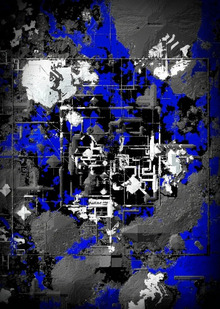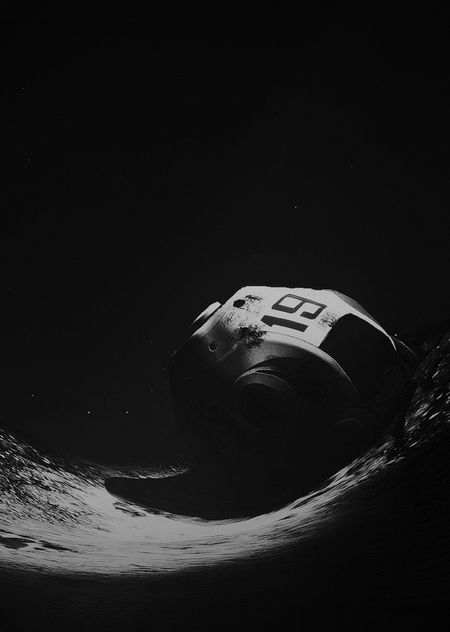
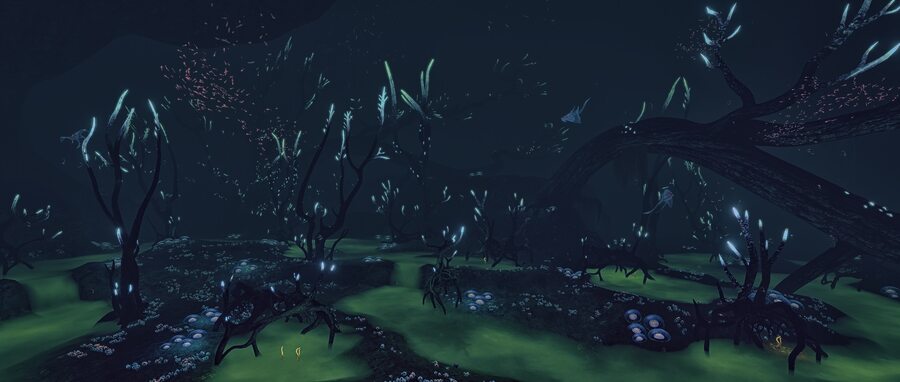
Underwater landscape. A frame from the game Subnautica (2018)
Table of Contents
1. Introduction
2. Research Concept
3. Theoretical Framework: The Beautiful and the Sublime in Kant’s Philosophy
4. Main Body 4.1 Scale: Humanity before something immeasurably vast 4.2 The Unknown: Fear of what cannot be seen 4.3 Powerlessness: Humanity as part of a hostile space 4.4 Dangerous Beauty: When the frightening becomes captivating 4.5 Safe Distance: Fear as a play experience
5. Conclusion
6. Bibliography
7. Image Sources
Introduction
Fear is one of the most paradoxical experiences in human perception. In everyday life, it is associated with danger, uncertainty, and the desire to avoid a threatening situation. However, in art and modern visual culture, fear often takes on an entirely different meaning.
People voluntarily gravitate toward works that evoke anxiety, tension, and a sense of helplessness. They watch horror films, examine images of disasters, explore dark spaces, and play video games built around the feeling of danger. Moreover, frightening imagery can be perceived not only as repulsive but also as beautiful, mesmerizing, and even sublime.
Video games provide a particularly compelling example of this contradiction. Unlike painting, photography, or cinema, they not only allow viewers to observe a depicted space but also enable direct interaction with it. The player becomes immersed within a virtual world, exploring it independently, approaching dangerous objects, and confronting the unknown.
This allows fear to become not just a depicted state, but an integrated part of the visual experience.
Encountering local fauna. A frame from the game Subnautica (2018)
However, what is frightening in video games is not always tied to monsters, violence, or traditional horror genre tropes. Sources of anxiety can include endless oceans, monumental architecture, dark forests, bottomless abysses, or creatures whose sheer size dwarfs human scale. Such imagery can simultaneously evoke terror and awe. The player may feel their own vulnerability against the surrounding world, yet simultaneously feel driven to continue exploring it.
This study pays special attention to the aesthetic nature of this contradiction.
Why can the frightening become attractive?
How does the visual image of danger acquire qualities that allow it to be perceived not only as a threat but also as an object of aesthetic contemplation?
To examine this issue, we utilize the philosophical concept of Immanuel Kant, articulated in his work, Critique of Judgment. Particular significance is given to his understanding of the sublime—the aesthetic experience that arises when a person encounters phenomena that transcend the limits of sensory perception. Through the concepts of the mathematically and dynamically sublime, we can explore how video games create images of the immense, the powerful, and the incomprehensible.
Thus, this research explores the visual methodologies used to generate fear in video games, tracing the shift from a direct experience of threat to an aesthetic apprehension of grandeur and the unknown.
Research Concept
The topic selection is driven by an interest in the contradiction between the negative nature of fear and the aesthetic appeal of frightening imagery. In contemporary culture, fear frequently becomes an object of voluntary seeking: the viewer or player independently chooses to engage with visual scenarios they would otherwise try to avoid in real life. This allows fear to be examined not merely as an emotional reaction, but as a specific mode of aesthetic interaction with an image.
Video games offer particularly suitable material for this kind of research, as they integrate visual imagery, space, and interaction. The player is not limited to observing what is happening; they become a participant in the virtual experience. They can approach a colossal entity on their own, descend into a dark depth, enter an abandoned structure, or stand before a space whose scale is impossible to encompass with a single glance.
The interesting point is that similar situations are not necessarily created within the horror genre. Fear can arise in adventure games, fantasy worlds, and works that focus primarily on environmental exploration. This allows us to view the aesthetics of fear more broadly than the conventional understanding of the horror genre.
Underwater landscape. A frame from the game Subnautica (2018)
Engaging with Kant’s philosophy is motivated by the possibility of examining this phenomenon through the category of the sublime. His concept allows for an explanation of why confronting something vast, powerful, or incomprehensible can evoke not only fear but also a specific aesthetic pleasure.
The primary subject of this research is video games where the visual construction of space and imagery plays a crucial role in creating a sense of danger, the unknown, and human vulnerability. To conduct the analysis, five titles were selected: Subnautica, Little Nightmares, INSIDE, Shadow of the Colossus, and Amnesia: The Dark Descent. Although they differ in artistic style, genre, and methods of interacting with the game space, they are unified by the use of unsettling visual imagery.
Each game demonstrates a distinct mechanism of generating fear. In Subnautica, it is tied to the ocean’s depth and unknown expanses; in Little Nightmares, it stems from disrupted proportions and the contrast of scales; in INSIDE, it arises from limited visual information and an anxious atmosphere; in Shadow of the Colossus, it is linked to the majesty of colossal beings; and in Amnesia: The Dark Descent, it is born from darkness and the inability to locate the source of the threat.
The material selection is not aimed at creating a review of horror games, but rather at comparing various visual methods of impacting player perception. Primary attention is given to composition, scale, perspective, lighting, color, space, and the relationship between the human figure and the environment.
The frightening is traditionally perceived as something repulsive, provoking a desire to avoid danger. However, in video games, images of threat often become objects of aesthetic interest. A player may feel anxiety when facing an unknown space, but simultaneously admire its scale, color, and visual expressiveness.
Thus, a contradiction arises between fear as a negative experience and the possibility of aesthetic pleasure derived from its visual manifestation.
Research Question
Why can visual representations of danger, the unknown, and overwhelming forces evoke not only fear but also aesthetic awe?
The aesthetic appeal of fear in video games arises from the combination of visual threat and the distance between the player and real danger. Through scale, perspective, limited visibility, and the contrast between the human figure and the surrounding video game world, images are created that exceed our usual perceptual capabilities. Confrontation with such imagery can elicit not only anxiety but also awe, bringing the gaming experience close to Kant’s sublime experience.
Research Objective
To identify visual methods for transforming a frightening image into an aesthetic object, using modern video games as a case study and relying on Kant’s concept of the sublime.
The research is limited to the visual component of video games and the specifics of its perception. The focus is on the imagery of spaces, creatures, and situations that create a sense of threat, uncertainty, scale, and human vulnerability.
Psychological causes of fear, the history of the horror genre, and the technical aspects of game development are not independent subjects of analysis. They are considered only when they help illuminate the specificities of the visual experience.
Surface landscape. A shot from the game Subnautica (2018).
Theoretical Basis of the Study: The Beautiful and the Sublime in Kantian Philosophy
To understand the aesthetics of fear, one must examine the distinction between the beautiful and the sublime, a concept Immanuel Kant explores in the «Critique of Judgment.» These categories describe different modes of aesthetic perception, allowing us to explain why some images evoke pleasure through harmony and proportionality, while others do so through the sensation of an overwhelming, superior power.
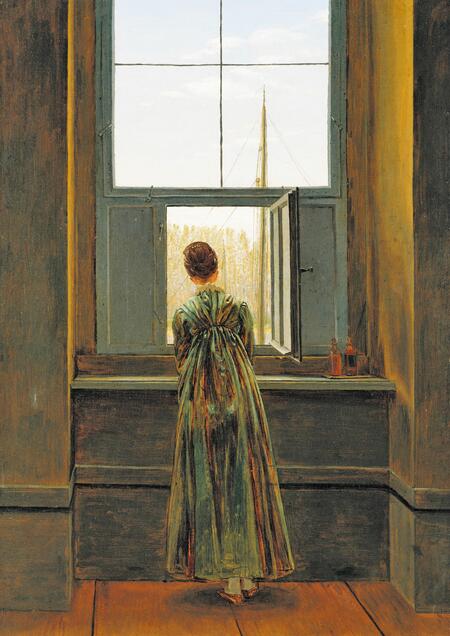

Caspar David Friedrich. Woman by the Window. 1822. An example of sublime beauty.