0. Navigation
1. Introduction 2. Concept 3. Question 4. Hypothesis 5. Furniture vs. Architecture 6. Gothic 7. Renaissance 8. Modern 9. Modernism 10. Symbolism 11. Conclusion 12. Bibliography
1. Introduction
Traditionally, furniture in society is perceived as an object proportionate to the human body and intended for utilitarian use. However, this understanding is limited. Furniture can be viewed not only as a functional object but also as an independent work of art, possessing its own form, structure, and expressiveness. In this sense, architecture serves as the foundation of form-making, setting the principles for space organization and construction. Therefore, it can be assumed that furniture does not exist in isolation; rather, it largely repeats and reinterprets architectural principles, albeit on a smaller scale.
2. Concept
We have become accustomed to labeling certain objects as small architectural forms without always considering what exactly underpins that definition. This classification seems obvious, yet upon closer examination, the question arises: what specific principles make an object «architectural»? If we look at furniture, we can observe that it borrows from architecture not just its external language, but deeper elements—structure, the method of joining components, load distribution, and the organization of form. In this sense, the similarity is not superficial, but structural.
This raises a question: is it sufficient to label furniture merely as a small architectural form, or does that concept oversimplify its nature? Perhaps furniture should be viewed as an independent system that not only echoes architecture but also functions according to the same principles of form generation, adapting them to the human scale. The core concept of my research is to examine furniture as a holistic object while meticulously analyzing how its individual components manifest. I do not separate the subject into discrete parts; rather, I aim to understand how architectural principles emerge through supports, frames, planes, and joints.
In the analysis process, I correlate these elements with components of large-scale architecture, such as columns, ceilings, and facades. This allows one to see what specifically they respond to and what principles underpin them. If we shift the scale of perception slightly, we can imagine that furniture is simply architecture adapted for a different body. It’s as if we shrink ourselves, and then a chair or a cabinet begins to be perceived almost as a building. This perspective allows us to view furniture not just as a miniature copy of architecture, but as a unified form where architectural thought manifests through detail.
3. Question
Can furniture be considered a reduced architectural system?
4. Hypothesis
Furniture reflects the structural principles of its era’s architecture.
5. Furniture vs. Architecture
In architecture and furniture design, we can identify core elements responsible for stability and the organization of form: supports, load-bearing members, joints, and planes. Despite differences in scale, their functions remain similar—they receive, distribute, and shape the object’s structure. When one compares, for instance, chair legs to columns and the seat to a floor slab, it becomes apparent that furniture replicates the same structural logic as architecture.
The assembly of elements in furniture can be paralleled with structural nodes in a building, where the issues of strength and stability are also addressed. Thus, the difference between furniture and architecture lies not so much in the principles, but in the scale of their application. Furniture can be viewed as architecture adapted to the human body, where the same structural ideas are realized on a reduced scale.
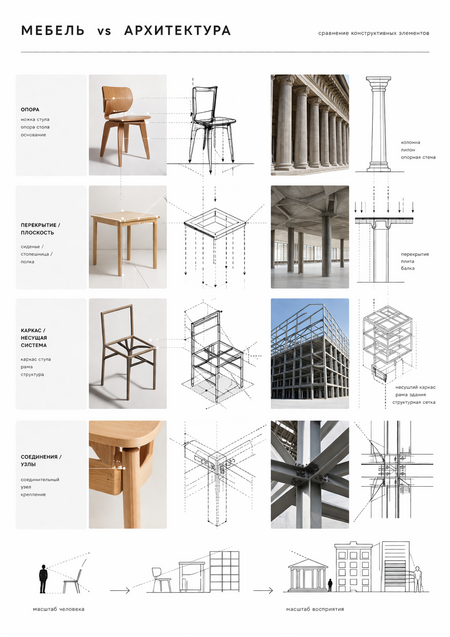
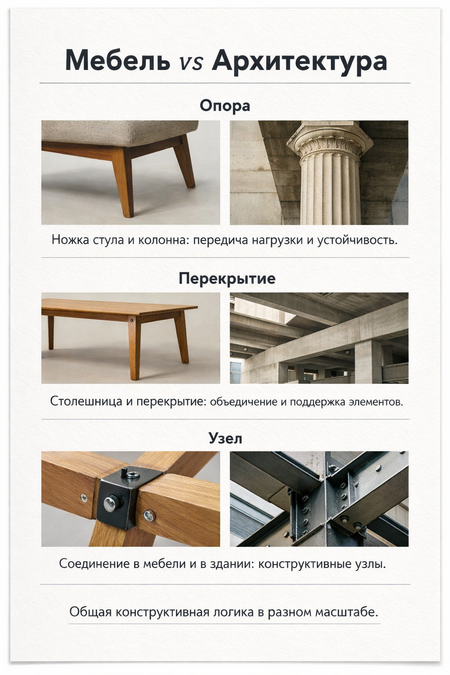
The image presents a comparison of furniture and architecture through shared structural elements, such as support, spanning, frame, and joint. The left side appears more research-oriented and analytical, featuring diagrams, blueprints, and a comparison of structural logic, while the right side conveys the same concept in a more straightforward and visually simple manner.
The central idea of the work is that furniture and architecture are built upon similar principles, despite their different scales. The project effectively demonstrates that product design and architecture are interconnected not only visually but also at the level of construction and thought process.
6. Gothic
Gothic represents a period in which architecture begins to define not only the appearance of buildings but also the form of objects surrounding humans. The characteristic trends of this era—a drive toward verticality, clear structural logic, and rhythmic articulation of form—gradually transition from the scale of the cathedral to the interior space.
Furniture items cease to be merely utilitarian objects and begin to be perceived as scaled-down architectural structures that retain the same principles of design. Through form, proportion, and construction, the same system of thought found in architecture is expressed within them. This is especially clear when looking at the example of a chest, which becomes one of the key pieces of Gothic interior design.
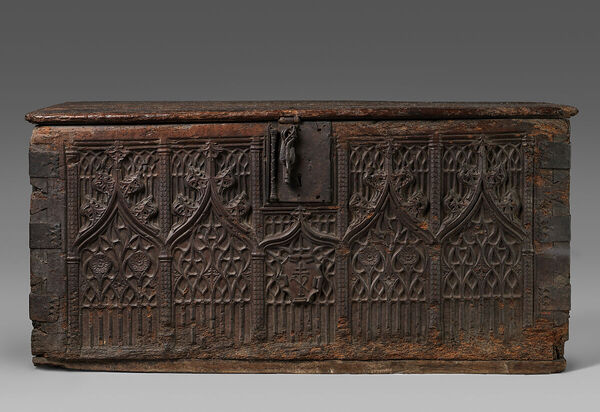
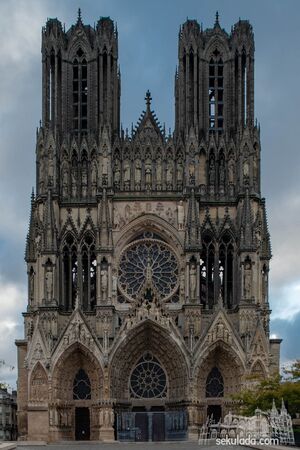
1. Chest, France, second quarter of the 16th century, walnut and iron mounts, The Met 2. Reims Cathedral
The Gothic chest and Reims Cathedral can first be compared at the level of overall form construction. In both objects, there is a noticeable drive toward verticality, clear surface articulation, and the use of pointed arches as the primary organizing element. On the cathedral’s facade, the arches establish the rhythm of the entire composition, direct the gaze upward, and create a sense of elongation and lightness.
The same logic is evident in the carved decoration of the chest, where the surface is divided into elongated panels containing repeated pointed arch forms. Because of this, the chest is perceived not merely as a piece of furniture, but as a miniature architectural plane.

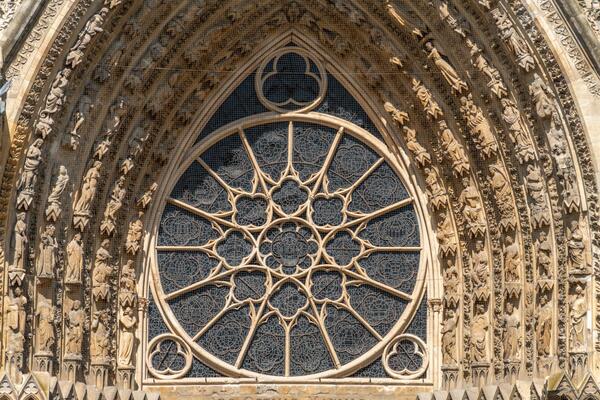
1. Detail of Chest, France, second quarter of the 16th century, walnut and iron mounts, The Met 2. Detail of Reims Cathedral
Upon closer inspection, the resemblance becomes evident even in the details. In the carving of the chest, one can observe an element reminiscent of a quatrefoil, a motif frequently found in Gothic architecture—especially in the ornamentation of windows, rose windows, and decorative stone tracery. In Reims Cathedral, this motif functions as part of a complex ornamental system, unifying geometry and decorative artistry. The same principle is translated onto the wood of the chest, becoming part of the carved surface. This demonstrates that furniture in the Gothic period borrowed not just the general aesthetic from architecture, but a specific plastic language, adapting it to the scale of the interior object.
Moving on to the analysis of the next piece, it is important to consider how in Gothic furniture, not only are individual decorative elements borrowed, but the architectural logic is reproduced at the level of the entire form. Unlike a chest, which functions as a unified volume, a cabinet is a more complex vertical structure, akin to a building facade. This allows us to trace how architectural principles are translated into interior design objects—no longer fragmentarily, but systemically—including division, proportions, and surface organization.
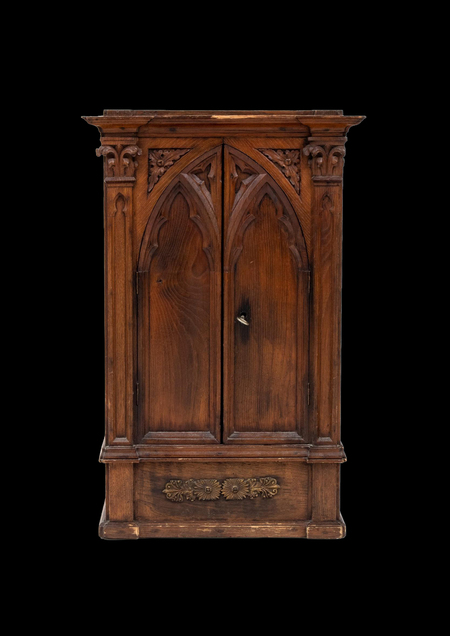
The Gothic wardrobe and Notre-Dame Cathedral can be compared primarily on the level of overall form. Both objects possess a pronounced vertical orientation and are structured as frontal compositions with clear symmetry. Their structure is divided into two main parts: in the wardrobe, these are the doors, and in the cathedral, these are the two towers, forming a stable and balanced system. This division creates the feeling that the cathedral’s facade, much like the wardrobe, can be mentally divided into two wings operating as a unified whole.
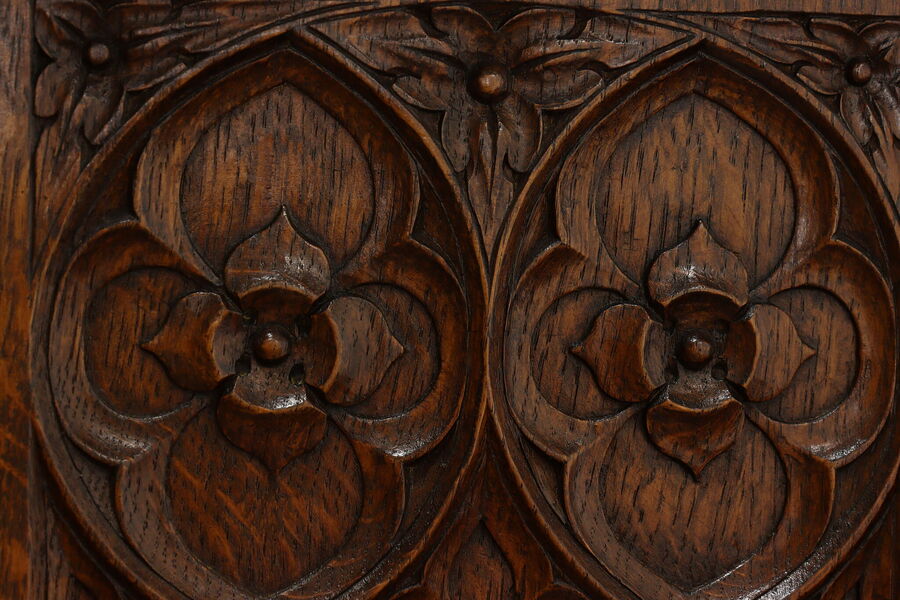
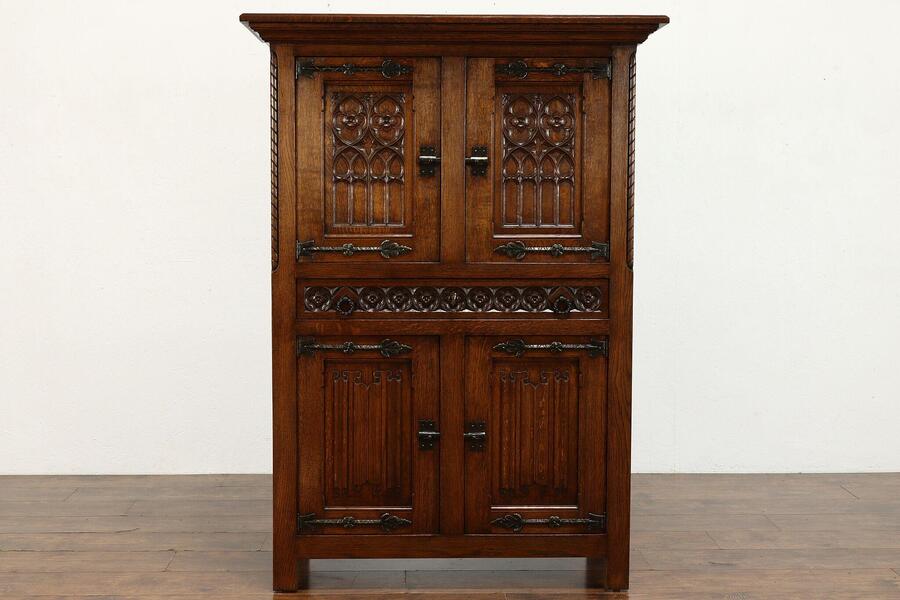
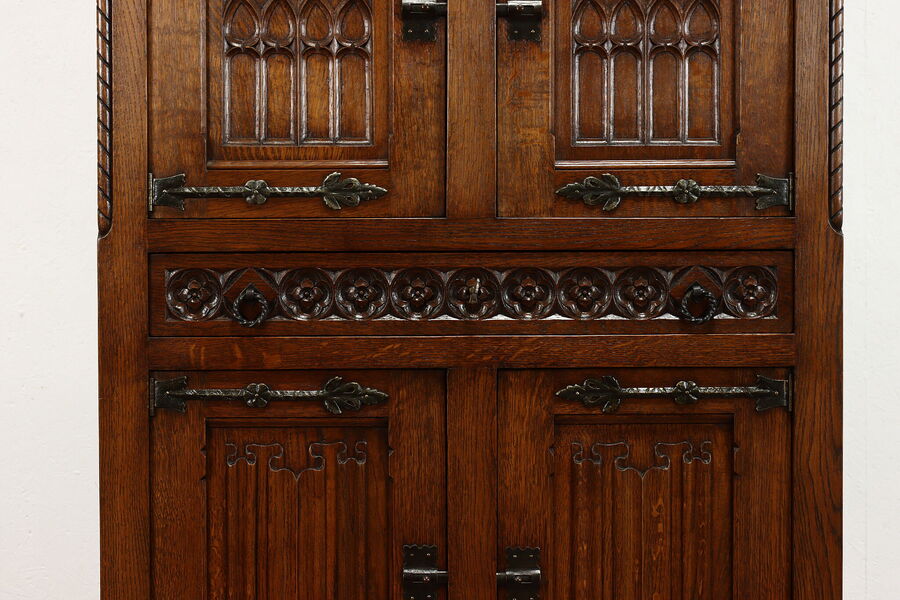
Gothic Linenfold Carved Antique Oak Dutch Court Cabinet or Cupboard
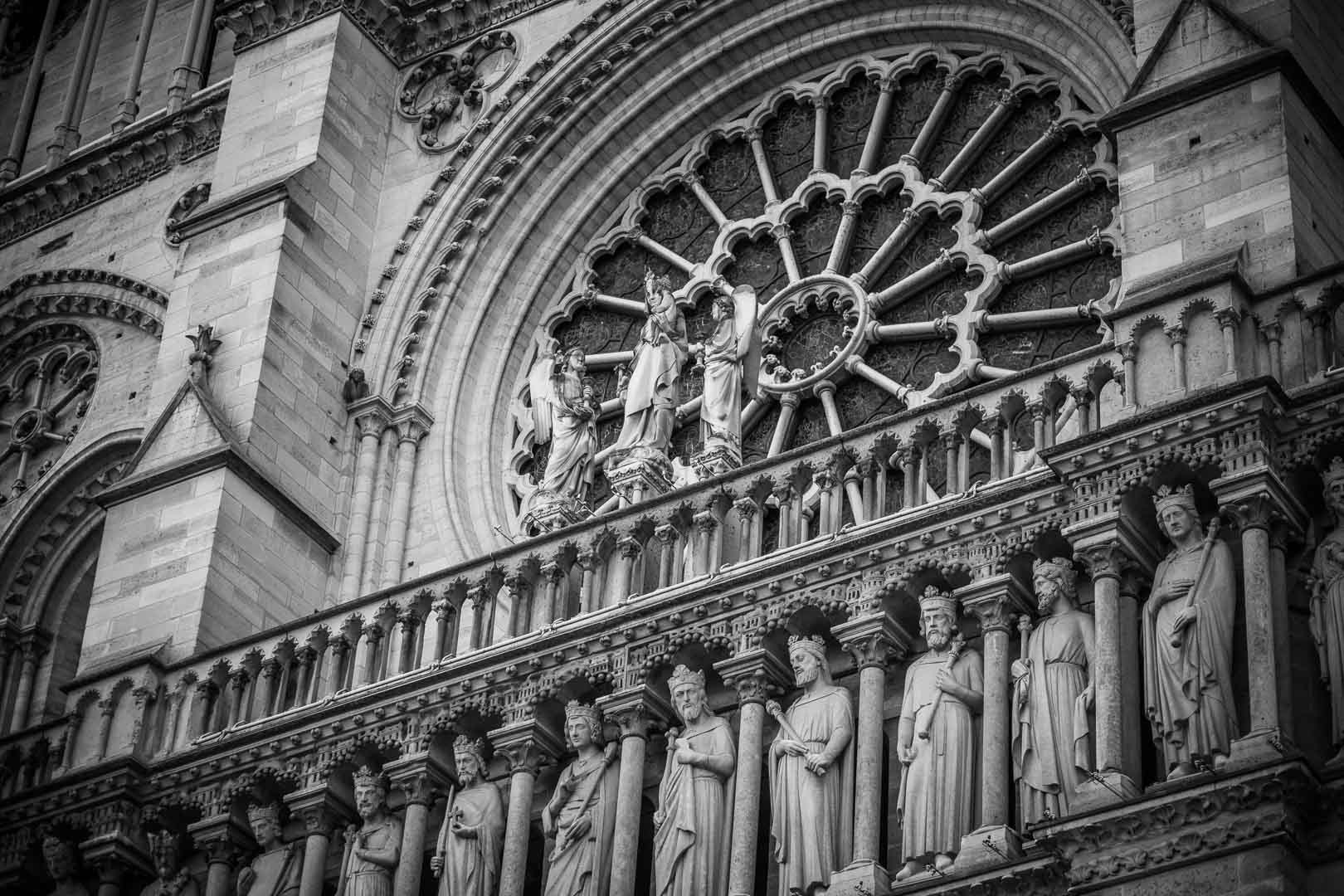
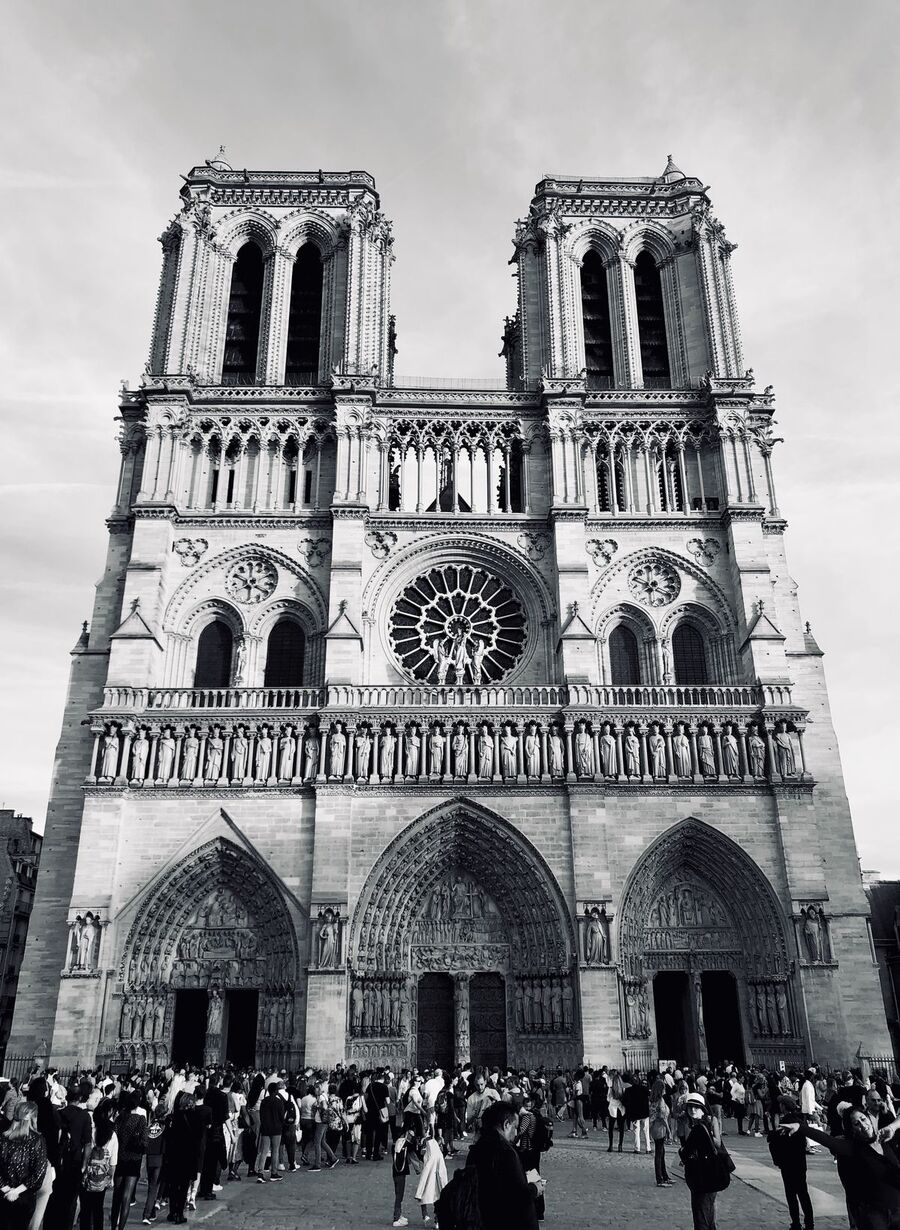
Notre Dame de Paris