Concept
The architectural order is examined not only as a structural system but also as a medium for expressing the aesthetic ideals of ancient society. Each of the three orders possesses its own visual character: the Doric embodies rigor and monumentality, the Ionic is distinguished by grace and proportional harmony, and the Corinthian is characterized by the complexity of its forms and the richness of its decorative elements. The study is built upon a comparative analysis of architectural monuments, column geometry, capital forms, proportional relationships, and ornamental solutions. Special attention is paid to the interconnection between architectural form, artistic expression, and conceptions of beauty across different periods of Ancient Greek architectural development. The evolution of the order system reflects not merely a change in the external appearance of architectural elements, but the formation of diverse ways to express harmony, order, and beauty through structure, geometry, and decoration.
Chapter 1.
The formation of the ancient Greek order system was one of the most crucial stages in the development of ancient architecture. During the Archaic period, primarily in the 7th–6th centuries BCE, there was a gradual transition from wooden temple structures to monumental stone constructions. This process was accompanied not only by a change in building materials but also by the formation of new concepts regarding proportion, symmetry, and harmony. Architecture gradually acquired an ordered system in which every element occupied a specific place and adhered to the overall composition. Temple architecture played a particularly important role in the development of the order system. It was in the temples that the search for ideal proportions, the refinement of structures, and the formation of an expressive architectural language took place.
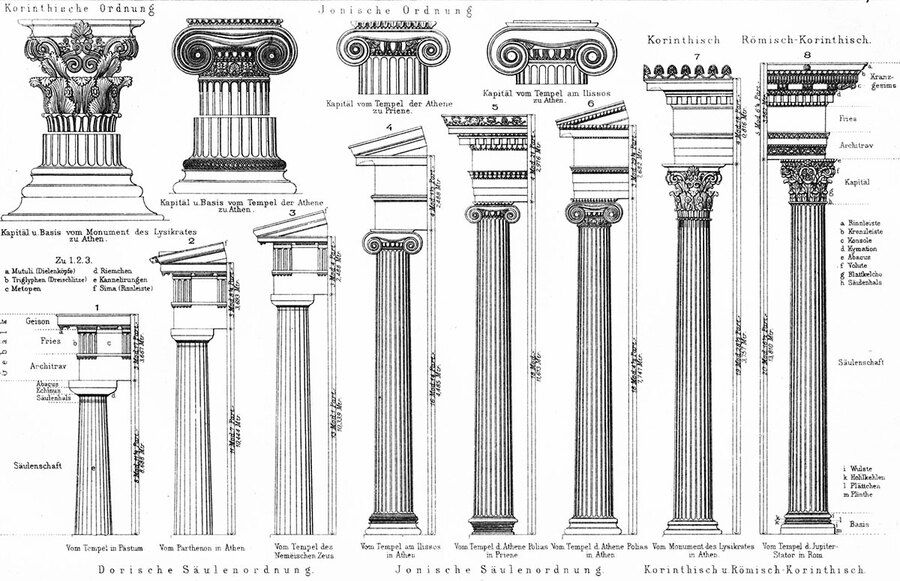
Ordering System
The architectural order is a system of interconnected load-bearing and non-load-bearing elements organized according to specific proportional and artistic principles. The foundation of the order system comprises the column and the entablature situated above it. The column includes the shaft and the capital, and in some orders, also the base. The entablature consists of the architrave, the frieze, and the cornice. A key feature of ancient Greek architecture was the drive to unify constructive function with artistic expression. The proportions of the columns, the spacing between them, the shape of the capitals, and the nature of the decorative elements determined not only the structure’s stability but also its visual perception. Thus, the order evolved from a system of building elements into an independent artistic language rooted in rhythm, geometry, and proportion.
The emergence of three main orders.
Three primary orders emerged in ancient Greek architecture: Doric, Ionic, and Corinthian. The Doric order developed in the 7th–6th centuries BCE and was characterized by massive proportions, the simplicity of its forms, and restrained decoration. Its architectural language conveyed a sense of stability, rigor, and monumentality. The Ionic order developed in the Greek regions of Asia Minor and the Aegean islands. Its distinguishing features were more slender columns, the presence of a base, and capital adorned with characteristic spiral volutes. Unlike the Doric, the Ionic order created an impression of lightness and plasticity. The Corinthian order appeared later, at the end of the 5th century BCE, and developed further in the 4th century BCE. Its main feature was the decorative capital with botanical motifs, primarily acanthus leaves. The Corinthian order expanded the expressive capabilities of architecture through its more elaborate ornamental detailing.
Chapter 2. Geometry and Proportion.
Proportions as the Basis of Architectural Harmony One of the defining features of Ancient Greek architecture is the pursuit of harmony, founded upon mathematical ratios, symmetry, and rhythm. Proportions dictated not only the structural stability of buildings but also their artistic expressiveness. The principle of proportionality underlies the classical order system: the dimensions of individual architectural elements are interconnected and subservient to the overall composition. The diameter of the column is often used as the measuring unit—the module—against which its height and the dimensions of other parts of the order are determined. The differences between the Doric, Ionic, and Corinthian orders are especially apparent in the ratio of column height to diameter, the form of the capitals, the character of the vertical lines, and the degree of decorative richness.
The Doric order is characterized by strict proportions, massiveness, and the conciseness of its architectural elements. Columns in early Doric temples feature a relatively low height in relation to their diameter. During the Classical period, their proportions become more slender. The column height in various structures is approximately 4 to 6.5 times the diameter. The shaft of a Doric column usually lacks a base and rests directly upon the stylobate. Its surface is divided by vertical fluting, which emphasizes height and creates a rhythmic alternation of light and shadow. The capital consists of a circular echinus and a square abacus. The simplicity of these geometric elements forms a clear and expressive silhouette. A significant feature of the Doric order is entasis—a slight change in the profile of the column shaft that visually corrects its form.
Visual characteristics: massiveness, stability, rigor, geometric clarity, and monumentality.
Ionic Order: The Geometry of Grace The Ionic order is distinguished by more slender proportions and a complex plasticity in its architectural elements. The height of Ionic columns is typically about 8–10 times their base diameter. This gives them a more elongated and lighter appearance compared to Doric columns. Unlike the Doric column, the Ionic column features a base composed of several profiled elements. This creates a smooth transition from the horizontal surface of the plinth to the vertical shaft. The defining characteristic of the Ionic order is its capital, featuring two spiral volutes. Their form is based on a combination of linear and curvilinear geometry. The vertical fluting on the shaft is usually separated by narrow flat grooves, which lends the column surface a softer chiaroscuro pattern.
Visual characteristics: gracefulness, plasticity, rhythm, lightness, and elegance.
The Corinthian order develops the principles of slender proportions characteristic of Ionic architecture, but it features a significantly more complex capital design. The height of the Corinthian column is often about 9–10 times its base diameter, though specific ratios vary depending on the period and the structure. The defining feature of this order is its tall capital, adorned with rows of stylized acanthus leaves, scrolls, and botanical elements. Despite the superficial complexity, the decorative composition of the capital adheres to a specific geometric organization. The repetition of the leaves, symmetry, and rhythmic distribution of the ornament create an ordered structure. The Corinthian order demonstrates the potential to merge a rigorous architectural system with expressive natural motifs.
Visual characteristics: decorative quality, complexity, refinement, plastic richness, and ornamental expressiveness.
Entasis and cannels. An analysis of the column’s vertical rhythm profile, created by the alternation of illuminated and shaded surfaces.
Proportion is the harmonious arrangement of the elements within a structure and the correspondence of individual parts to the whole relative to a specific, chosen unit.
Chapter 3. The Evolution of the Decorative Language of Ancient Greek Architectural Orders.
Decorative embellishment played a vital role in shaping the artistic language of ancient Greek architecture. Ornamentation, reliefs, and plastic elements did not merely adorn the structures; they also emphasized their constructive framework, proportions, and compositional rhythm. As the order system developed, decorative elements gradually gained increasing complexity and autonomous artistic expression. While the Doric order was characterized predominantly by laconic geometric forms, the Ionic incorporated more diverse plastic elements, and the Corinthian was distinguished by its richness in vegetal motifs. The interaction between decoration and architectural structure held particular significance. Ornament was situated on capitals, friezes, cornices, and other elements, underscoring their form and establishing a visual connection between the various parts of the building.
The Doric order is distinguished by its restrained decorative design and the predominance of simple geometric elements. One of its characteristic features is the frieze, which consists of alternating triglyphs and metopes. Triglyphs are vertically segmented stone slabs that create a strict rhythmic pattern. Metopes are placed between them and can be decorated with sculptural reliefs. The capital of the Doric column has a concise form, comprising a circular echinus and a square abacus. The absence of complex ornamentation allows the focus to remain on the proportions and the interaction of geometric volumes. Repetition of identical elements plays an important role in the artistic expression of the Doric order. The rhythm established by the columns, triglyphs, and fluting creates a sense of order, stability, and architectural integrity. Nevertheless, the Doric order cannot be considered entirely devoid of decoration; sculptural metopes, pedimental compositions, and the original polychrome painting could have significantly enriched the exterior appearance of the structures.
Visual characteristic: decorative expressiveness is achieved through geometric clarity, the rhythm of repeating elements, and the contrast of architectural forms.
The Ionic order is characterized by a more complex system of decorative elements, based on the combination of geometric and curved forms. The main feature of the Ionic capital is the volutes—spiral scrolls located on either side of the central part of the capital. Their smooth lines create a contrast with the vertical fluting of the column and the horizontal elements of the entablature. In the decorative design of the Ionic order, oval ornaments, palmettes, plant motifs, and relief compositions were widely used. Unlike the Doric frieze with alternating triglyphs and metopes, Ionic architecture frequently utilized a continuous frieze decorated with sculpted figures. This allowed for the creation of extended narrative compositions and enhanced the horizontal orientation of the architectural design. Particular significance is given to the fluidity of transitions between elements. The decoration not only emphasizes the structure but also forms an independent plastic rhythm.
Visual characteristic: the combination of straight and spiral lines, the symmetry of volutes, and the continuity of decorative compositions create a sense of lightness and harmony.
The Corinthian order is the most richly ornamented type within the ancient Greek architectural order system. Its defining feature is the capital, which is adorned with stylized acanthus leaves. The botanical elements are arranged in multiple tiers, creating a complex spatial composition.