Эволюция изображения Христа
- Rationale for Topic Selection The image of Christ is not merely an illustration for a text; it is a distinct visual language that has mirrored theological debates, political decisions, and evolving views of humanity over two millennia. The value of this topic for visual research lies in the following: From the symbol (fish, lamb, Good Shepherd) to the anthropomorphic figure, from iconoclastic disputes to the Pantocrator canon, from the realism of the Modern Era to the dissolution of the visage in contemporary art—every shift bears distinct visual markers.
- Principle of Material Selection for Visual Research Chronological Slices, Not Continuous Series: Select artifacts that document the transition from one type to another. For example: catacomb imagery from the 3rd–4th centuries (symbolic and «youthful» type); decrees of the Council of Trullo and the formation of a historical type; the Byzantine Pantocrator; Russian iconography from the 15th–16th centuries (Rublev, Dionysius); the Western European tradition from the Renaissance to the 19th century; the 20th century (expressionism, abstraction, modern interpretations). Typological Representativeness: Include both canonical specimens and marginal/controversial images (such as Christ in the form of Orpheus or Helios in early Christian art), as these are precisely what reveal the mechanism of borrowing and legitimization.
- Principle of Categorization (Structuring) of Research Symbol in place of the face: the early Christian period. Christ as a fish, a lamb, the Good Shepherd, Orpheus. Question: why was the depiction of a human face impossible or undesirable? The invention of the face: from late antiquity to the early Middle Ages. The transition from the young, clean-shaven type to the bearded, historical type. The role of the Council of Trullo and imperial patronage. —The face as dogma: the Byzantine and Old Russian tradition. Pantocrator, the Iconoclast Crisis, and its visual consequences. The canon as a form of control over the image. —The face as human suffering: the Western European tradition. From the Romanesque Christ-King to the Gothic Suffering Christ, and then to the anthropocentrism of the Renaissance and Reformation. The dissolution of the face: 19th–20th centuries. Christ as a moral teacher, as a social critic, as an object of psychological alienation. Yaulenko’s Expressionist Christ, Ruo’s Christ, dissolution into abstraction. —The face after the «death of God»: contemporary strategies. What happens to the image of Christ when it ceases to be an object of cult and becomes a cultural sign? (Ideally—using local material if you incorporate contemporary art).
- Principles of Selecting and Analyzing Textual Sources Normative Sources: Ecumenical council decrees (especially the Council of Trullo in 691–692 and the Seventh Ecumenical Council), writings by John of Damascus defending icons, and iconoclast treatises (as recounted by opponents). These documents reveal which visual solutions were prescribed or prohibited. Descriptive Sources: Contemporary accounts of specific images (for example, descriptions of miraculous icons or pilgrim diaries). These record what was considered a «correct» or «living» image. Analytical Texts: Modern scholarship on iconography and visual history. These provide a conceptual framework, but they must be used critically—not as established truth, but as a particular interpretation.
- Core Research Question and Hypothesis Core Question: Why and how has what is considered an «authentic» depiction of Christ changed throughout history, given that no single image has documentary confirmation of his appearance? Hypothesis: The evolution of the image of Christ is not an approach toward some «true portrait,» but rather a sequential shift in modes of visibility. Within these modes, the figure of Christ fulfills different functions: in the early Christian period—a function of recognition within a closed community (symbol); in the Middle Ages—a function of dogmatic affirmation (canon); in the Modern period—a function of emotional participation (suffering, humanity); and in the 20th century—a function of critique or deconstruction of tradition.
Chapter One—The Evolution of the Image of Christ: From the Catacombs to the Baroque.
«Christ in a Crown of Thorns» Guido Reni (1575–1642).
Problem Statement
Early Christian art avoided anthropomorphic depictions of Christ. The first images appeared in the catacombs and held a symbolic nature. How and why did the depiction of Christ change?
Early Christian Period: From Symbol to Likeness
«Christ the Good Shepherd» (c. 200–300 CE)
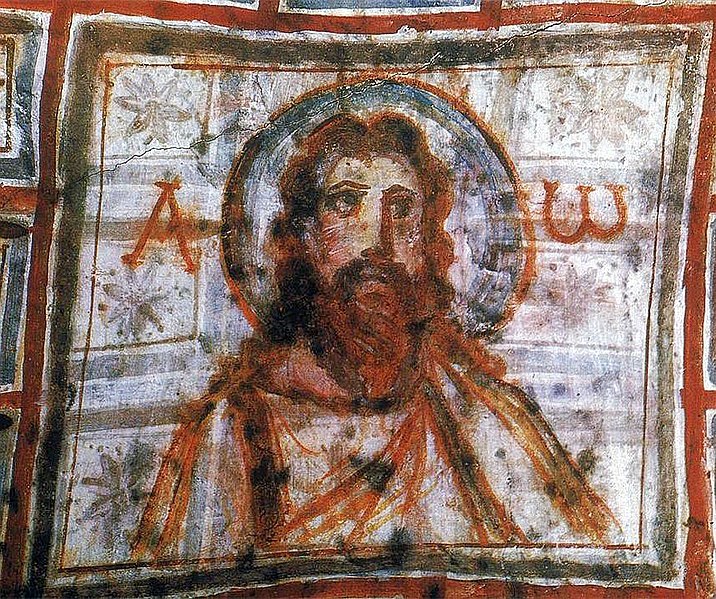
The Catacombs of Commodilla, Rome (late 4th — early 5th century AD)
In Leon’s cubicle, a fresco depicting the earliest known image of the face of Christ is painted on the vault. This is the first instance where Christ is depicted with a beard; previously, he was shown as a clean-shaven youth. The expression is stern, the hair is wavy, and the beard is thick and reddish. To the sides are the letters Alpha and Omega from the Book of Revelation. The intensity of the gaze is explained by the historical context: the empire’s decline, barbarians at the gates, and the sack of Rome in 410 AD.
Jesus Christ. Fresco. 4th Century. Catacombs of Commodilla, Rome
The Emergence of Painting
Images from the catacombs predating the late 2nd century are unknown to us. This raises the question: did they exist at all? For Christian art, the statement «in the beginning was the word…» has always been true. For an image to appear, its core idea must first be formulated—precisely what should be depicted. Christianity, in its early stages, was still developing and refining its texts and postulates.
The painting dates to the 4th century AD (around the 300s).
Catacombs are ancient underground burial sites, consisting of a system of galleries and corridors that terminate in small rectangular rooms—cubicles, larger chambers—crypts, or large chapels. These spaces were by no means solely Christian; they held the remains of pagans and Jews as well, people who, in the early years of our era, could very well have belonged to the same family. However, they ultimately became a gathering place specifically for Christians.
Narratives that reimagine ancient scenes and characters
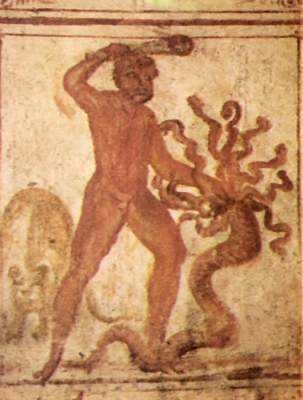
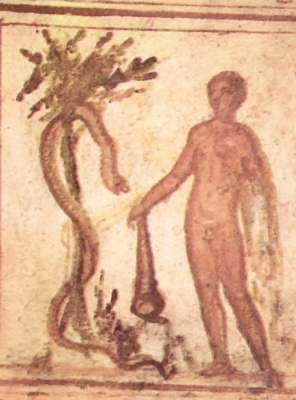
In the catacombs on Via Latina (4th century), one can see a small cycle of frescoes dedicated to the labors of Heracles. In mythology, Heracles is a hero—the son of a God (Zeus) and a mortal woman—and this image of Heracles resonates with the image of Christ. Heracles performed feats; Christ performed healings; Heracles led Alcestis from the underworld; Christ resurrected Lazarus. Thanks to such parallels, the mission and image of Christ became clearer to contemporary pagans. In the mentioned catacombs, images of Heracles' second labor (The Battle with the Lernaean Hydra), eighth labor (In the Garden of the Hesperides), and eleventh labor (Heracles bringing Alcestis out of the underworld) can be seen.
The most common composition that can be assigned to this group is the depiction of Christ as the Good Shepherd. «I am the Good Shepherd; I know my sheep, and my sheep know me.» In the catacombs of Domitilla (4th century), there is an image of Christ surrounded by sheep and carrying a lamb on his shoulders. A similar composition can be found in the catacombs of San Callisto (3rd century).
Iconography of the Good Shepherd
The iconography of the Good Shepherd reinterprets the pagan image of the Herdsman Hermes, who also carried a lamb on his shoulders. Hermes is the intermediary between the Gods and humankind; his role is to convey the supreme will to people. The Good Shepherd is the Redeemer, and the lamb on his shoulders is a symbol of the conscious and voluntary sacrifice—"behold the Lamb of God, who takes away the sin of the world.»
The Cross and the Christogram — Symbols of the Savior
The fish signifies Jesus Christ as the founder and guardian of the church
Images of the Theotokos, Christ, saints
Images of the Mother of God, Christ, and saints
The search for external imagery is also evident in the depiction of Jesus Christ. In the catacombs, the Savior appears sometimes youthful and clean-shaven, as seen in the Via Latina catacombs (4th century) in scenes such as the Resurrection of Lazarus and Christ and the Samaritan Woman, and sometimes mature with a beard, as in the Commodilla catacombs (4th century). In the latter, the image of Christ is supplemented with the letters Alpha and Omega—"I am the Alpha and the Omega, the beginning and the end, the first and the last"—which attests to a deepening understanding of Christ’s nature, the unity of the divine and the human, and a desire to enhance the image’s authentically Christian resonance, distancing it from comparisons with ancient prototypes.
Santa Maria Maggiore, Rome (5th Century)
In the mosaics of the side nave, Christ is depicted in scenes from the Old Testament, such as the offering of Melchizedek. The bust of Christ emerges from the clouds—an iconographic type transitional from symbol to historical image.
On the triumphal arch of the childhood scene of Christ, the cities of Jerusalem and Bethlehem, and Etimasius with the four symbols of the evangelists above and figures of the apostles Peter and Paul on the sides