Research Concept
Play is a distinct form of human activity that establishes a special space governed by its own rules and conventions, within which real actions acquire new meanings and subtexts. It is worth noting, however, that any game can engage with various aspects of the real world—social relations, cultural perceptions, natural phenomena, and so on. E. Fink, when discussing the phenomenon of play, terms it «the fifth of the fundamental sources of human existence» [1, pp. 338–339].
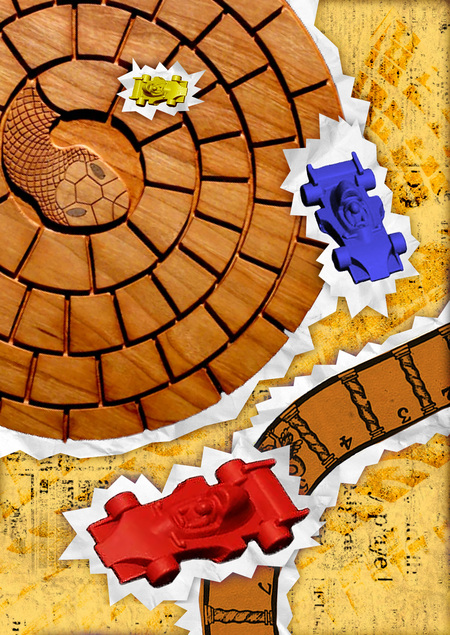
In my view, tabletop racing games are particularly interesting in this regard, as their gameplay is organized around athletic competition—specifically, the pursuit of a goal and rivalry for the top position based on movement across a defined space. Although the underlying principle is shared across these games (the struggle for first place within a defined space, i.e., the game board), these games differ significantly in the nature of their game space, the ways they represent and interpret reality, and their overall rule structures.
The core problem of this research is to determine the ways in which tabletop racing games across various historical epochs—specifically antiquity, the Middle Ages, the early modern, and modern periods—transform reality into a system of rules and a defined game space.
Of course, when moving from a real-world object or process to its game representation, a certain filtering takes place: some characteristics are retained, others are simplified, or they are simply ignored and completely excluded. As a result, the game system is not an exact replica of reality; it is an independent model with its own organizational principles. In light of this context, it is necessary to distinguish between abstraction, symbolization, and modeling: abstraction involves simplifying reality, symbolization involves assigning a specific meaning to game elements and mechanics, and modeling involves directly reproducing individual processes through the game system. Thus, the need arises to determine precisely which elements of reality form the basis of the board racing game system, how they are transformed into game mechanics—that is, the game rules, «tools, ” and player abilities within the game system—and how these elements affect the nature of the competition itself.
The research hypothesis posits that the evolution of tabletop racing games is reflected not only in changes to their aesthetics and mechanics but also in the transformation of how specific elements of reality are embodied within the game system.
For textual sources, we will draw upon E. Finke’s work, «Fundamental Phenomena of Human Existence» [1], and G. Fraska’s article, «Ludology: From Representation to Simulation» [2]. These will form the basis for analyzing games through the lens of the relationship between reality and its game interpretation. D. Parlett’s «The Oxford History of Board Games» [3] will serve as the historical reference, and catalogs and rulebooks [4–7] will be used for accurate description and understanding of the board games selected below.
The objects of analysis selected are board racing games, which span various historical periods and allow for an examination of different methods for organizing racing game spaces and modeling competition:
- Ancient Period: Mehen, 3650–3000 BCE [8].
- Middle Ages: «Goose Game, ” 15th Century [9].
- Early Modern Period: „Derby Steeple Chase, ” 19th Century (Original: „Derby Steeple Chase“) [10].
- Contemporary Period: „Pole Position, ” 2024 (Original: „Pole Position“) [11].
It should be noted, however, that the selected games will serve as independent examples illustrating the change and diversity in methods of modeling racing in board games, rather than representing sequential stages of evolution for this genre.
The research structure is built on the principle of moving from a historical analysis of specific modeling game forms in board racing games to a subsequent philosophical comparison:
1. The Transformation of Board Racing Games
1.1 Mechan 1.2 Game of Goose 1.3 Derby: Steeplechase 1.4 Pole Position2. Comparative Analysis
2.1 The Evolution of Reality Representation in Play Space 2.2 Changes in the Structure of Racing Games 2.3 The Board Racing Game as a Form of Modeling Human Activity3. Conclusion
4. Bibliography
5. Image Sources
1. Transformation of Tabletop Racing Games
1.1. Mekhen: The Symbolic Space
Mehen is an ancient Egyptian board game known to us through images and archaeological finds dating back to the 4th millennium BCE [4].
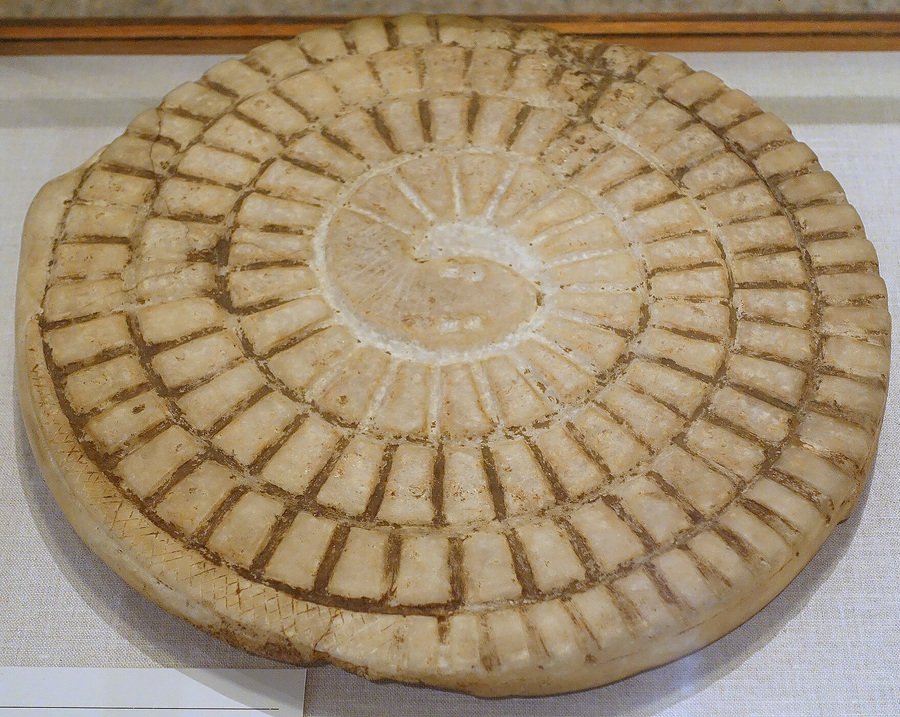
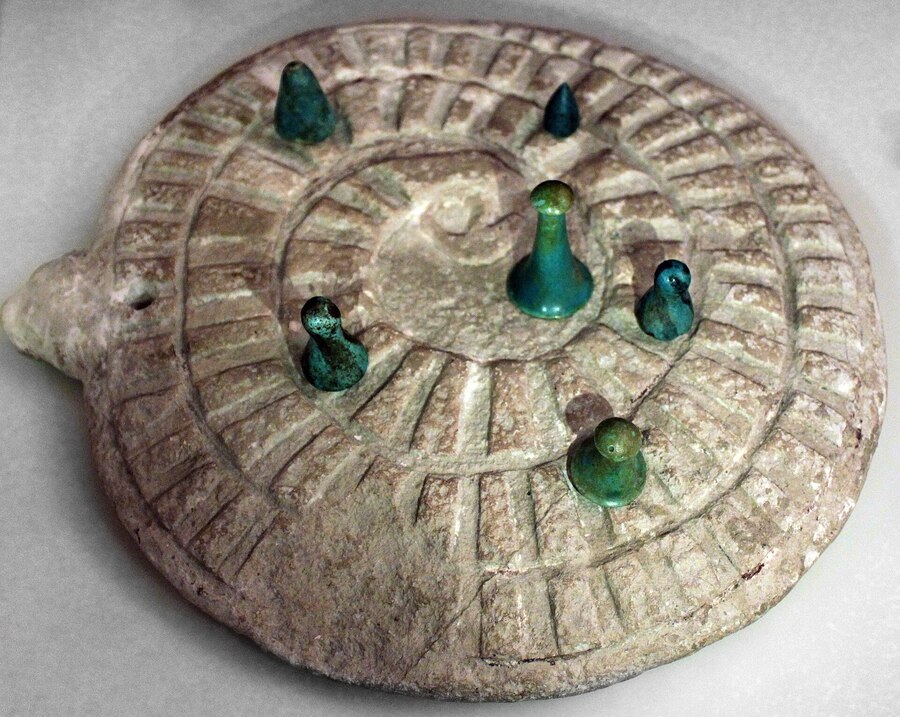
This game is interesting for investigation primarily because of its game space design: its playing field is shaped like a coiled snake whose body is divided into segments. The game space not only dictates the player’s path of movement but also contains a combination of mythological imagery: the movement of the tokens along the spiral body of the snake symbolizes the soul’s journey toward the center of the universe and its merging with the sun god Ra, while the snake itself is the god-snake Mehen (which means «The Coiled»), serving as a protector against the serpent-demon Apep, who embodies darkness and chaos [4].
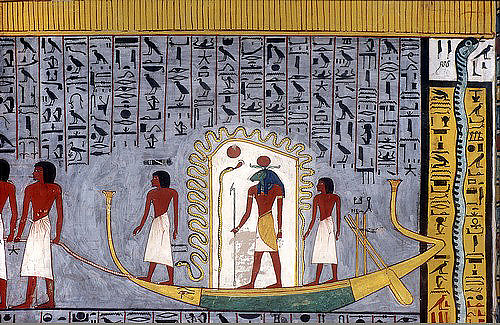
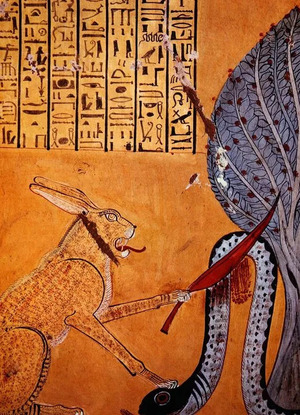
Symbolism clearly dominates the semantic context of the game system, but if we abstract from it, classifying Mehen as a racing genre is quite simple: the main objective and mechanics boil down to competing for speed as pieces move from the start to the finish line.
Thus, Mehen can be viewed as an early example of a game-like form, where symbolic imagery and the route are united into a single system.
1.2. Goose Game: Forming a Conceptual Model of a Race Competition
The game of Goose gained popularity in 15th-century Italy. Like is customary in racing board games, the objective is to cross the finish line first on a game board shaped as a linear route of numbered spaces (the number of spaces changed in each subsequent edition of the game) by rolling a die [5].
k
Comparing Goose Game and Mekhen, one can observe that the player’s objective shifts from interpreting a mythological narrative (which takes precedence over the race mechanics) to simply traversing the board for the sake of movement, even though a competitive element is present in both games. In Goose Game, the playing path begins to include spaces with obstacles and traps, as well as spaces that accelerate movement. It is worth noting that the entire setting—that is, the game’s context (where and when the actions take place)—remains abstract and symbolic, although less pronounced than in Mekhen: the goose symbolizes luck and success, and the game board represents the path of life.
The game of Goose is characterized by the primacy of game mechanics over symbolism, due to the transformation of the board game’s role in society—from a sacred ritual to a secular form of entertainment.
к
1.3. Derby: Style-Chees: Transforming a Real Sporting Competition into a Game System
Derby: A tabletop racing game by McLoughlin Brothers, set in the context of horse races, released in the 19th century. Its board depicts a closed oval track, unlike the open fields of Mechen or Goose Game, but it also features numbered squares [6].
k
It should be noted that in the Derby, the playing field features more specific obstacles: certain sections have barriers and ditches that must be cleared by jumping on the horse, thus utilizing mechanics beyond simple movement. The game intentionally reproduces specific elements of horse racing—running the distance, obstacles, and participants falling.
Thus, the typical goal of a board racing genre begins to exist within the context of a more complex game system, featuring numerous obstacles that require supplementary mechanics beyond the core mechanics defining the game’s essence.
1.4. Pole Position: Modern Methods for Organizing and Modeling Racing Competitions
Pole Position—a tabletop racing game from Doit Games—draws from contemporary motorsports, modeling a competition that directly borrows its rules from «Formula 1.» Unlike earlier racing games, Pole Position accounts not only for progress on the track but also for external factors that influence the outcome of the competition: tire choice and vehicle condition, weather conditions, accidents, and pit stops [7].
k