Concept
Production is one of the key elements in our conception of the future. Throughout the 20th and 21st centuries, science fiction literature, cinema, animation, and video games have created diverse images of factories, mills, and industrial systems, reflecting society’s relationship with technological progress. In some works, industry becomes a symbol of human might; in others, it is a tool of oppression; and in yet others, it is an autonomous force capable of existing without the involvement of its creator.
This visual study examines the evolution of the image of production in fantastic culture and the changing relationship between humanity, machinery, and the industrial environment. The primary focus is not on technology itself, but rather on the visual structure of industrial space—the architecture of factories, the organization of workspaces, the scale of the structures, the character of the mechanisms, and the presence of humans within the production system.
Key Research Question:
How have perceptions of future production and humanity’s place within it evolved in 20th and 21st-century visual culture?The mode of production in speculative fiction evolves from a system that completely subjugates humanity to mechanical rhythm, to a hybrid environment where the biological and technological gradually merge, and subsequently—to autonomous production ecosystems capable of functioning without human oversight. Concurrently, the architecture of industrial space undergoes a transformation: monumental factories with massive machinery and assembly lines are replaced by multi-tiered technological complexes, automated workshops, and endless machine megastructures.
Works from different eras and genres were selected for this study to better illustrate how the attitude toward technology has evolved. The starting points are Fritz Lang’s film Metropolis (1927) and H.G. Wells' novel The Time Machine (1895). In these pieces, the advancement of industry is depicted bleakly: society is stratified, labor becomes mechanized, and humanity is subservient to machines.
The next stage features works exploring the increasing intimacy between humans and technology: William Gibson’s «Neuromancer» (1984), «Ghost in the Shell» (1995), and «The Fifth Element» (1997). Here, technology is no longer confined to the factory floor. It permeates the human body, the urban environment, and everyday life.
The final stage—production—operates autonomously. Tsutomu Nihei’s manga *Blame! * and Philip K. Dick’s short story «The Factory» (1955) depict worlds where machines build, produce, and reconstruct everything around them without human intervention.
Thus, the research is divided into three blocks:
- Human subservience to the machine.
- Co-authorship and the fusion of humans with technology.
- Autonomous production and the displacement of humans from the production process.
Block I: Subordination of Human to Machine
Fritz Lang, «Metropolis» (1927)
At the beginning of the 20th century, the machine became a primary symbol of technological progress. Factories and plants were perceived as spaces where human potential was expanding through mechanization. However, along with the growth in productivity, the role of the worker itself also changed: instead of an independent artisan, he increasingly became merely a component of a complex production system.
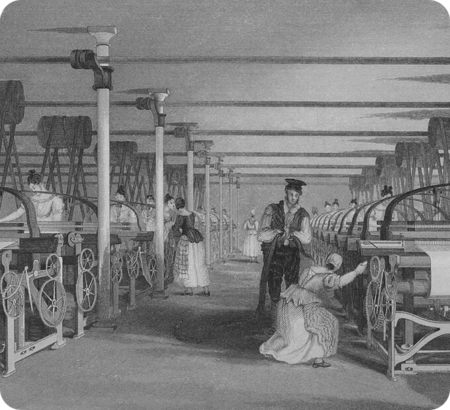
Mechanization changed not only the tools of labor but also its organization. The production process began to divide into sequential operations, and the pace of work was increasingly determined by the machinery and the plant’s schedule. The human being had to adapt to the rhythm of the equipment, rather than the equipment adapting to the human.The illustration is by T. Allom, Engraver J. Tingle, from History of the Cotton Manufacture in Great Britain (1835)
The factory system gradually displaced the artisanal model of production. Where a master craftsman once created a product in its entirety, production could now be divided among dozens of workers. Each was responsible for a separate operation, transforming a complex process into a sequence of repetitive actions performed by a soulless machine.
The repetition of the same movements gradually brought humans closer to the machine. The worker had to maintain the speed, precision, and rhythm necessary for the smooth operation of production. Their body became a tool adapted to the demands of the mechanical system—and this was without even considering that the machine would break down and require maintenance.
Charlie Chaplin, Modern Times (1936)
The factory rhythm gradually displaced the individual pace of labor. The start and end of shifts, breaks, and the speed of operations were governed by an external system. In the industrial world, time became a production resource, just like energy, raw materials, and labor.
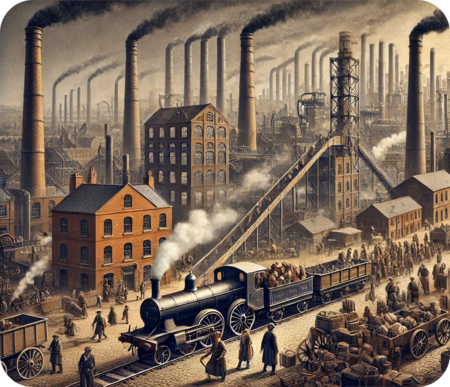
As industry expanded, factories ceased to be isolated buildings. Around them, worker settlements, transportation hubs, warehouses, and energy infrastructure formed. Production gradually became the foundation of urban organization, shaping not only the economy but also the daily lives of the residents.
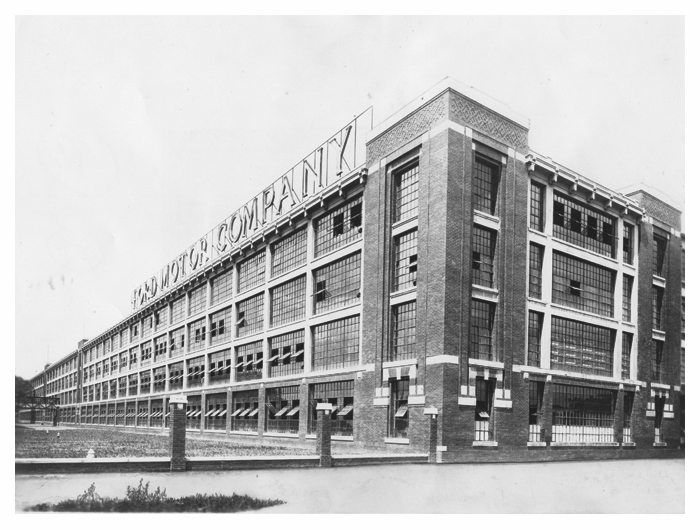
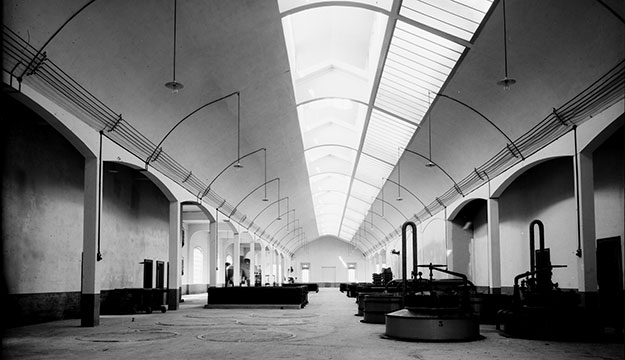
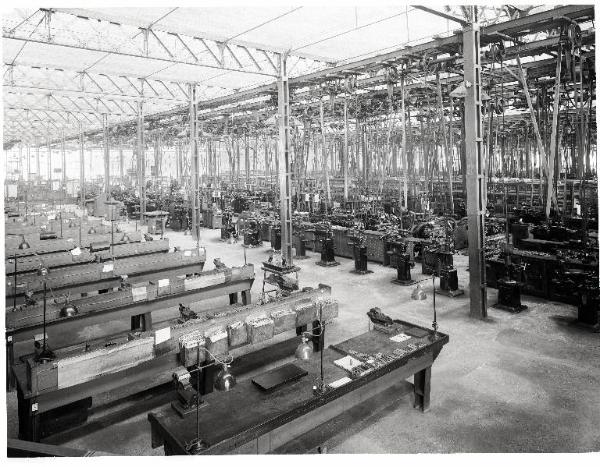
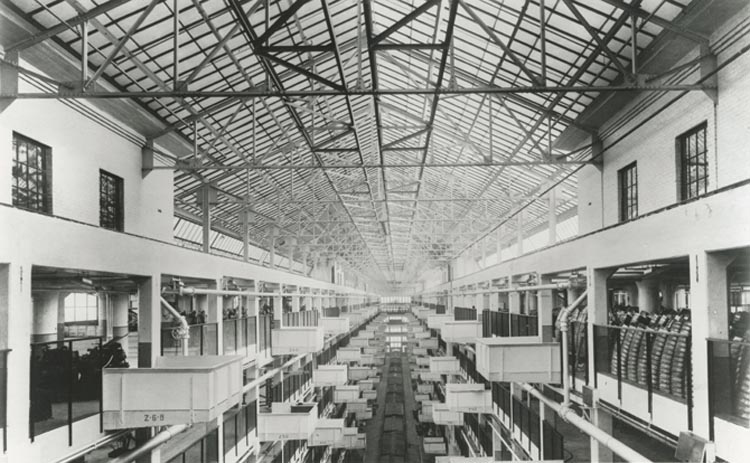
Industrial architecture was subservient to functionality and efficiency. Large spans, repetitive structures, high ceilings, and expansive production halls allowed for the placement of massive equipment and the organization of continuous processes. The building became a casing for the mechanism of work.
Bibliography
https://avatars.mds.yandex.net/get-kinopoisk-image/1773646/b191cb11-d0d4-4a3c-85bb-72b585f0655e/3840xhttps://thumb.wikimedia.org/wikipedia/commons/thumb/d/dc/Powerloom_weaving_in_1835.jpg/960px-Powerloom_weaving_in_1835.jpg?utm_source=ru.wikipedia.org&utm_campaign=index&utm_content=thumbnailhttps://i.pinimg.com/1200x/14/1b/02/141b02e6a731883885a94dd6b5251c65.jpghttps://yandex.ru/images/search?url=https%3A%2F%2Favatars.mds.yandex.net%2Fget-images-cbir%2F1603473%2FaONFCSu94HhHOMrFtT735Q4709%2Forig&img_url=https%3A%2F%2Fprovidencechildrensfilmfestival.org%2Fwp-content%2Fuploads%2F2015%2F01%2Fchaplin-modern-times-blu-ray15.jpg&cbir_id=1603473%2FaONFCSu94HhHOMrFtT735Q4709&search_client=unknown&rpt=imageview&lr=213&cbir_page=similarhttps://general-history.com/wp-content/uploads/2025/01/the-Industrial-Revolution-era.webp