TABLE OF CONTENTS
CONCEPTUAL FRAMEWORK
I. THE TECHNICAL FOUNDATIONS OF INVISIBILITY EFFECTS
II. TECHNIQUES FOR CREATING DISAPPEARANCE EFFECTS
III. TECHNIQUES FOR CREATING APPEARANCE EFFECTS
IV. PRACTICAL EFFECTS AND DIGITAL COMPOSITING
V. CREATING PARTIAL VISIBILITY
VI. COMPARATIVE ANALYSIS OF TECHNIQUES
CONCLUSION
image
CONCEPT
How do you depict a character in film who becomes invisible? At first glance, the task seems simple: you just need to remove the character from the frame. However, depicting the process of disappearing or reappearing is far more complex—it requires showing the audience a transformation that a standard camera cannot capture. To achieve this, filmmakers must not only remove or add the image of the person but also devise a sequence of intermediate states and then find technologies capable of credibly reproducing them on screen.
In this study, I aim to trace how approaches to solving this problem have evolved over two decades. For comparison, I selected two films: Paul Verhoeven’s Hollow Man (2000) and Leigh Whannell’s The Invisible Man (2020). Despite the shared theme of invisibility, the creators of these two works employed fundamentally different methods to depict the person’s disappearance and reappearance. It is this difference that allows us to examine how a specific visual challenge dictates the selection of technologies and influences the final outcome.
In the film The Invisible Man (2000), a person’s disappearance is depicted through a sequential transformation of anatomical structures, which was created using 3D modeling and procedural animation [3; 6; 7].
In the film «The Invisible Man» (2020), the effect was based on the work of an optical suit, which was rendered using computer graphics, animation, and compositing [2; 4; 5].
The central question of this research is how the technologies used to create human disappearance and reappearance effects differ between these two films, and why the resulting imagery looks different. I hypothesize that the key distinction is related to the object undergoing digital transformation itself. In the 2000 film, artists manipulated the visibility and geometry of a complex anatomical model, whereas in the 2020 film, they primarily worked with the costume’s surface and its ability to conceal a person. Furthermore, it is crucial to determine which differences are truly attributable to the advancement of computer technology and which are dictated by the specific nature of the problems presented.
The foundation of this research will be a comparison of scenes depicting a person’s disappearance, appearance, and partial visibility. I will examine the sequence of transformations, modeling and animation technologies, the application of practical effects and compositing, with a special focus on their impact on the final image.The structure of the research will follow the logic of the effects themselves: first, the technologies for creating digital objects are examined; then, the methods of portraying disappearance and emergence are explored; finally, intermediate states of visibility and techniques for combining practical and computer effects are analyzed. In the concluding section, the results will be benchmarked using unified technological criteria.Ultimately, I aim to determine how the technologies for creating human disappearance and appearance effects have evolved over the last twenty years and how this evolution has influenced cinematic imagery.
I. TECHNICAL BASIS OF INVISIBILITY EFFECTS
«Invisible» (2000): a digital anatomical model
image
The transformation effects in the film The Invisible Man were overseen by the Lead VFX Supervisor, Scott E. Anderson. Sony Pictures Imageworks was one of the primary vendors. VFX specialists managed various production areas, including Digital Effects Supervisor Scott Stokdyk, Animation Supervisor Eric Armstrong, and Modeling Lead Wayne Kennedy. [3; 6; 7]
«I knew it was technically feasible, the question was just how we would do it, but at that time, we had no idea.»
Скотт Э. Андерсон, VFX-супервайзер фильма «Невидимка». Источник [7], Cinefex, № 83, с. 108. Цитата п
The primary technological challenge was to create a digital human capable of displaying various stages of decay. Unlike a standard digital twin, which is primarily intended to reproduce external form and movement, Sebastian Kane’s model had to incorporate internal anatomical structures.
The model was constructed using photographs, measurements, and three-dimensional scans of Kevin Bacon. Experts in anatomy were brought in to consult with the team regarding the placement of bones, muscles, and internal organs. In Maya, NURBS models of the skeleton, muscle system, vessels, and organs were created. According to Wayne Kennedy, over two hundred muscles were modeled in the torso area alone. Each muscle possessed its own volumetric geometry and had to deform correctly during movement. [6]
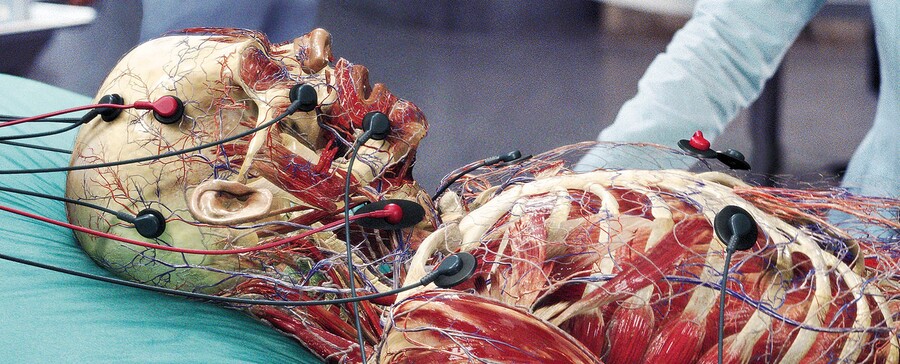
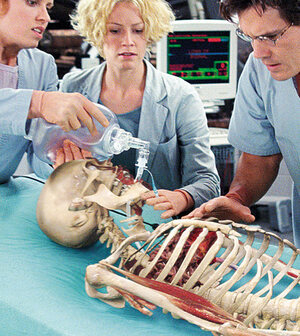
This degree of detail was necessary because, during the transformation, the viewer sequentially saw structures that are usually hidden beneath the skin. Errors in their placement or deformation became immediately noticeable in the frame.
«The Invisible Man» (2020): A Digital Model of an Optical Surface
image
Jonathan Dearing served as the main VFX Supervisor for the film «The Invisible Man.» Digital effects were created by Cutting Edge Studios. CG Supervisor Matt Ebb participated in the development of the digital costume and production tools. [1; 2; 4; 5]
Unlike the 2000 film, the main subject of the digital development was not human anatomy, but the technological surface of the invisibility suit. The practical suit was manufactured by Odd Studio. Its construction incorporated repeating cells representing the fictional optical elements of the camouflage system. Cutting Edge created a digital version of the suit, augmenting it with mechanical components necessary for animating lens movement and surface state changes. [2; 4]
Image
A digital model was used to visualize the costume’s normal operation, including its engagement, disengagement, and malfunctions. In these states, it was necessary to control the visibility of individual surface areas and the rendering style of the surrounding environment. [2]
For the 2000 film, creating the transformation required a multi-layered, volumetric model of the human body. For the 2020 film, the basis for the corresponding effect was a digital model of an external technological shell. The difference in the objects being modeled determined the subsequent methods of animation and visualization.
II. TECHNIQUES FOR CREATING A DISAPPEARING EFFECT
Layered transformation of the body in the film «The Invisible Man» (2000)
image
In the scene where Sebastian Kane transforms, the change in visibility occurs sequentially. First, the skin becomes translucent and then disappears, followed by the transformation of muscles, blood vessels, and internal organs. In the final stages, the skeleton remains visible before it too vanishes. [6] To create this effect, procedural systems were used to control the alteration of the geometry of individual anatomical elements. Specifically, the muscle fibers did not merely become transparent. Their form changed through procedural animation: the fibers contracted and gradually disintegrated. Implicit surface systems in Maya were utilized for this implementation. [6]