Navigator
- Concept
- Dune (1984)
- Dune (2021)
- Dune: Part Two (2024)
- Comparison
- Conclusion
- Bibliography
- Image Sources
Concept
In this paper, I want to trace how the technologies used to create the same creature—the sandworm from Frank Herbert’s novel Dune—have evolved.
The worm appears in three adaptations: David Lynch’s 1984 film and two films by Denis Villeneuve, released in 2021 and 2024.
Over forty years between the first and last film, mechanical models and optical printing have given way to digital modeling and computer simulation. The objective remains the same: to depict a creature of immense size moving through the sand and placing a human upon it.
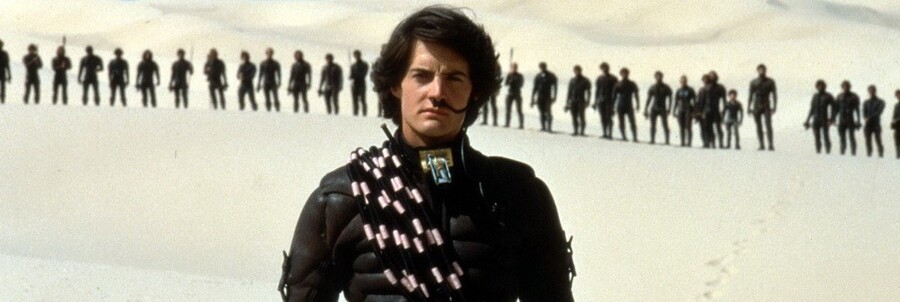
Still from the film «Dune» (1984). Director David Lynch.
Hypothesis
The believability of the worm on screen depends not so much on the creature itself as on the sand around it.It is the sand that communicates the scale and weight to the viewer.I propose that both in 1984 and today, the main challenge for creators was not the worm itself, but the sand: the size of the grains reveals the true scale of the scene. In the first film, this problem was solved by selecting physical materials; in the newer productions, it is achieved through computer simulation settings.In each film, I examine the worm’s appearance, the method of its creation, the behavior of the sand, the conveyance of scale, and the riding scene. I consider Villeneuve’s films as one stage in this process: the worm is shown briefly in the first one, and the primary material is presented in the second.
Dune (1984)
David Lynch’s film was shot at the Churubusco studios in Mexico City. The worm in the film is entirely physical—it consists of mechanical models filmed in a miniature desert and integrated with the actors using optical printing. Carlo Rambaldi built the models, and his credit in the end titles is that of creature designer. Barry Nolan, who was in charge of special photographic effects, directed the shooting of the models and the compositing of the shots. Keith West managed the sand, smoke, and mechanics on set, overseeing the mechanical special effects.
Concept art by Ron Miller for the film Dune (1984).
APPEARANCEThe initial sketches of the worm were done by production designer Anthony Masters and illustrator Ron Miller. The final appearance was developed alongside Rambaldi. The skin coloring was inspired by a photograph of a spotted elephant tusk—red and black—but on screen, the worms appear gray because they are covered in dust.The worm’s mouth opens with three lobes, inside which are rows of needle-like teeth. This shape is derived from John Schoenherr’s illustrations for the novel. Judith Miller was also responsible for the three-lobed mouth and created the early mock-up of the worm.
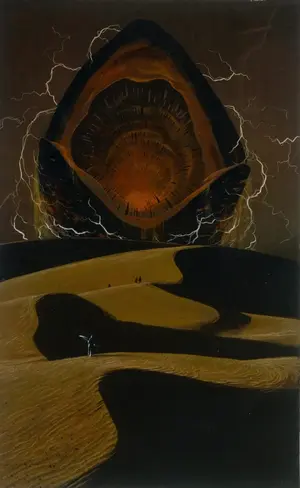
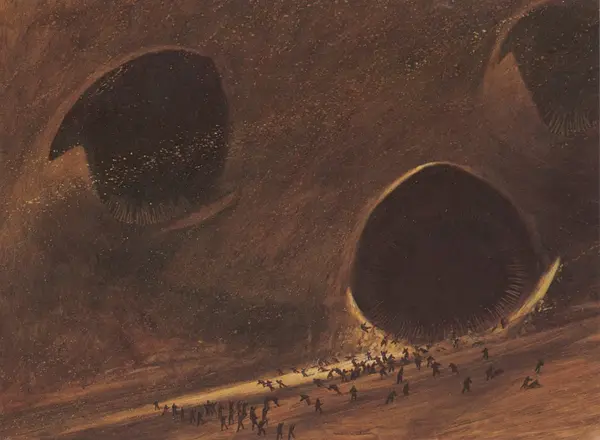
Left: Concept art by Ron Miller for the film Dune (1984). Right: Illustration by John Schoenherr for the novel Dune.
MOCKUPSInstead of a single universal worm, Rambaldi constructed fifteen mockups. Over twenty-four mechanics, molders, and sculptors worked on them, while chief mechanic Steve Townsend helped design the internal mechanisms.The two most complex mockups were 6.7 m long and 0.9 m in diameter. Their bodies moved, and their outer and inner jaws could open. Three other 4.6 m mockups were capable only of bending; one of them was mounted on a pole to show how the worm submerged into the sand. Ten simple, stationary worms were used for the distant background.A head, 3.7 m long and 1.5 m in diameter, and a tail section, 6.1 m long, were constructed separately. The worms were sculpted from clay, gypsum molds were taken, filled with polyurethane foam, and covered with latex skin.
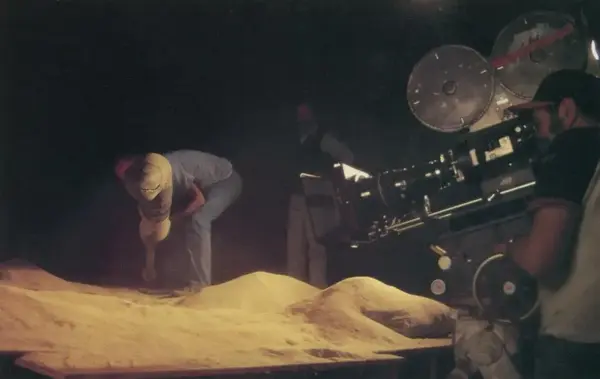
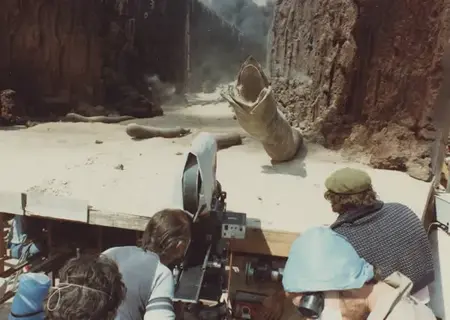
Left: A close-up shot of a small worm head affixed to a rod, for a sand-diving scene. Right: A shot of models in a scene of attack through a breach in a rock wall. «Dune» (1984).
MOVEMENTModels were placed on guides shaped like a sine wave, which allowed the worms to writhe as they moved. The guides were hidden under a layer of sand, and the worms were pulled by cables.The models were operated manually. According to Rambaldi, controlling three small worms simultaneously required nine people, and eighteen for the largest ones. Sixty assistants were hired for this project in Mexico City.
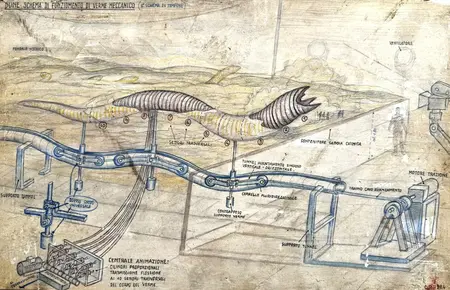
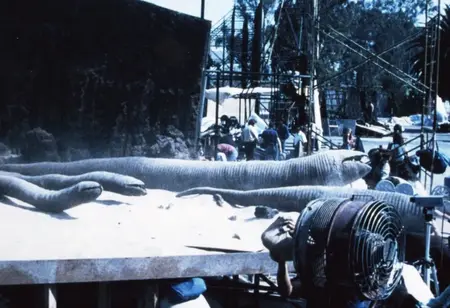
Carlo Rambaldi’s schematic of the worm mechanism device. Worm models on a film set. «Dune» (1984).
SANDStandard sand for the miniature wasn’t suitable: next to the models, the grains looked too large and gave away the scale. Keith West replaced it with two materials. The first is fuller’s earth, a fine mineral powder that was tinted to match the background color of each scene. The second is microspheres—hollow glass beads about 60 microns in diameter.Approximately 2,270 kg of microspheres went into the pavilion. They dripped from the worms almost like water. Inhaling them is dangerous, so the entire group worked while wearing protective masks.The sand emitted from the worm’s body fed into four pneumatic tubes that opened upon command to blow out the fine sand.
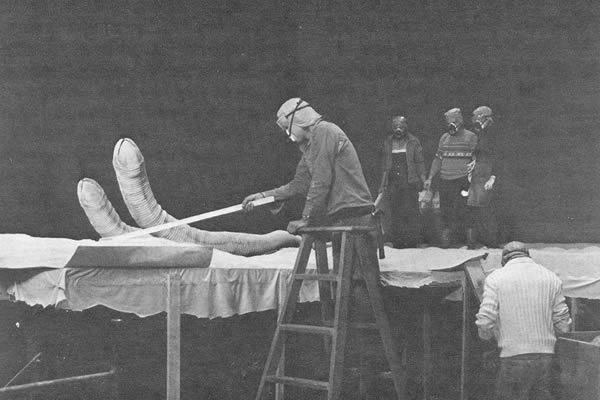
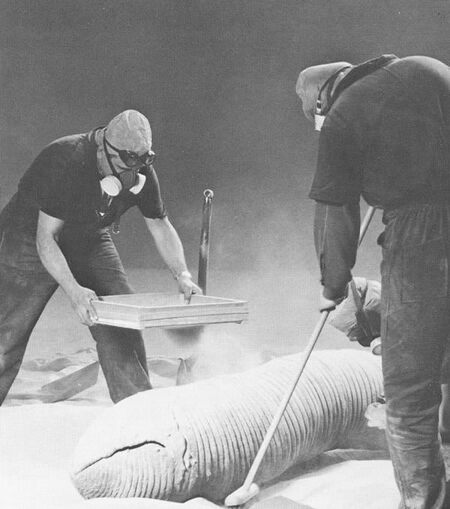
FILMINGThe majority of the 125 frames featuring the worms were shot in the «Churubusko» fourth studio. The miniature desert was shaped as a semicircle, measuring 30.5 m wide and 18.3 m deep, and was set upon platforms 1.5 m high.The worms gained mass due to the filming speed. The models were shot at a rate of 120 to 240 frames per second, and when normally projected, the motion slowed down five to ten times. The small object on the screen began to move as if it were extremely heavy.
In the scene depicting the attack through the breach in the rock wall, models of various scales were arranged in forced perspective: larger ones closer to the camera, smaller ones further away.
The shot of the worm consuming the spice harvester was filmed outdoors. The harvester model stood on a platform 6.1 m high and 3.7 m wide, featuring a hole in the center, through which the worm’s head was raised by a counterweight.
Barry Nolan and the group film a background plate of the worm’s tail. Dune (1984).
THE WORM RIDEThe scene in which Paul Atreides first rides the worm was assembled from several separately filmed elements. For the actors, a full-scale section of the hide—15.2 meters long and 5.5 meters high—was constructed from wood and rubber. It rested on a steel frame equipped with twenty wheels and traveled along a 61-meter path.Kayla McLaughlin was filmed against a blue background. The worm’s head was shot at 240 frames per second for close-ups, and a large miniature set was used for the background. The running Fremen were filmed in the Samalauk desert and composited onto the plates with the miniature. All elements were combined into a single shot using optical printing.
Kyle MacLachlan runs after a piece of worm hide being pulled along the rails. The camera moves along the parallel track. «Dune» (1984).
«Dune» (2021)
A still from the film «Dune» (2021). Directed by Denis Villeneuve.
Thirty-seven years later, Denis Villeneuve released the first part of the new adaptation. The worm in it is digital. Paul Lambert served as the VFX Supervisor for the film, and the worm and sand were created by DNEG, whose VFX Supervisors were Tristan Myles and Brian Connor.Practical effects on set were managed by Special Effects Supervisor Gerd Neefzer. All four received an Oscar for Best Visual Effects.
Bas-relief featuring a sand worm. A still from the film «Dune» (2021).
VISUALSThe creature design by Villeneuve and production designer Patrice Vermett established the concept art even before the effects work began. The digital model was assembled from rigid plates connected by a soft membrane. Because of this, the body moves stiffly, like the bellows of an accordion, and the animation remains simple.The initial model variations seemed too expressive to the creators, so they were simplified: the director needed a slow, ancient creature. The mouth, according to Lambert, is structured analogously to a whale’s baleen, which the whale uses to filter food from the water.
Director Denis Villeneuve and the visual effects team from DNEG focused on the mechanics of the massive subterranean movement. To simulate the displacement of sand and the dunes’ waves, complex physics calculations were used in the Houdini software, studying how real sand dunes and combat creatures behave in the desert.The sounds of the worm were recorded using a «mockumentary» approach. The team employed hydrophones (underwater microphones) in Death Valley, recorded the creak of trees and the rustle of canvas, and even placed microphones in the vocal tracts of actors and sound designers to create visceral organisms.