Navigation
▸ Concept ▸ Analysis of «Ghostbusters» (1984) ▸ Analysis of «Ghostbusters» (2016) ▸ Comparison ▸ Conclusions
Concept
Visual effects in cinema rarely deal with objects that do not exist in nature. But a ghost is a special case. It is immaterial, it glows, it changes shape, it passes through walls. And yet, the audience must believe in it, and the actor must play it as if it were real.
This is precisely why the ghost became my ideal entry point into the theme of technological evolution: through one character, I could trace how the entire production pipeline changed over thirty-two years—from the puppet on the stage to the digital model compiled in a computer.
I chose the Ghostbusters franchise for the following reasons:
▸ First, it is the same studio (Columbia/Sony), meaning the production culture and approach to effects remain within a single tradition.
▸ Second, the ghosts in this film are not mere background elements or episodic creatures, but fully realized characters around whom the action revolves.
▸ Third, there is an entire epoch between the 1984 original and the 2016 remake: a shift away from optical compositing, the introduction of digital models, and changes in on-set lighting practices.
All these data allow for a comparison not between abstract «practice and digital,» but between concrete technological solutions that altered the visual aesthetic.
In the main section, I will proceed chronologically, following the films so that the differences between eras are visually apparent.
The first segment will focus on the 1984 film. Here, I will analyze how ghosts were created in an era without CG characters or digital compositing. Using the Slime as an example, I will demonstrate that it was a foam costume worn by an actor, featuring controllable facial expressions, filmed against a black background, and optically inserted into the shot. With the Marshmallow Man, I will illustrate how animatronics functioned and how Visual Effects Supervisor Richard Edlund and Special Effects Supervisor Steve Johnson divided responsibility for different types of imagery. In this section, it is crucial to show that the ghostly effects in 1984 were created not on set, but in the laboratory: the actor performed with a puppet, and light and translucency were added afterward on an optical printer.
The second segment will focus on the 2016 film. Here, I will analyze how the same challenge was addressed in the age of digital technology. Using Slimer as an example, I will show that the character became a fully CG model, but a reference puppet was still present on set for lighting and for the actors. Taking Gertrude as another example—how the actress was suspended on cables in a costume equipped with LED lighting to achieve realistic illumination on the set pieces, while the digital form and aura were completed later in the computer at the Iloura studio under the direction of Glenn Melenhorst and Andrew Hallen. I will also touch upon the role of Pete Travers, the film’s VFX Supervisor, who was responsible for ensuring that the digital ghosts interacted with the physical world on set—with the light, the camera movement, and the actors' reactions.
The third block will be a comparative analysis. I will compare how the same challenges were addressed in two films: how the actor interacted with a non-existent object, how the light from a ghost was created, and how its «intangibility» was shaped. In 1984, this involved optical compositing and physical puppets. In 2016, it involved digital models, but with physical references on set: a drone with lights, LED costumes, and light puppets. I will show that evolution is not merely about «replacing puppets with a computer.» It is a shift in the very logic: today, the digital object first seems to exist in the physical space of the frame before being completed in the computer, rather than the other way around.
In my conclusion, I plan to demonstrate that the technology for creating ghosts has changed over the past thirty-two years not toward greater realism in and of itself, but toward greater integration with the set. The ghost from 1984 was filmed on film and composited into the frame. The ghost from 2016 was first created using on-set lighting and then rendered as a digital form. It is precisely this evolution—rather than simply swapping a puppet for a computer—that has defined how ghosts appear on screen.
«Ghostbusters» (1984)
Before diving into specific technologies, it’s important to note that when the creators of Ghostbusters made the film in 1984, they did not have digital characters, a green screen in the modern sense, or CGI.All the ghosts on set were physical objects—rubber, foam, latex, mechanics, and an actor inside. Their «ghostliness» was created not by a computer, but first on the soundstage and then in the laboratory using an optical printer. In other words, the VFX team’s task was to film a real object in such a way that it appeared unreal.
Slime on the stage: an actor in a foam costume against a black background.
Slimey is the most convenient example to demonstrate this. Within the team, he was nicknamed «Onionhead.» He was created by Steve Johnson, a special effects supervisor, who was responsible for the puppet’s sculpture and mechanics. However, the Slimey moved thanks to actor Mark Brian Wilson, who wore a green-painted foam rubber suit and performed in front of a black curtain.
Slime on the stage: an actor in a foam costume against a black background.
The actor’s legs were wrapped in black fabric, and because the costume was only waist-high, the figure in the shot appeared to be a creature lacking a lower body, as if floating in the air. The Slime’s mouth and eyes were controlled by puppeteers in black who stood behind and below, while the tongue was operated by a separate hand.
Slime on the stage: an actor in a foam costume against a black background.
The key technical solution here is the frame rate. To make Slimeir look hyperactive and jerky, he was filmed at six frames per second, while the film projected at the standard speed. As a result, the movement appeared fast, nervous, and unnatural—it was an in-camera trick without post-production.Next, the film went to the optical department, where Slimeir was cut out from a black background using an optical printer and overlaid onto footage of the hotel corridor. It was at this stage—under the direction of Richard Edlund, the film’s visual effects supervisor—that the transparency and glow around the ghost were achieved: these were created using multiple exposures and masks. In other words, the result was born not on set, but in the laboratory.
Slime after optical compositing. A still from the 1984 film.
By 1984: the technological stack consisted of a physical object (a costume or doll) + in-camera techniques (shooting frequency, angle) + optical compositing (optical printer, masks, multiple exposure). The presence of a ghost in the shot is explained by the fact that it was actually filmed, while its unreality stemmed from laboratory processing. The viewer sees a Slime, but essentially, it is an optically processed actor in a rubber suit. This was necessitated by the technological limitations of the time: for something to appear in the frame, it first had to exist physically.
«Ghost Hunters» (2016)
In the 2016 remake, the production logic was completely changed. Pit Travers served as the VFX Supervisor for the film, and his task was not to shoot a physical object that looked like a ghost, but rather to create a digital ghost that looked genuinely present in the scene. The result was exact—"physical"—in that first, the light from the ghost was created on set—real light falling onto the actors and set pieces—and only afterward was its form completed in the computer.
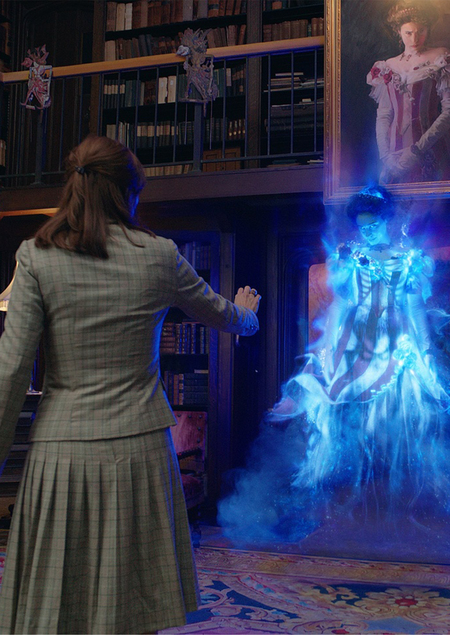
Gertrude—a ghost from the mansion who appears at the beginning of the film—is the best example of this logic. Actress Bess Rous played her. On set, she was suspended on cables, and her costume was stitched with LED lights. These lights illuminated things for real: the actors, the walls, the furniture. Travers explained in an interview that this was done so that the «Hunters» had a real object to look at (an eyeline), rather than a void.
Gertrude: LED lights are embedded in the costume—it’s real light, on set.
In the final shot, Gertrude’s face and most of her body are played by an actress, while her lower body and the glow surrounding her are digitally painted. In the angles where the character is fully digital, shooting with an LED costume was used as a reference for lighting and movement. Iloura Studio (a division of Deluxe) was responsible for creating the ghosts, and VFX Supervisors Glenn Melenhorst and Andrew Hallen led the work—they created about 500 frames featuring the ghosts.
Gertrude in the final frame: the lower body and aura were finished in Iloura. Frame from a 2016 film.
The slime character in this version became a fully digital persona. However, a physical doll still stood on the set—it wasn’t filmed but served as a reference for the lighting and the actors. Travers explicitly stated that the doll was necessary so that the light would have a source and the actors would have a focal point to look at.
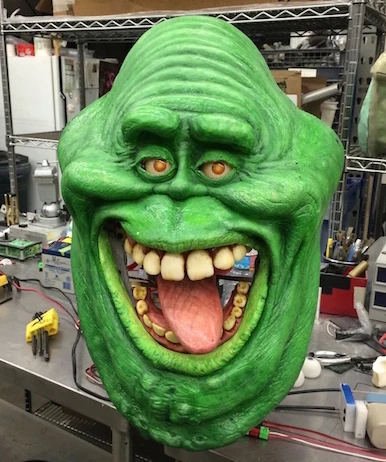
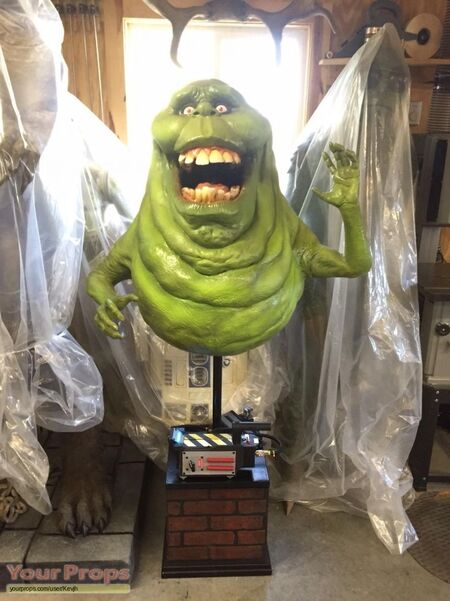
Slime on the platform, a puppet for light and reference.
This is the exact reverse of the situation from 1984: back then, the puppet was filmed and then processed optically; now, the puppet is only needed so that a digital character can inhabit real space.