Introduction
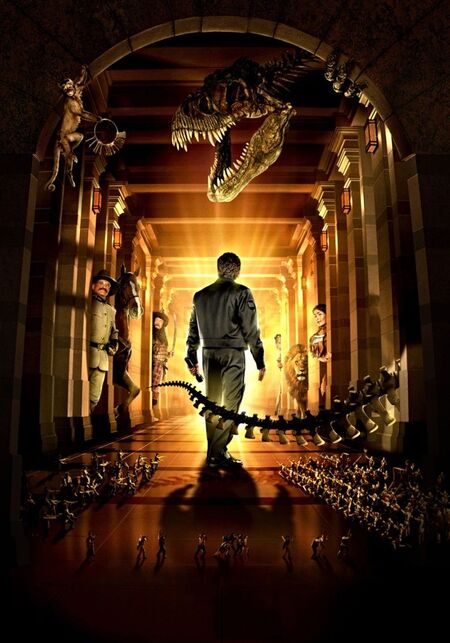
The «Night at the Museum» trilogy is interesting for research due to the recurring production tasks. The same or functionally comparable museum animals appear in the three films: dinosaur skeletons, large mammals, furred creatures, and animated exhibits.
Research Question: How did the methods of creating and integrating digital entities in the «Night at the Museum» trilogy change between 2006 and 2014, and what consequences of these changes are truly discernible in the final image?
Hypothesis: The primary development of technologies occurs within the stylistic constraints set by the initial stage. Surface detail is enhanced, the range of materials and deformation types expands, and the interaction with actors and stage lighting becomes more complex. Rexy’s model serves as confirmation for this hypothesis: in 2009, Rhythm & Hues reused the model and animation setup from the first film, reworking the textures for closer shots. This suggests that visual evolution can happen within a single digital asset, without requiring its complete replacement. An analogous example is the compositing of a live animal and its CG double.
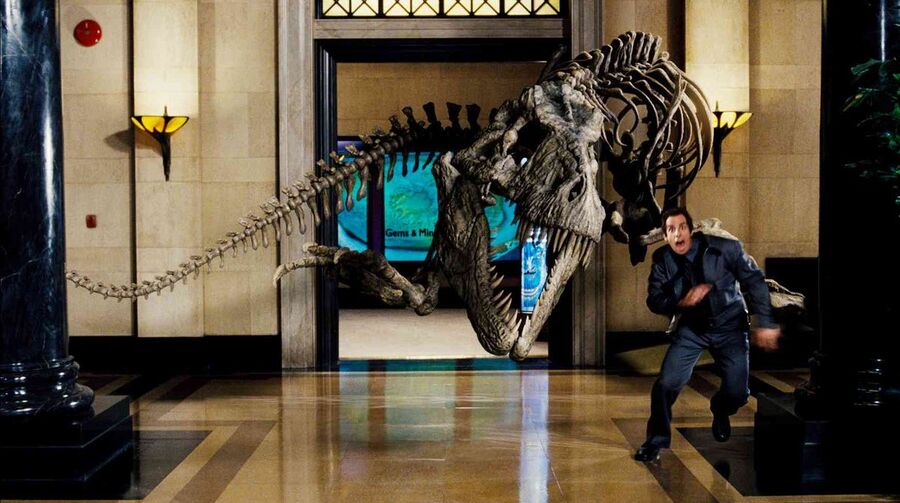
«Night at the Museum, ” 2006. Rex Tyrannosaurus digital skeleton. Main VFX Supervisor: Jim Rygiel. Rhythm & Hues, VFX Supervisor: Dan DeLeeuw; Animation Director: Craig Talmy.
«Night at the Museum, ” 2006
Rexy: From Museum Skeleton to Digital Character
In the first film, Jim Riggle oversaw the overall control of visual effects, and Rhythm & Hues was the primary VFX studio. The studio completed over 300 frames, including Rexy and a significant portion of the animated animals. Dan Deleu served as the VFX Supervisor at Rhythm & Hues; the Rexy team also included Animation Director Craig Talmi, VFX Producer Julie D’Antoni, Digital Supervisor Will Telford, and Compositing Supervisor Craig Seitz. Rexy’s reference was an existing, life-sized museum skeleton used on set. Gentle Giant executed a LiDAR scan of the object from multiple angles. Rhythm & Hues then built the CG replica based on this scan. For every skeletal element, corresponding real bones and joints were photographed, and the resulting materials were used as the foundation for the digital surface. A major challenge for the rig was the mutual penetration of vertebrae and other skeletal parts. The joints of the digital object were oriented based on the construction of the physical museum model, where the bones were connected by metal components.
«Night at the Museum,» 2006. Rexy, the final CG character. Main VFX Supervisor for the film: Jim Rygiel. Rhythm & Hues, Studio VFX Supervisor: Dan DeLeeuw; Animation Director: Craig Talmy.
Visually, Rexy differs from most digital characters by lacking soft tissue. It has no skin, fur, or facial musculature capable of conveying emotion. Character is perceived through the position of the skull, the tilt of the neck, the movement of the pelvis, the spine, and the tail—the overall rhythm of movement.
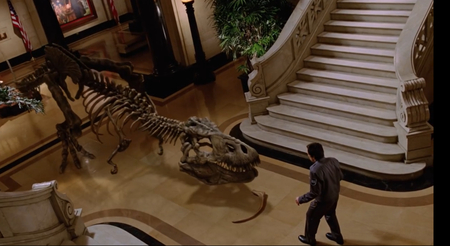
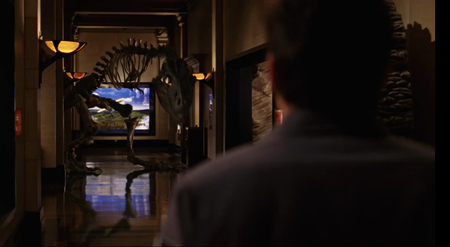
«Night at the Museum, ” 2006. Rex in two states. Lead VFX Supervisor: Jim Rygiel. Rhythm & Hues, VFX Supervisor: Dan DeLeeuw; Animation Director: Craig Talmy.
This comparison shows that a change in behavior is achieved without altering facial expressions. In one frame, the silhouette is perceived as threatening, but in the gameplay state, the movement becomes more springy and canine. Furthermore, Rexy’s technological upgrade improves surface quality, but the fundamental acting challenge remains tied to body animation.
Physically, the skeletal structure was significantly lighter than a living adult Tyrannosaurus Rex. The initial R&H animation tests accounted for this low skeletal mass, causing the character to move more quickly. According to De Liuw, the result lacked sufficient believability. The team then began animating Rex as a creature with the mass of a full-grown dinosaur. A camera vibration was added when the feet struck the floor, intensifying the subjective sense of weight. This approach intentionally contradicts the literal physics of the museum skeleton but better aligns with the audience’s expectation of a giant dinosaur.
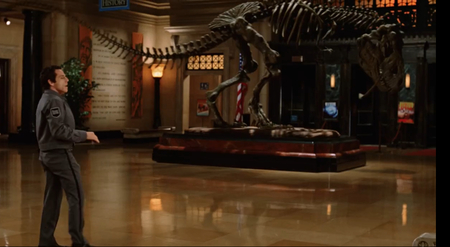
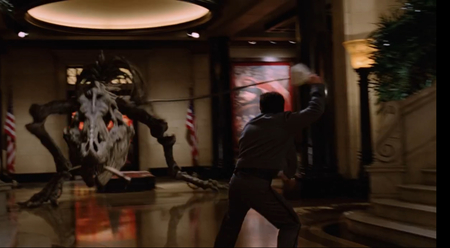
«Night at the Museum, ” 2006. Rexy. Lead VFX Supervisor: Jim Rygiel. Rhythm & Hues, VFX Supervisor: Dan DeLeeuw.
This means that realism is determined not by the literal adherence to an object’s physics, but by the consistency of its visual cues. A large silhouette, a heavy gait, the duration of mass transfer, and the camera’s reaction all communicate the necessary scale to the viewer’s brain. If the skeleton were to move with the actual mass of its bones, its behavior would conflict with its visual size.
Modeling, surface, and pipeline.
Rhythm & Hues modeled the objects in Maya. Rexy was then transferred to the proprietary Voodoo package, where rigging, animation, and lighting were performed. Lighting and color parameters were processed through Lighthouse, rendering was executed using the custom Wren engine, and compositing took place in the internal Icy system. During rendering, the lighting was separated into individual layers, allowing for source adjustments during compositing.
«Night at the Museum, ” 2006. Rexy, digital bone surface detailing. Lead VFX Supervisor: Jim Rygiel. Rhythm & Hues, VFX Supervisor: Dan DeLeeuw.
In the close-up fragment, one can assess the color variation of the bone, the condition of the edges, and the contamination in the recesses, as the light separates one bone from another.
HDRI and integration into the museum interior.
On the R&H set, HDRI lighting data was collected. Subsequently, the studio used its proprietary six-camera HDRI system with CMOS sensors, which generated a 360-degree image of the environment. This data formed the basis for CG lighting and reflection maps. In the first film, HDRI was also used to capture the set lighting and generate texture maps for integrating Rexy.
«Night at the Museum, ” 2006. Integration of digital Rexy into the set interior. Lead VFX Supervisor: Jim Rygiel. Rhythm & Hues, VFX Supervisor: Dan DeLeeuw.
In such an image, the quality of the integration should be assessed in areas of contact: the lower part of the feet, the brightness of the bones relative to the surrounding surfaces, the softness of the shadows, and the reflected light from the floor. The model can be highly detailed, but inconsistent lighting immediately separates it from the plate. Therefore, as early as 2006, the photorealism of creatures was constructed as a combination of modeling, shading, lighting, and compositing.
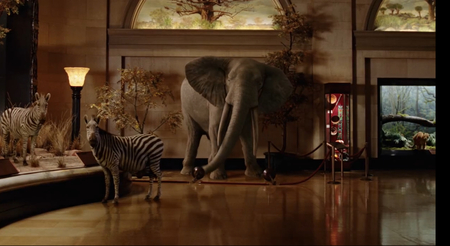
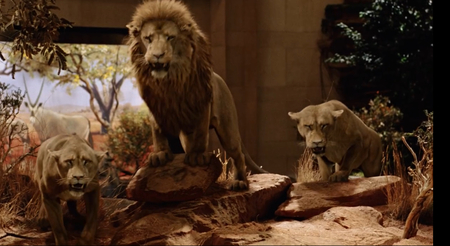
«Night at the Museum, ” 2006. Digital African animals. Lead VFX Supervisor: Jim Rygiel. Rhythm & Hues, VFX Supervisor: Dan DeLeeuw.
The special class of creatures in the first film consists of animals from the African savanna. The director and Raigill wanted the animated creatures to appear like real beasts, even though their original form resembled museum taxidermy specimens. The modelers used the specimens as references to maintain size and proportions. For the lion, Rhythm & Hues built upon the technological foundation developed for Aslan, altering the face and eyes; the digital animal’s fur received a more pronounced texture and sheen compared to the static exhibit.
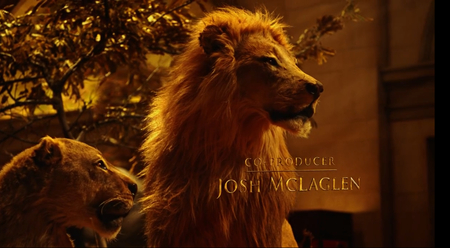
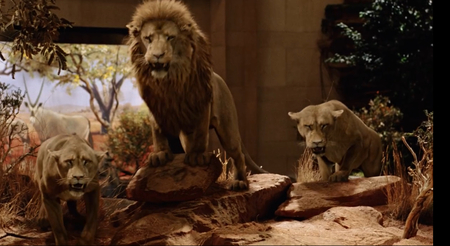
«Night at the Museum,» 2006. A museum taxidermied animal and its animated digital version. Lead VFX Supervisor: Jim Rygiel. Rhythm & Hues, VFX Supervisor: Dan DeLeeuw.
In the CG version, the eyes change, the nature of the specular highlight on the fur, the dynamics of the hair, and the light distribution on the moving form are altered.
Mammoth.For the woolly mammoth, R&H adapted concepts from the Aslan mane system. The character’s height was approximately 14 feet, or about 4.3 meters. De Louis specifically noted the hair scaling issue: the hair does not scale proportionally to the character’s size, meaning improper length or dynamics can easily diminish the perceived visual size of the animal. The fur acts as a scale indicator. If long strands move too quickly, the enormous character begins to appear as a small model shot up close.
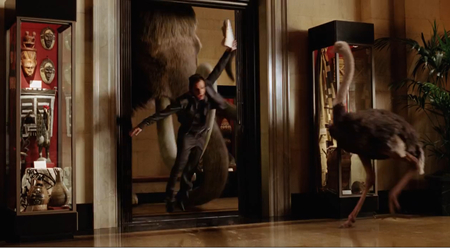
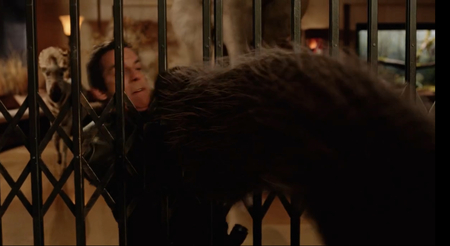
«Night at the Museum, ” 2006. Digital woolly mammoth. Lead VFX Supervisor: Jim Rygiel. Rhythm & Hues, VFX Supervisor: Dan DeLeeuw.
Herd and spatial interaction.
In the episode featuring running animals, R&H used supplementary technical animation passes for muscles, fat tissue, and hair. Individual animals were animated and then composited into a unified shot. After motion approval, the team manually corrected overlaps between characters within the camera frame: limbs, ribs, and other model parts could penetrate each other.
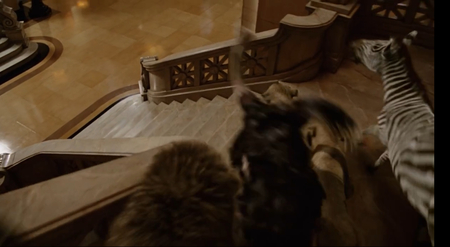
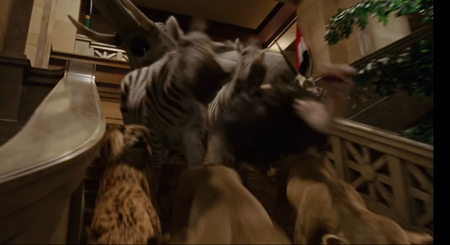
«Night at the Museum,» 2006. Herd of digital animals. Lead VFX Supervisor: Jim Rygiel. Rhythm & Hues, VFX Supervisor: Dan DeLeeuw.
The contact shadow, reflected light, and stable point of support create the illusion that the animal is truly carrying its weight through the museum space.