Categories
Concept Key Question and Hypothesis From Physical Effect to Digital Body — How Cinema Portrays the Impossible — Practical Methods for Altering Appearance — The Transition from Makeup to Computer Graphics Vampiric Transformation in Cinema — Practical Effects: Fright Night and The Lost Boys — Artificial Immortality: Interview with the Vampire — Digital Transformation: Twilight Saga: Breaking Dawn — Part 1 — The Computer Body: Dracula Untold Comparison of Technologies and Conclusion Bibliography
Concept
The vampire transformation interests me as a specific challenge for cinema: the viewer must be made to believe that the person has ceased to be human, even if they retain nearly all their familiar external traits. Unlike transforming into an animal or a fantastical creature, this transformation doesn’t always require a complete alteration of body form. Sometimes, it is enough to change the eyes, the skin, the teeth, the prominence of veins, or specific facial features. But it is precisely these subtle changes that must convincingly convey what has happened. I chose this theme both because I genuinely love stories involving vampires and their screen adaptations, and because the vampire archetype has existed in cinema for decades, and the methods of creating it have noticeably evolved. In some films, the transformation is based on physical changes visible directly on the actor. In others, the image is enhanced with computer effects, and in some cases, the character’s body is created almost entirely through digital means.
This research focuses on the visualization techniques for the transformation of a human into a vampire and the resulting changes in their appearance after turning. I am not interested in the entire history of the vampire archetype or its literary or folkloric origins, but rather a specific cinematographic problem: how to present the audience with the emergence of a new, non-human nature within a human body. The focus is on the visible signs of transformation: changes in skin color and texture, the appearance of veins, alterations to the eyes, teeth, and facial features, and the transition from human to a conditionally supernatural anatomy. Specific attention is given to instances where the change occurs gradually, and cases where the audience sees the fully realized result.
Five films have been selected for this study, released between 1985 and 2014: — Fright Night (1985), — The Lost Boys (1987), — Interview with the Vampire (1994), — Twilight Saga: Breaking Dawn — Part 1 (2011), — Dracula Untold (2014). These films allow for a comparison of different stages in technological development. The first two examples showcase the capabilities of practical effects and the alteration of an actor’s appearance directly. Interview with the Vampire is crucial for studying detailed work with human skin and its visual authenticity. Twilight demonstrates a combination of physical and digital solutions, while Dracula Untold allows for an examination of the digital model of the vampire body as a standalone visual object. I would like to focus most heavily on Interview with the Vampire and Twilight: in these films, it is particularly interesting to study the methods used to depict transformations while retaining the character’s human likeness.
The study is structured around the principle of examining several methods for creating a vampiric body. First, there is the technical context: what challenges arise when depicting transformation and how film can solve them. Next, practical effects, working with the surface of the human body, combined technologies, and fully digital imagery are examined. This structure allows for a comparison between films, even if they originate from different decades or employ diverse visual styles. Each film is analyzed through specific shots and sequences where the work of visual effects specialists can be observed. Within the sections, I focus on which changes were implemented physically, which were created using computer processing, and how these methods interact within a single image.
The analysis utilizes materials regarding visual effects production, interviews with industry specialists, publications from specialized journals, and archives from studios involved in film creation. Particular importance is given to publications from Cinefex, American Cinematographer, Animation World Network, fxguide, as well as production materials from Stan Winston Studio, Framestore, and Image Engine. Priority is given to sources where specialists themselves describe the technologies used and their role in creating the effect. This allows one to move beyond the mere visual impact of a frame and instead correlate it with the production process. The visual analysis is constructed by comparing film frames, individual image details, and available materials detailing the effect creation.
«Dracula Untold» 2014
A key question is how the advancement of visual effects technology has changed the ways of depicting human transformation into a vampire, and what opportunities new technologies have given cinema.
Hypothesis
In my view, the evolution of digital technologies has not entirely displaced practical effects; rather, it has shifted the distribution of tasks between physical and digital imagery. Practical methods allow for the creation of real surfaces, volume, and detail live during filming, while digital tools enable manipulation beyond the physical limitations of makeup and prosthetics—even allowing for the creation of entirely computer-generated bodies and environments. As a result, the vampire transformation gradually ceases to be merely a change in the actor’s appearance and becomes a complex visual construction integrating both real and digital elements.
From Physical Effects to Digital Being
Transforming a person into a vampire doesn’t necessarily mean complete anatomical alteration. Most often, the viewer recognizes the change through several signs: the skin becomes paler or gains an unusual texture, the eyes change color, fangs become visible, veins surface, or the face shape changes. The set of characteristics varies across different films, but the fundamental goal remains the same: the viewer must perceive that what stands before them is the undead.
Before computer graphics became widespread, character transformations were achieved primarily through physical means. Actors wore special compounds, used makeup, artificial teeth, contact lenses, and other elements that existed in the real space during filming. This method allowed for an image in which the main details were already present before the camera. These details could be seen in close-up, and the actor could interact with them in the shot. The limitation was that physical materials could not always achieve complex changes in form and movement, so some effects had to be created using on-set stunts and subsequent post-production.
With the advancement of computer graphics, it became possible to modify specific sections of an image after filming. Digital processing allowed for color and skin texture correction, altering body proportions, creating additional details, and compositing recorded material with computer-generated elements. At the same time, computer graphics does not have to replace the physical effect entirely. It is capable of complementing an existing image. It is precisely the combination of these methods that is becoming one of the main directions in the development of vampiric transformation.
Transformation in Cinema: Visual Effects
Fright Night 1985
«Fright Night» 1985
In Fright Night, character transformations are primarily achieved using physical effects. Specialists from the monster workshop, led by Steve Johnson and Randall William Cook, were involved in creating these effects. The article in American Cinematographer details the work on the film’s practical effects, but the main focus is on the transformation of Evie Edna into a wolf, rather than the change of Amy into a vampire. Therefore, for an analysis of Amy’s vampiric appearance, a separate document detailing the film’s creation and information on her character design is necessary. Her appearance is not reducible to a single element. Teeth, eyes, and facial structure play a crucial role. The specialists utilized practical elements that allowed the actress’s features to be altered directly in front of the camera. Production materials mention the involvement of Steve Johnson and Ken Diaz in creating Amy’s vampiric look.
«Fright Night» 1985
Special prosthetics allowed for the creation of relief that could not be achieved merely by changing skin color with makeup. The volumetric details had to form a new facial surface in such a way that their boundaries would be invisible on camera. The construction’s compatibility with facial expressions was also important so that the actress could maintain the ability to move her face, preventing the alteration of appearance from turning the character into a rigid mask. Teeth are one of the most recognizable characteristics of a vampire. In this case, the effect did not require changing the entire face—a single detail was enough for the audience to perceive the character differently. Visually, the fangs function as a focal intervention in human appearance. Furthermore, one cannot ignore the makeup in the film, which, combined with the fangs and contacts, looks quite harmonious and complements the overall look.
The Lost Boys 1987
«The Lost Boys» 1987
In this film, the vampiric transformations are built upon the formation of a facial structure atypical for humans: prominent cheekbones, emphasized brow arches (with the absence of eyebrows), and an unusual skin texture. Greg Kinnan was responsible for developing the character designs, and Ve Neil also participated in the work. In an interview for Stan Winston School, Kinnan discusses the visual research and tests that preceded the final look of the characters.
Vee Nell for makeup creation on set
Kenne described how the initial visual concept for the vampires was developed based on an old photograph featuring unusually expressive facial features. The tests helped determine the degree of transformation for various characters. A more stylized version was chosen for Cypher Sutherland, whereas Jason Patrick utilized a more restrained design. The visual characteristic of the look is that the face remains fundamentally human, but its surface begins to appear different. The topography of the skin and emphasized protruding features alter the conventional proportions of the face.
«Fright Night»

«The Lost Boys»
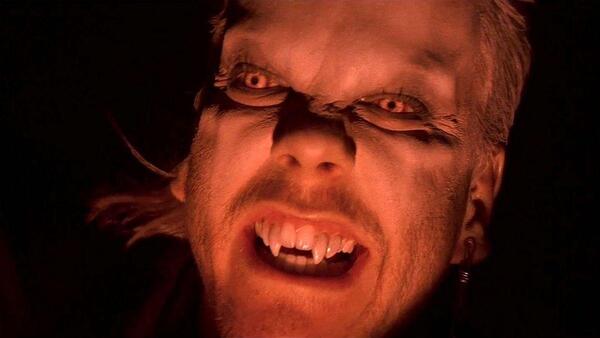
In both films, the appearance of the vampires is created physically, although the visual solutions differ. «Fright Night» utilizes distinct facial expressions, while «The Lost Boys» forms a more cohesive vampire image through texture and feature modification. In both instances, the audience sees the results of the specialists' work directly on the actor.
«Interview with the Vampire» 1994
«Interview with the Vampire» 1994