NAVIGATION
— Concept — Developing Gwen Stacy’s initial look — Creating a new persona: Spider-Gwen — Evolving the visual identity of a modern heroine — Conclusion
CONCEPT
Gwen Stacy—a character in the Marvel universe whose visual representation has significantly evolved since her first appearance in The Amazing Spider-Man comics in 1965. Initially, she was presented as a supporting character tied to Peter Parker’s story. Several decades later, an alternate version of the heroine emerged—Spider-Gwen—who gained her own comic book series and independent narrative.The transformation of this character is interesting not only from a narrative development perspective but also from a visual design standpoint. Gwen’s appearance, costume, color palette, and physicality have changed along with her role in the comics. Using this character as an example, one can trace how approaches to creating female figures in American comics have changed, as well as how the visual identity of an independent heroine is formed.
The primary material for this study will be Marvel comic books featuring Gwen Stacy. We will first examine issues of The Amazing Spider-Man from the 1960s–1970s, which established the character’s initial look, as well as Edge of Spider-Verse and subsequent series like Spider-Gwen and Ghost-Spider, dedicated to her alternate version.
The selection of issues is based on significant changes to the character’s appearance and role, as well as on the shift in artists who influenced her visual realization. Additionally, we will utilize covers, individual pages, and character imagery from different periods to compare the nuances of the drawing style, costume design, color palettes, and composition.
The research is divided into three thematic blocks, sequentially revealing the evolution of Gwen Stacy’s visual portrayal.
The first block focuses on the formation of the character’s initial image in The Amazing Spider-Man comics. It examines the depiction of female characters in American comics from the 1960s and 1970s, Gwen’s appearance and everyday attire, as well as the changes in her artistic rendering across different artists.
The second block addresses the introduction of Spider-Gwen and the creation of the new hero’s image. It analyzes the development of the superhero costume, color palette, silhouette, plasticity, and graphic depiction of the character. Special attention is paid to the differences between the new look and the original Gwen Stacy version.
The third block explores the further development of Spider-Gwen’s visual identity in subsequent comic series. It studies changes to the costume, the appearance of new visual solutions, the hero’s casual look, and the influence of various artists on her design.
The sources will include materials on the history of American comics, the development of female characters, and the visual language of the comic medium. Official Marvel materials, along with interviews with artists and writers, will also be used to refine the character’s creation history and design specifics.
How has Gwen Stacy’s visual identity evolved in Marvel comics, and how do changes in her appearance reflect the transformation of her character role—from a secondary heroine to an independent superhero?
Gwen Stacy’s role in Marvel comics was accompanied by the formation of a new visual identity for the character. The transition from her original appearance to Spider-Gwen was evident not only in the introduction of her superhero costume but also in changes to her silhouette, color palette, plasticity, and artistic presentation. These changes reflect the evolution of approaches to creating female characters in modern superhero comics.
Forming the Initial Image of Gwen Stacy
Gwen Stacy first appeared in the comic The Amazing Spider-Man #31 in December 1965. The character was created by writer Stan Lee and artist Steve Ditko. Initially, Gwen was a student at Empire State University and part of Peter Parker’s social circle. Her character was shaped within the traditions of the Silver Age of American comics, where supporting characters helped illuminate the protagonist’s everyday life.
Steve Ditko Version
In the early issues, Gwen is depicted as an attractive, confident, and slightly reserved young woman. Her appearance is characterized by light hair, an expressive gaze, and neat clothing that reflects mid-1960s fashion. Ditko employs a rather stylized and graphic illustrative style: simple forms, sharp contours, and bright, localized colors.
Amazing Spider-Man #31, 1965, Stan Lee, Steve Ditko
In the opening pages, it is evident that Gwen does not immediately become Peter’s romantic interest. Initially, she is perceived as an independent student within his new social circle. Her character is highlighted not so much through complex physical details as through her facial expressions, postures, and interactions with other characters.
Amazing Spider-Man #31, 1965, Stan Lee, Steve Ditko
Reimagining the image by John Romita Sr.
A significant stage in Gwen’s visual development involved a change in artist. Starting with The Amazing Spider-Man #39 (1966), John Romita Sr. took over the series. His approach noticeably differed from Ditko’s art: the characters began to look more realistically proportioned, their facial features softened, and the illustrations became more detailed.
Amazing Spider-Man #64, 1965, Stan Lee, John Romita
It is in Romita’s work that Gwen’s most recognizable classic image has been cemented: long blonde hair, a black headband, tidy clothing, and softer facial features. The artist made her visually more expressive and brought the character’s depiction closer to the aesthetic of romantic comics and fashion illustrations of that era.
Amazing Spider-Man #64, 1965, Stan Lee, John Romita
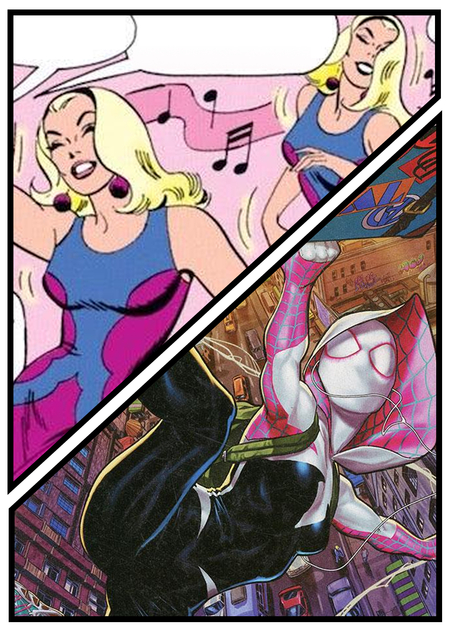
Steve Ditko renders Gwen in a more graphic and angular manner. His drawings are characterized by crisp outlines, expressive facial expressions, and somewhat conventional proportions. The character’s appearance has not yet fully settled; her look is constructed through her hairstyle, clothing, and demeanor within the frame.
John Romita Sr. makes Gwen’s portrayal softer and more realistic. Her facial features become smoother, her figure more natural, and her hairstyle and clothing are more detailed. In his work, Gwen takes on the recognizable romantic image of a 1960s woman.
Amazing Spider-Man #34, 1965, Stan Lee, Steve Ditko Amazing Spider-Man #47, 1965, Stan Lee, John Romita
The shift from Ditko to Romita illustrates how not only the artistic style of the comic changed, but also the visual perception of Gwen herself. While in Ditko she appears as a more graphic character, with Romita her image becomes softer, more feminine, and closer to the aesthetic of fashionable illustrations of that era.
Creating a New Image: Spider-Gwen
In 2014, Marvel introduced an alternate version of Gwen Stacy in the issue Edge of Spider-Verse #2. In this universe, it is Gwen who gains powers after being bitten by a radioactive spider and becomes the superhero instead of Peter Parker. This is how Spider-Gwen was born—an independent interpretation of a familiar character who retains Gwen’s name and some original traits but acquires a completely new role and visual identity.
New superhero suit
Spider-Gwen, Edge of Spider-Verse, Robbie Rodriguez
The main change is Spider-Gwen’s suit, designed by artist Robbie Rodriguez. Unlike the classic Spider-Man suit, it combines a white base with black and pink elements. The pink lining of the hood and the bluish details create a vibrant color accent, making the heroine’s silhouette easily recognizable.
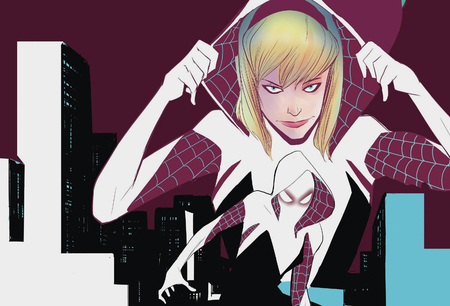
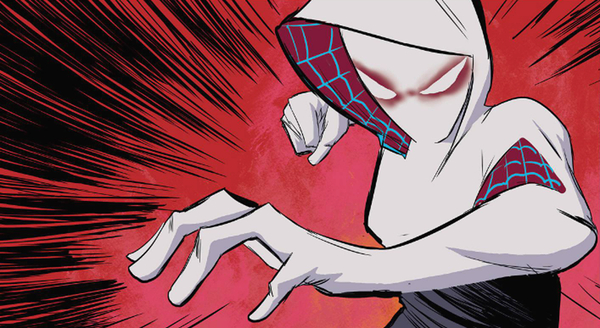
Edge of Spider-Verse #2, Marvel Comics, Jason Latour, Robbi Rodriguez