Navigation
1. Concept
2. Introduction
3. Analog Phase
4. Digital Phase
5. Algorithmic Phase
6. Conclusions
1. Concept
The selection of this topic is driven by the need to explore the transition from the physical trace of sound on film to abstract mathematical algorithms within digital interfaces.
The materials were selected based on principles of technological representativeness and artistic significance. The selection includes artifacts that became turning points in the history of audiovisual synthesis—specifically, optical sound tracks on film, works by experimental directors, oscillograms and spectrograms that emerged with the development of electronics, as well as interfaces of modern digital sound stations, generative graphics, and neural network installations. The main objective is to illustrate how the visual language of audio has evolved.
The research hypothesis is based on the premise that each technological stage corresponds to specific types of audiovisual synthesis, which gradually succeed one another and evolve from physical representation to mathematical abstraction. This approach allows us to view the history of audiovisual synthesis not merely as a linear sequence of technical innovations, but as a multi-layered process wherein the methods of recording, processing, displaying, and perceiving sound are transformed.
2. Introduction
In classic film theory and audiovisual art, sound has traditionally been conceived as an invisible element that supplements the image. The aural track creates an emotional backdrop, but for a long time, it remained secondary to the visual. However, throughout the 20th and 21st centuries, artists, directors, and engineers have consistently strived to overcome this hierarchy and make sound visible.
Human perception in the audiovisual environment operates at the intersection of hearing and sight. We interpret rhythm, dramatic structure, and emotional tension based on how the sound signal is presented on screen. This phenomenon of synesthesia becomes key to understanding contemporary audiovisual practices.
To understand modern algorithmic visualizations, one must return to the origins. The first stage of this evolution is connected to an era when sound and image were inextricably linked at the level of physical matter.
3. Analog Stage.
In the analog era, sound and image were physically linked. The optical track on motion picture film is sound translated into graphics. Light passing through transparent and opaque sections of the film was converted into an electrical signal, and subsequently into a sound wave. In this context, the visualization was not an abstraction, but the literal trace of sound.
Experimental directors quickly realized that if sound was a graphic, it could be drawn by hand. The technique of direct animation (drawn on film) allowed artists to apply paint, scratches, and geometric shapes directly onto the film’s sound track. This was an act of absolute synthesis, where the artist became the composer, and the image generated the sound.
A prominent representative of this field was the Canadian animator Norman McLaren. In his films, scratches and lines on the film created not only the visual imagery but also complex sound scores. McLaren proved that the visual language of audio could be entirely handcrafted and physically tangible.
Norman McLaren working on an optical sound track.
Norman McLaren. A still from the film Synchromy.
But artist Len Lay went further; by using vibrant colors and various geometric shapes, he painted directly onto film stock. Thanks to him, a unique direction emerged—visual music—where an image is perceived as sound, and sound as painting.
Len Lai. A still from the film «A Colour Box.» Direct film painting.
It is important to note that the forms of the analogue stage did not attempt to create an illusion of depth. They existed on a flat screen, emphasizing their materiality. Sound functioned here as a plastic material, shaping movement and the frame’s composition, and the viewer acted as a direct witness to the physical connection between eye and ear.
However, the analog method had its limitations. The physical connection between the scratch and the sound restricted the complexity of the textures created, and with the advent of digital technologies, this physical link was completely severed. Matter gave way to data, and manual painting gave way to interfaces.
4. Digital Stage.
With the advent of digital technology, sound ceased to be a physical artifact and transformed into data, and the visualization of sound became an interface. In digital audiovisual production, sound can now be infinitely cut, stretched, layered, and cleaned of noise.
The Interface of a Modern DAW
The interface of a Digital Audio Workstation (DAW) shapes a new form of professional vision for directors and sound designers. It dictates exactly how sound must be perceived and edited, and while the waveform visualizes amplitude, allowing for precise timing edits, it obscures the richness of the frequencies.
Soon, the flat waveform gives way to the spectrogram. Unlike a simple wave, the spectrogram lends depth and texture to the audiovisual image—it creates the effect of a soundscape where the time axis intersects the frequency axis, and color becomes equivalent to volume.
spectrogram
However, to the untrained viewer, a spectrogram appears only as visual overload—this gives rise to a new need for media literacy: the ability to understand the language of spectrograms in order to read the sonic image.
A frame from the movie «Arrival» as an example of cinematic stylization of reading a «spectrogram.»
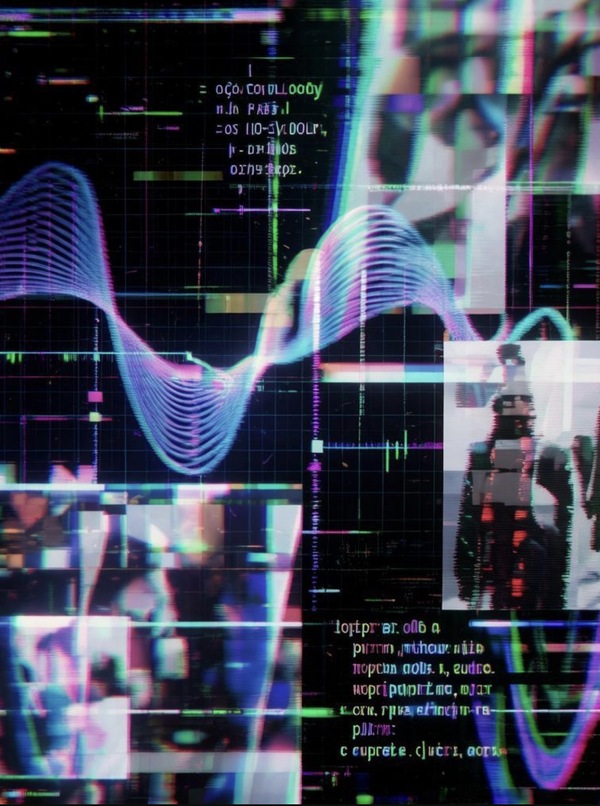
The digital phase made sound controllable, but the human remained the operator, working with pre-existing data through an interface. The next step is when the data begins to generate itself, birthing new forms never seen before. This led to the emergence of the algorithmic phase.
5. Algorithmic Stage.