Navigation Menu
— Concept — Tarot — Occult Symbolism — The Image of the Witch — Authors Related to Esotericism — Conclusion — Sources
Concept
Today, comics are still often perceived as mass entertainment for a narrow audience. However, contrary to many misconceptions, comics have long since evolved beyond a light read for teenagers. Authors create complex, unique narratives, incorporate numerous references to various cultures and events, and embed distinct ideas.
In their comic, the creator can reflect not only their civic stance or personal opinion on a particular issue, but something more intimate. Faith, for instance, serves as an example of such a personal topic. I decided to take up exactly this theme because the subject of magic is still considered taboo. Addressing religious topics in comics is sometimes perceived as propagating a specific belief, much like was the case with Franco-Belgian comics. In the early 20th century, the Catholic Church was the impetus for the birth of bande dessinée in order to promote its faith among children. Esoteric practices, however, could not afford to exist openly, making their appearance in comics at least intriguing.
Let’s delve a bit deeper into what the term «Esotericism» implies. Esotericism refers to certain hidden knowledge accessible only to a limited number of people. Most often, this term is used to refer to various magical practices, such as love spells, occultism, and the worship of non-traditional deities like Lilith or Kali, depending on the tradition an individual is immersed in.
There is also the term «Exotericism.» The difference between esotericism and exotericism is that the latter is knowledge available to a wide range of people. For example, astrology, tarot, and so on, fall under exotericism. It is worth noting that debates about this topic still persist within esoteric communities, as many practices do not accept the division between esoteric and exoteric.
In this study, I will not separate references to these two types of practices, but it should be kept in mind that the use of tarot cards or zodiac signs in plotlines or character imagery is a far more common occurrence. Its appearance does not always imply the author’s involvement in magical practices, since astrology and card readings are exoteric disciplines whose knowledge is possessed by many people.
In this study, I aimed to gather various references to esoteric practices and analyze their function within the history.
Tarot
The first Tarot cards appeared as early as the 14th–15th centuries in Italy, but they were used not for divination or rituals, but for ordinary gambling. At that time, they were known as Tarocchi.The classic Rider-Waite Tarot deck we know today was created in 1909. Its authors are the occultist Arthur Edward Waite and the artist Pamela Colman Smith. Of course, the cards were used for divination before the advent of Waite’s interpretation, but this is the deck currently considered the classic Tarot card set.
Secret Defenders
«Secret Defenders» No. 1, 1993
The initial series of Marvel comics, «Secret Defenders, ” was released in 1993, starring none other than Doctor Strange. According to the plot, Doctor Strange uses a deck of tarot cards to select team members to complete a mission. The team composition changes every time.
«Secret Guardians» No. 1, 1993
Justice League of America
«Justice League of America» #194, 1981
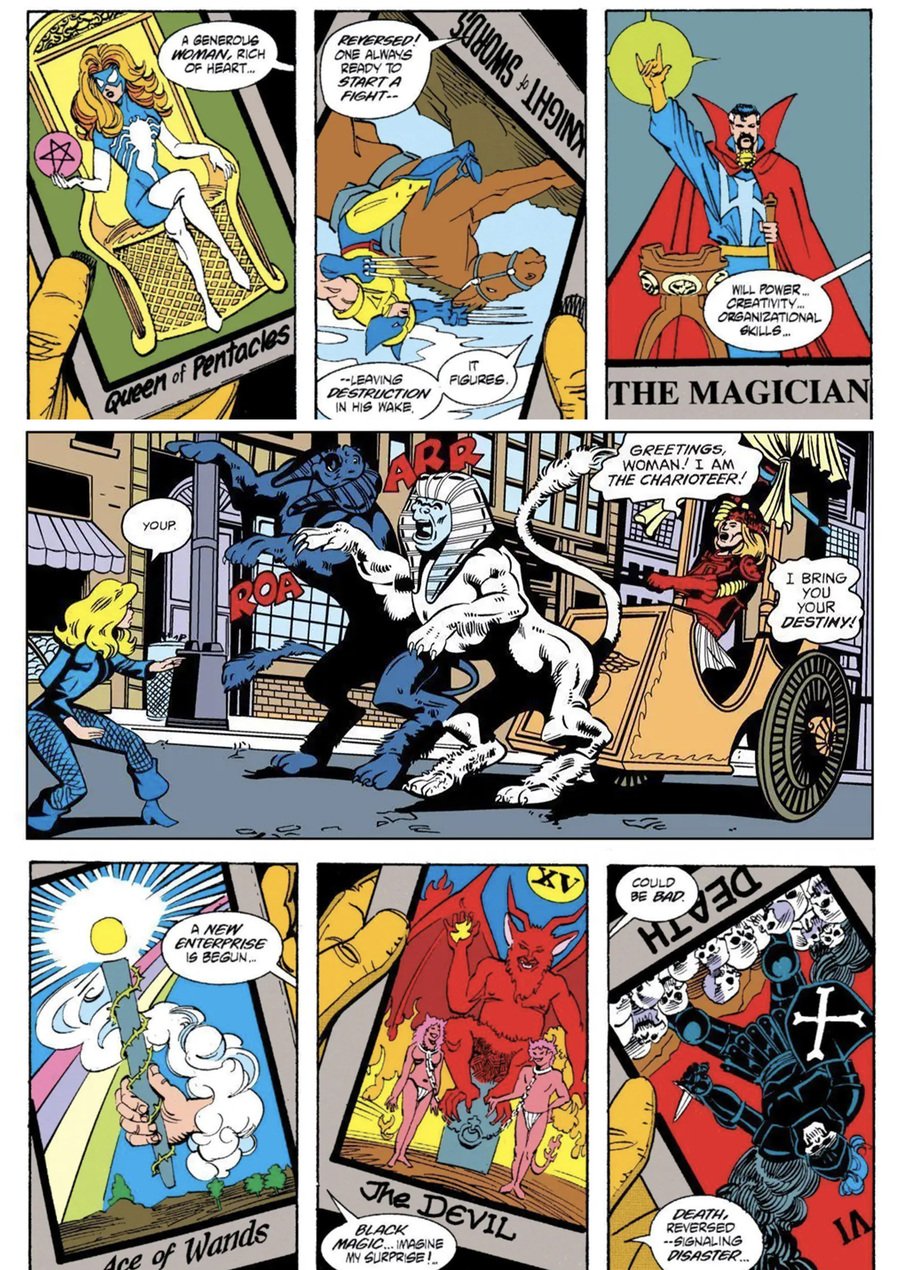
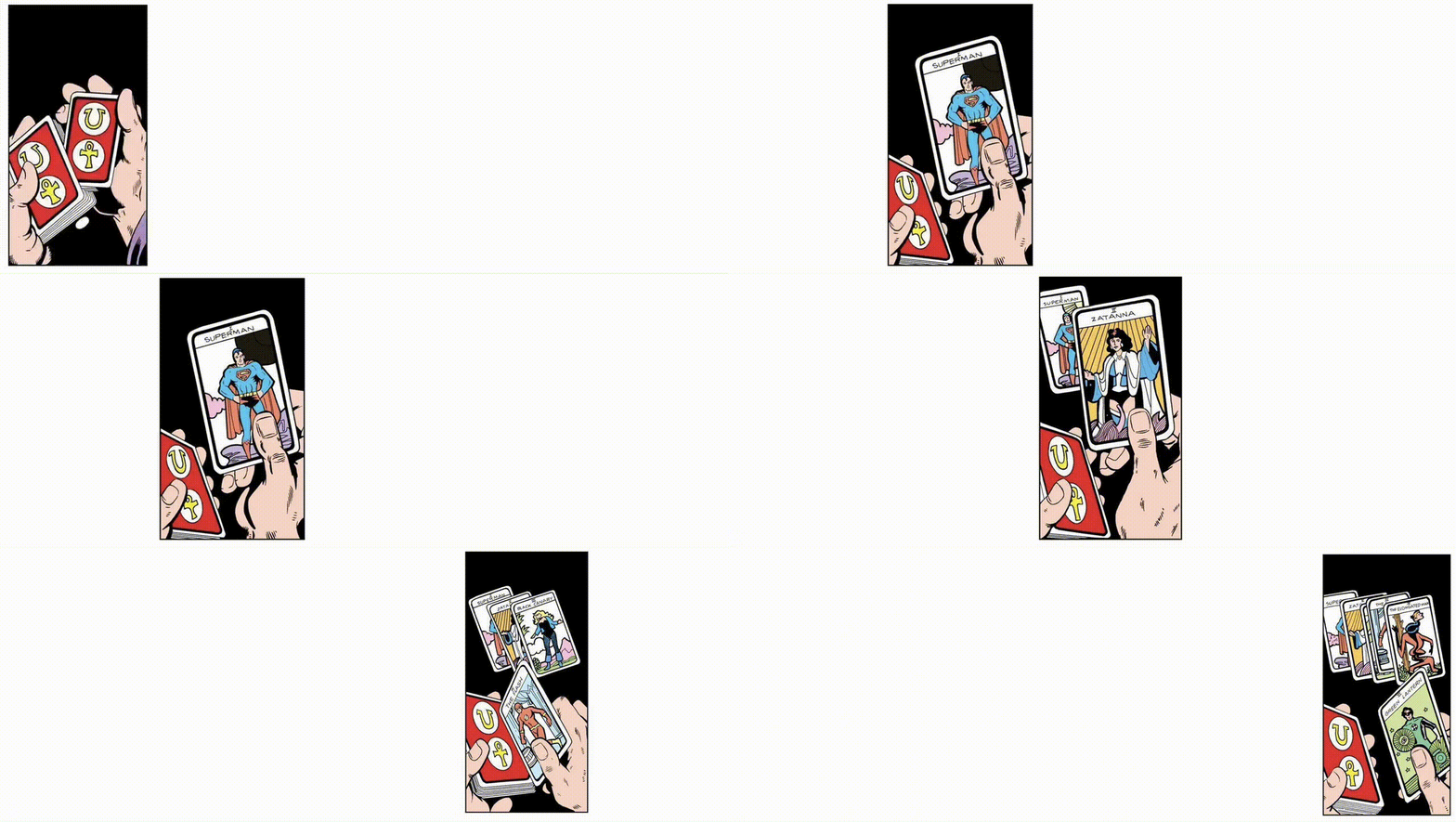
Tarot cards first appear in Issue #194 of «Justice League of America,» published in 1981. There, just like in the first example, they are part of the plot.The villain uses magic to materialize the Tarot card characters and attacks the members of the Justice League.
«Justice League of America» No. 194, 1981
In the examples provided, tarot cards are used as a convenient narrative device rather than a hint toward some secret knowledge to which the comic author feels connected. This is not surprising because, as mentioned earlier, fortune-telling with cards has long since gained significant popularity, so references to this esoteric field are quite common—in both lesser-known works and famous comic series.
Occult Symbolism
Occultism is often confused with esotericism, but there is a fundamental difference between the two concepts—occultism is not merely a body of knowledge for self-discovery and understanding the world, but a set of knowledge applied in practice to achieve desires in the material world, whether that is money or attracting an object of adoration.Occult practices include magical rituals such as summoning various entities, casting curses and jinxes, and enchantment.
Sand Person
«Sand Person» No. 1, 1989
Neil Gaiman’s 1989 comic, «The Sandman,» is brimming with references to occult practices.The Order of Ancient Mysteries is an obvious reference to the real-life occult order, the Golden Dawn.Rodger Burgess was likely inspired by the famous 20th-century occultist, Aleister Crowley.
«Sand Person» No. 1, 1989
Also, in «The Sandman,» there is another, less obvious, reference to Aleister Crowley. The shirt originally features the inscription, «Do what thou wilt, buster!» This is none other than the central tenet of Thelema, the teaching created by Aleister Crowley. «Do what thou wilt shall be the whole of the law,» which translates to, «Do what you will—that shall be the entire law.»
Witch Image
The witch archetype is one of the most popular archetypes that authors frequently use when creating characters.Beneath this popular image lies a person initiated into esoteric knowledge inaccessible to the general public. While movies, books, and comics are currently being produced featuring witches and sorcerers, the roots of this archetype run deep into esotericism.
Wanda Maximoff
Marvel: Teamwork» No. 41, 1976