Функции пространства в книжной миниатюре XIV–XV веков
Concept
The history of perspective is usually told as a story of triumph: Brunelleschi conducts his mirror experiment, Alberti writes his treatise, and Western art gains the «correct» way to represent space. Everything before that is described as a «prehistory”—clumsy attempts and naive errors; the „reverse perspective“ of Byzantine icons, which the modern viewer perceives as little more than an „eccentric feature.“ However, every visual technique used to depict landscapes and cityscapes has its own logic. Cornelia Logemann, studying the 1317 French manuscript „Vie de Saint Denis, ” demonstrated that the miniatures of that period created different kinds of pictorial „volumes.“
In other words, miniature space addressed a different set of objectives than simply «conveying perspective.»
In the 15th century, these challenges were particularly acute for artists because Italian perspective already existed, yet French, German, and Northern Italian miniaturists approached space in diverse ways and were far from eager to adopt the «correct» methodology. Jean Fouquet, for instance, utilizes Italian perspective in his works—but simultaneously constructs recognizable panoramas of Paris, where Notre Dame Cathedral does not conform to the surrounding blueprint; it turns three-quarters toward the viewer, compelling the viewer to assume a vantage point from the heights of Montmartre. It would be a mistake to categorize this as a drawing flaw or, as previously mentioned, a «naive error» of the creator. Fouquet works with a unique miniature plan, thereby creating a «hybrid» in the world of perspective—a combination of realism and symbolism. These very «hybrids» constitute the subject of this study.
The space in 14th–15th-century book miniatures does not always adhere to the rules of «linear perspective, ” as it is also presented through a collection of visually diverse tools designed to convey the artist’s vision and the patron’s request.
The framework for this visual study is based on Margaret Herring’s work, «Space Set There.» In this work, she defined four functions of space applicable to the analysis of illuminated manuscripts: rhetorical, ornamental, didactic, and political. The study will be divided into four chapters, each corresponding to one of these four functions. The analysis will focus on illuminated manuscripts rather than frescoes or easel paintings because the manuscripts are always constrained by the page, exist in proximity to the text, and adhere to the rhythm of turning pages. Due to the highly restricted plane of the pages (in contrast to the walls of a fresco or the canvases of easel works), the spatial solutions in miniatures are closely tied to the structure and size of the book, as well as the meaning of the text and the client’s requirements. The work will feature artists from various countries (primarily France and Italy); however, there is no clear association of specific regions with the functions of space—examples of miniatures were selected solely based on their correspondence to Herring’s typology. The goal of this study is to demonstrate that the spatial constructions in 14th and 15th-century illuminated manuscripts should not be categorized as merely «clumsy precursors» to linear perspective, but rather represent a distinct set of visual tools for conveying textual meaning. The functions of space in these miniatures, and how they operate across the pages of books, will also be a subject of this research.
Space as a Rhetorical Function
The rhetorical function of landscape implies that elements of nature and architecture within the miniature are utilized as a tool for persuasion and the intensification of meaning—either through recognizable «memory loci» (from Latin mnemonic loci) that help the reader retain and quickly recall the acquired knowledge, or through the device of amplification (from Latin amplificatio), which expands and enriches the text.
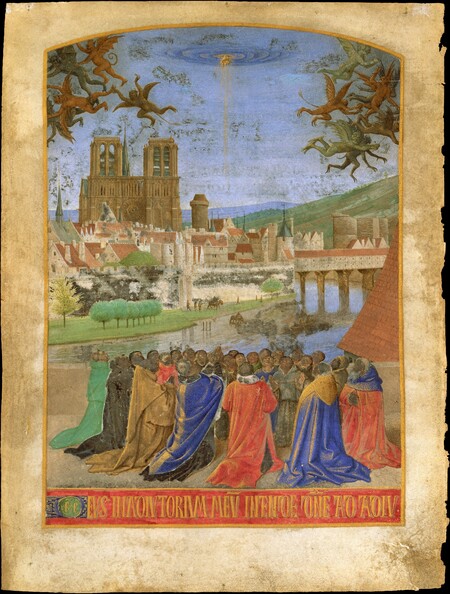
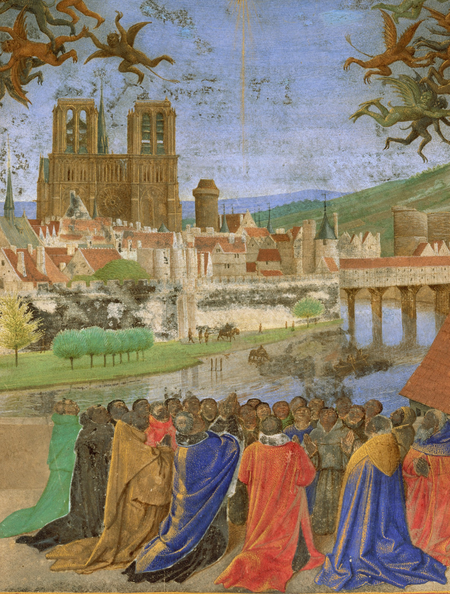
Jean Fouquet, «The Right Hand of God protecting the faithful from demons,» 1452–1460.
In Foucault’s «Descent of God, ” a panorama of the Île de la Cité is placed in the background, featuring the façade of Notre Dame, the spire of Saint-Chapelle, and the Saint-Michel Bridge. These architectural landmarks allow the depicted space to be related to real Paris. Consequently, the scene of the Pentecost evening is linked not to an abstract sacred space, but to a specific location within urban life. The recognizable appearance of the Île de la Cité enables the viewer to relate the prayer event to a familiar urban environment. Thus, the topography of Paris becomes part of the visual interpretation of the prayer text, which directly corresponds to Gerring’s rhetorical function—persuasion and memorability through visuals.
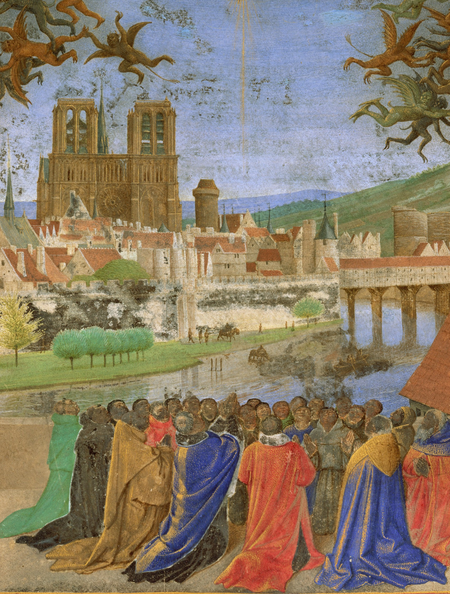
The placement of figures within the composition also amplifies the scene’s meaning. In the foreground, the believers are oriented toward the right side of God, while the demons are pushed to the periphery of the image. This contrast allows the composition to be read as an illustration of restored order through divine intervention. Set against this backdrop, the recognizable panorama of Paris acquires additional significance: the presence of Notre Dame and Saint-Chapelle refers to a specific urban space, thereby «sacralizing» the city. In this way, the space expands the meaning of the miniature by connecting the scene of divine patronage with a real location in Paris.
Paul Limburg, fragment of the miniature «March,» 1410–1490.
The miniature «March, ” created by the Limbourg brothers between 1412 and 1416 for the „Très Riches Heures du Duc de Berry, ” depicts spring agricultural work against the backdrop of the Château de Lusignan in Poitou, which belonged to the Duke and served as one of his residences. The dragon hovering above the tower is connected to the legend of the fairy Mélusine, who medieval genealogical tradition ascribed the role of ancestress and patroness of the Lusignan lineage.
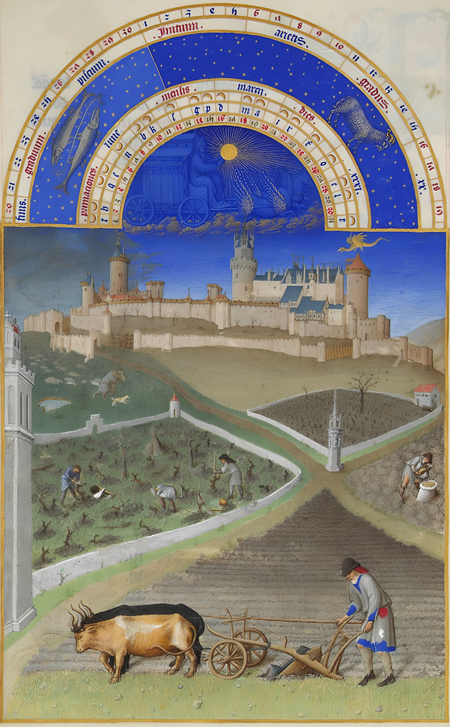
In «March, ” the „sites of memory“ and „amplification“ are realized simultaneously. In the foreground, peasants engaged in springtime field work are depicted: plowing, sowing, and pruning the grapevines. These scenes of labor themselves serve as a „sign“ of the month of March in medieval calendar iconography. Furthermore, the castle in the background acts as the key rhetorical element—Château de Luzignan, one of the Duke of Berry’s favorite residences. A winged dragon is depicted above the castle tower—the Melusine fairy, the legendary patroness of the Luzignan family. These images connect the scene of agricultural work to the patron’s identity, his land rights, and the mythological origin of his power for the contemporary reader.
The spatial organization adheres to the concept of «amplification.» The land is divided into nearly geometric parcels, and roads and boundary markers guide the viewer’s gaze into the distance. The castle rises on a hill, constantly drawing the eye back down to the cultivated earth. This relationship between architecture and cultivated land allows the landscape to be viewed as both an image of agricultural activity and a reflection of the land ownership system. Thus, the miniature captures an ordered world: the peasants work for the benefit of the landowner, who, in turn, dictates their labor.
Space as an Ornamental Function
Girolamo di Cremona, «Saint Justina Discussing with Emperor Maximian, ” 1462, fragment
The ornamental function of space, according to Gerring’s typology, signifies that the landscape is integrated into the decorative hierarchy of the book. It directly frames the text, intensifies its meaning, and contains details that allude to the book’s own history or to the figures mentioned within it.
Girolamo di Cremona, «Saint Justin discussing with Emperor Maximian,» 1462.
In this miniature, Girolamo de Cremona uses the letter «M» as a physical frame. It draws attention while simultaneously creating an illusion of depth in the illustration, as the main subject of the miniature unfolds behind it. The space here functions as an «extension» of the letter—it transforms the initial into a «window» while maintaining the letter’s priority as an ornamental frame. The technique employed by Cremona directly relates to the ornamental function, specifically reinforcing the meaning of the text.
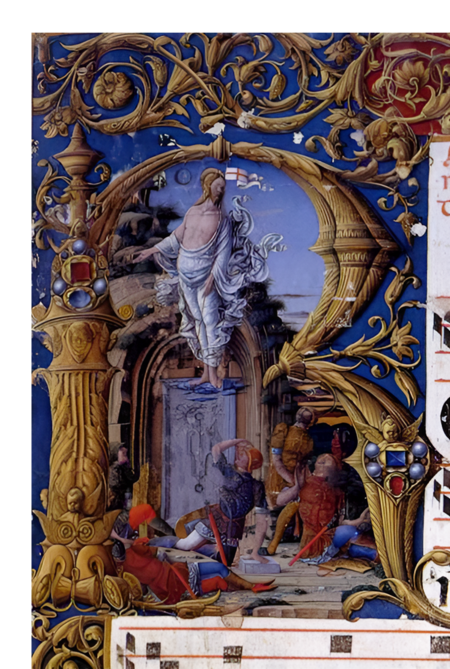
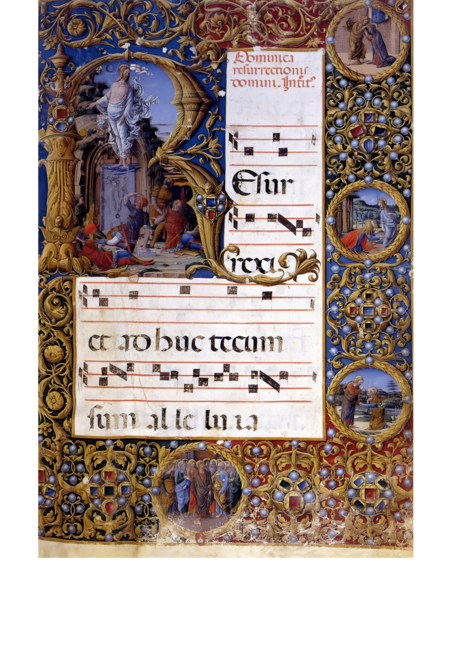
Liberale de Verona, Illuminated Book of Songs. «The Resurrection and Appearance of Christ to the Disciples,» c. 1472–1473.
The narrative of the miniature «The Resurrection and Appearance of Christ to the Students» combines two biblical events: the Resurrection itself (the moment Christ rises from the tomb, often depicted with sleeping guards by the empty sepulchre) and the series of appearances to the students following the Resurrection.
The ornament in the miniature under consideration helps organize the page’s space. Vegetal decorations, golden scrolls, and images of precious stones and pearls highlight the central field containing the liturgical text and musical notation. The decorative medallions include small scenes of the Resurrection and Transfiguration of Christ, which supplement the main image and expand its religious content. The connection between the biblical episodes and the ornamental design is also evident in the use of landscape motifs: natural elements are incorporated into the overall decorative composition, unifying the separate parts of the image. Thus, the ornament contributes to shaping the semantic relationships between the text and the image.
Master Ekaterina Klevskaya and Master Azor, «Ekaterina Klevskaya’s Hourglass,» c. 1440.
«The Hours of Catherine Klevsche» is one of the most complex 15th-century Dutch manuscripts, created in Utrecht around 1440 for Catherine Klevsche, Duchess of Guelders. The manuscript contains 157 miniatures and is known for its marginal ornamentation.
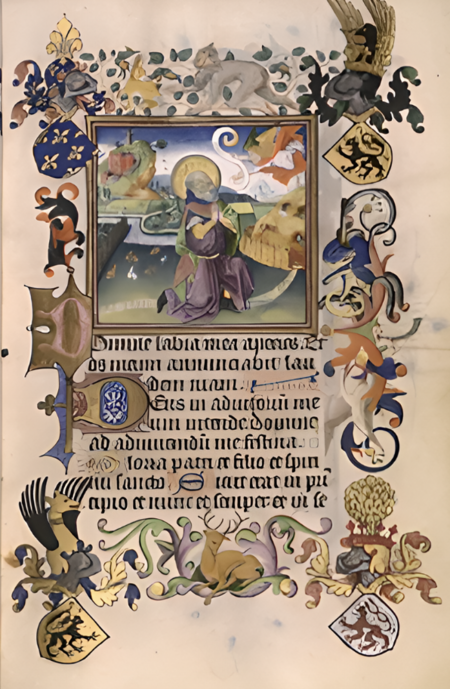
The page is adorned with both botanical motifs and images of everyday objects, animals, hybrid creatures, and small genre scenes. These elements relate to the central image, complementing it and creating direct associations with the text. In this design, the ornamentation goes beyond a purely decorative function—it participates in the interpretation of the main image and expands the page’s content.
Furthermore, the structure of the manuscript allows us to discuss the division of labor among the artisans. As Robert Kalkins’s research shows, at least two artists worked on its embellishment—the «Master of Ekaterina Klevskaya» and the «Master of Azor.» Within a single notebook, responsibilities might have been divided as follows: one master executed the miniature on the recto side of the leaf, while the other decorated the verso side with text and ornamentation. This division of labor enables us to view the ornamentation as part of an organized workshop production coordinated among multiple individuals.
Space as a Didactic Function
Turning to the didactic function of imagery, it is worth noting that the miniatures associated with it are most frequently found in encyclopedias, of which very few have survived. In this case, the image helps reveal the content of the text through its schematism. This function is particularly evident in the «Book of the Properties of Things» (Livre des propriétés des choses). In such works, the miniatures often form a distinct visual structure where the relationship between the text and the image supersedes perspective.