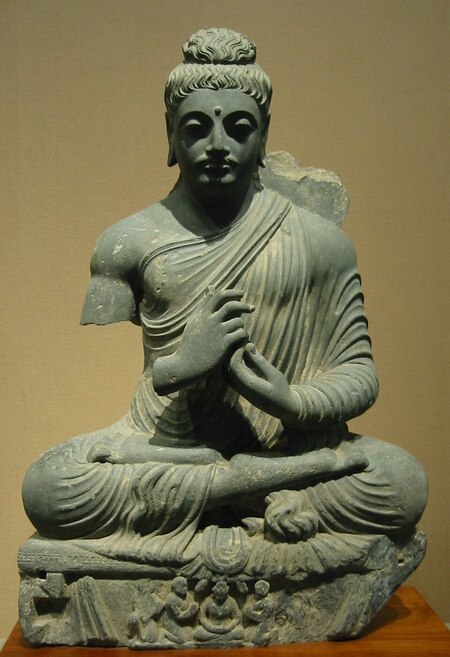
The core idea of the research
How can the same sacred Buddhist image be transformed under the influence of different religious, artistic, and cultural traditions?
Concept
The image of the Buddha is now universal and recognizable even to ordinary people far removed from art and religion. However, behind this recognizability lies a long history, as the Buddha was not always depicted as a human. In early Buddhist art, his image and presence were conveyed through symbols—the Dharma Wheel, the Bodhi Tree, the empty throne, footprints. Later, when there arose a need to represent not only the teachings but also the spiritual teacher, the sacred concept began to take physical form.
This transition became the starting point of the research. What features make the depiction of the Buddha specifically the Buddha? Why did the appearance and material of the sculpture begin to carry a specific meaning?
This process is particularly evident when examining two artistic centers of ancient India—Gandhara and Mathura. It was these schools, in the first centuries of the Common Era, that became integral to the formation of Buddhist sculpture. Despite existing within the same cultural sphere and working with a unified religious tradition—depicting the same Buddha—they created visually very different representations of him.
Thus, comparing Gandhara and Mathura allows one to view Buddhist sculpture not as two isolated art schools, but as two distinct ways of visualizing a single idea.
The research will begin by examining the general symbolism as the foundation for the emergence of early anthropomorphic figures of the spiritual teacher. This will be followed by an investigation into the historical and cultural environment of the schools and a direct comparison of the sculptures.
The search for material was not solely centered on historical texts about Buddhism but also on the works of art themselves. Museum collections, studies of Buddhist iconography, and visual archives will allow us to view sculpture both as an artistic object and as a testament to cultural exchange.
As a result, the Buddha will be presented not merely as a fixed and eternal «religious» canon, but as an artistic image in constant transformation.
Navigation
1. Introduction
2. Pre-Iconography: Buddha as a Symbol
3. The Birth of the Anthropomorphic Buddha
4. Gandhara: The Image of India and the Hellenistic World
5. Mathura: The Indian Path of the Sacred Body
6. Contrast of Two Schools
7. Conclusion
Introduction
Buddhism emerged in India in the 5th–4th centuries BCE and gradually developed into one of Asia’s largest religious and cultural traditions. Central to Buddhist teaching is the path to liberation from suffering—achieved by overcoming attachment, ignorance, and the endless cycle of rebirth. The Buddha himself—the «Awakened One”—is initially perceived primarily as a teacher who discovered this path.This is why early Buddhist art does not attempt to depict the Buddha in human form, instead representing him through symbols. The Gandhara and Mathura schools played a crucial role in the evolution of this imagery.
Gandharan sculpture, shaped by the influence of Hellenistic, Roman, Iranian, and Central Asian artistic legacies, exhibited meticulously modeled bodies, deep drapery folds, wavy hair, and features reminiscent of ancient statuary.Mathura, developing within a different environment, conversely formed in close connection with the Indian sculptural tradition, where figures were presented more frontally, integrally, and monumentally. The body gained expressiveness, and the sculpture itself could be perceived less as a depiction of a human and more as the presence of a sacred entity.Behind these differences in technique lies the formation of two distinct visual languages of Buddhism and the evolution of sacred symbolism.
On the Image: Buddha as a Symbol
In the early art of Buddhism, there was no prohibition against depicting human figures; however, it nevertheless constituted a unique artistic language of aniconism, wherein the Buddha was represented through symbols possessing their own plastic expressiveness.
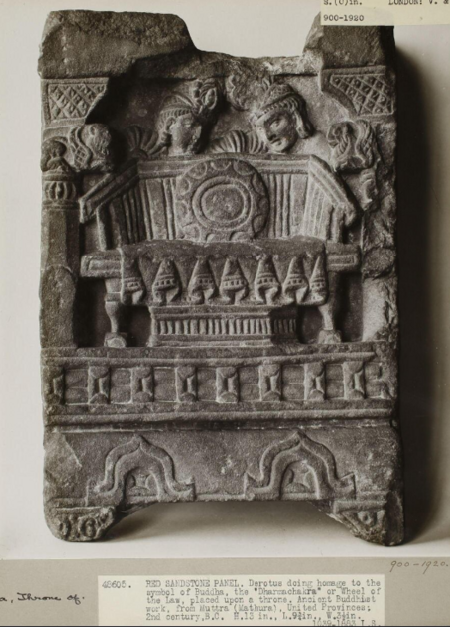
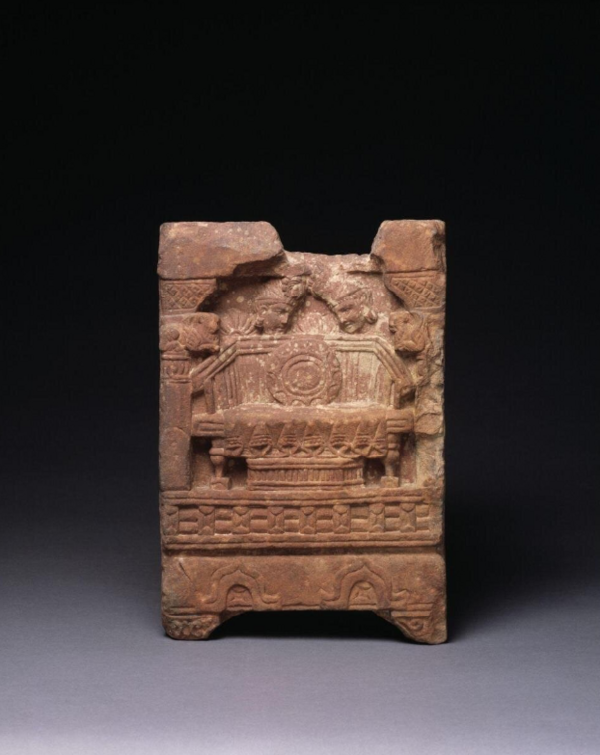
Relief depicting the veneration of an empty throne, sandstone, Mathura, Uttar Pradesh, North India, 2nd–3rd centuries CE.
One of the key symbols became the «Empty Throne.» In the relief sculptures of Mathura, it is depicted as an architectural form toward which the figures of worshippers are oriented.The main composition of this symbol is structured around the clear direction of the gazes of those present toward the empty space of the throne, which consequently feels like a place of unseen presence.The absence of a human figure in the leading position of the sculpture lends a special meaning to the entire composition and draws attention to the invisible spiritual center.
Symbolic image of Buddha as a throne. «Mara Tempting Buddha, ” 2nd century CE. Amaravati
«The Legend of the Bodhi Throne”—after achieving enlightenment, the Buddha cast eight bundles of grass onto the ground, which turned into a precious throne. The throne became a symbol of the moment of enlightenment. In Gandhara art, this legend became a literal depiction: the throne under the Bodhi Tree is shown covered with cushions made of grass.
Illustration of a temple built for Ashoka in Bodh Gaya around the Bodhi tree. Satavahana period sculpture from Sanchi, 1st century CE.
The Bodhi Tree is depicted as a lush, symmetrical canopy with clearly delineated leaves and branches. Its composition is structured around a central axis, toward which figures of humans and animals approach from both sides. The tree’s symmetry imbues it with an image of stable vital energy and monumentality. The tree, in turn, becomes the visual centerpiece around which the entire relief space is organized.
The Dharma Wheel with deer. Jokhang Temple roof, Lhasa
The Dharma wheel presents a different type of visual language. In early sculpture, it is most often carved in high relief and possesses strict geometric symmetry. Its structure with repeating spokes creates a distinct visual rhythm. Later, as seen in examples of sculptural compositions, the wheel can become a standalone object where the geometric aspect of the work emphasizes the very idea of an eternal and unchanging law.
Buddha’s Footprints, 2nd century CE, Kushan Empire (30–275 CE), modern Pakistan.
Footprints suggest a more graphic language. Flat images featuring fine patterns—the wheel and the lotus—interact with the stone surface. The sacred meaning of the symbol is conveyed not through volume, but through the detail of the lines. That image becomes tangible and directional, indicating the path that has been traveled.
Collectively, these symbols form a profound visual code through which the sacred subtext is conveyed not only by the overall appearance but also through every element of the composition—the geometry, the rhythm, and the material texture. The symbolic language established a strong foundation for the subsequent transition to an anthropomorphic form, where the Buddha attains a human appearance while retaining its symbolic attributes.
The Birth of the Anthropomorphic Buddha
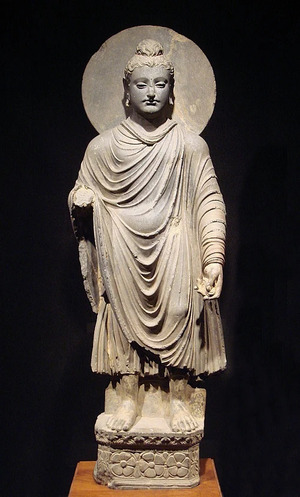
The transition from symbol to human form occurred in Gandharan art (1st–3rd centuries CE). Due to its location at the crossroads of trade routes, this region experienced the most profound influence of Hellenistic and Roman art. Here, artisans began depicting the Buddha as a human figure, applying sacred signs to his body and transforming them into elements of a canonical portrait.
Image of Buddha in Gandharan Greco-Buddhist Art, 1st Century CE
Nimbus
Круглый диск за головой
The Hellenistic element (a solar symbol) that later became an obligatory attribute in sacred imagery of Christianity and Buddhism.
Buddha’s Head, crowned with ushnisha, 3rd century