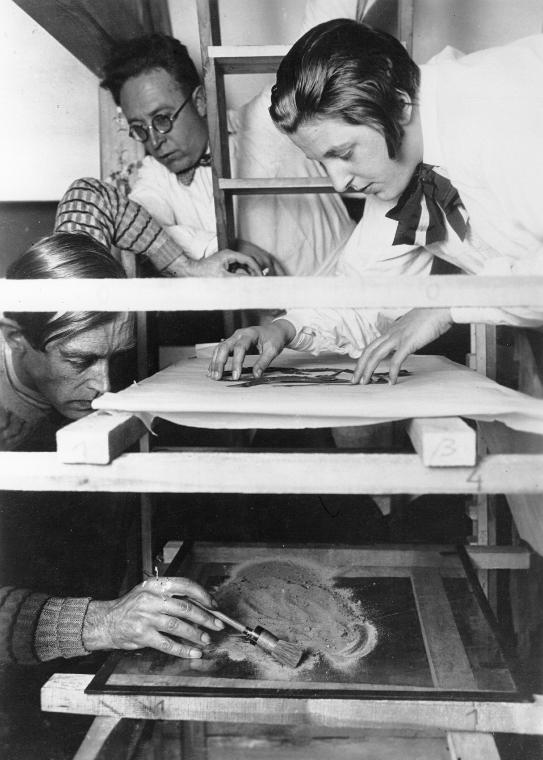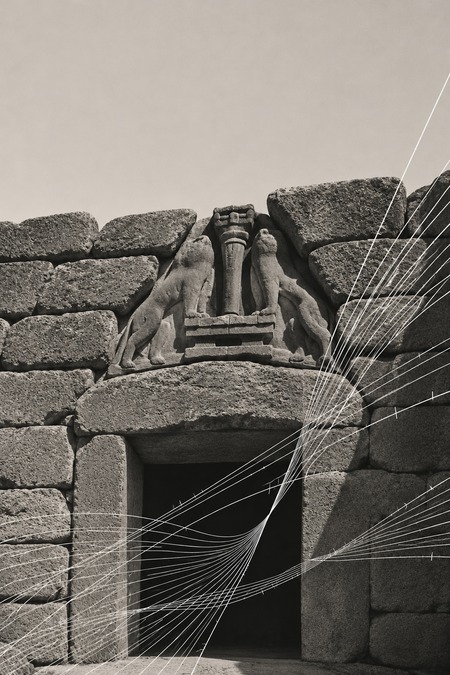
Concept
Music and architecture might seem like entirely different forms of art. Music exists in time, while architecture exists in space. However, in both disciplines, rhythm, proportion, density, direction, and the interaction of individual elements hold significant importance. I became curious whether common principles for organizing musical and architectural space could be discovered and how those principles might be visualized.
I was particularly drawn to the graphic scores of Iannis Xenakis—a composer and architect of the 20th century who employed mathematical and geometric methods in his musical compositions. Unlike conventional notation, some of his graphic constructions resemble architectural blueprints or abstract drawings. Numerous lines intersect, diverge, coalesce, and form complex structures. Meanwhile, each line can denote a change in pitch over time, and their collective arrangement signifies the movement of an entire sonic mass.
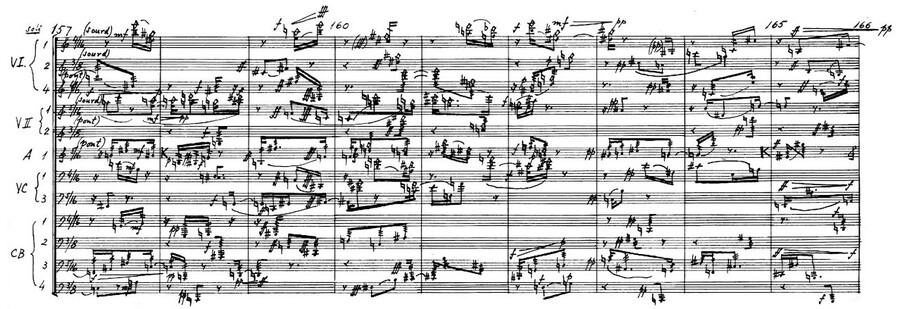
Scores for the work Metastaseis (1953–1954) by Yannis Xenakis
I found the piece Metastaseis (1953–1954) particularly interesting; in it, Xenakis utilized massed glissandi from string instruments. The graphic scores reveal how individual sound trajectories coalesce into a unified form. I am interested in why the composer adopted this method of musical organization and how closely his graphic techniques relate to architectural thinking.
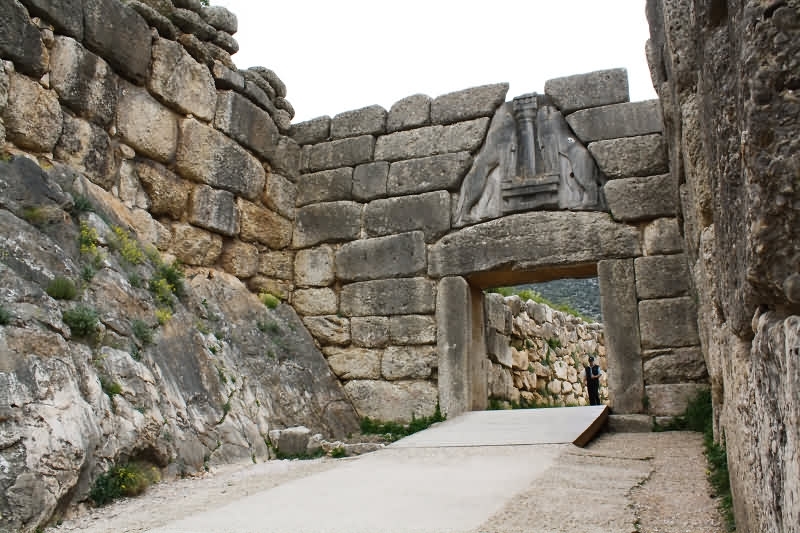
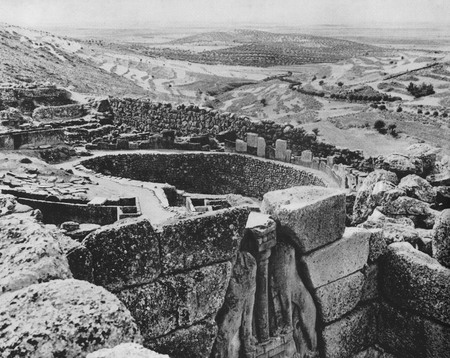
Tyrinth, Mycenae (16th–12th centuries BCE) Architecture and Sculpture of the Aegean Culture
To create a parallel with musical graphics, I chose the ancient Mycenaean Acropolis. Its architecture captivated me first and foremost due to its monumentality and unusual geometry. The cyclopean walls, constructed from massive stone blocks, the Lion Gate, the system of passages, and the placement of the structures on the natural terrain create a space where human movement is guided and constrained by the architecture. Individual elements coalesce into a cohesive structure, whose perception shifts as one moves through the Acropolis.
In studying Xenakis’s work, I discovered that the composer’s connection to Mycenae extends beyond mere visual resemblance. In 1978, he organized the large-scale musical and light performance, Polytope de Mycènes, where music, lighting, architecture, and the surrounding landscape interacted with one another. For this event, the electronic composition Mycènes Alpha was created, written using the UPIC system, which allowed graphical drawings to be transformed into sound. This historical example became a crucial starting point for my research.
Can the graphic scores of Xenakis and the architecture of Mycenae be examined through shared principles of spatial organization? How do lines, density, direction, and boundaries influence the perception of sonic mass and architectural form? And in what way can a graphic score serve as the foundation for a new musical performance within an ancient architectural space? These questions became central to my visual research.
My hypothesis is that structural parallels can be identified between Xenakis’s graphic methods and the spatial organization of Mycenae. In both cases, individual elements form a complex whole, and their relative placement influences the perception of the composition. However, I do not propose a direct historical link between the construction principles of the Mycenaean acropolis and the composer’s musical methods. I am interested in the possibility of comparing them as two distinct approaches to organizing visual and spatial experience.
When selecting material, I decided to focus on Xenakis’s works most illustrative of music’s graphic organization: Metastaseis, Pithoprakta, and Mycènes Alpha. Examining these allows one to trace the composer’s diverse approaches to working with sound masses, probabilistic processes, and graphic notation. In Mycenaean architecture, I highlighted the cyclopean masonry, the Lion Gate, the A Tomb Circle, the passage system, and the acropolis’s placement on the topography. These elements allow for an investigation of spatial characteristics such as density, boundary, direction, rhythm, and the sequence of perception.
The principle of rubrics in this research is based on the gradual transition from music to architecture and their subsequent comparison. In the initial sections, I examine the work of Xenakis, his graphic schematics, and methods for organizing sound masses. Subsequently, I turn to the history and architectural structure of the Mycenaean Acropolis. In the following sections, I compare specific graphic and spatial structures, paying attention not only to their external similarities but also to differences in function and organizational principles. A dedicated section is devoted to the historical representation of the Polytope de Mycènes, which links the two parts of the research.
The visual foundation consists of Xenakis’s original scores and graphic schemes, archival photographs, archaeological plans, photographs of architectural structures, and scientific reconstructions. For a more in-depth analysis, I also utilize proprietary diagrams and comparative collages. These elements enable me to isolate specific image components, compare line directions, mass distribution, passageway geometry, and spatial organization. Documentary materials and my own interpretations will be visually distinguished.
Matrix «Achorripsis, ” 1957, Yan Xynakis
To work with this theme, I consulted archival materials, musicological studies, publications on Xenakis’s work, and scientific sources on Mycenaean archaeology. The textual sources are necessary to verify historical information, understand the composer’s musical methods, and correctly analyze the architectural objects. Particular importance is given to the materials documenting the 1978 performance, as they allow me to separate Xenakis’s actual artistic decisions from my own assumptions.
Lion Gate, 14th century BCE, Mycenae.
In the concluding part of the study, I propose a concept for a hypothetical live audiovisual performance titled Score of the Threshold, which is based on the music of Xenakis and the characteristics of the Mycenaean space. In this concept, the graphic principles of musical notation become the foundation for organizing light, sound, and the audience’s movement. Thus, the outcome of this research is not merely a comparison of two artistic systems, but also an attempt to apply the identified principles in my own visual-spatial composition.