
Concept
Sound volume is the subjective perception of sound pressure, allowing all sounds to be placed on a scale from quiet to loud.
Discussions about loudness and its effect on human hearing began long before the digital age. In 1860, the fundamental Weber–Fechner psychophysical law was established, which states that our nervous system responds to stimuli not linearly, but logarithmically.
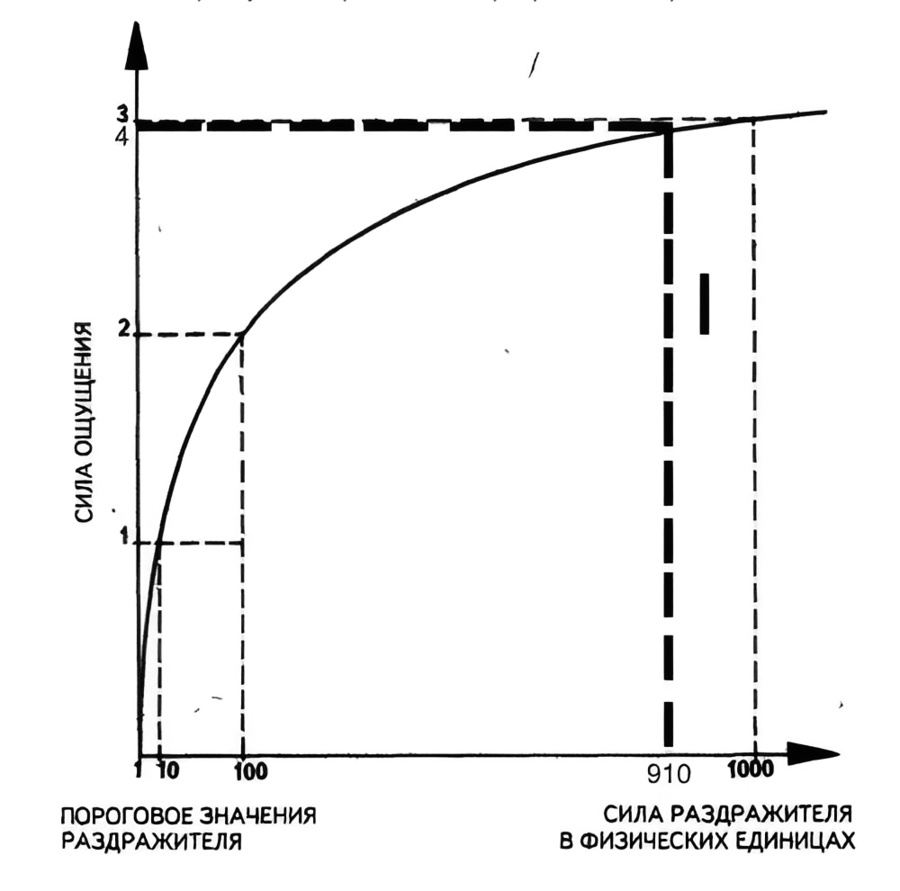
Weber-Fechner Law. The rate of increase in sensation slows as the intensity increases. 1860.
Regarding sound, subsequent psychoacoustic research (Just et al., 1977) demonstrated that human hearing possesses a barely perceptible threshold of intensity difference. For the average person, this threshold is about 1 dB. This value is not universal and depends on the signal’s level, frequency, duration, and other characteristics.
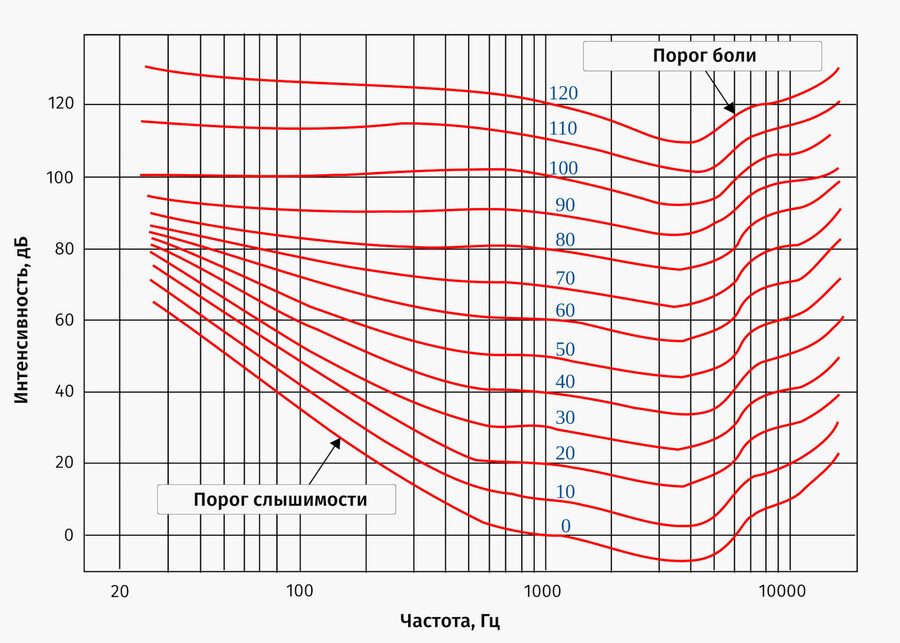
Fletcher–Munson Equal-Loudness Contours (based on the 1933 study).
These curves, where the horizontal axis displays signal frequency in Hertz and the vertical axis displays its level, illustrate the nonlinearity of human hearing. At low volumes, we practically cease to hear the bass and the highest frequencies; our perception becomes mid-range, which compels us to increase the signal level to fully hear and experience the entire frequency spectrum. Even slight changes in volume (as little as 0.5 dB) can affect the subjective evaluation of sound quality. When comparing two identical recordings, the louder one often seems more «full» and «rich,» even though the objective quality has not changed.


Modeling the intersection of adjacent grooves on a vinyl record. Screenshots from the TDR Simulathe program, 2026.
Increasing the volume almost always results in a loss in some other parameter. For example, a loud signal when cutting a vinyl record allows for the «masking» of natural surface noise and static. At the same time, signal volume directly affects the groove modulation (deviation)—the louder the signal level at the cutter, the greater the deviation. Exceeding the allowable volume level can lead to adjacent groove crossover, distortion, and tracking issues during playback.
With the advent of digital sound recording, the compromise has changed. Techniques such as compression, limiting, and clipping allow for increasing the average signal volume while keeping the peak value constant. A competition for a louder signal began—the so-called «loudness war.» In the case of digital sound recording, implementing the aforementioned techniques reduces the signal’s dynamic range, which is the difference between quiet and loud signals. As a result, the music begins to sound «flat.»
Contemporary streaming platforms utilize normalization algorithms for every track on the service, attempting to level out their volume. However, in practice, the system is not perfect, and louder tracks frequently remain louder than the others regardless.
Beyond digital recording, volume acquires a physical and spatial dimension. The culture of mobile sound systems from Jamaica, India, and other countries shapes the way collective listening occurs, and the struggle for volume transforms into a real confrontation among DJs.
Saykat Sur. Mobile sound system in West Bengal, India. 2024.
This study examines loudness as a technical, psychoacoustic, and cultural phenomenon. Using three case studies—analog sound recording and radio broadcasting, digital sound recording and public playback through sound systems—the work will demonstrate the advantages high loudness offers, the compromises required to achieve it, and how loudness influences the ability to perceive music and sound.
Volume in the Analog Era
Mechanical Sound Recording
Recording of a musical ensemble using mechanical sound recording. Early 20th century.
Before the advent of electrical recording, musicians gathered in a room equipped with a special metal horn that directed sound waves toward a diaphragm connected to a recording stylus. The vibrations of the stylus then cut a sound groove into a wax disc or cylinder. It was crucial to correctly adjust the distance of each participant from the horn to ensure the proper volume level and avoid distortion.
The Function of the Phonograph Diaphragm.
In 1898, the Columbia company introduced the Graphophone Grand, an improved version of the phonograph. The enlarged cylinder provided a greater linear speed, which enhanced recording quality and allowed for louder playback. Additionally, a large horn was integrated into the design for listening, which eliminated the need for individual tubes and transformed the experience of listening to music into a collective one.
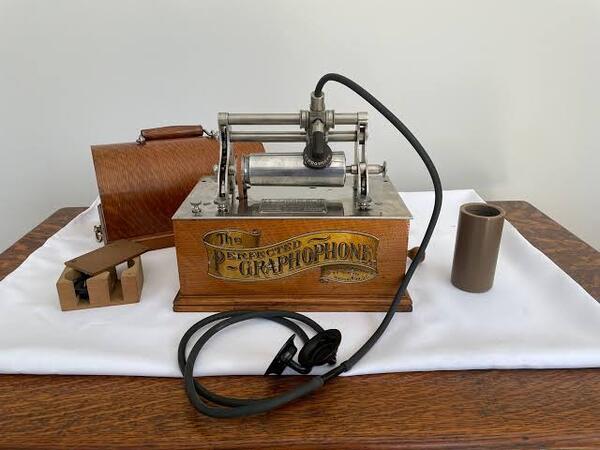

Left: a phonograph with individual horns. Right: a phonograph with a megaphone.
Electrical Recording and Vinyl
The era of electrical sound recording began in the 1920s. The advent of microphones, amplifiers, and electric pickups changed how audio signals were handled, allowing for increased volume levels, an expanded frequency range, and more precise and flexible sound shaping.
The first condenser microphones expanded the frequency range from 250–2500 Hz to 50–6000 Hz. This made it possible to record quiet sounds without needing to boost the performance volume, as was required with mechanical sound recording.
Shure. Early condenser microphones by the company. 1930s. Archive photo from Shure
With the advent and proliferation of long-playing vinyl records and singles, volume gained a new technical significance: the longer the recording duration on one side, the lower the cutting level was typically set.
Dense arrangement of sound grooves on a long-playing record. Screenshot from the TDR Simulathe program, 2026.
A single with one or two songs per side allows for increased spacing between grooves, which in turn provides more room for groove modulation at high incoming signal volumes. The high volume of the single improves the signal-to-noise ratio and may seem higher quality due to the increased loudness. The trade-off in this case is a reduction in the playtime of the record side.
Increased spacing between grooves on a vinyl single. Screenshot from the TDR Simulathe program, 2026.
Magnetic Tape