Concept
Beyond being primarily perceived as a form of leisure or entertainment, it is interesting to examine play as a unique environment where individuals can temporarily step outside conventional social structures. Within the play space, social roles, relationships between participants, and perceptions of appropriate behavior, morality, and responsibility shift. A person might become a ruler, a military strategist, or a fictional character, undertaking actions that would be considered unacceptable in real life, and interacting with others based on conventions unrelated to everyday social norms.Nevertheless, play is not a space devoid of limits; it establishes its own rules that define the boundaries of possible behavior.
Play simultaneously frees a person from some norms while submitting them to others. This very contradiction seems the most interesting subject for study, and I wanted to examine play not merely as entertainment or a temporary escape from reality, but as an autonomous space where one can experiment with social relationships, power, morality, and responsibility.
D&D
For the study, a range of diverse gameplay practices were selected: from familiar board and strategy games to role-playing and computer games. This approach illustrates that the issue of social norms is not confined to any single game genre or format, but extends to completely different ways of interacting with the game.
Specifically, the study includes: Dungeons & Dragons, Grand Theft Auto (GTA), «Nemesis», «Dracula’s Rage», «Dead Season», «Civilization», and «Twilight of Empires».
The selection of games is determined not so much by their genre or historical period, but by the interaction mechanisms they allow us to examine. Comparing different game forms helps reveal common principles of social norm change while simultaneously demonstrating how differently these principles manifest depending on the specific design of each game.
Frame from the GTA game
The research is structured thematically: materials are grouped according to the aspects of play through which the issue of social norms is revealed.
1. Introduction. (Huizinga and the conception of the nature of play space: its separation from everyday reality, the presence of its own rules, and the possibility of transitioning between different systems of norms) 2. Role-Playing. Liberation from habitual social roles. (The study refers to role-playing and the creation of alternative social relationships) 3. Play as a space of conditional freedom and impunity. (Violation of moral constraints and the issue of personal and collective responsibility) 4. Play Simulation. (Simulations and hyperreality) 5. Territory Control—a model of power and the struggle for space. (Strategy games that model political relationships and mechanisms of power)
This sequence allows for a gradual shift—from examining how game space is structured to investigating the specific social relations it can alter and reproduce. Each game example is examined through a specific problem, rather than simply serving as an illustration of a theoretical concept.
The theoretical foundation of this research is drawn from the works of several philosophers, each offering a distinct perspective on the subject. The authors are not divided into separate thematic blocks; rather, their ideas are utilized to analyze specific gameplay practices and compare various aspects of the interactive space. The chosen philosophical texts are selected based on their relevance to the specific research problems. Their concepts are not treated as direct theories of individual games but are employed as analytical tools to interpret the mechanics of play and the relationships between the individual, the rules, and social order.
Key Question and Hypothesis
Key Question How does play temporarily alter established social norms, and what alternative rules, constraints, and relationships emerge within the play space?Hypothesis Play functions as a space for temporary liberation from ingrained social norms, allowing individuals the opportunity to shift social roles, experiment with moral boundaries, responsibility, and power dynamics. Play establishes its own system of rules that regulates participant behavior and shapes alternative relationships. Thus, play simultaneously becomes a space of both freedom and constraints—it allows for a temporary questioning of existing social norms while potentially reproducing them in a different form.
1. The Nature of Play Space
Johan Huizinga, in his work Homo Ludens: A Study of the Play-Poet, examines play not as a secondary form of entertainment, but as one of the fundamental elements of human culture. According to Huizinga, play predates culture—meaning culture itself arises and develops within play structures. Huizinga identifies several core characteristics of play: voluntariness, limitation of time and space, the existence of its own rules, and a distinct relationship to everyday reality.
Among these, the concept of play space is particularly significant. By entering a game, an individual accepts conditions that may differ substantially from familiar social norms. Within the play space, the criteria for success, the permissible and impermissible actions, and the relationships among participants all change. For example, a person who lacks high social status in real life might be a military strategist, a ruler, or a hero of a fictional world within a game. Their standing within the game is then determined not by social origin or material status, but by the game’s rules and actions.
This leads to another important aspect noted by Huizinga—play is not a realm of absolute freedom; it is impossible without rules, and violating those rules destroys the game itself. Play, in a way, «frees» the individual from one set of rules while simultaneously subjecting them to another. Therefore, it does not destroy order; it creates an alternative one.
Johan Huizinga
If we continue to view play not as an isolated form of leisure, but as a principle governing human activity, we can find a similar logic in language, as, for example, Ludwig Wittgenstein wrote. In his Philosophical Investigations, he states that the meaning of words is determined not only by their content but also by their use in specific situations (within defined practices). This means that language functions as a collection of different language games, each having its own rules and modes of interaction—meaning that everyday conversation, professional work, family relationships, and public communication all presuppose different behavioral rules.
A language game is language along with the actions into which it is woven: a command, a request, a joke, a prayer, a description, a scientific debate—all of these are different games with their own rules. Furthermore, Wittgenstein writes that «following a rule is a practice, ” and it is not enough merely to think that you are following a rule; specific common criteria for understanding and correct usage are necessary. Yes, a person uses language, but simultaneously, language itself sets the boundaries for how its words can be understood by other people.
In this context, play becomes an opportunity to transition from one system of rules to another. What is deemed unacceptable in everyday conversation might prove to be normal or even necessary within a playful space.
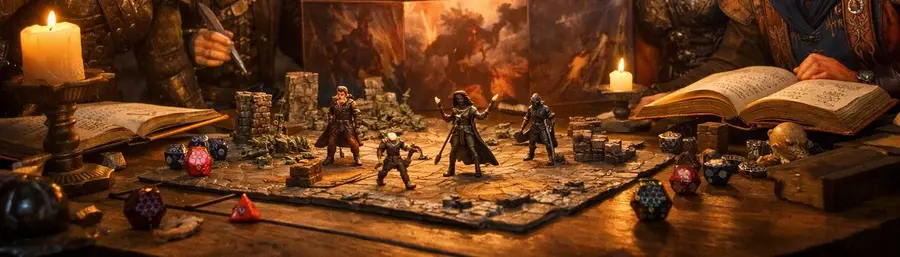
This logic can be examined using the example of the tabletop role-playing game Dungeons & Dragons (hereafter D&D). In everyday life, the word «death» signifies the cessation of human life. In D&D, a character’s death can become part of the game mechanics—depending on the circumstances, they can be resurrected, brought back into the game, or the player can continue playing as a different character.
D&D
Or, for example, deception. In everyday life, it is perceived as a breach of trust; however, in D&D, deception can become part of a character’s strategy. For instance, a character might hide information, mislead other characters, or use lies to achieve their own goals. In this case, the consequences of deception exist primarily within the fictional world and affect the relationships between the characters. It is important, however, to distinguish such actions from deception among the players themselves. If a participant intentionally violates agreements or misleads others outside of the game’s conventions, this affects real-world interpersonal relationships. Thus, it is not the action itself that changes, but the context in which it is performed and judged.
2. Role-Playing. Liberation from established social roles
D&D, overall, is an excellent example of shifting social norms within a gaming space. Essentially, D&D involves deep immersion into a written, invented character who can turn out to be anyone—even the complete opposite of the person playing them.This mechanism can be compared to Mikhail Bakhtin’s analysis of carnival culture, as presented in his work, «The Creativity of François Rabelais and the Folk Culture of the Middle Ages and Renaissance.» He explores a carnival culture that can be structurally compared to D&D. Of course, Bakhtin’s carnival culture cannot be fully equated with D&D, but both practices share the potential to temporarily question ingrained social hierarchies.
Pieter Bruegel, «The Battle of Maslenitsa and Lent,» 1559
Bakhtin views the carnival as a unique form of popular culture in which the usual system of social relations temporarily dissolves. The carnival creates a peculiar world of reversal where conventional boundaries between social groups are temporarily blurred: an ordinary person can portray a king, religious authorities become objects of ridicule, and the high and sacred mix with the low and corporeal.In D&D, participants create an alternative reality where they can assume entirely different social roles, and within the game, their status is determined not by real-life social standing, but by the character’s attributes, decisions, and the rules of the game system. Bakhtin pays great attention to laughter in carnival culture, which is interesting because laughter becomes a means of reinterpreting the familiar order. In the chapter «The Fool in the History of Laughter, ” Bakhtin explains laughter as a form of worldview that allows one to temporarily escape the conventional, mundane perception of the world, to question authorities, and to present reality differently.
D&D
The D&D play space allows participants to engage with alternative models of social relationships, and humor becomes a tool for reinterpreting them. Laughter also functions as an act of accepting convention, because everyone understands that the carnival creates a temporary space, and after it ends, people return to everyday life. D&D operates in a similar manner: participants gather at the game table, accept the world’s rules, interact within their roles, and then return to their usual reality after the game concludes.Humor maintains an atmosphere of playfulness, which is important because taking the game too seriously—as if it were real life—destroys the essence of the game. This does not mean, however, that the game cannot hold emotional significance or that players are exempt from observing the rules and agreements. On the contrary, game rules and mutual respect are necessary precisely to maintain the distinction between real relationships (people) and fictional ones (characters).
3. Play as a Space of Conditional Freedom and Impunity