Concept
Humans have been fascinated by the theme of the afterlife and religion throughout the ages, as death is the one thing no one can insure against. In the view of Ancient Chinese residents, it was perceived as a transition from one world to another (as in most religions), which required careful preparation and proper navigation in the afterlife. In the funerary culture of the Han Dynasty, every item placed in the tomb served to protect the soul, order chaos, and achieve immortality. However, among the familiar burial offerings, one unusual artifact held a special place—an ancient board game called liubo—that transformed the post-mortem journey into a sacred contest for the soul’s destiny.
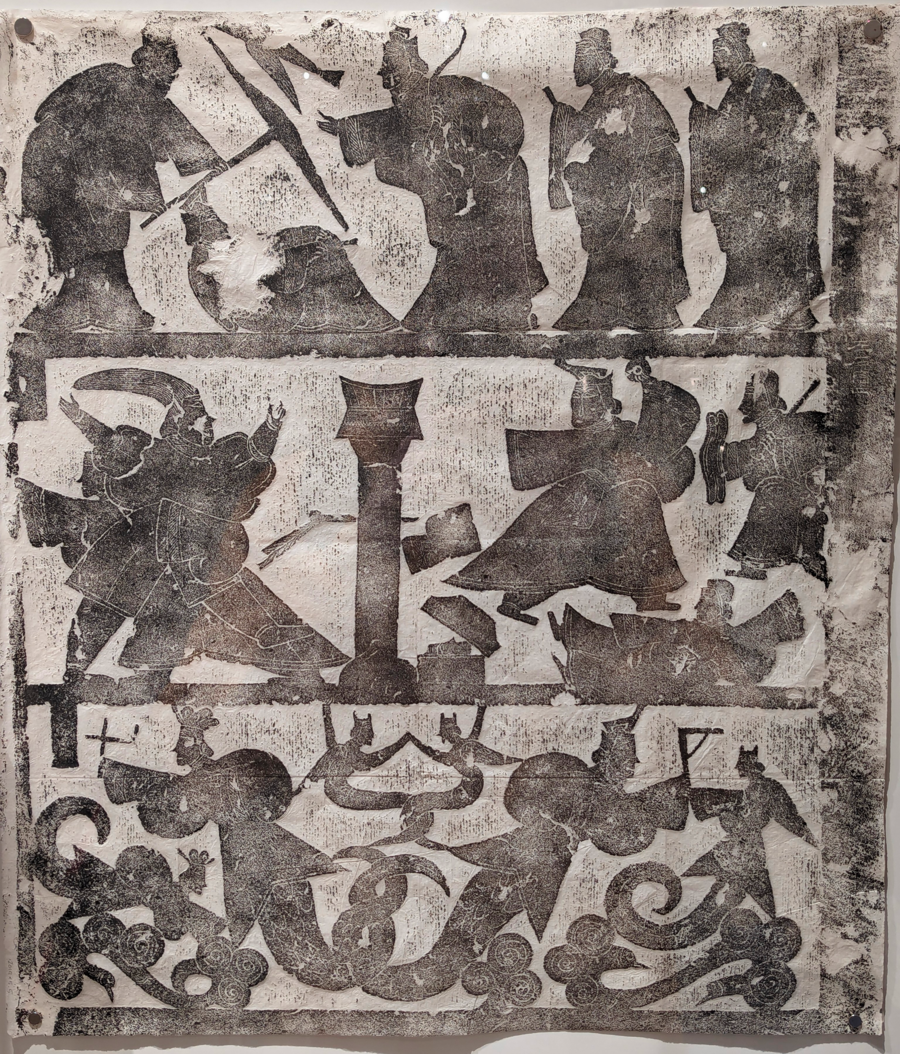
Relief from the U family tomb—unknown master (c. 151 BCE, Han Dynasty)
The selection of this topic is driven by a combination of cultural and research interest. Games with a similar meaning and concept existed in other countries besides East Asia, but I was specifically intrigued by how the theme of death was interpreted through game mechanics. However, today, this game has effectively «died» because its authentic rules have been irrevocably lost. This research allows us not only to study burial rituals more deeply but also to attempt to understand the meaning of a vanished cultural phenomenon where the game about the afterlife itself became part of history.
Research Question
What visual markers from a lost game with forgotten rules influenced people’s perception of ancient Chinese religion?
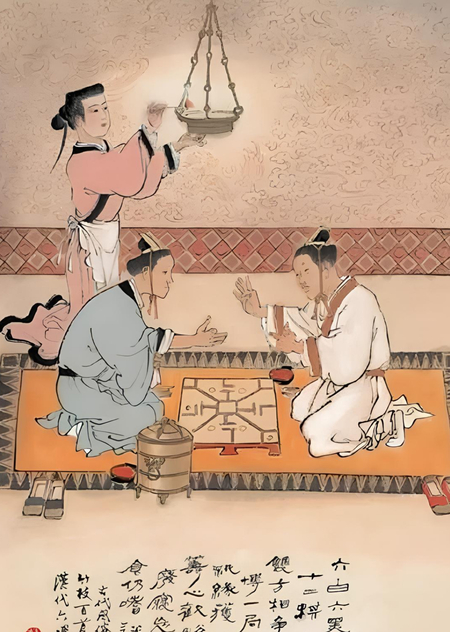
Relief brick depicting a scene of playing ludo and feasts — unknown master (25–220 CE, Eastern Han Dynasty)
Example of a Misinterpretation:
One of the world’s largest and most famous museums—The Metropolitan Museum of Art—writes beneath a photo of the game on its website: «These figures, captured in a dramatic moment, embody the yearning for life to continue in the afterlife.»
Screenshot from the Metropolitan Museum of Art website featuring the exhibit card for «Board and Tokens for the Game of Ludo.»
Example 2 of Misinterpretation:
On the Virgin Museum of Fine Arts (VMFA) website, beneath an exhibit—mirrors with TLV patterns—it reads: «…others believe it resembled a portable board game for Ludo. One such mirror, dated to the beginning of the 1st century, bears the inscription: ‘Cast with a pattern for the game of Ludo to ward off misfortune.’ This suggests that the Ludo pattern on the mirrors may have had a ritualistic significance.»
Screenshot from the website of the Virginia Museum of Fine Arts featuring the exhibit card for «Bronze Mirror with TLV Ornamentation»
3 Example of Misinterpretation: In British catalogs, scenes of the game of Luobo depicted on tombstone carvings are interpreted as part of the Si-wan-mu (Lady of the West) cult—a goddess who grants immortality—where winged figures (xian) play Luobo in the heavens. For instance, in Mysteries of Ancient China (on the website https://www.babelstone.co.uk), the author writes: «…the game of Luobo they play reflects a specific story from the mythology surrounding the Queen Mother of the West.»
Visual materials were selected based on chronological and functional criteria: the sample was grounded in artifacts from the game’s heyday (the Warring States and Han Dynasty eras, 5th century BCE — 3rd century CE) that were directly related to funerary culture.Since the original game rules have been lost, the selection of textual sources was based on finding indirect references in ancient Chinese written records and contemporary works on archaeology and sinology. By gathering this information together, we can only make approximate assumptions about how the game mechanics related to beliefs about the afterlife, but this is nevertheless enough to better understand the cultural characteristics of the era.
The research is structured along a detective principle—that is, from the external form and mystery toward revealing the truth. This sequence first establishes context and demonstrates visual «clues, ” and then unveils the game’s more probable meaning.
1. The History of Its Appearance
2. Hypothesized Mechanics and Rules
3. Visual Analysis: Board, Inventory, and Imagery
4. The Game’s True Purpose, Its Significance, and Religion
5. Conclusion
1. History of appearance
Lacquered board for a game from Mawangdui—an unknown master (before 168 BCE, Western Han Dynasty period).
There are two versions of the story: the historical and the mythological.
Ancient written monuments, including the treatise Shiben (世本 — «The Basis of Generations, ” author unknown) and the etymological dictionary Shuowen Jiezi (說文解字 — „Explanations of Simple Characters and Interpretation of Complex Characters“) by Xu Shen, attribute the invention of the game to a noble named U Zhao. He served at the court of Zhe—the last ruler of the semi-legendary Xia Dynasty (c. 1766–1600 BCE). Legend holds that the king was extremely cruel and unpredictable. U Zhao created the game to distract the ruler from executions and channel his destructive energy into the peaceful realm of competitive rivalry.
Stone relief impression depicting the ruler of the Zhou Dynasty
Modern archaeologists and sinologists view this history as a later legend. During the Han Dynasty, authors frequently linked the origins of ancient objects to mythical kings to bestow upon them a special status, even though there are no actual archaeological findings from the Xia Dynasty.
The verifiable history of Yu-ji begins during the Warring States period (476–221 BCE). Scholars agree that it did not originate as a secular pastime, but rather as a byproduct of ancient divination rituals. With the final formation of Yu-ji, its gaming and gambling functions completely superseded the ritualistic ones. After the unification of China under the Han Dynasty (206 BCE — 220 CE), Yu-ji transformed into the nation’s principal game.
Ceramic funerary figurines of two players in a board game with a board and pieces — unknown artist (1st century BCE — 1st century CE, Han Dynasty era)
In the 3rd century CE, following the fall of the Han Dynasty and the advent of the Three Kingdoms period, the popularity of the game began to decline. The elite became engrossed in a new, deeper strategic game—Weiqi (Go). By the 7th century (Tang Dynasty), nobody seemed to play it anymore, and its rules were forgotten. This transformation turned the simple board game into a mysterious artifact for future generations.
2. Proposed Game Mechanics and Rules
Fragment of a mural painting from a tomb depicting a game of Liubo (from Xincun Village, Luoyang) — unknown master (9–23 CE, Xin Dynasty).
In 2019, archaeologists discovered over a thousand bamboo slips with text during excavations of the tomb of Han Emperor Liu He (who ruled in the 1st century BCE). Decipherment revealed that these slips contained a lost set of rules for the game of Liubo.
By the 4th–3rd centuries BCE, a standard set had been established: a square board with geometric markings, 12 game tokens, and 6 counting sticks. During this period, aristocrats and military commanders actively played the game, viewing the match as a model for governing a state and an army. The number of players was always the same—2 players.
The game begins with all six tokens for each player positioned outside the square board. On their turn, participants take turns rolling six bamboo sticks instead of dice to determine the movement range. Based on the resulting value, players place their tokens onto the board and move them along the marked lines.
1. Board, token, and stick game schematic from one of Lü Shēn’s tombs on Haotoushan Hill — unknown master (Early Western Han Dynasty, 2nd century BCE). 2. Archaeological photograph and impression of a board, tokens, and stick game from Tomb M31 in Jincuiquan — unknown master (Early Western Han Dynasty, 3rd–2nd centuries BCE).
When an ordinary piece reaches the central zone of the board—the so-called «river"—it transforms into a special «owl» piece. This enhanced piece gains the ability to move in both directions and capture opponent pieces. If it lands on a square occupied by an opponent, the opponent’s piece is removed from the board and eliminated from the game.