Concept
Dolls can depict infants, adult women, or characters with their own narratives. Clothes, furniture, and entire houses are created for them. All of this exists today, so I am less interested in the appearance of different doll types and more interested in the ideas about adult life that informed their design in the 19th and 20th centuries.With a doll, a child can role-play situations in which they themselves are not yet involved: caring for an infant, hosting a family dinner, choosing an outfit, or inventing a profession for the heroine. The accessories suggest possible actions but do not dictate the play entirely. A girl can turn a doll into any character, even if the manufacturer intended a different role.The central question of this research is: how did dolls from Europe and the United States in the 19th and 20th centuries reflect prevailing ideas about women’s roles, and what play scenarios did they offer to children?My hypothesis is that the doll’s appearance and the set of its accessories are connected to societal expectations of women. Furthermore, these changes were not linear: infant dolls, fashion dolls, and play wardrobes existed concurrently. Therefore, I will not describe the history as a transition from motherhood to freedom of choice.I will compare museum pieces, historical catalogs, advertisements, and images of children’s play. I will examine who the doll represents, how she is dressed, what is included in the set, and what actions are possible with it. Advertisements and toy design cannot be considered proof of how children actually played, so I will strive to separate the suggested scenario from the actual use.Structure of the Research:
- How the research was conducted
- Little Adults: 19th-Century Dolls
- The Play of Motherhood
- Paper Dolls: The Possibility of Choice
- Barbie: A New Adult Life
- ConclusionBy comparing these examples, I aim to understand the extent to which the doll reflected the child’s familiar world versus how much it helped visualize other possibilities of adult life.
How the research was conducted
For this research, I selected several types of dolls that were common in Europe and the United States during the 19th and 20th centuries. I was interested in what adult life images these toys offered and how their design might influence children’s play.
First, I consulted museum collections that house dolls, clothing, miniature furniture, and other playthings. Such items allow one to see exactly what was available to children of different eras. However, museum collections cannot fully convey the diversity of contemporary toys; they tend to preserve items that hold historical or artistic value.
Next, I identified four groups for comparison: fashionable adult dolls from the 19th century, baby dolls, paper dolls, and Barbie. I chose these not because one type historically replaced another. All these forms of play coexisted to some degree. I was interested in the variety of roles they allowed to be acted out and the notions of femininity that could be discerned from their design.
When making comparisons, I paid attention to the doll’s depicted age, proportions, clothing, and accessories. The play actions proved to be equally important. For example, a changeable wardrobe allows the character to be re-dressed, and a pram or crib can be used to enact childcare.
I also decided to examine advertisements and historical images of children playing. These help us understand who the toys were intended for and how manufacturers presented their use. That said, the advertising image cannot be considered an accurate description of real children’s play. Children could invent their own narratives, even if the toy offered a very specific scenario.
Therefore, in this study, I will correlate three aspects of doll play: the toy’s appearance, the actions it suggests, and the historical perceptions of how it ought to be played with.
This approach will allow me to view the doll not only as an object reflecting the fashion of its time but also as a participant in a game in which a child could assume various adult roles.
Little Adults: 19th-Century Dolls
Among 19th-century dolls were toys depicting adult women. Their attire mirrored the fashion of the era: wide skirts, elaborate sleeves, hats, and lace collars. Some dolls featured interchangeable clothing that could be dressed and undressed.
It is interesting to note that these toys placed significant emphasis on costume. The clothing could reveal the persona the maker intended for the woman: a richly dressed lady, a young woman from a prosperous family, or a fashion-forward woman keeping up with the latest styles.
However, the doll’s appearance alone does not tell us what role it played in children’s play. One girl might dress it up, another might enact family narratives, and a third might invent adventures entirely disconnected from adult daily life.
Therefore, we should first examine the toys themselves and the possibilities they offered.
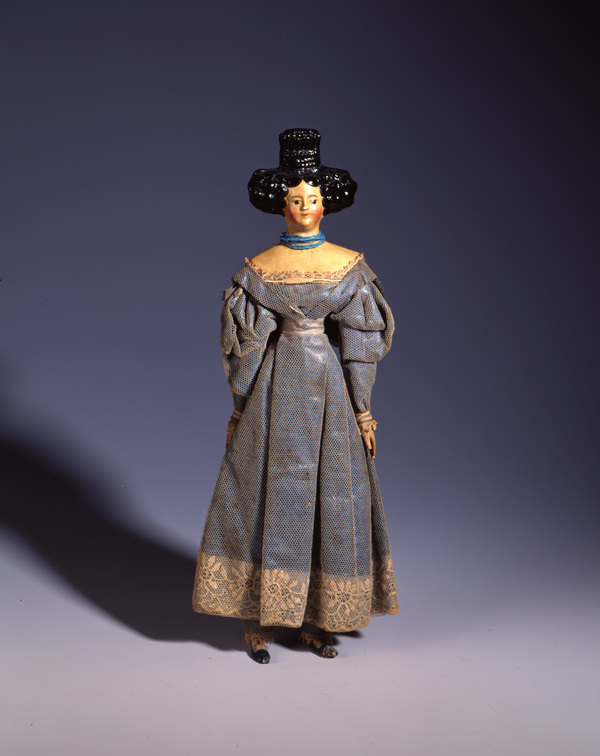
Unknown maker. Biedermeier-era doll. Germany, c. 1830–1835. German Historical Museum.
For example, this German doll from the first half of the 19th century is dressed in a gown with a wide skirt and voluminous sleeves. Her clothing resembles the costume of an adult woman from the Biedermeier period. Her hairstyle also adheres to adult fashion.
Visually, the doll bears little resemblance to the image of an infant who needs feeding or putting to sleep. It is much easier to imagine a child dressing her, taking her for a walk, or staging a meeting with other characters.
But can we definitively say that this is how she was played with? Without information about her owner and history of use—no. We can only discuss the possibilities afforded by the toy’s construction and appearance.
This distinction is crucial for the entire study. The doll might have reflected the adults' perceptions of an appropriate feminine image, but the final narrative depended on the child themselves.
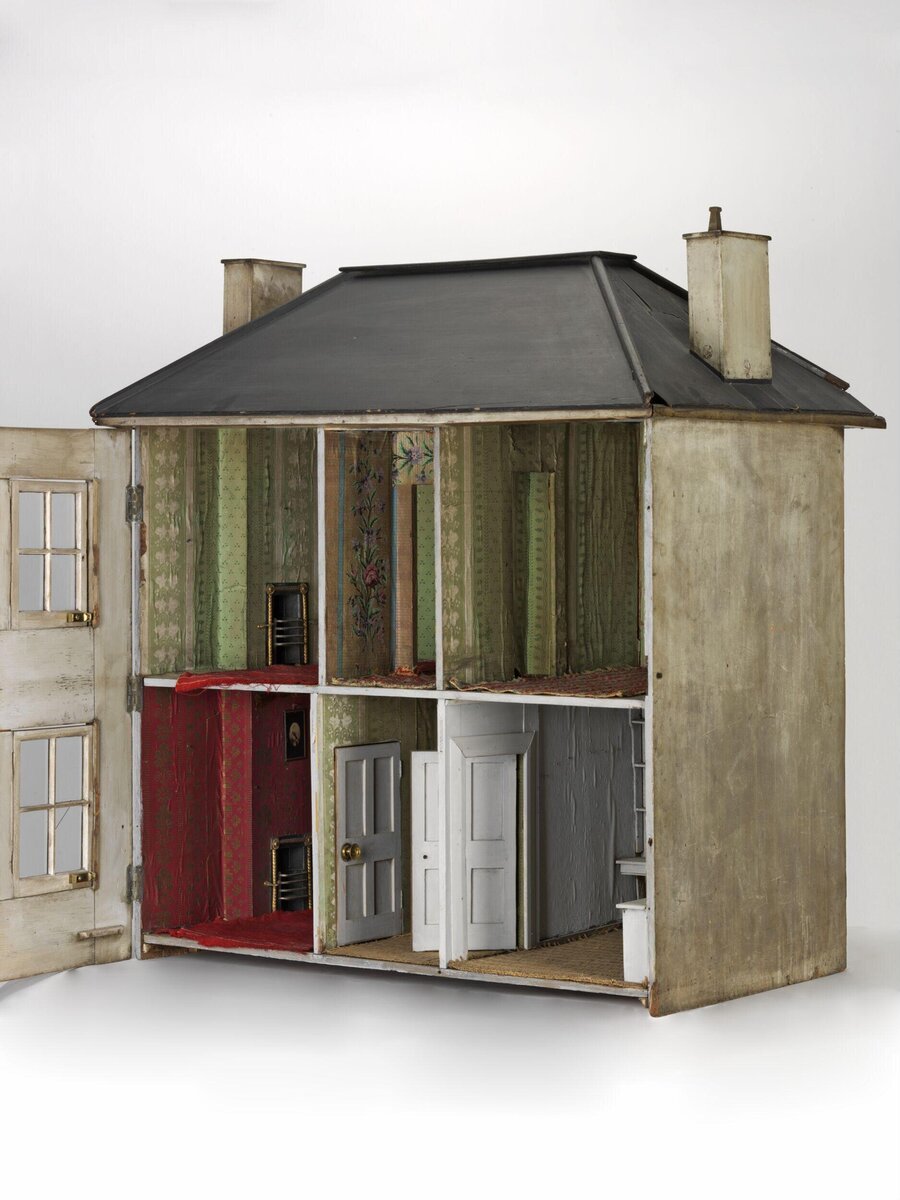
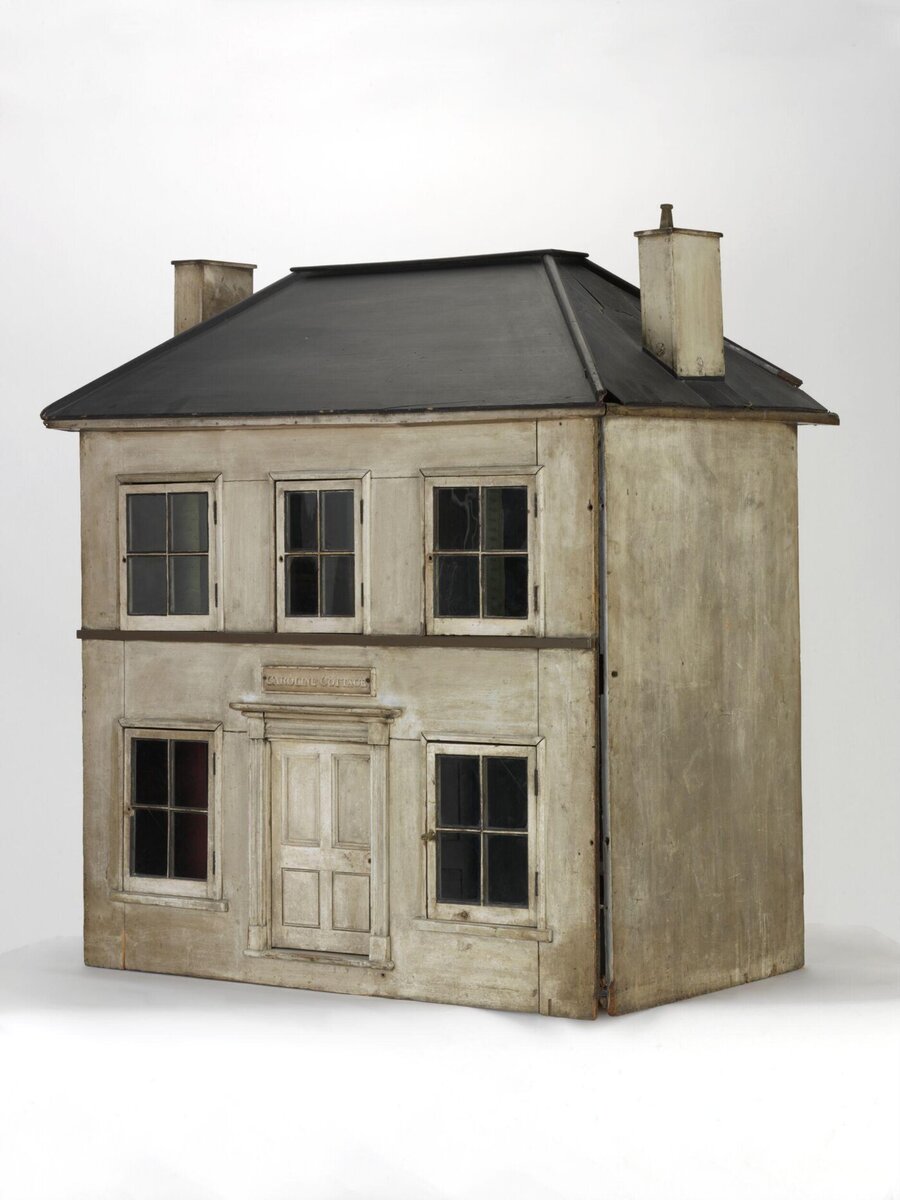
Unknown artist. Caroline Cottage Dollhouse. Scotland, 1831. Museum of Victoria and Albert, London.
Adult life could also be re-enacted using dollhouses. Rooms, furniture, tableware, and other objects mimicking a real dwelling were created for them.
Unlike a single doll, such a house offered an entire space for play. Characters could be distributed among rooms, seated at the table, put to bed, or sent out to visit.
In the Caroline Cottage dollhouse, created in 1831, one can observe how the familiar domestic space was transformed into a miniature. The play pieces replicated the setting of the adult world, yet the child could independently rearrange them and invent scenarios.
The dollhouse is interesting precisely because of this combination. On one hand, its rooms and furniture reproduced the familiar organization of daily life. On the other, the child gained the ability to manage this space autonomously.
Using the Caroline Cottage as an example, it is clear that doll play was not limited to dressing up characters. Entire spaces were created to replicate the conventional home environment. But another issue arises here: not every 19th-century doll was designed for the same activities. Some toys could be freely moved and dressed in, while others represented fragile items that required much more careful handling.
Therefore, I decided to proceed by comparing several dolls and historical images of children’s games. I was interested in what possibilities the toys themselves offered and what could be learned about how children actually interacted with them.
The Doll as a Fashion Object
When examining antique dolls, I noticed that not all of them were created solely for children’s play. Some served as models for fashionable clothing. Such dolls allowed us to see how a dress looked in volume, how the fabric folds were arranged, and how the costume details complemented each other.This tradition existed long before the 19th century. Before illustrated fashion magazines became widespread, dolls in elaborate attire were used to showcase new styles. They were transported between cities and countries so that clientele could become acquainted with the latest fashions without personally visiting the workshop.It turns out that items that look similar on the surface could have different purposes. One doll might become a child’s toy, while another was used to display clothing. Therefore, when studying historical dolls, it is crucial to determine who they belonged to and what they were made for.
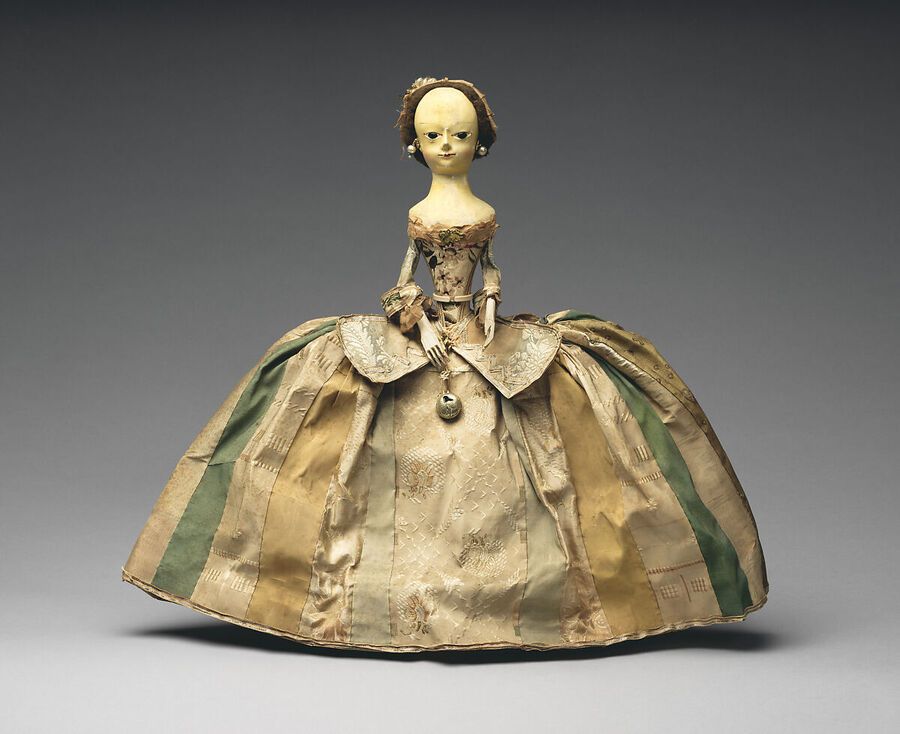
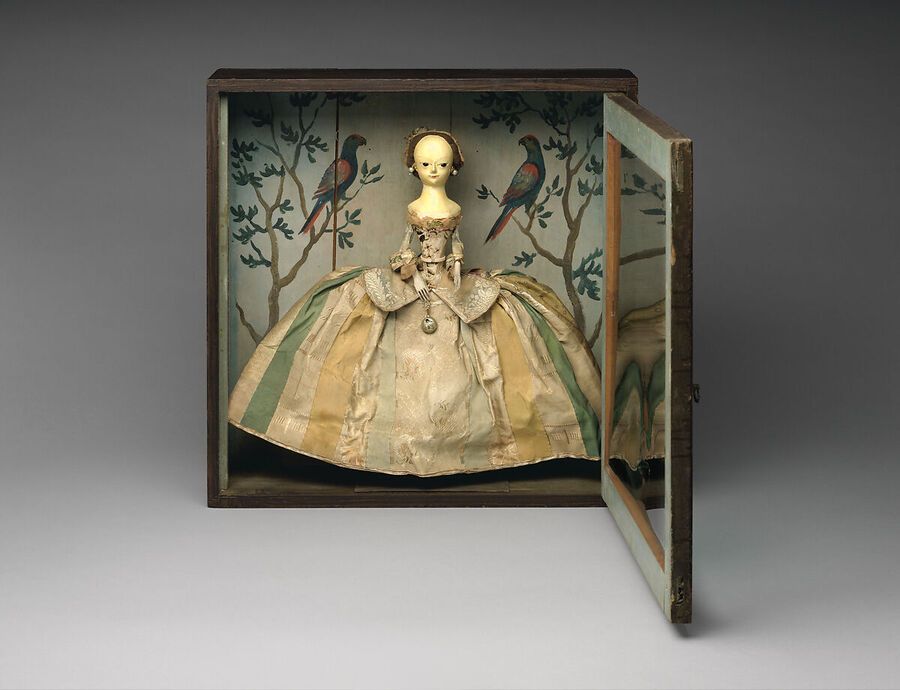
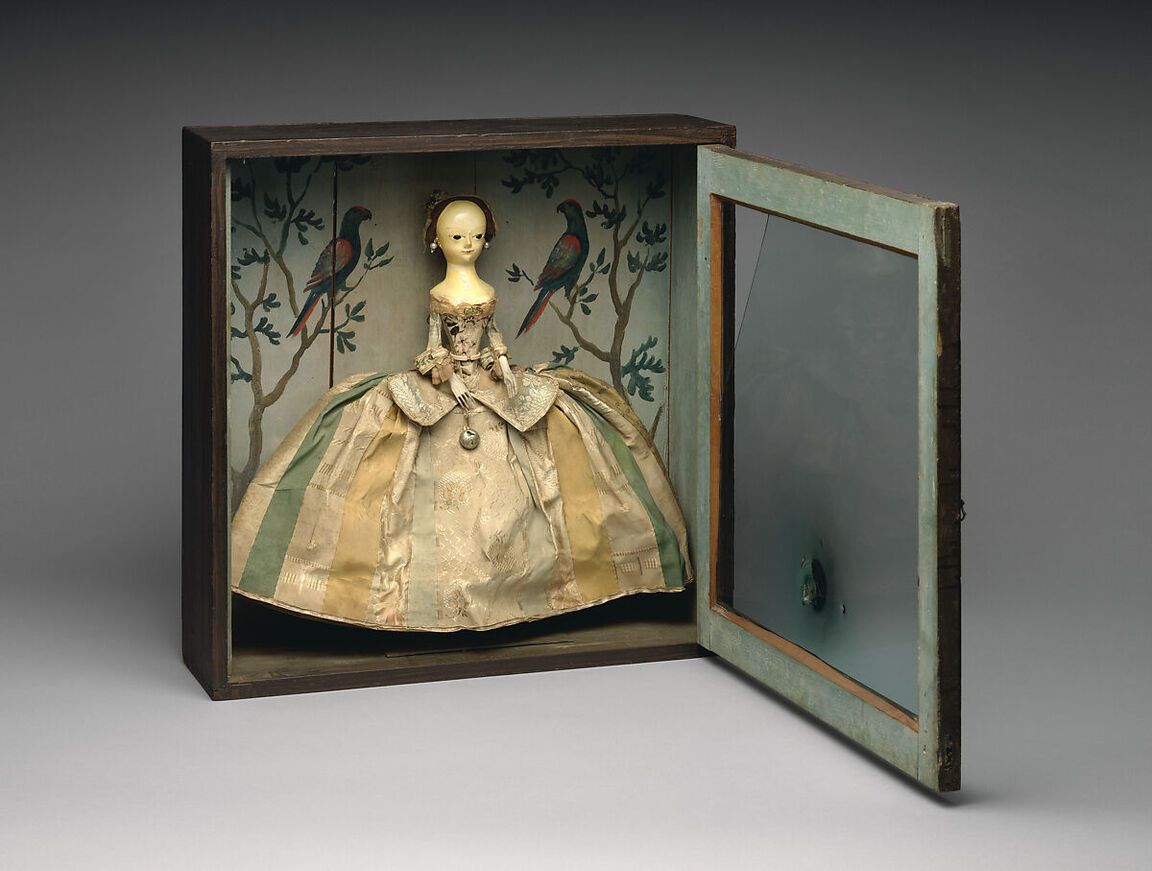
Unknown maker. «Doll in a box.» England, c. 1748. Metropolitan Museum of Art, New York.
A good example of this dual purpose is an 18th-century English doll from the Metropolitan Museum of Art’s collection. It has been preserved along with the box in which it was kept. According to the museum, dolls like this could simultaneously serve as toys and models of fashionable clothing.
It is particularly interesting that this doll was not intended for constant costume changes. Its outfit was almost an integrated part of the figure. Even the small ornaments remain in place.
When compared to later dolls, which were designed with interchangeable wardrobes, the difference in play potential becomes noticeable. In the first case, the finished look was the main focus. In the second, the child had the opportunity to independently alter that look.
Of course, one cannot assume that this difference is universal for all dolls from the 18th and 19th centuries. But it helps us understand why the design of a toy is just as important to the history of play as its appearance.
One Era — Different Toys
Let’s return to the 19th century. If we examine dolls made across different decades, we can observe variations in size, materials, and level of detail. Some feature meticulously crafted faces and costumes, while others appear much simpler.
Furthermore, the cost and complexity of production determined who could afford the toy. A doll with elaborate clothing and delicate features required far more careful handling than a simple wooden or rag figure.
This prompts reflection on another aspect of doll play. When discussing the upbringing of girls in the 19th century, we cannot assume all children were alike. Toys for a girl from a wealthy family could look drastically different from those of a child from a poor urban neighborhood.
Therefore, beautiful museum dolls should not be interpreted as a complete portrait of childhood during that era. They only represent a subset of the possibilities that existed.
Unknown maker. Doll. Great Britain, c. 1870. The Metropolitan Museum of Art, New York. Inv. No. 23.127.2.
The Metropolitan Museum of Art collection houses a British doll dated to approximately 1870. It measures about 37 centimeters tall. The museum card provides details on its origin and dimensions, but says almost nothing about who played with it.
This is also important information for research. We can establish that such a toy existed, examine its design, and compare it with other objects. However, the history of its use must remain open to interpretation.
This is why I felt it necessary to look at images depicting dolls alongside children. While these images do not always provide a precise answer regarding actual play, they allow us to see how contemporaries portrayed the relationship between child and toy.
How Children Were Depicted Playing
In the late 19th century, scenes of children’s play frequently appeared on postcards, illustrations, and promotional imagery. Girls were depicted holding dolls, sitting at toy tables, or surrounded by miniature furniture.
Such images help us understand what activities adults considered recognizable and appropriate for children. However, these images must be viewed cautiously. The artist might have deliberately composed the scene, selected fashionable clothing, and presented an idealized setting that bore little resemblance to daily life.
Therefore, a depiction of a child with a doll can reveal the prevailing notions of that era, but it does not always reflect how children actually spent their time.
Ida Waugh. «Right or Left?» c. 1890. Chromolithograph. L. Prang & Co. Library of Congress, USA.
In the chromolithograph by American artist Ida, two girls playing with dolls and a boy guessing which hand hides a fruit are depicted.
Interestingly, the dolls do not become the central focus of the scene. They are near the girls, but the children’s attention is directed at the interaction happening between them. The toys become part of a broader scenario where the children are communicating, getting distracted, and switching between activities.
I believe this is a good example of why one should not view doll play as a strictly defined sequence of actions. Even if a toy has an intended purpose, in real life, it can participate in a wide variety of events.
Meanwhile, the illustration itself remains a work of art. It shows how the artist envisioned a childhood scene, rather than documenting a specific game.
Edward Meibridge. «Animal Locomotion, ” Plate 481. Girl Lifting a Doll. 1887. Library of Congress, USA.
A completely different material—a series of Edward Muybridge photographs from 1887. In consecutive frames, a girl picks up a doll lying on the ground, turns around, and walks away with it.These photographs were created to study human movement. Therefore, what we see here is a staged sequence, not a snapshot of spontaneous childhood play. Nevertheless, it is interesting because it illustrates the interaction between a child and a toy in action.Unlike a museum photograph of a doll, here we see how a person picks it up and moves it through space. This simple action reminds us that a toy exists not just to be looked at. It can be carried, seated, laid down, and incorporated into imagined scenarios.However, the sequence itself does not allow us to determine what role the girl assigned to the doll. She could be portraying a child, a friend, or an entirely different character. Answering that question would require testimony from the participant herself, which these photographs do not contain.
Comparing these materials revealed how cautiously we must draw conclusions about the history of doll play. Surviving toys allow us to study their appearance and construction, artistic depictions offer a view into contemporaries' concepts of childhood, and photographs capture specific actions of children. However, none of these sources alone reveals the entire history of play.
Nineteenth-century dolls may have introduced children to fashion, domestic life, and conventional social roles. Yet, it would be too simplistic to claim that girls merely replicated what they observed around them. The capabilities of a toy do not equate to all the possibilities of the imagination.
I believe it is especially crucial here to distinguish between the image of the adult woman created by the manufacturers and the character the child invented during play. These two could coincide, but not necessarily.
Until now, we have primarily focused on dolls that represented the adult world through clothing and domestic settings. In the next section, I intend to address a different play dynamic—one where the child assumes the role of the adult, caring for a baby doll. This will allow us to compare two ways of engaging with adult life: directing the narrative of an adult character versus enacting the care of a small child.
The Game of Motherhood
In the previous section, I discussed dolls depicting adult women. With them, children could act out walks, meetings, domestic events, and other scenarios from adult life. However, there was another way to play, one in which the child themselves became the adult character.
This did not require an elaborate dollhouse or a large wardrobe. All it needed was a doll that could be held, put to bed, or imagined as one’s own child.
Baby dolls existed long before the 19th century, so it would be inaccurate to tie their appearance to any single historical period. However, surviving toys from the 19th and 20th centuries allow us to examine how young children were depicted and what accessories were used for playing with them.
Unlike the doll representing an adult lady, the infant doll hardly implies independent actions within the imagined story. It can be fed, dressed, soothed, and put to sleep. The child playing with such a doll gains the opportunity to experience the role of a caregiver.
It was this shift that interested me. In one case, the girl invents the life of an adult character, whereas in the other, she can assume the role of a mother or another caring adult herself. Moreover, the same doll was not necessarily used for only one storyline.
Unknown manufacturer. Infant doll. 1860–1880. Wax, paint, glass, cotton. London Museum, Inv. No. 33.139.
A baby doll in the London Museum’s collection dates from 1860–1880. It is constructed using wax, glass, paint, and fabric. Standing about 89 centimeters tall—quite large for a toy a child would need to carry constantly—it is quite imposing.The doll is dressed in long garments resembling an infant’s gown. Museum staff speculate that the fabric items may have originally belonged to a real child, as their style dates to an earlier period.This detail struck me as particularly fascinating. If the clothing was indeed used previously, the toy might have acquired items from a genuine child’s wardrobe. However, the museum does not assert this with certainty, so such a story cannot be considered proven.Unlike the ornate dolls of the Biedermeier era, nearly all the design elements here relate to the image of a small child. The long clothing obscures the figure, while the face and proportions convey the impression of an infant. This appearance clarifies why the doll could be incorporated into caregiving-related play.Meanwhile, its large size prompts reflection on practicality. How easily could a young girl lift such a doll? Was it used for active play or did it mostly reside in a specific location? The museum’s descriptive card offers no answers to these questions.
Unknown maker, possibly a workshop of the Pierotti family. Baby doll. 1881–1890. London Museum, inventory no. 28.127.