Erasing the Boundaries Between Nature and Interior: Semantics and Composition of Marine and Botanical Motifs in Minsk Art of the Neo-Palace Period.
Rubricator:
1. Concept. Work Characteristics.
2. Historical and Cultural Context.
3. Fundamentals of Visual Language.
4. Artifact Analysis.
5. Conclusion.
6. Bibliography. Image Sources.
1. Concept
Research Hypothesis and Goal:
Hypothesis
Rationale for Topic Selection:
Since childhood, I have been fascinated by the history of Ancient Greece, particularly after visiting Crete at the age of eight. I was deeply impressed by the myth of the Minotaur’s labyrinth, and later, studying the myths of Ancient Greece became my favorite subject. As I grew older, my interest in Greek history never faded. I discovered that it is rich not only in mythology but also in architecture and painting. Everyone knows that Greece borders the sea. This made me curious how its geographical position influenced the evolution of Greek culture. Because sea creatures are unlike other beings, their imagery is unique. Furthermore, the rich nature surrounding the Greek population contains symbols and signs important to people across different eras. I became interested in the life of the Minoans, and their art will help me understand it.
Material Selection Principle:
Chronology: Neopalatial Period, c. 1700–1450 BCE. Geography: Around Crete (Knossos, Phaistos, Zakros, Paleokastro), Around Thira (Akrotiri)Artifacts are divided into three categories: ceramics, fresco painting, and small-scale sculpture. The variety of artifact types allows for an exploration of different facets of Minoan art. Most materials were sourced from the Archaeological Museum of Heraklion, the National Archaeological Museum of Athens, and the Museum of Prehistoric Thera. Finds from Akrotiri, unlike those recovered from the rebuilt Palace of Knossos, preserve the authentic art and spatial context of the Minoans.
2. Historical and Cultural Context.
The Bronze Age Minoan civilization (c. 3000–1100 BCE) was discovered by the British archaeologist Arthur Evans, who named it after the mythical King Minos, son of Zeus and ruler of Knossos. It reached its zenith during the Neopalatial period, which spanned from 1700–1450 BCE. The insular location of Crete and Thera made maritime trade, particularly with the Near East, the primary economic activity. In art, connections with other nations were evident in exotic imagery and the incorporation of new materials, such as gold and ivory.
Following the devastating earthquakes around 1700 BCE, Knossos, Phaistos, Malia, and Kato Zakros—the main centers of Crete—were rebuilt with architectural grandeur. Cretan palace complexes were intricate labyrinthine structures that served economic, sacred, and administrative functions. Knossos' architecture is characterized by numerous partitions, light wells, and a complex system of corridors. Art complemented the stone spaces.
Unlike the palatial Crete, Akrotiri was an example of a highly developed urban environment. Natural light rarely reached the multi-story houses, which were connected by streets and plazas. Because of this, frescoes acted as «windows» to expand the space.
The architectural complexity and enclosure of Minoan rooms created a need for visual variety on the stone walls.
Unlike cities in the Middle East and mainland Greece, the Minoan palaces and wealthy homes of Akrotiri lacked massive defensive walls, as they were protected by the sea and the Cretan fleet. The layout of the buildings revolved around a central courtyard, and the architecture was characterized by light wells, pillars, and porticoes. Resources were directed toward the beautification of the houses and the painting of their interiors. The interior walls continued to connect with the outside world. Art united humanity with nature, lending it spiritual significance. At the core of Minoan culture was the worship of the Great Mother Goddess, whose power was embodied in the earth and the sea. Natural motifs carried symbolism and were directly connected to the Goddess.
3. Visual Language.
Minoan masters utilized the buon fresco technique (painting on wet plaster), which allowed pigments to chemically bond with the wall.
The fresco was located on the second floor of the residential complex, above the storage facilities. Several long-tailed blue monkeys climb colorful volcanic rocks, escaping pursuing dogs. The monkeys depicted by Minoan artists were given anthropomorphic traits. Since they were not native to the Cyclades and were imported from Africa, their uncharacteristic blue fur suggests exoticism.
A fragment of a frieze, approximately 5.5 meters long, is displayed in a small room with low benches. A blue rock dove is captured in mid-flight against a wild landscape. The contrast between the cool blue plumage and the warm, ochre-toned rocks narrowing toward the center creates an optical lens effect. The room wall transforms into a sunlit gorge.
Red and yellow ochre.
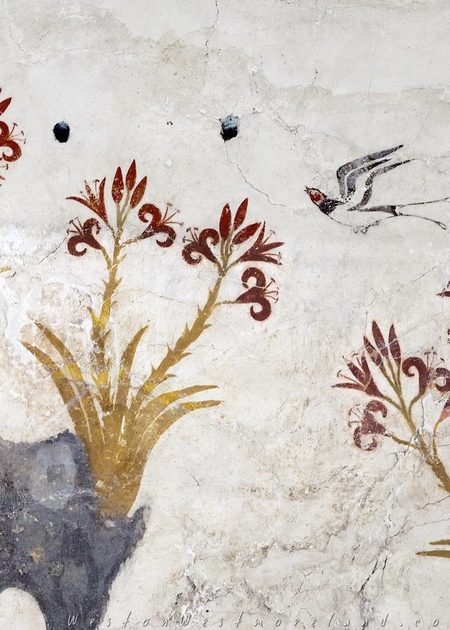
Iron oxide ochres, which featured a diverse color palette ranging from golden-yellow to terracotta and purple, symbolized energy and life. These pigments were used to color skin and denote status (the reddish tan of male figures contrasted with the chalky-white skin of women).This is a unique example of ancient environmental design. The fresco was discovered in a private bedroom. The lower section of the wall is painted with ochre and grayish-blue washes that imitate the veining of fine marble. Above the stone figures, vases filled with bouquets of red lilies—rendered in vivid iron-rich ochre—stand out. The artist creates a multi-layered composition, blurring the lines between reality and representation.
Contrasting duochrome in «sea style» ceramics.
During the Early Minoan period, ceramic art was rudimentary, typically featuring linear patterns of spirals, triangles, curved lines, and crosses. By the Middle Minoan period, a shift toward more naturalistic designs occurred, with common motifs including fish, squid, birds, and lilies. In the Neo-Palatial period, and with the refinement of the potter’s wheel, Minoan culture began producing ceramic masterpieces. In this era, the drawings on artifacts became more realistic, although geometric patterns remained to fill the space around the central narrative figures.Cretan ceramics of the «Marine Style» are characterized by dichromy: dark, ferruginous slip was applied to a light clay background. The lack of color did not make the pieces simpler, as the focus shifted to the composition. The masters painted figures densely packed together. The graphic design adhered to the vessel’s form.
The jug is entirely adorned with patterns. The design is clearly visible due to the contrast. The composition is asymmetrical, yet balanced. The patterns on the vessel form a landscape: delicate ornamentation resembling waves and nautilus shells, and depictions of marine flora. An unconventional handle adorned with seashells and the relief work on the vessel itself complete the underwater world. The nautilus, in Minoan culture, was not only a symbol of the sea but also of eternal movement due to its resemblance to the spiral. The spiral itself is a key motif on this vessel. Furthermore, the marine creature alludes to maritime trade routes and wealth. From this, one can conclude that the jug might have belonged to influential individuals who hosted banquets and used the vessel for pouring wine.
Polychrome Acrotiri Ceramics
Unlike the two-color Cretan «marine style, ” the masters of Akrotiri worked with matte polychromy. Pigments of various colors were applied to light clay.When decorating, the artists considered the vessel’s practical use in daily life. The drawings complemented the functional aspect of the objects.
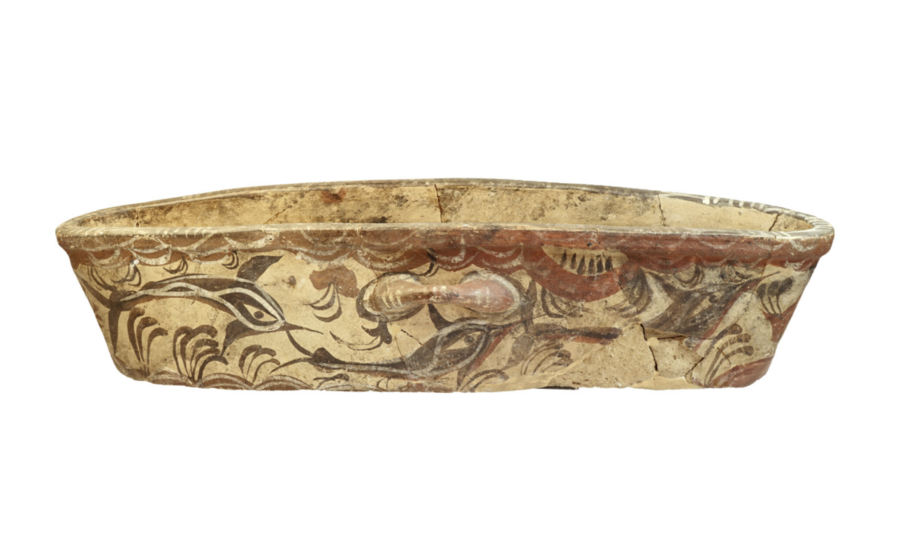
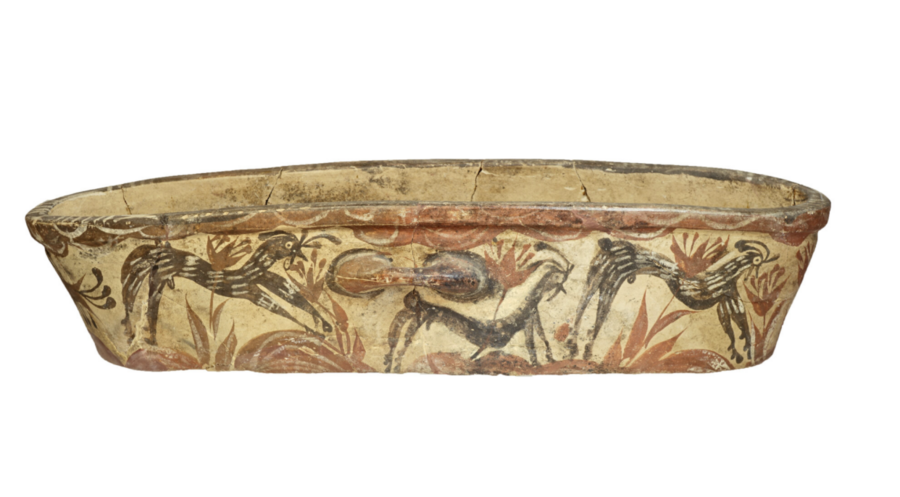
Kimba is a rare, elongated, trough-shaped vessel characteristic exclusively of the Tira culture. This vessel was often used in rituals.Let’s examine the work with space and composition on this artifact. The elongated body of the vessel resembles a two-sided panoramic screen. One side depicts wild mountain goats among myrtle bushes, while the opposite side features a pod of dolphins swimming above sea cliffs. The painting lacks borders and a visible horizon line. This technique blurs the boundaries between land and water, symbolizing the unity of the elements. If the vessel was used in ceremonies, the design on it merges when rotated.