Topic: Erasing the Boundaries Between Nature and Interior Space: The Semantics and Composition of Marine and Botanical Motifs in Minsk Art of the Neoclassical Period.
Navigation:
I. Concept and Work Characteristics.
II. Historical and Cultural Context.
III. Principles of Visual Language.
III. I. Ceramics.
III. II. Fresco Painting.
III. III. Small-Scale Sculpture.
VI. Hypothesis Confirmation and Conclusion.
V. Bibliography and Image Sources.
I. Concept.
Hypothesis:
In the art of the Minoan civilization during the Neopalatial period, maritime and botanical motifs served a semiotic and spatial function. The absence of a horizon line, precise perspective, and symmetry dissolved the visual boundaries between architecture and objects. Masters employed curves, contrasting color palettes, and the principle of horror vacui (filling empty space). Furthermore, the meaning of the same natural motifs shifts depending on the context: in monumental frescoes, they possess ritual significance; in ceramics of the «marine style, ” they function to animate the vessel; and in small sculptures, they combine ritual and life. Minoan art presents a unique visual code where humanity does not dominate nature but is instead a part of it.
Rationale for Topic Selection:
My interest in the Aegean world began in childhood after learning about the myth of the Minotaur’s labyrinth. This fascination evolved into a desire to study the architecture and art of the Bronze Age material culture. I became curious about how geographical location influenced Greek culture. Marine life is unlike other creatures, giving rise to unique imagery. Furthermore, nature plays a significant role in Minoan religion and also influenced their perception of the world. The advancements in architecture and iconography by Minoan masters compel us to compare their art with the modern world.
Research objectives, primary tasks, and the main question.
Objective: To identify artistic techniques across three types of artifacts—ceramics, fresco painting, and small sculpture—to demonstrate their unified focus on animating the spatial environment. Research Objectives: 1) To analyze the historical, cultural, and architectural context of the palaces of Crete and the settlement of Acrotiri. 2) To reveal the semantics of the principal animal and plant symbols. 3) To analyze artifacts of different types, taking into account the rooms in which they were discovered. Research Question: How do masters of Minoan art transform natural motifs from static imagery into a rhythmic environment that shapes the surrounding space?
Material Selection Principle.
Chronology: Neopalatial period, circa 1700–1450 BCE. Geography: Crete, ThiraThe artifacts are divided into three categories: ceramics, fresco painting, and small sculpture. The variety of artifact types allows for a comprehensive exploration of different facets of Minoan art. The materials are primarily drawn from the Heraklion Archaeological Museum and the Museum of Prehistory in Tyre. The findings from Akrotiri, unlike those recovered from the reconstructed Palace of Knossos, preserve the true artistry and spatial context of the Minoans.
II. Historical and Cultural Context.
Map of the Minoan palace centers of Crete, Glykos, and maritime trade routes in the Neopalatial period (c. 1700–1450 BCE). Source: Digital Maps of the Ancient World.
The Minoan civilization of the Bronze Age (c. 3000–1100 BCE) was discovered by the British archaeologist Arthur Evans and named after the mythical King Minos, son of Zeus and ruler of Knossos. It reached its peak during the Neopalatial Period, which spanned from 1700 to 1450 BCE. Thera Island is also considered part of the Minoan civilization due to its use of Cretan Hieroglyphic Script A and similar artistic styles. The island location of Crete and Thera made maritime trade, particularly with the Middle East, the primary sector of the economy. In the arts, connections with other countries are evident in exotic imagery and the use of new materials, such as gold and ivory.
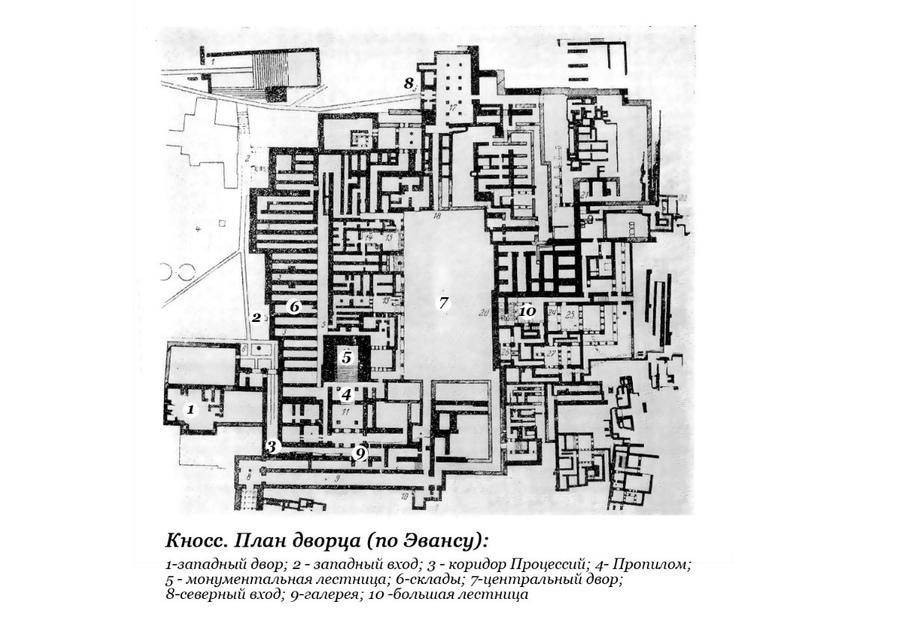
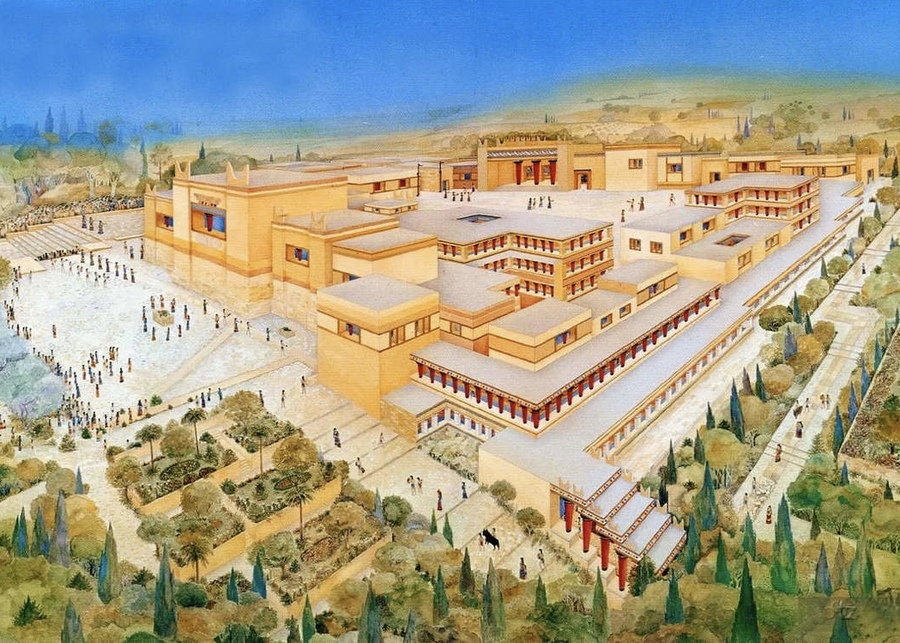
1: Artistic reconstruction of the Palace of Knossos. Source: iLoveGreece.ru 2: Plan of the Palace of Knossos by A. Evans. Source: archi_plans
Following the devastating earthquakes around 1700 BCE, Knossos, Phaistos, Malia, and Kato Zakros—the primary centers of Crete—were rebuilt on a grand architectural scale. The palace complexes of Crete comprised intricate labyrinthine structures that served economic, sacred, and administrative functions. Minoan architecture is characterized by numerous partitions, light wells, and a complex system of corridors. The architectural complexity and enclosed nature of the Minoan spaces necessitated visual diversity in the stone walls.
The Minoan palaces and affluent houses of Akrotiri lacked the powerful defensive walls found in settlements across the Middle East and mainland Greece, as they were protected by the sea and the Cretan fleet. The buildings were organized around a central courtyard. Resources were directed toward beautifying the homes and painting their interiors.At the heart of Minoan culture was the cult of the Great Mother Goddess, whose power was embodied in the earth and the sea. Natural motifs carried symbolism and were directly connected to the Goddess. Consequently, nearly every Minoan building included a sacred space.
Acropolis archaeological complex under a protective canopy. Source: tonkosti.ru
Systematic excavations at Akrotiri began in 1967 by the Greek archaeologist Spyridon Marinatos. Following his death in 1974, Professor Christos Doumas continued Marinatos’s work.
General plan of the Akrotiri Bronze Age settlement excavations, showing the Western House, the «Women’s House, ” and rooms with wall paintings. Source: Wikimedia Commons
Unlike Palace Crete, Akrotiri was an example of a highly developed urban environment. Natural light rarely penetrated the multi-story buildings connected by streets and plazas. Because of this, the frescoes served as «windows» to expand the space. The interior walls continued the outside world.
Building Xeste 3 was a three-story civic and cultural center constructed of finely cut stone, discovered by S. Marinatos in 1973–1974. It was the only building on the island to feature a chandelier pool, an adytum for purification rites, and age-grade initiation ceremonies.
The Western House belonged to the maritime elite, featuring grand halls and private chambers inside. It was situated on the Triangle Square.
The Women’s House consisted of three floors, each containing about ten rooms. The building received its name because of the frescoes depicting women.
III. Visual Language.
In Minoan culture, animals and plants formed a unified system characterized by specific symbols. To link the frescoes of Akrotiri with sacredness, researcher N. Marinatos introduced the concept of the «religious landscape.» In doing so, the artists consciously created an idealized, timeless environment.
Ceramics.
Contrasting duochrome in «marine style» ceramics.
In the Early Minoan period, ceramic art was primitive, featuring simple linear patterns of spirals, triangles, and motifs of curved lines and crosses. By the Middle Minoan period, there was a transition toward more naturalistic depictions, with images of fish, birds, and lilies becoming common. During the Neopalatial period, and with the development of the potter’s wheel, Minoan culture became enriched with ceramic masterpieces. In this era, the depictions on the artifacts became more realistic, although geometric patterns remained used to fill the space around the central figures of the narrative.
Cretan pottery of the «marine style» is distinguished by its bichromy: dark, iron-rich slip was applied onto a light clay background. The absence of color did not make the pieces simpler, as the focus shifted to the composition and the anatomy of the creatures.
Ewer with a «maritime style» relief. Circa 1500–1450 BCE. Pylos, workshop in the Knossos area. Clay, slip painting. Archaeological Museum of Heraklion, inv. Π2661.
The jug is completely covered in patterns. The design is clearly visible due to the contrast. The composition is asymmetrical yet balanced. A landscape emerges from the patterns on the vessel—a fine ornament resembling waves, nautilus shells, and depictions of marine flora. The jug’s unconventional handle, adorned with shells, and the relief on the vessel itself complement the underwater world. In Minoan culture, the nautilus is not only a symbol of the sea but also a symbol of eternal motion due to its resemblance to a spiral. The spiral itself is a key motif on this vessel. Furthermore, the sea creature alludes to maritime trade routes and wealth. From this, one can conclude that the jug may have belonged to influential individuals who hosted banquets and used the vessel for pouring wine.
Flask depicting an octopus and seabed in a «marine style.» Circa 1500–1450 BCE. Paleocastro. Clay, slip painting. Archaeological Museum of Heraklion, Inventory No. Π3383.
The octopus is rendered with curved lines and intricate anatomy. The boundaries of the water surface are absent, and all patterns fit within the empty space between one another. This creates the sensation that the creature is floating weightlessly. Because of the composition and the vessel’s rounded shape, the vase transforms into the sea. The octopus’s curved tentacles resemble waves. The creature and the vase become a single entity.
Polychrome Acrotiri Ceramics