Gesture, operation, code, and prompt in the history of digital art
Concept
The digital interface is often perceived as a mediator between the artist and the image. It provides tools, accepts commands, and displays the result. However, the design of the workspace affects more than just usability. The arrangement of windows, input methods, and feedback mechanisms shape the conception of what it means to create an image—whether it is drawing, transforming, programming, or selecting.
This research investigates the evolution of human-machine interaction language using Sketchpad, early Photoshop, Processing, and Midjourney as case studies. These systems are examined not as a succession of progressively advanced software, but as distinct models of artistic practice. Comparing them allows us to trace the transition from controlling geometry to image editing, rule creation, and formulating generative conditions.
The subject of this study is the interfaces of digital tools for image creation and transformation. The object of study is their visual organization and the distribution of decisions between the user and the program. The main question is: under what conditions does a tool begin to be perceived as a co-creator? The hypothesis suggests that this impression is amplified when the artist shifts from direct control over the form to defining the conditions of its emergence and selecting the outcomes.
Co-authorship is not understood here in a legal sense, nor as proof of machine consciousness. It is a research category that denotes the perception of a system as a participant in the process. The unexpectedness of a result, on its own, does not indicate the program’s autonomy; it may arise from the complexity of the rules, the use of randomness, or the limited visibility of the computations.
The visual corpus consists of photographs of screens, demonstration footage, screenshots, documentation fragments, and sequences of actions. The interfaces are correlated with the outcomes of the work to illustrate the relationship between the team, the transformation, and the image. Historical materials are separated from contemporary experiments; for each example, the program version and the date of capture are essential.
The research structure is built around four languages: gesture, operation, code, and query. It first examines interaction with geometric relationships, then the manipulation of imagery as an editable surface. The next chapter is dedicated to the rules that generate form, and the final one addresses the generation, selection, and refinement of options.
The interface is considered an artistic object not because every working screen is a work of art. Rather, it is understood as a visual system that organizes attention and defines available actions. Research shows how, along with the screen device, concepts of control, artistic labor, and the boundaries of authorship are changing.
Navigation
Who makes the decisions?
Sketchpad: drawing relationships.
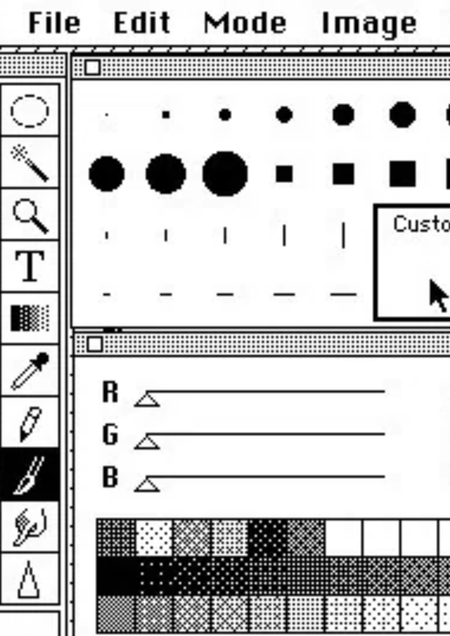
Photoshop: assembling the image.
Processing: writing the rules.
Midjourney: formulating and selecting.
From tool to co-creator.
Conclusion.
Text sources.
Image sources.
If the form is not a direct trace of the hand, where is the authorial act located?
1. Who makes the decisions?
Four ways to organize artistic action: establishing a relationship, executing an operation, writing a rule, or formulating a condition.
The history of digital tools can be viewed as the history of the changing distance between human action and visible form. In one instance, the user directly manipulates an element on the screen. In another, the user selects an operation that transforms an image. In a third, the user describes a sequence of computations. In a fourth, the user sets parameters and evaluates proposed options. These modes of interaction are represented in Sketchpad, Photoshop, Processing, and Midjourney, although no single program is reducible to just one of them.
Direct instruction and verbal description: different ways to link intention with imagery.
2
The interface makes some actions obvious while rendering others difficult to access or invisible. The toolbar offers the selection of operations. The code editor suggests formulating rules. The query field allows for describing what is desired. Therefore, the workspace can be analyzed as a system of prompts: it suggests not only what the user can do, but how they should frame their task.
2. Sketchpad: Mapping Relationships
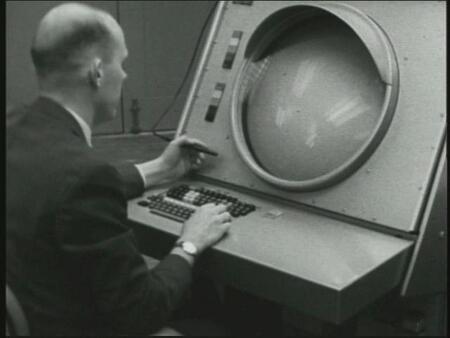
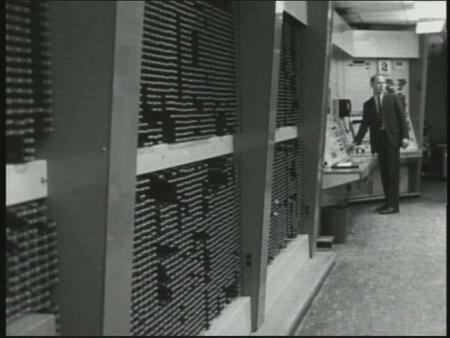
Ivan Sutherland demonstrates Sketchpad on a TX-2 computer. Circa 1963. Computer History Museum.
Sketchpad was created by Ivan Sutherland as part of his doctoral research at the Massachusetts Institute of Technology in 1963. The system allowed users to build and modify geometric images using a light pen and other input devices. The drawing existed not just as a visible trace—the program stored the structure of the elements and the relationships between them.
The workstation photograph shows that interaction was not limited to the image on the screen. The light pen, the buttons, and body posture constituted a single working situation. Therefore, the historical interface here should be viewed not as a separate program window, but as a connection between the screen, the computing system, and the user’s physical actions.
The sequence of actions is more important than any single frame—it demonstrates the connection between user input and system response.
The unique feature of Sketchpad was the ability to set constraints. The geometric construction had to maintain specific conditions—for instance, the horizontality of a line or a point’s membership on a line. The user interacted not only with the placement of elements but also with the rules governing their relative positions.
This drawing differs from a static image. Its form depends on the connections that can be maintained during transformation. A visually simple line becomes part of a structure, and changing one element requires recalculating the others.
The constraint links the elements of the construction and sets the conditions for their transformation.