When Art Becomes a Commodity
Contemporary art is increasingly moving beyond galleries and exhibition spaces, becoming part of everyday visual culture. Artistic imagery appears on clothing, accessories, and in advertising campaigns, and collaborations with artists are transforming into an independent tool for fashion brands' communication.
However, when transitioning from the gallery to the commercial sphere, not only the medium of the image changes, but also the way it is perceived. A work that existed as an autonomous artistic statement becomes part of a product, an advertising image, and the brand’s visual identity.
What happens to art when it becomes part of a brand?
When an artwork is transferred onto clothing, not only its physical medium changes, but also the context of its perception. The artistic object becomes part of everyday life, and its visual language begins to shape the image of a fashion brand.In this study, we will examine which elements of the original artistic language are preserved during commercial adaptation, which transform, and what new meanings arise in clothing design and advertising communication.
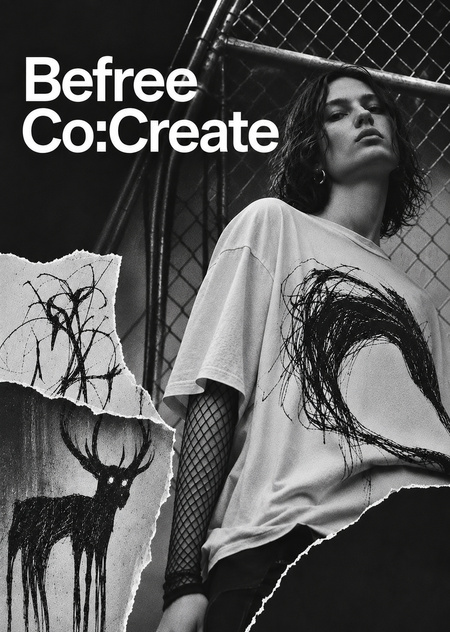
Befree Co: Create: Art Beyond the Gallery
Befree Co: Create — a platform for collaborative projects between the Befree fashion brand and artists, illustrators, and representatives from the creative industries. As part of this project, the original artwork and artistic techniques are adapted to create everyday apparel collections.The distinct feature of Co: Create lies in the diversity of the participants' visual languages. Rather than adhering to a singular aesthetic, the brand engages with individual artistic practices, transforming them into the foundation for clothing design and advertising campaigns.Three collaborations were selected for this study: with Alexandra Gart, the Bang! Bang! studio, and the artist Turben. These partnerships allow us to examine different mechanisms for translating art into fashion—from spatial scenography to illustration and textile texture.
Alexandra Hart 2024
Bang! Bang! 2024
Turbine 2023
Alexandra Hart: Artistic Language as a System
The central case study for this research is the collaboration between Befree and Alexandra Gart, released in 2024. Unlike partnerships primarily focused on transferring illustrations onto clothing, this project allows us to trace a more complex transformation of an original artistic language.
Alexandra Gart’s practice integrates graphic design, installation, and spatial work. Her pieces feature expressive lines, high-contrast imagery, and metallic constructions and materials associated with the industrial environment.
In the collaboration with Befree, these techniques appear not only in the clothing prints but also in the styling of the advertising shoot. Therefore, we can examine three levels of the artistic language’s existence: the original artwork, the garment, and the advertising image.
A line extending beyond the plane
In Alexandra Hart’s artistic practice, the line exists not merely as a graphic element but as a spatial form. The metallic structures resemble a drawing translated from a two-dimensional plane into a three-dimensional environment.The uneven outlines, elongated shapes, and intersections create a sense of organic growth, despite the use of industrial materials. A tension emerges between the natural plasticity of the objects and the artificiality of their material composition.In this context, the line transcends being just a means of representation—it becomes an autonomous element that shapes space.
Alexandra Gart. «Web Forest,» 2021–2022. Exhibition Documentation. Anna Nova Gallery.
Material as part of an artistic statement
Alexandra Hart. Work from the exhibition «Web Forest, ” 2021–2022. Grid, Embroidery. Anna Nova Gallery.
In Alexandra Gart’s work, material is not merely a vehicle for the image but becomes integral to the artistic statement itself. Metal, mesh, paper, and graphite retain their inherent texture and significantly influence the viewer’s perception of the piece. The interplay between the fragile and the rigid, the organic and the industrial, holds particular significance. Uneven surfaces, evidence of handcraftsmanship, and material heterogeneity evoke a sense of instability and incompleteness. Consequently, the materiality of the artwork becomes just as vital as the depicted narrative. The artistic image is formed concurrently through form, surface, and space.
Monochromaticity as a Visual Language
Alexandra Gart, «Untitled, ” 2022.
Alexandra Hart’s graphic works are built upon the expressive interplay of black and white, dense masses, and negative space. The limited color palette amplifies attention to silhouette, the character of the line, and the image’s texture.
Irregular contours, uneven color fills, and traces of the artist’s hand create a recognizable aesthetic, in which the graphics retain a sense of the immediate authorial gesture. The image does not strive for technical perfection; its expressiveness arises from contrast, formal tension, and visual ambiguity.
It is precisely these characteristics that make Hart’s graphic language suitable for transfer onto apparel. The contrasting images maintain their expressiveness across scale changes and interact with the fabric’s surface, becoming an integral part of a fashion collection’s design.
From Artwork to Print: Art on Fabric Surfaces
In the Befree × Aleksandra Hart collaboration (2024), the foundation of the clothing design was the artist’s printmaking—specifically, linocuts and monotypes. The collection features motifs characteristic of her work: deer in headlights, bird silhouettes, the rabbit-grid, and paint drips.When transferred to apparel, the artistic image exists in a new context. Instead of the relatively autonomous surface of the artwork, it is presented on fabric—a medium that moves, folds, and interacts with the human body.However, the contrast, the uneven graphic line, and the evocative quality of the imagery are retained. The function of the image changes: it simultaneously becomes part of the author’s statement and an element of commercial product design.
Deer in the Headlights: From Artistic Image to Fashion Print
The image of the deer in the headlights becomes one of the unifying elements between Alexandra Hart’s graphics and the Befree collection. In its original artistic context, it allows for an ambiguous reading: the collision of the natural and the artificial, the vulnerability of a living creature before external threat, or a state of sudden suspension.
In the realm of fashion, this image acquires an additional function. It transforms into a graphic accent on clothing, beginning to interact with the human silhouette, the fabric material, and other elements of the look.
At the same time, the meaning of the image does not entirely disappear. Its anxious tone persists but becomes part of the collection’s aesthetic. The artistic motif functions simultaneously as an independent image and as a means of visually individualizing a commercial product.
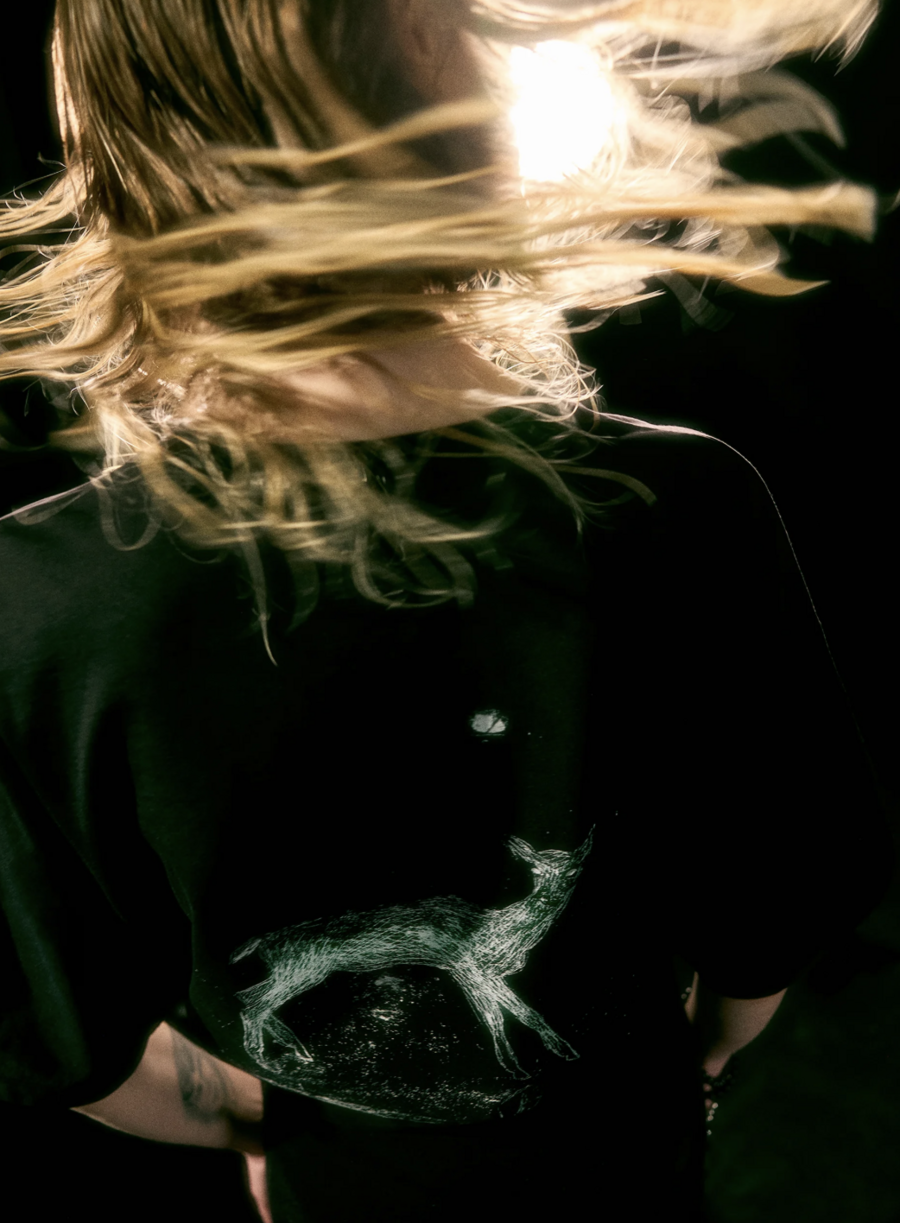
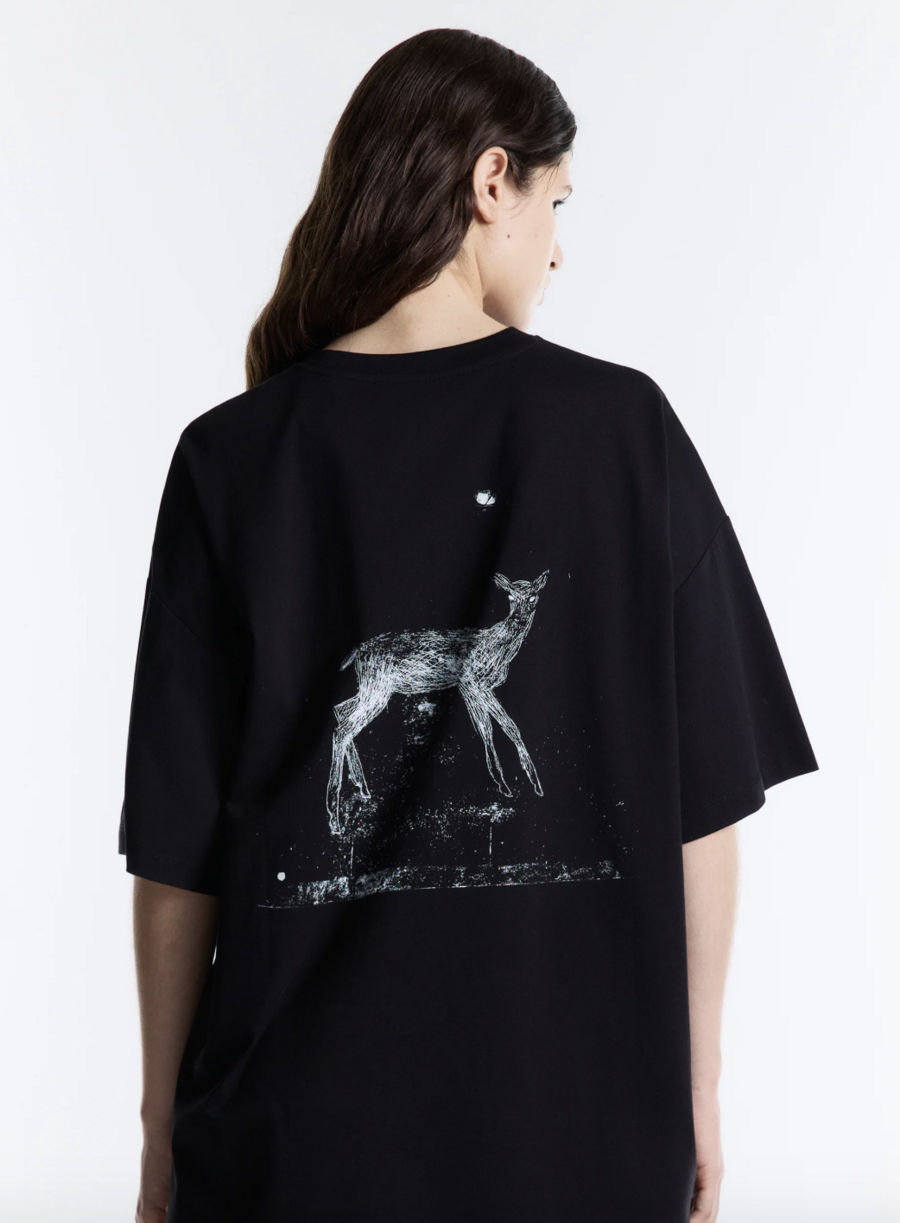
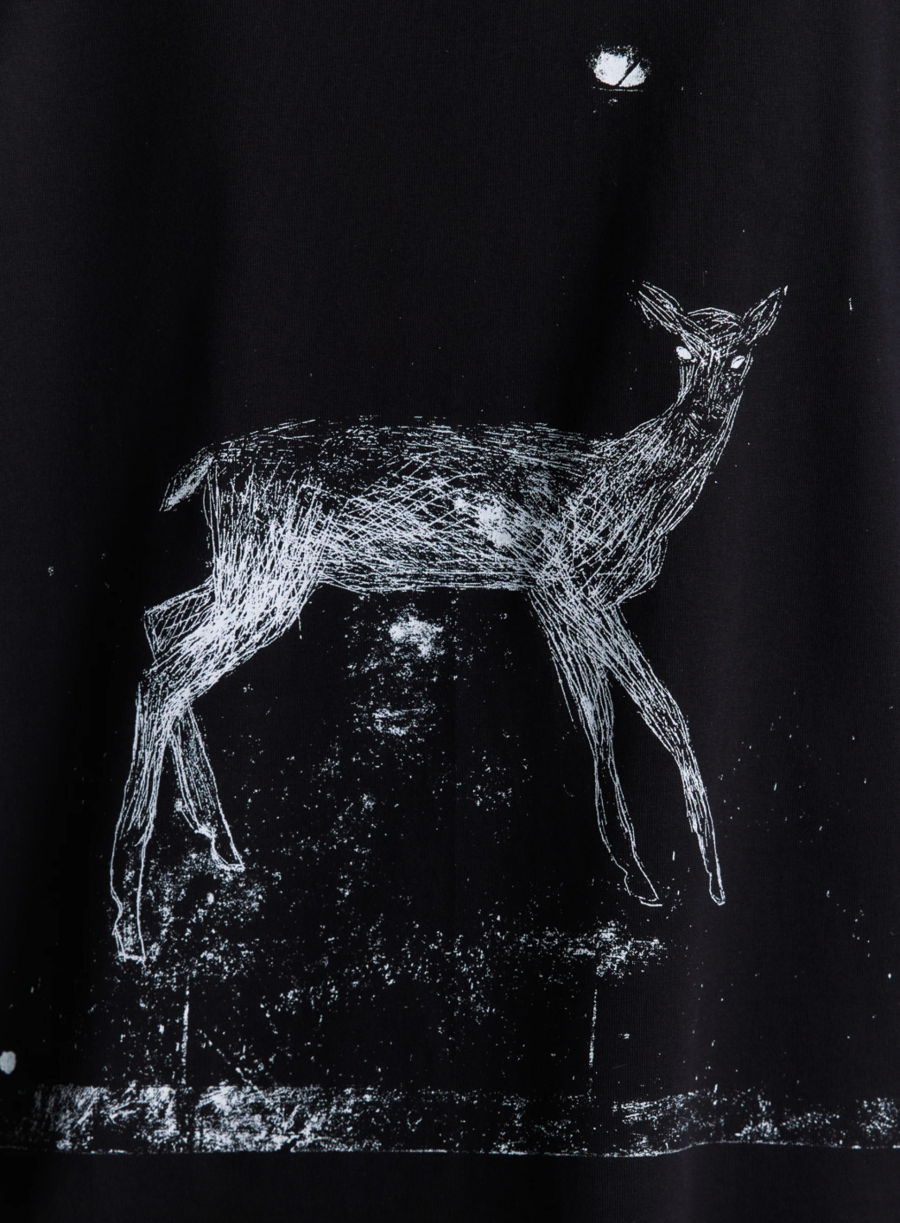
What is preserved: graphic motifs, contrast, line quality, and emotional atmosphere.
What changes: scale, material, context of perception, and the image’s interaction with the human body.
Wire Mesh: From Image to Space
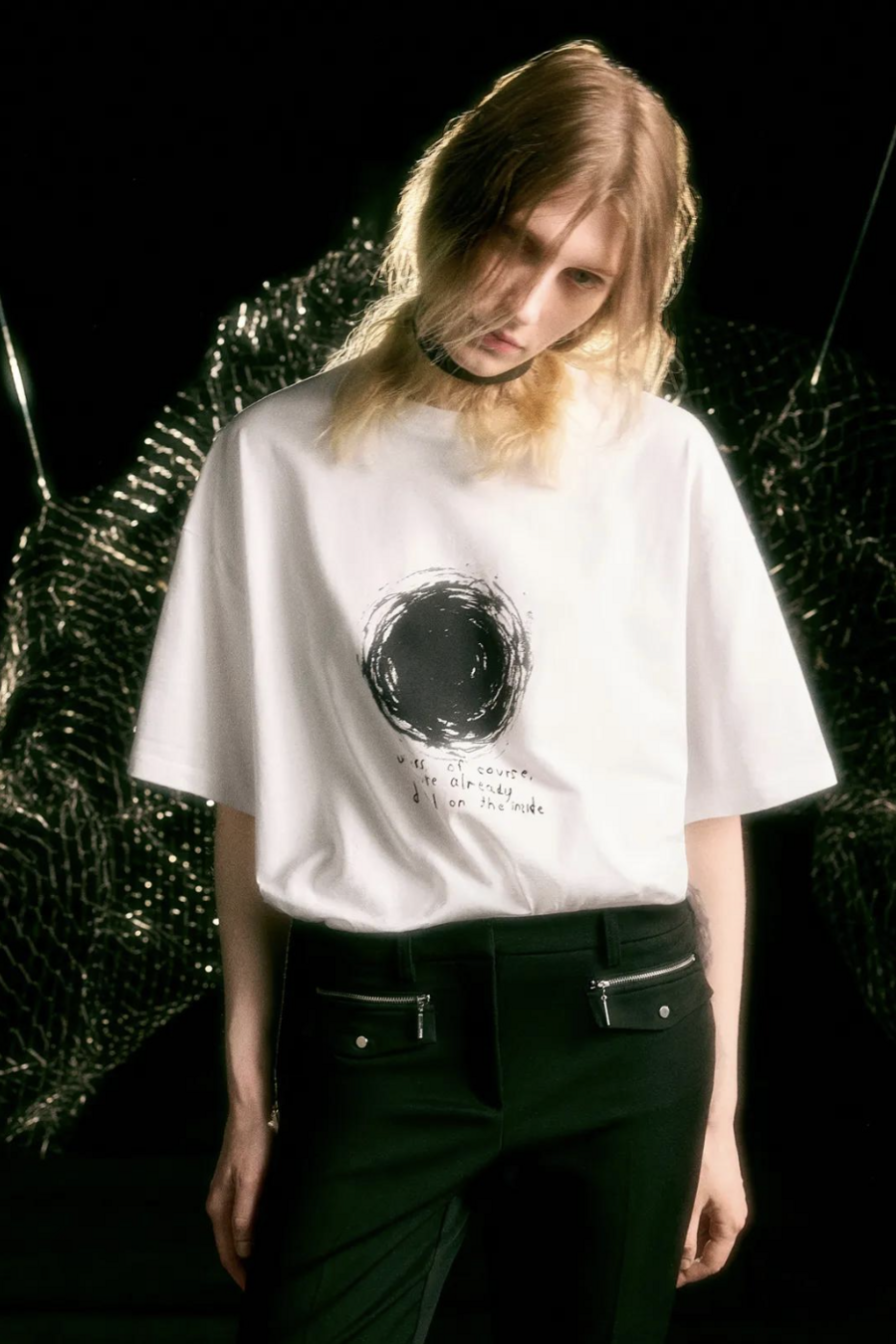
Befree × Alexandra Gart. Promotional shoot for the Co: Create capsule collection, 2024. Scenography featuring a rabbit-wire mesh and metal structures.
The wire mesh becomes a key connective element between Alexandra Gart’s artistic practice and Befree’s visual communication.
In her original graphics, the grid functions as both an image and a system of intersecting lines. When transferred to clothing, it transforms into a print that interacts with the fabric’s surface and the shape of the human body.
However, another transformation occurs in the advertising campaign: the grid returns to physical space, becoming part of the set design. It is no longer just depicted; it surrounds the model, shaping the visual environment of the shoot.
Thus, the artistic motif moves through three states: a graphic image, a textile print, and a spatial object. Its material embodiment changes, but the recognizable structure of intersecting lines remains constant.
GRAPHIC → FASHION → ADVERTISING SPACE
The visual motif maintains recognizability while consistently transforming material, scale, and function: moving from an artistic image to object design, and finally to the organization of a commercial frame.