Concept
Sculpture has always been one of the most memorable and engaging ways to depict the human form. In Ancient Greece, sculpture was diverse, encompassing statues of gods, rulers, cultural figures, and idealized human representations. It did not merely tell a story or present an image; it also demonstrated the era’s understanding of beauty and physical perfection.Undoubtedly, one of the defining characteristics of Greek sculpture is the remarkable similarity among the depictions of gods, heroes, and athletes. Almost all were portrayed as young or middle-aged men—tall, with excellent physical development, and harmonious proportions. But which specific details have allowed audiences to distinguish between characters even today?
The primary question of this visual study is, «How do individual character traits manifest in ancient Greek sculpture from the 5th–4th centuries BCE against the backdrop of the established ideal of the human form?»
The objective of this study is to analyze images of gods, heroes, and athletes in Ancient Greek sculpture from the 5th–4th centuries BCE and determine the extent to which their physical characteristics are dictated by their specific persona or by the era’s general conceptions of the human body.
Greek statues and their copies rendered in the canons of the classical period
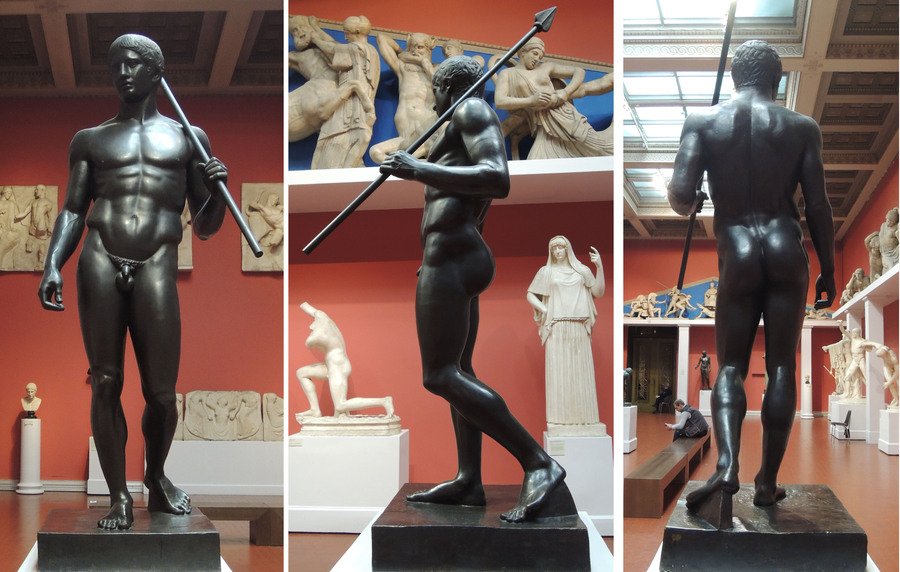
«Doriphoros» («Spear Bearer»), Polykleitos, 450–440 BCE
«Diadumen,» Polykleitos, 430 BCE
«Marathon Youth, ” unknown artist, 4th century BCE
«Ephebe of Antikythera, ” Euphranor, 340 BCE
In the 5th–4th centuries BCE, ancient Greece ushered in an era of classicism, democracy, and cultural flourishing. This period is characterized by the elevation of the ideal Greek citizen and the standard he ought to embody. Sculpture naturally served as a medium for expressing this ideal. The Doryphoros is one of the prime examples of the ideal male physique of that time, rendered according to the canons of Polykleitos.
The sculpture, «Ephibos of Antikythera,» stands as a magnificent illustration of the subject of our study. Before us is a tall, disciplined, and athletic young man with a clear gaze. These are characteristic features of male sculpture from that period; the «Ephibos of Antikythera» possesses no distinguishing marks. Researchers continue to debate his identity—some posit he is the hero Perseus holding the head of Medusa, while others suggest he is a victorious athlete. A few have hypothesized that he might be Paris holding the apple of discord.
These examples present athletically built individuals who achieve victories, participate in competitions, and were intended to inspire Greek citizens to aspire to the same ideal.
Identification of Deities in Classical Greek Sculpture
Apollo
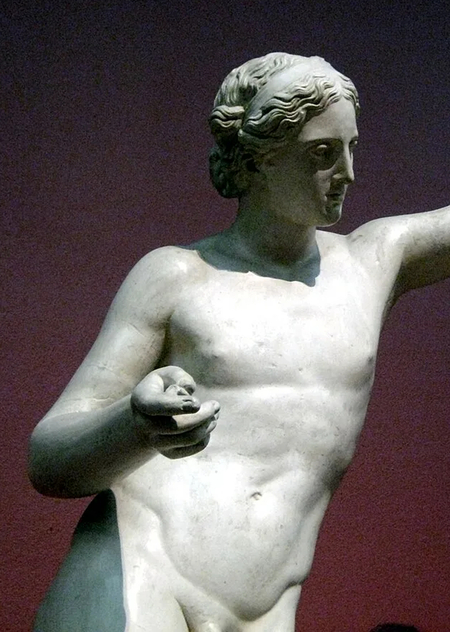
«Apollo Slaying a Lizard» (copy), Praxiteles, 330–320 BCE
«Olympian Apollo, ” unknown artist, 460 BCE
«Apollo on the Eastern Frieze of the Parthenon, ” Phidias, 447–432 BCE
Apollo will serve as an interesting example in my visual research. The depiction of this god in sculpture largely comprises the elements listed above—characteristics utilized in every male figure of that era: a slender body, ideal proportions, and a youthful face. However, sculptors also infused him with unique attributes. Ancient Greeks and historians identify Apollo through a variety of details: a laurel wreath or a branch woven into his hair, a lyre or kithara in his hands, a bow and quiver of arrows, as well as lizards and snakes. These features include external ones: compared to athletes, Apollo is also toned, but far more aesthetic, and his posture is relaxed, which aligns with the mythological representation of the god. Consequently, Apollo possesses identifying attributes related both to his appearance and his surroundings, which facilitates his recognition.
Poseidon
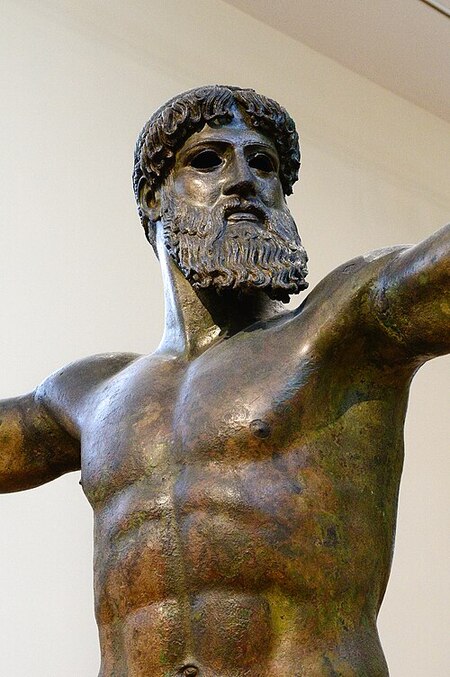
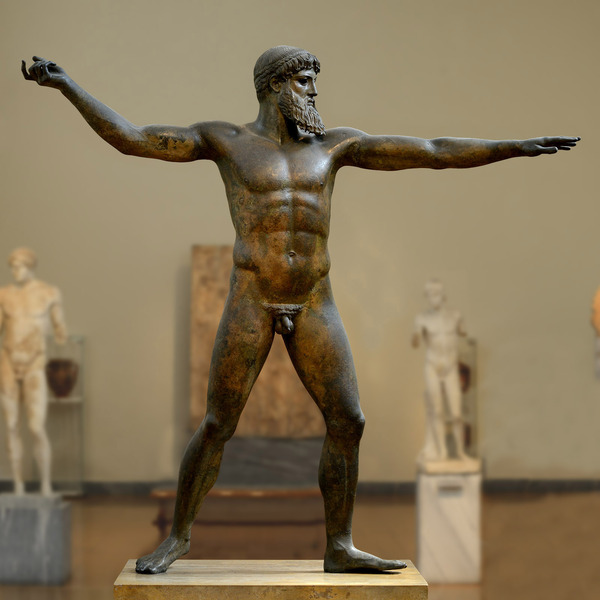
«God from the Artemision Cape, ” unknown artist, 5th century BCE.
«Poseidon Statue, ” the game „Assassin’s Creed: Odyssey“
Our next example is a statue from the Cape of Artemisium. The sculpture depicts a man. He is severe, tall, and has a physique that adheres to the canon, yet he appears more imposing and wears a beard, which suggests a greater maturity than Apollo or the other athletes. The man is in an active pose, as if preparing to throw something, and this detail has generated numerous debates among historians and art critics to this day. Many believe this statue portrays an ancient Greek god, but the lack of attributes prevents a definitive answer, as many gods and heroes of that period were depicted similarly, distinguished only by minor details. Depending on what the god held, he could be named Zeus or Poseidon, as both have their own «throwing» attributes: a thunderbolt for Zeus and a trident for Poseidon.In one part of the «Assassin’s Creed» game series—specifically, «Assassin’s Creed: Odyssey,» which focuses on Ancient Greece—the creators depicted the famous statue holding a bronze trident, identifying the hero as Poseidon.
«Poseidon on the West Pediment of the Parthenon,» Phidias, 432 BCE
«Poseidon of Lysippus» (original lost), Lysippus, 4th century BCE
Poseidon is depicted in sculpture as a mature, bearded man with well-developed musculature, which aligns with many statues of gods and heroes from that period. His primary distinguishing features are the trident and marine animals. He was also often depicted in a chariot with horses, as mythology holds that the god was their patron. Without these unique attributes, identifying Poseidon can be difficult. Many sculptures still lack clear attribution because the god’s symbols have been lost, making it easy to substitute foreign ones. Often, researchers resort to what I find to be the most interesting method of character identification: the myths of Ancient Greece. Sculptural compositions depict not only the god himself but also narratives involving him. Thus, «Poseidon on the Western Frieze of the Parthenon» was identified and reconstructed based on the myth concerning Poseidon’s dispute with Athena over patronage of the city.Following these observations, Poseidon is recognized not by his physical appearance but by his attributes. If the attributes are lost—researchers turn to surviving records, sketches, or the nation’s mythology, correlating them with the location.
Zeus
Drawing of the lost statue of Zeus at Olympia by Phidias, 435 BCE
Drawing of the lost statue of Zeus at Olympia, Phidias, 435 BCE
Statues from the exterior decoration of the Temple of Zeus in Olympia, unknown artist, 5th–4th century BCE.
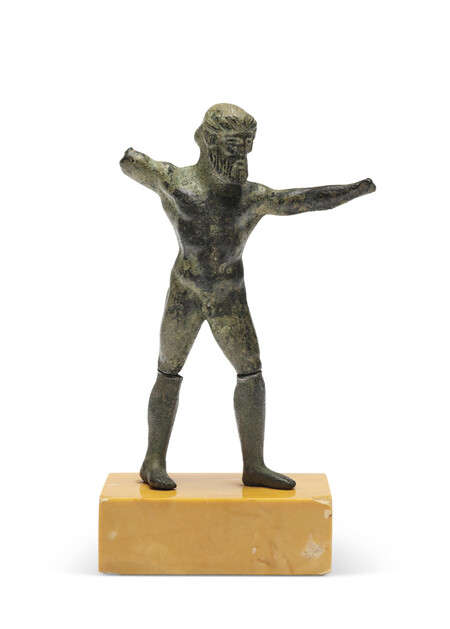
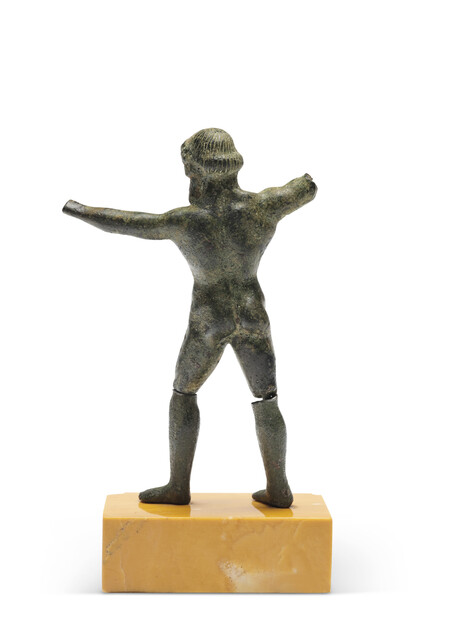
«Bronze statue of Zeus hurling a spear», unknown author, 5th century BCE
Statues of Zeus from this period share characteristics with statues of Poseidon: a commanding and physically developed male physique, a beard and curly hair, a stern gaze, and a majestic posture that underscores the status of the supreme god. Because of this, like the aforementioned Poseidon, the thunderer is distinguished by his attributes and environment. In his case, these are lightning, or a scepter in his hand, an eagle depicted nearby, and the throne upon which the supreme god sits. Interestingly, in group compositions, Zeus appears far more imposing than the other gods, even though the bodies of all are rendered according to the common canon of the Classical period. The presence of at least one of the mentioned attributes helps to immediately identify Zeus, and their absence opens the door to debate. The most striking statue, in terms of attributes, is the lost wonder of the world, the «Statue of Zeus at Olympia.» In its drawings, we see all the aforementioned attributes ascribed to Zeus, as well as an olive wreath.
Limestone statuette of Zeus, artist unknown, 4th century BCE.