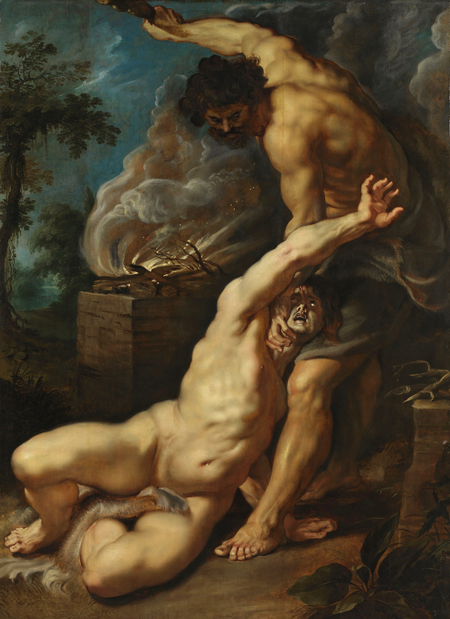
Concept
- Topic Justification
For my visual exploration, I have chosen the biblical story of Cain and Abel. I am interested in this theme because it allows for an examination of the relationship between two close individuals experiencing conflict. This narrative encompasses several episodes that vary significantly in tone and content—visual interpretations of which can differ greatly, even though the core events remain unchanged. Artists portray the brothers in diverse ways; their emotions, and their relationship with each other and with God, can vary widely. I am particularly drawn to the figure of Cain and how his depiction shifts across different episodes. I want to understand how artists represent him: as a man consumed by extreme jealousy and rage, or as a criminal confronting the repercussions of his own actions. It is also important to examine how Abel is depicted in contrast to Cain and the role he plays in these works.
2. Material Selection Principle
The primary material for the study will be paintings created up to and including the end of the 19th century. I plan to select works dedicated to the story of Cain and Abel, featuring four main episodes:
— The Sacrifice of Cain and Abel
— Abel’s Murder by Cain
— Cain’s Condemnation
— Cain’s Punishment and Banishment
3. Rubrication Principle
The study will be divided into four parts, corresponding to the main episodes of the narrative. This structure will allow for a sequential examination of the plot’s development. Each section will feature works dedicated to a single event. Within these divisions, I plan to compare artworks based on specific visual criteria: composition, character placement, posture, gestures, facial expressions, inter-character interaction, and environmental detail. For example, when examining the murder scenes, one can observe how artists depict the moment of violence and what emotions they convey through the characters' poses and gestures. In the scenes of exile—the depiction of Cain and the methods artists use to convey his solitude. Thus, the research will be built not only around the sequence of events but also around the comparison of artistic choices.
4. Principles of Selecting and Analyzing Textual Sources
For working with visual materials, I plan to use a minimum of textual sources. These will be materials that help me understand the nuances of the narrative.
5. Research Question and Hypothesis
Key Question: How have artists from different eras depicted the conflict between Cain and Abel? I want to find out what characteristics of this depiction are repeated across various works and which ones differ. Special attention will be paid to how artists portray Cain and Abel, how they distribute focus between the characters, and what visual means they use to convey the relationship between them.
Hypothesis: Cain’s image can change significantly depending on the depicted episode. Furthermore, as the story develops, he may become the central figure around whom the composition and the viewer’s attention are built. I hypothesize that comparing various works will reveal how artists conveyed not just the events themselves, but also the characters' inner states. During this study, I aim to test this hypothesis using specific pieces to determine how differently artists approached depicting the same narrative.
Concept
«1 Adam knew his wife—Eve. She became pregnant and gave birth to a son, Cain, and said, „I have gained a human being—a man—from the Lord!“ 2 She also gave birth to Abel, Cain’s brother. Abel began to keep sheep, and Cain began to till the ground. 3 After some time, Cain brought an offering to the Lord from the produce of the earth. 4 And Abel also brought his offering: lambs from the first of their flock, the fattest parts. 5 The Lord looked favorably upon Abel and his offering, but did not look on Cain and his offering. Cain became furious and lowered his head. 6 The Lord asked Cain, „Why are you angry? Why have you lowered your head?“ 7 If you do good, lift up your head. But if you do not, sin waits at the doorway. It longs for you—you are its master. 8 So Cain said to Abel, his brother. And while they were in the field, Cain attacked Abel, his brother, and killed him. 9 The Lord asked, „Where is your brother Abel?“ Cain answered, „I do not know. Am I a guard for my brother?“ 10 The Lord said, „What have you done? The blood of your brother calls to Me from the ground.“ 11 Now you are cursed from the ground that opened its mouth to receive the blood of your brother from your hands. 12 No matter how much you till the ground, it will no longer give you its yield. From now on, you are an exile and a wanderer. 13 Cain said, „This punishment is too heavy for me to bear.“ 14 You are driving me from the land; I will be hidden from You. An exile and a wanderer—anyone can kill me. 15 But the Lord said, „Whoever kills Cain will be avenged seven times over.“ And the Lord marked Cain with a special sign so that strangers would not dare kill him. 16 Cain went away from the Lord and settled in the land of Nod, east of Eden» [2]
«The history of the interpretation of the biblical story of Cain and Abel traces back almost to the birth of the Jewish tradition. The issues of rivalry, sin, human freedom, good, and evil are just a brief list of themes that arise in the context of this narrative» [1]
«Eve saw in her son’s figure (Cain) the promised Savior… She was certain that by giving birth, she had paid the price necessary to restore the relationship after the transgression… of Cain, whom she named—an acquisition… Unlike the birth of Cain, upon whom the parents placed all their hope, the birth of Abel marked a personal tragedy in their faith, as the return to Eden did not occur after all the ancestral pains endured, and the promises, as they understood them, were not fulfilled. Therefore, Eve expressed all her great disappointment and sorrow by naming her second son Abel—the void» [1]
The Sacrifice of Cain and Abel
In all three of the following images, the landscape plays a vital role: it not only establishes the setting but also emphasizes the scale of the events, integrating the figures into the surrounding world.
Claudio Joseph Verne — «Cain and Abel Bring Their Offerings, ” 18th Century
Willem van Herp — «God accepts Abel’s sacrifice, rejecting Cain’s offering; in the background, Cain kills Abel, ” c. 1626–1677
The smoke from the sacrifices becomes a crucial detail in the narrative: it emanates from Abel’s offering, but not from Cain’s, leading us to understand that God accepts Abel’s gift and rejects Cain’s.
Albertinelli Mariotto — «The Sacrifice of Cain and Abel,» c. 1474–1515
In the paintings by the workshop of Simeon Alvarez and Luke Giordano, the focus is less on the surrounding space and more on the figures of the brothers. Their placement and the lighting help to illustrate the difference between the heroes: Abel’s face is illuminated; he is turned toward God, whereas Cain turns away and remains in the shadow. Through the chiaroscuro contrast, the artists emphasize the opposition between the brothers and the different attitudes God holds toward their sacrifices.
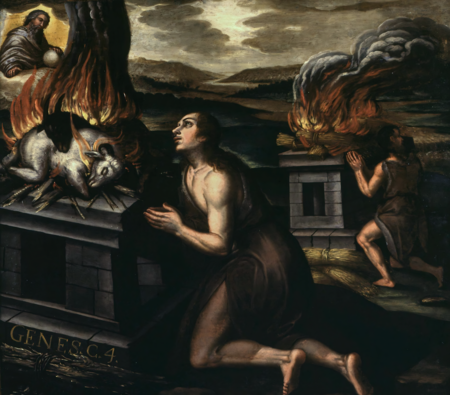
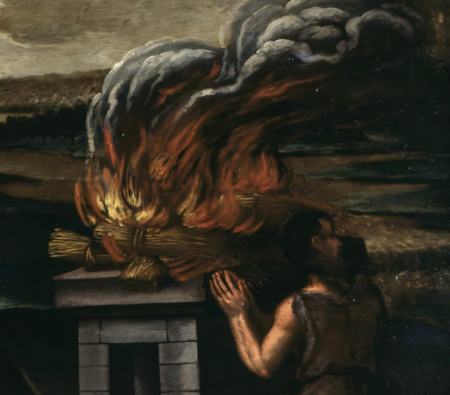
Siman Alvarez’s Workshop — «The Sacrifices of Cain and Abel, ” 17th Century
Interestingly, both pieces utilize a similar composition: God is depicted in the upper left corner—the most significant area of the painting.
Luca Giordano — «Sacrifices of Abel and Cain, ” 17th Century
The Murder of Abel by Cain
In the paintings of Tintoretto and Titian, the characters' faces are obscured, which prevents us from examining their emotions. Abel’s face is turned away from the viewer, and Cain’s face is cast in shadow; consequently, our focus is drawn to the movement of the bodies and the action itself. This technique intensifies the drama of the scene, making the murder more brutal and tense. The hidden faces also strip the characters of individual traits, shifting the emphasis onto the conflict and its tragic outcome.
Jacopo Tintoretto (Robustus) — «Cain and Abel. The Murder of Abel, ” 1552