Concept
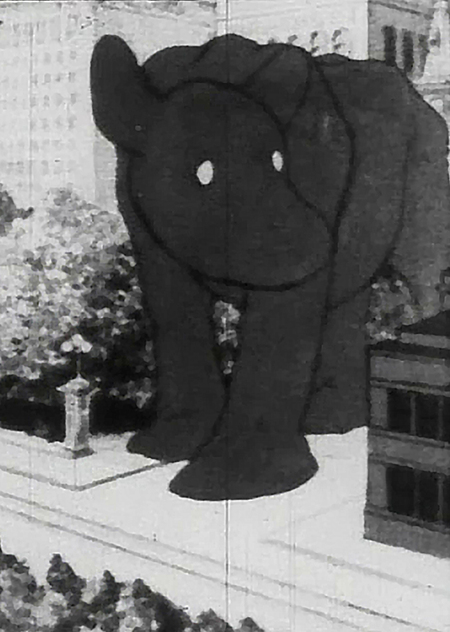
The beast from The Pet is initially held in someone’s hands. After several minutes, its back rises above the rooftops. In The Flying House, an entire house with a porch and a chimney initially takes up almost the entire frame. By the end of the flight, the same silhouette must be found among the stars.
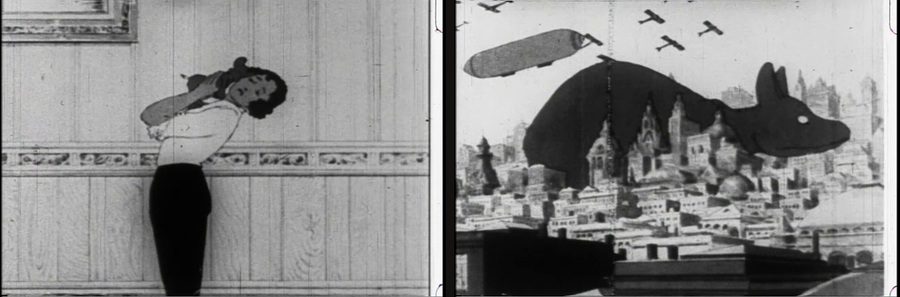
Two appearances of the same beast. On the left, it is held up to a face; on the right, airplanes fly over it. The Pet (1921)
What details allow the viewer to notice that the scale has changed? Episodes featuring a familiar object next to the character—which allows for the size of the figure to be assessed—were selected for comparison. Changes in perspective also take into account the distance from which the character is shown.
Both films were released in 1921. The credits for The Pet attribute the drawings to Winsor McKey. For The Flying House, the credits name Robert Winsor McKey and indicate that he worked in the Winsor McKey animation technique.
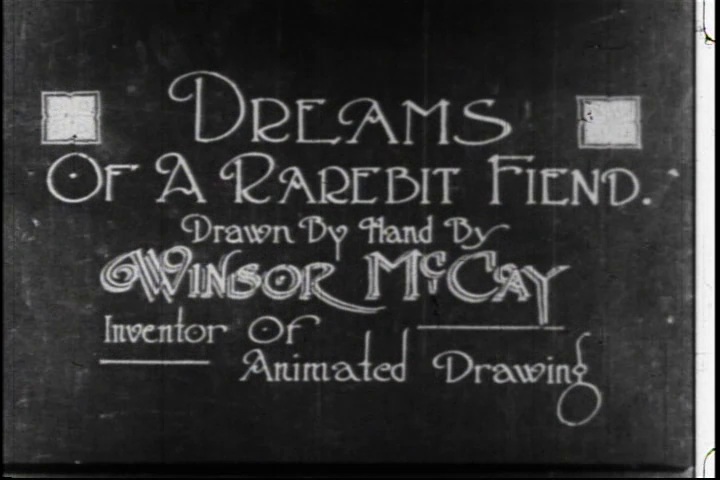
The credits state that the drawings were hand-drawn by Windsor MacKay. The Pet (1921).
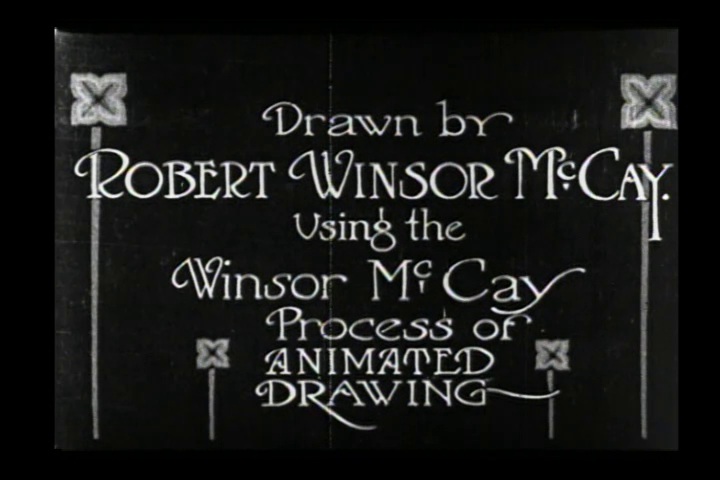
The drawings are attributed to Robert Winsor McKee. Below is the Winsor McKee animation method. The Flying House (1921).
From bowl to bed
The little creature walks diagonally toward the door. Its dark silhouette easily blends into the shadows on the path. As it approaches the wall, it becomes clear how much space it occupies next to the doorway.
Creature on the path. A dark door is visible in the distance. The Pet (1921).
The figure moves toward the opening. The contour diminishes within a single perspective. The Pet (1921).
Here, the reduction of the figure is related to the absence. The seam on the path and the edge of the wall remain in place, and the creature passes between them. When it reaches the door, its height allows us to estimate its size within the scene’s space.
A woman raises a small animal to her face. The length of its body is visible in relation to her forearm. The Pet (1921).
Bathing. The woman’s hands and the edge of the tub remain close to the animal as she changes positions. The Pet (1921).
While bathing, the figure is sometimes elongated on its arms, and sometimes nearly slips over the edge of the tub. Even when parts of the body are obscured, the hands and the tub edge remain nearby, allowing for a comparison.
A flat bowl is placed on the floor in front of the animal. The Pet (1921).
The bowl obscures the body. Legs are visible underneath. The Pet (1921).
In the scene with the bowl, the low viewpoint makes the animal more prominent than the doorway. The tilted rim of the bowl almost obscures it from above. This allows the viewer to judge the animal’s size while the furniture remains out of frame.
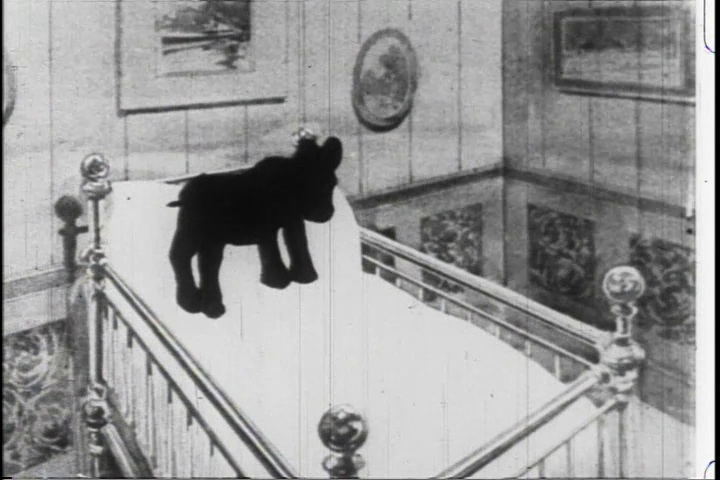
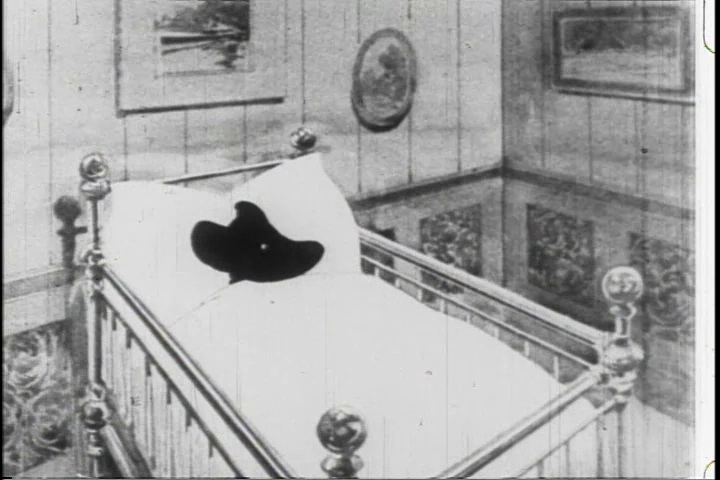
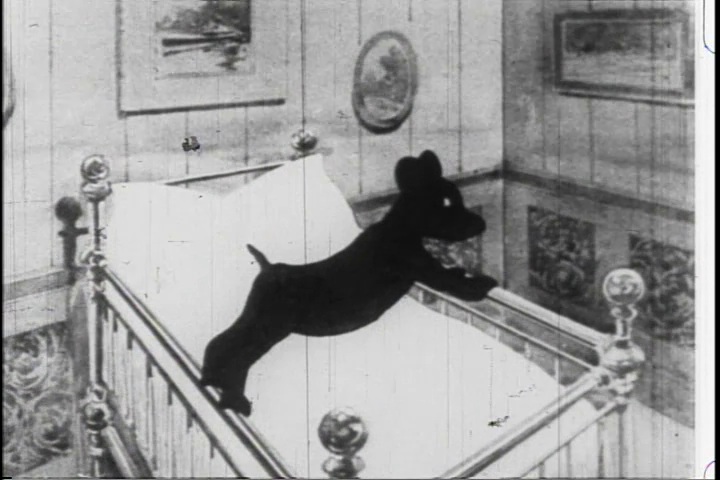
Three shots of the same metal crib. The Pet (1921)