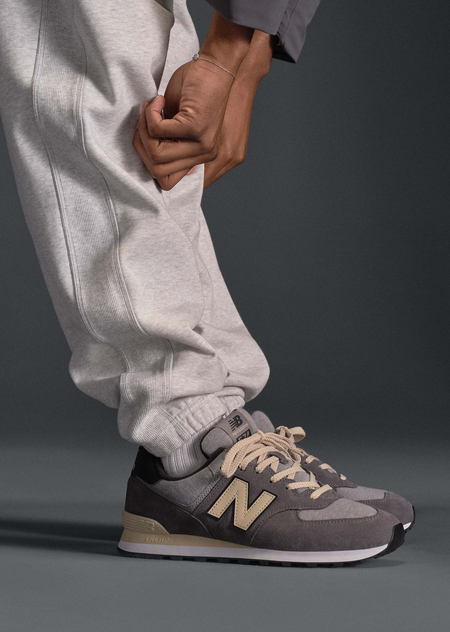
Promotional Video
Concept
Gray is often described as calm, neutral, or inconspicuous. Phrases like «gray routine» and «gray mass» in speech associate it with boredom or a lack of individuality. But for New Balance, gray is not a random color choice. In the 1980s, the brand adopted it for running shoes, and over time, this color became one of the brand’s recognizable hallmarks. I became interested in how advertising can change a preconceived notion of a shade without altering the shade itself.In 2024, New Balance released the «Grey Days» campaign, centered around a seven-minute film that weaves together seven short stories. The film depicts an airport, a running track, urban encounters, and everyday situations. Much of the film is shot on black-and-white 16 mm film; against this backdrop, the color animation segment detailing the history of the 990 model stands out particularly. As a result, gray appears not just on the sneakers—it defines the entire visual language of the advertisement.
What visual and psychological techniques does «Grey Days» employ to encourage the viewer to perceive gray as an element of individuality, cultural memory, and the recognizable New Balance brand?
Hypothesis: The campaign alters the associations presented with gray by sequentially linking the product to various contexts. Initially, the viewer’s attention is drawn to the shoes within familiar situations; subsequently, the running model’s story and animation imbue it with special significance; the DMV episode establishes a cultural connection with a specific community; the final phrase synthesizes these meanings. Furthermore, the repetition of gray and a uniform filming style tie these disparate narratives together as parts of a single message.
Research Objective: To analyze the advertising impact at the level of imagery. I am interested in selective attention, visual hierarchy, contrast, recognition of everyday scenarios, associative linking, and the interplay between text and image. It is crucial to distinguish between a device visible in the frame and the presumed viewer reaction, which cannot be considered an established fact without audience research.
For the analysis, I selected key frames from the film, the promotional poster, and product photography from the «Grey Days» materials. These allow me to trace how the sneaker’s position within the frame changes, how the director utilizes the monochromatic palette, why color animation is introduced, and how the final title card helps interpret the preceding episodes. The material is organized according to perceptual tasks: first—attracting attention; second—forming associations, cultural recognition, emotional connection, the final metaphor, and adapting the idea to various advertising media.
Table of Contents
1. How the Viewer Notices the Gray
2. Why the 990 Model is Memorable
3. How Footwear Becomes a Sign of Belonging
4. Recognizable Scenarios
5. The Final Metaphor
6. One Idea in Different Formats
7. Strengths and Limitations of Advertising Techniques
8. Conclusion
The visibility of gray depends on contrast, environment, and composition. In «Grey Days,» New Balance uses the repetition of color across the footwear, the setting, and the photography, transforming it into a unifying element of the campaign. Denotation—the literally depicted objects: sneakers, people, the city. Connotation—the associations that arise through context. Because of this, gray acquires additional meanings: everyday life, athletic history, and affiliation with a particular culture.
How the viewer notices the gray. First impression.
The film opens with the phrase «Grey brings us together.» This is an advertising metaphor that emphasizes the connection between people through New Balance gray sneakers. The viewer is immediately given a frame of reference: to find commonality between characters in different scenes. From a Roland Barthesian perspective, the text serves the function of signifier reinforcement—helping the viewer understand the images exactly as the advertisement intended.
New Balance. Grey Days, 2024. Airport Episode
Next, the airport is shown. First, the viewer sees people and the familiar baggage claim area. This is a contextual demonstration of the product: the advertised item is integrated into a daily situation. This order allows the audience to first become interested in the action and the characters. The footwear is perceived as part of their usual appearance.
Grey Days, 2024. Two people at the baggage carousel (film, 00:08–00:12 / film, 00:16–00:20).
Grey Days, 2024. Sneaker from a low angle (film, 00:20–00:24).
Transitioning from a wide shot to a close-up of the footwear alters the visual hierarchy, directing the viewer’s focus onto the product. Thanks to the preceding shots, the sneakers are already associated with the characters and the travel scenario.Conclusion: The edit gradually shifts attention from the person to the product, and the text and visual context help establish the desired associations.
Why the 990 model is memorable. Contrast and history.
New Balance. Grey Days, 2024. Title: «Grey was born from running.» Freeze frame, 00:32–00:36.
The phrase «Grey was born from running» shifts the conversation from the abstract concept of color to the product’s history. According to New Balance materials, grey was chosen for running shoes in the 1980s, partly due to its connection with the urban environment—concrete and asphalt. In the advertisement, the text serves as a conceptual anchor: it signals to the viewer why the next episode is specifically related to running.
New Balance. Grey Days, 2024. Sneaker on a treadmill. Still frame, 01:08–01:12.
On the treadmill, the footwear is presented in the context of its original purpose, establishing an association between the product and its function. The monochromatic shooting visually links this scene to previous sequences.
Color Animation as a Violation of Expectation
New Balance. Grey Days, 2024. Juxtaposing black-and-white footage with color animation. Freeze frames, 01:36–01:40 / 01:56–02:00.
After a monochromatic film shoot, the film transitions to vibrant retro animation dedicated to the 990 model. The contrast in color, style, and motion disrupts the established visual expectation, captures the viewer’s attention, and highlights a new thematic focus.
The sneaker is the hero of its own legend
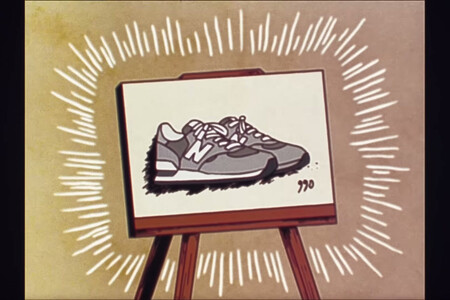
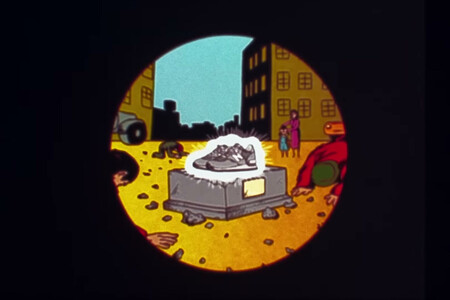
New Balance. Grey Days, 2024. Model 990 in the light. Still frame, 02:20–02:24. New Balance. Grey Days, 2024. Sneaker on a pedestal. Still frame, 02:48–02:52.
In the sneaker animation, the shoe is highlighted with light and presented as an exceptional invention. This technique is called «visual hyperbole”—an intentional exaggeration of the object’s significance. A light touch of self-irony underscores the special place the 990 model holds in the brand’s history.The animation references the release of the New Balance 990 in 1982 and its high price for that time—around $100. This historical fact is transformed into a vivid, memorable image.Conclusion: The running scene reveals the footwear’s functional purpose, while the animation emphasizes the exclusivity of the 990 model. The sharp visual contrast draws attention and enhances the memorability of the segment.
New Balance. Grey Days, 2024. Sneaker on a pedestal. Freeze frame, 02:48–02:52.
How Shoes Become a Sign of Belonging
New Balance. Grey Days, 2024. Episode Title DMV. Freeze-frame, 02:56–03:00.