Categories
- Concept
- Who buys premium furniture? Consumer psychotypes and values.
- What exactly does the brand sell? Product positioning and image.
- How does the visual strategy transform a commodity into a desired object?
- How does an object become a symbol of status, taste, and lifestyle?
Concept
Furniture often seems to be an object whose value can be explained through practical attributes: it must be comfortable, durable, long-lasting, and suitable for the interior. However, in the premium segment, the purchase is rarely just about solving a domestic need. A chair, sofa, or table can become a way to express one’s personal taste, underscore one’s vision of a high quality of life, demonstrate cultural interests, or signify social standing. Therefore, the appeal of an object is not derived solely from its materials, construction, or the designer’s work. The image a brand cultivates around the item and presents to the potential buyer plays a crucial role.Advertising participates in this process by translating the object’s properties into a language of desires and values. It can portray furniture as the result of technological mastery, as a piece of authorship design, as a symbol of understated luxury, or as part of an ideal daily scenario. In one instance, the focus is on construction, texture, and execution precision; in another, it is on the interior, architecture, and atmosphere; in a third, it is on the person using the object and the lifestyle with which the viewer can identify. Visual communication does more than just display a finished product—it shapes the context in which that product acquires additional meaning.
This research examines premium Russian furniture brands and analyzes their advertising materials created between 2015 and 2026. For comparative analysis, Dantone home, Tok Mebel, Boca Room, Modenature, and Mononova have been pre-selected. These brands allow for the examination of various value-building strategies: through architectural restraint and the perception of luxury, design authorship and history, technological advancement and manufacturing expertise, formal expressiveness, and the emotional dimension of interior design.

A crucial theoretical foundation will be David Ogilvy’s book, On Advertising. His practical perspective allows us to view advertising as a deliberate system: a brand must understand the target audience, formulate a convincing promise, create a recognizable image, and select a presentation method that supports the product’s positioning.
Jean Baudrillard’s book, The System of Objects, offers a different perspective. In it, the object is examined not only in terms of its practical function but also as an element within a system of signs and social distinctions. Objects can communicate information about their owner—their status, taste, and affiliation with a particular cultural milieu. This is especially relevant when analyzing premium furniture: an object can gain value not just from its comfort or manufacturing quality, but also from the meanings associated with its name, form, origin, and presence within a specific interior design.
Another tool will be the psychographic typology of consumers from the article by Evgenia Gromova and Marina Gerasimova, «Consumer Psychotypes and Brand Positioning, ” published in 2005. This typology will not be used to identify the actual buyers of specific brands, but rather as an analytical model to help observe which motivations a marketing message might appeal to.
The focus of the visual analysis will be on comparative materials from various brands: advertising campaigns, image shoots, video clips, collection presentations, and publications designed to promote specific furniture pieces or collections. We will examine how the furniture itself is presented, the space it occupies, the presence of people, how materials and details are portrayed, and the role of light, color, composition, architecture, and stylization. It is crucial to differentiate between advertising materials, editorial shoots, and catalog images—they serve different functions and should not be automatically categorized as the same type of advertising.
This comparison will reveal which visual techniques are used to convey functional qualities and which are employed to create emotional or symbolic value. Special attention will be given to how the object connects to the portrayal of the desired lifestyle: does it become a sign of status, an expression of individual taste, an object of sensory pleasure, or a component of cultural experience? The outcome will be an attempt to understand precisely how advertising shapes the desire to own furniture and what lifestyle ideals premium brands propose.
To whom is premium furniture sold? Consumer psychotypes and values.
The purchaser of premium furniture cannot be defined solely by high income. Financial capacity allows for the consideration of expensive items, but it does not explain the selection of a specific model, brand, or designer. For research purposes, it is more important to understand what expectations a person associates with the purchase: comfort, durability, aesthetic pleasure, self-expression, or recognition. It is these motivations that allow us to view furniture as an object possessing both practical and personal value.
One person may seek furniture that will last for many years and become part of their family home. Another may value surrounding themselves with pieces of original design, viewing the interior as a personal collection. A third seeks to underscore their achieved status, while a fourth primarily values physical comfort and the pleasant sensation of the materials. These scenarios help reveal that different ideas about the desired life can lie behind an interest in a single category of furniture.
The distinction in motivations allows for the suggestion of different ways to approach furniture sourcing. A consumer focused on practicality will pay attention to construction, materials, and usage conditions, while one interested in designer authorship will focus on the creator’s name, the concept, and the object’s story. For someone seeking self-expression, the unusual form and the possibility of custom fabrication may be the most significant factors. In this research, these represent working scenarios—they help determine what information and imagery a brand offers a consumer to substantiate their choice.
Furniture searching can occur independently or with the assistance of an interior designer. In the latter case, the professional helps align the client’s wishes with the space, budget, and the characteristics of the items. Therefore, it is useful to differentiate between the personal motivation of the future owner and the arguments a specialist needs to incorporate furniture into a project. When analyzing communication, we will consider to whom a specific piece of content is addressed: the person envisioning their life within the interior, or the professional selecting the solution.
To systematize these motifs, we employ the typology developed by Evgenia Gromova and Marina Gerasimova, which is based on consumers' core life values. The authors delineate six types: the Ordinary, the Intelligentsia, the Independent Creatives, the Careerists, the Hedonists, and the Imitators. These labels are conceptual and do not constitute a judgment of an individual or a direct indicator of their profession or income. In our research, this typology helps distinguish the underlying motivations for furniture selection and align them with brand messaging.
For the general public, home, family, and stability are important. Therefore, in the context of furniture, one can assume an interest in the convenience of daily life and the arrangement of shared spaces. In this scenario, an object is valuable primarily for how well it meets the needs of the household. The intelligentsia also values family and comfort, but their value system prioritizes personal development, self-realization, and inner harmony. Thus, a similar image of a cozy home can appeal to various motives: practical well-being or the creation of an environment that reflects the owner’s interests.The cultural interests of the intelligentsia suggest an attention to authorship, design history, and the content of the object. For independent creative individuals, the possibility of expressing one’s own vision of space may be a more significant basis for selection. In the first case, furniture is interesting as part of a cultural context; in the second, it is a means of self-expression. These motives can intersect within a single object if it combines an original concept with expressive form.
Careerists and Imitators are united by an interest in the social aspects of choice, though the basis for that interest differs. For the Careerist, an object can become a symbol of achievement and recognition, whereas for the Imitator, adherence to the role models of a group important to them is more significant. Applied to furniture, this allows us to distinguish between the desire to emphasize one’s own success and the aspiration to approximate an approved lifestyle. The recognizability of the object can work in both cases, meaning it alone is not enough to definitively identify the target audience for the advertisement.
For Hedonists, pleasure and sensory experience are paramount; therefore, furniture can be analyzed through the anticipated experience of interacting with it. The softness of the seat, the expressiveness of the texture, and the opportunity to relax become the foundations of the object’s emotional appeal. In contrast to an orientation toward social recognition, what is important here is what the individual anticipates feeling for themselves. Furthermore, pleasure can coexist with other motivations—such as an interest in the designer’s intent or the desire to create a personalized interior.
Therefore, four primary motivational drivers are identified for further analysis: cultural interest, self-expression, achievement, and pleasure. In this typology, these correspond to the Intellectuals, Independent Creatives, Careerists, and Hedonists. The Commoners and Imitators remain in the scope of research as supplementary benchmarks for analyzing domestic well-being and social approval. This is a working grouping of motives, not a definitive statement on which psychotypes are numerically predominant among buyers of premium furniture.The prospective consumer of premium furniture seeks an item whose value aligns with their self-perception and the home they desire. This alignment can be established through cultural significance, individuality, recognition, or sensory enjoyment. A single piece can encompass multiple motives, and advertising communication can emphasize specific ones. Next, it is necessary to examine which values the brands themselves select and what promises accompany their furniture.
What does the brand sell? Positioning and product image.
The identified consumer values allow us to address how furniture is imbued with corresponding meanings in advertising. For this analysis, it is important to consider not only the object itself but also its surroundings, the method of depiction, and the accompanying text. The approaches of Roland Barthes and Judith Williamson help us examine how visible elements connect the product to cultural perceptions and desired experiences. In this study, visual strategy is understood as the recurring way furniture is presented, which supports a specific value proposition. Therefore, brand materials will be compared based on common strategies: integration into a lifestyle, appeal to sensual pleasure, cultural significance, and craftsmanship. This grouping will allow us to determine the different ways brands address similar consumer motivations.
Submitting photo materials using brand examples
Dantone Home x Boca Room
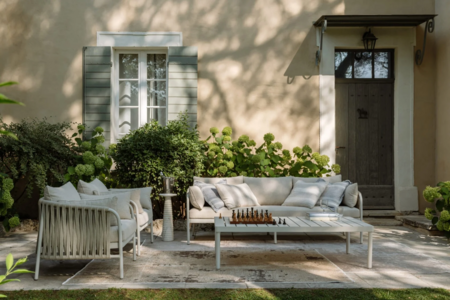
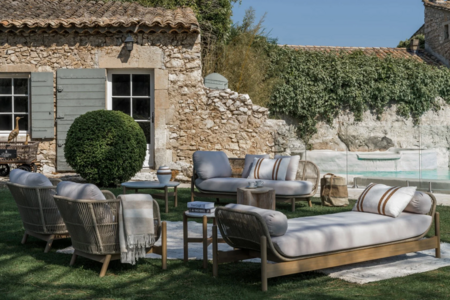
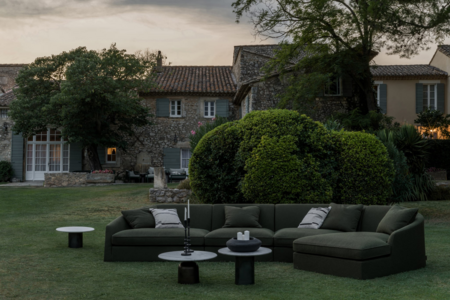
In the Dantone Home shoot at the villa in Provence, the furniture is integrated into a narrative of leisurely downtime. A light seating area is positioned against the historic facade, while the chessboard on the table suggests a specific activity. The architecture and greenery expand the meaning of the objects—making the possibility of spending time in such an environment appealing. Even without people present, the space looks ready for their arrival.
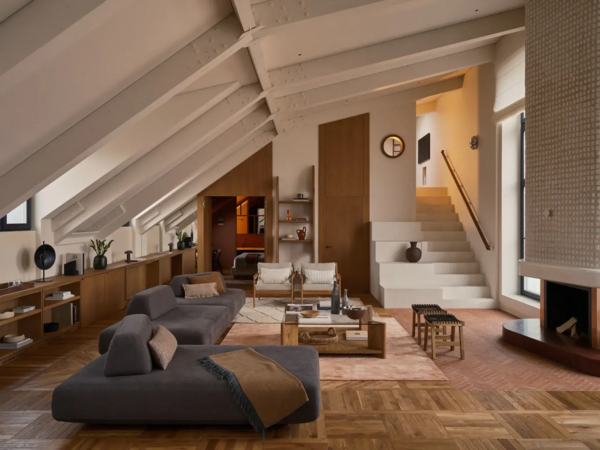
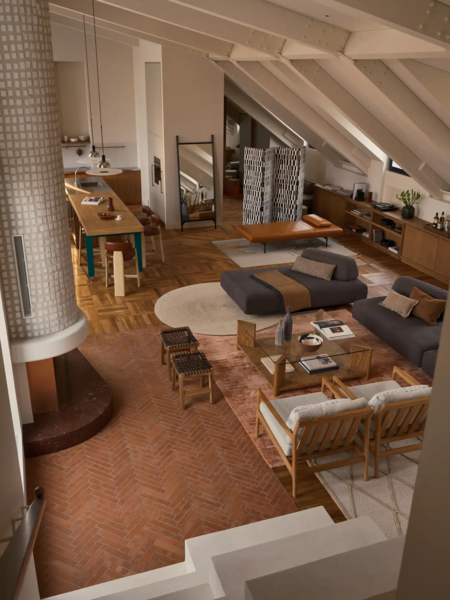
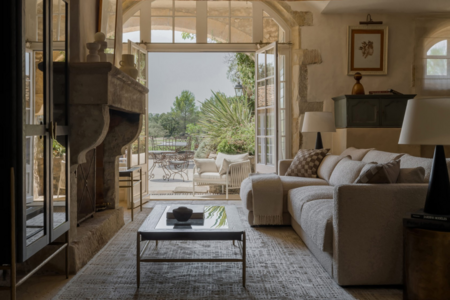
In the BOCA ROOM publication on Hideout Residence, the focus is on the intimate interior. A gray sofa, a ochre pillow, wooden surfaces, and a book on the side table create a setting that can be read as an invitation to solitude. If Dantone Home unfolds a vacation narrative through the connection between the home and the surrounding landscape, BOCA ROOM portrays it through a close, lived-in space. In both instances, the object gains value as part of a desirable life experience.
Mononova x Modenature
In the MONONOVA materials, the promise of comfort is conveyed through the direct interaction between the human body and the furniture. The semi-reclined posture illustrates a potential way to rest, while a close-up of hands on the upholstery highlights touch as a distinct experience. This allows the viewer to mentally associate the object with their own body. Texture becomes significant not only as a decorative characteristic but also as an anticipated sensation.
In the EIDA images by MODÉNATURE, no person is present, shifting focus to the form of the piece. The light upholstery is juxtaposed with the wooden frame, while the front and top views reveal the rounded contours of the seat and backrest. MONONOVA conveys the experience of comfort through posture and gesture, whereas MODÉNATURE invites the viewer to infer it through the object’s visual qualities. These modes of presentation can be related to the theme of sensual pleasure; however, the photographs themselves do not confirm the actual comfort of the furniture.