Concept
I am from another world. I have always felt it.
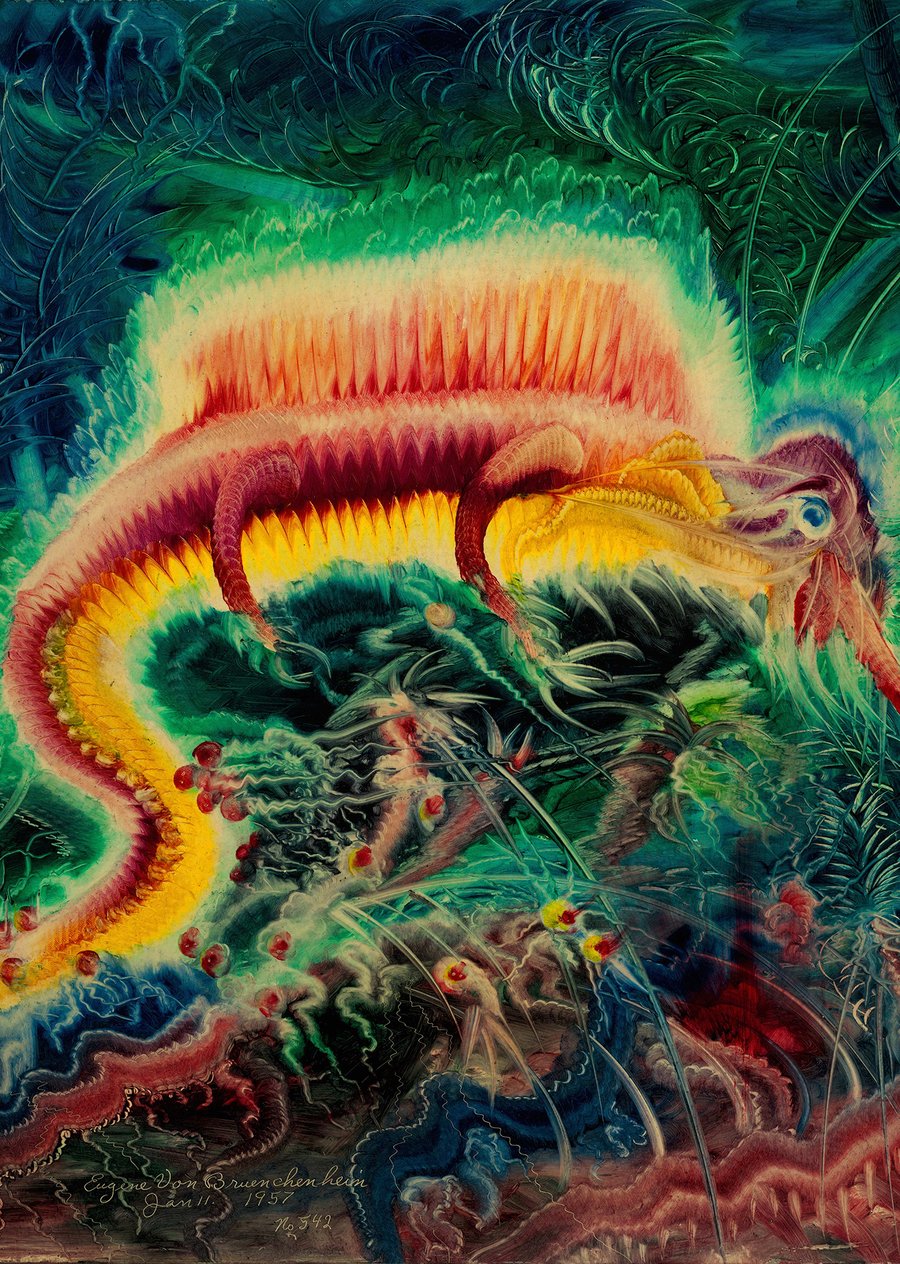
This «other world» is constructed from recognizable details. Eyes and stems emerge from the colored bands, curves resemble arches, and tight cells transform into a cityscape.
The topic selection stems from the fact that in the paintings of American self-taught artist Eugene von Brünnhenhain, the images of atomic catastrophe and the genesis of life are sometimes difficult to distinguish from one another. An expanding cloud moving upward resembles a growing organism, and within the contours of a fantastic city, stems and canopies can be discerned. This similarity has a historical context. Von Brünnhenhain collected photographs of atomic tests on the Marshall Islands, was interested in the origin of life, and wrote about his own conceptions of the structure of the universe. In his art, these interests converge on one question: how does one depict a world in the moment it is changing its form?
The theme allows for an examination of the similarity between two opposing processes: destruction and growth. An explosion and a sprouting shoot move from the center toward the periphery, occupying more and more space, and branching out. In life, they are easily distinguished at least by speed. On the surface of the painting, both movements are frozen, and the viewer must judge what has happened based on the residual trace. I am interested in what detail makes one perceive the force of the impact in the diverging lines and why, with a slight change in their arrangement, there arises a sense that we are looking at something alive.
The key research question is: what specificities of line, color, and composition allow von Brünnhenhain to create images of explosion, nascent life, and a fantastic city from similar forms?
The research hypothesis is that the significance of form is largely determined by its proximity to other forms. When lines radiate from a central point, the gaze returns to the presumed source of the flash. When several bands curve around a color spot, it acquires its own contour, and the viewer begins to distinguish a body. This hypothesis allows for exceptions. The works that are particularly illustrative are those in which one can shift the gaze from one detail to another, causing the cloud to resemble a creature, and the tower to again resemble a plant.
The selection of visual material is based on comparing a single technique across different subjects. The core consists of paintings from 1954–1962, which feature juxtaposed bursts of light, fantastic organisms, and cities.
Selection Criterion I: Distinctiveness of the approach. Each painting has a specific reason for being included in the study. In one, you can trace how lines converge toward a focal point; in another, you can see where a color band separates from the background; and in a third, you can examine a repeating print that forms a facade.Selection Criterion II: Repetition of the approach. The study includes paintings where the same technique can be observed across different compositions. Such pairings help verify whether the identified pattern recurs in the artist’s other works.
The research consists of four chapters. First, outbreaks and explosions are examined, followed by fantasy landscapes, living creatures, and cities. This sequence helps trace how similar lines and shapes coalesce into diverse forms.
Chapter I. «How to Recognize an Explosion?»: examines how a static image conveys the suddenness of a flash. It compares the silhouette of a cloud, diverging rays, and sharp line intersections. It also separately discusses whether an explosion can be recognized without a hint in the title.
Chapter II. «Where Does the Cloud End?»: explores the structure of a fantastic landscape. Overlaps, transparent edges, and repeating curves help distinguish near and far, yet sometimes a single form resembles a cloud, a wave, or a fold of land.
Chapter III. «When Does Paint Acquire a Body?»: presents the details through which the living is recognized among colored traces. Branching suggests a plant, a curve denotes a spine, and an eye helps distinguish a head. A comparison of works shows how the body separates from its surroundings and why its boundaries sometimes remain ambiguous.
Chapter IV. «How Does a City Grow?»: considers how repeating lines coalesce into windows, columns, and towers. Furthermore, the structures retain similarities to plants and rocks, as if the city is gradually emerging from the landscape itself.
Chapter I. How to Recognize an Explosion?
The easiest approach would be to start with the mushroom cloud. It has a familiar silhouette, and since photographers from von Braunenhausen captured images of atomic tests, such an interpretation has historical grounding. However, I am more interested in beginning with a painting where the artist proposed an almost opposite event in the title: the first appearance of light in the world. Can one discern from the image alone that we are witnessing a birth, if that flash could just as easily signify destruction?
Eugene von Brunnenhain. Atomic Age / Total Disaster, No. 919, August 4, 1961. A bright cloud rises over a dark strip of land, allowing one to gauge its scale.
Eugene von Brünnhagen. Atomic Age, No. 887, December 4, 1960. It’s hard to imagine the scale of the blast until you don’t notice the city below.
The yellow column occupies almost the entire height of the painting. Inside it, stripes stretch upward, diverging at the top as if the substance has become cramped. As the gaze follows this movement, the magnitude of the flash remains relative. It is simply large in relation to the sheet. Scale emerges when tiny structures appear in the lower right. The height of an entire city fits within a small section at the base of the cloud.
Eugene von Brünnhahn. 1945 to 1955: Atomic Age. February 22, 1955. The edges of the red cloud branch out like shoots, and the explosion resembles plant growth.
In earlier work with the atomic theme, the gaze lingers on the edge of the cloud. The red deeply recedes into the green, turning, pulling back, while a delicate light fringe traces every curve. From a distance, the upper portion appears as a single expanding cloud. Up close, numerous small edges are revealed, each seemingly growing in its own direction. This fragment especially clarifies why Von Bruchhenhain’s explosion resembles a plant. The distinction between matter dispersal and shoot growth is easily felt over time, but difficult to trace along a single winding line.
Eugene von Brünnholtz. Transitory Glory, No. 213, April 24, 1955. The clouds dissolve into light, and only the shore below helps us understand where we are looking from.
Here, the base of the cloud has almost disappeared. The pink and whitish clusters crowd one another, sometimes jutting out from the blue mass, sometimes sinking into it. On this fragment, such a mass might be foam on the water’s surface, but a green ridge is visible in the lower left, and from it, the coastline curves to the right. This narrow strip alters the entire interpretation of the upper section. In No. 887, the scale could have been estimated by the height of the towers, but here the length of the coast reveals it, which is unsettling: there is little land left, and the cloud still has room to grow.
Eugene von Brünnhoven. No. 818, July 3, 1959. Light rays radiate from several points simultaneously and intersect over a red background.
In Transitory Glory, the edge still allows us to understand our vantage point relative to the cloud. In issue 818, the gaze first catches a bright flash near the upper edge, but slightly below, another appears—and from it, rays spread out in several directions. Individually, these areas resemble bursts, but assembling them into a single explosion is difficult.
Eugene von Brünnhayn. No. 596, June 11, 1957. The colored stripe leads the eye across the entire composition, yet the direction of movement remains ambiguous.
In the untitled 1957 work, the coastline disappears. Long red and turquoise stripes emanate from the bottom right corner, gathering into a light, rounded head. It reminds me of a flying body with a stretched tail. But if you start looking from the opposite end, the tail becomes an expulsion from a blazing hearth. I see the direction of the diagonal perfectly, but the direction of the event itself—I can still choose.
Eugene von Brünnhain. No. 700, April 15, 1958. Light lines sharply break among soft forms, creating a sensation of impulse.
In piece No. 596, one could trace a long, colorful streak from one edge of the canvas to the other. Here, the streak is constantly lost. A pale band curves into a reddish haze, and thin, light strokes cross it further, as if cracks suddenly appeared across a dark pane of glass. In one area, the paint looks almost weightless; in another, the same light gathers into a sharp corner. It’s impossible to determine the original starting point, but the sensation of impact remains. This is given by a sharp inflection, especially noticeable next to a soft patch whose edge is barely discernible.
The feeling of an explosion is created by how light and color spread across the canvas, capturing more and more space. If earth or buildings are visible nearby, it becomes clear how small they are in comparison to this force. Without them, the flash retains its tension, but there is nothing to compare it to—so the viewer perceives the sharpness of the event rather than grasping its scale.
Chapter II. How to See Depth When the Horizon is Unseen?
Through the dense foliage, you can look into the distance, seeing neither land nor sky. In the same way, the overlapping forms in Franz Brunkhenhain create depth without a horizon. This is also related to the artist’s technique. He dragged paint with his fingers and combs, sometimes lifting it back to the pale ground layer. The trace of the tool could become an outgrowth or the edge of a fold. It is evident that one form passes in front of another, although identifying them or determining their size is not always possible.
Eugene von Brünnhayn. No. 775, January 9, 1959. Patches of light between the branches draw the eye deep into the distance, though no ground is visible.
In the center, something resembling the skeleton of a leaf emerges. Thin ribs radiate out from the bright central vein in both directions, and dark verticals and a bluish haze are visible between them. The small opening speaks most eloquently to the space here. The light line at its edge continues; the dark one behind it disappears for a moment, and then reappears a little further on. This implies that one is layered in front of the other. However, if you trace the central branch downward, it gets lost in new offshoots right at the edge. This branch has depth, but there is no sign of roots—no way to find the earth.
Eugene von Brunnenhain. No. 547, January 21, 1957. The apex resembles a rock, yet its edge curls, like a fold in fabric.
In No. 547, the earth seems to have finally been found. A dark-red peak rises from the bottom edge, sharply defined against an ochre background. The rock’s contours are easily recognizable. The peculiarity is found on the right slope. A blue band descends along it; under its curve, yellow is revealed, and the mountain’s edge begins to resemble a fold of fabric. The peak carries a sense of weight overall, but up close, it appears as if one could peer underneath it.
Eugene von Brunnhain. No. 811, June 19, 1959. Through the dark branch, a space opens up whose depth is difficult to define.