Concept
Navigation
1. Concept
2. A Brief History of Maps
3. Maps in Europe
4. Maps in Russia
A Brief History of Mapmaking
It is not precisely known when the first playing cards appeared. Some researchers link their origin to China, but these pieces of evidence cannot be considered definitive.One of the earliest written records dates back to 1294: a Chinese legal document reports the detention of players from whom nine paper cards and wooden printing blocks were confiscated.However, these same cards were also referred to as «sheets» in many other sources. One biography mentions that households enjoyed «playing with sheets.» It is impossible to say exactly what this phrase means. Descriptions of the cards’ appearance or any other identifying features have been lost. Therefore, researchers cannot definitively say whether the reference is to cards specifically, or to some other gaming object.
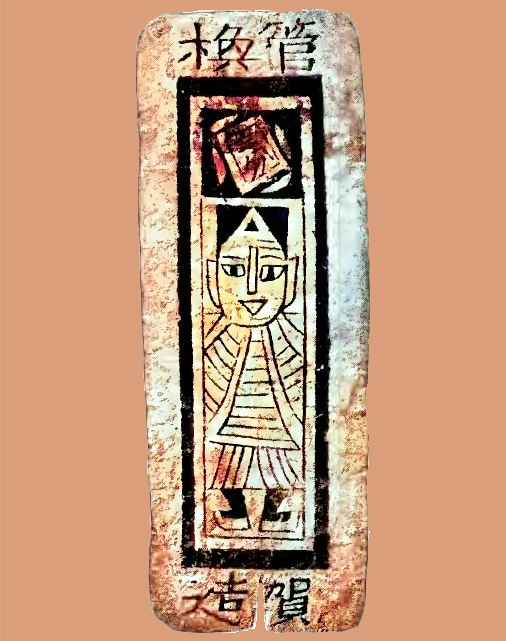
Turfansk map, unknown artist, c. 1400
There is also a theory suggesting that India might be the origin of playing cards. Convincing evidence to support this theory is currently lacking.However, it is worth noting the tradition of card games within India itself. Indian cards often had a round shape. This suggests that card games developed not only in China but also in other regions of Asia.
Round Indian map, artist unknown, date unknown
Later, these playing cards spread to the Middle East, including Egypt.Mamluk decks typically comprised suits featuring images of cups, coins, swords, and polo mallets. The cards might depict rulers, court officials, musicians, and servants. These decks were not always uniform: the number of cards, figures, and suits could vary. Most researchers believe that cards reached Europe from this region.There is also a theory suggesting that cards entered and spread throughout Europe through Venice.
Fragment of a playing card found in Egypt, artist unknown, 13th century.
Mamluk playing cards, unknown artist, 15th century.
Maps of Europe
Now that we have a general understanding of how maps arrived in Europe, we can discuss their social role in that territory.
Initially, maps were held by the upper class: rulers, officials, and, more generally, wealthy people.
At that time, map printing was not widespread, so maps were drawn by hand, which was quite expensive.
Hand-painted maps were distinguished by their exceptional detail and the finesse of their writing. Usually, these maps were not used for games, or if they were, it was very rarely. More often, they served as an attribute to display the owner’s wealth.
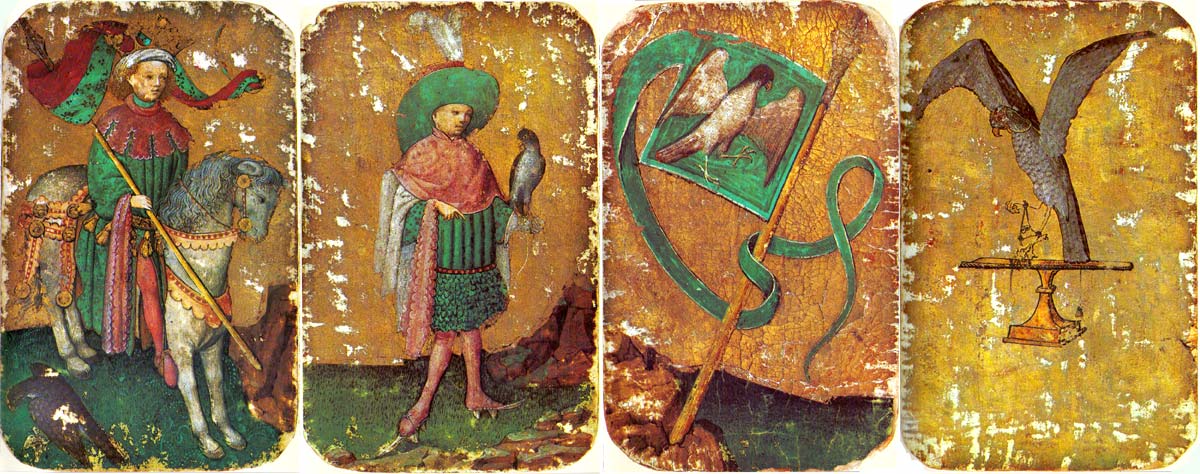
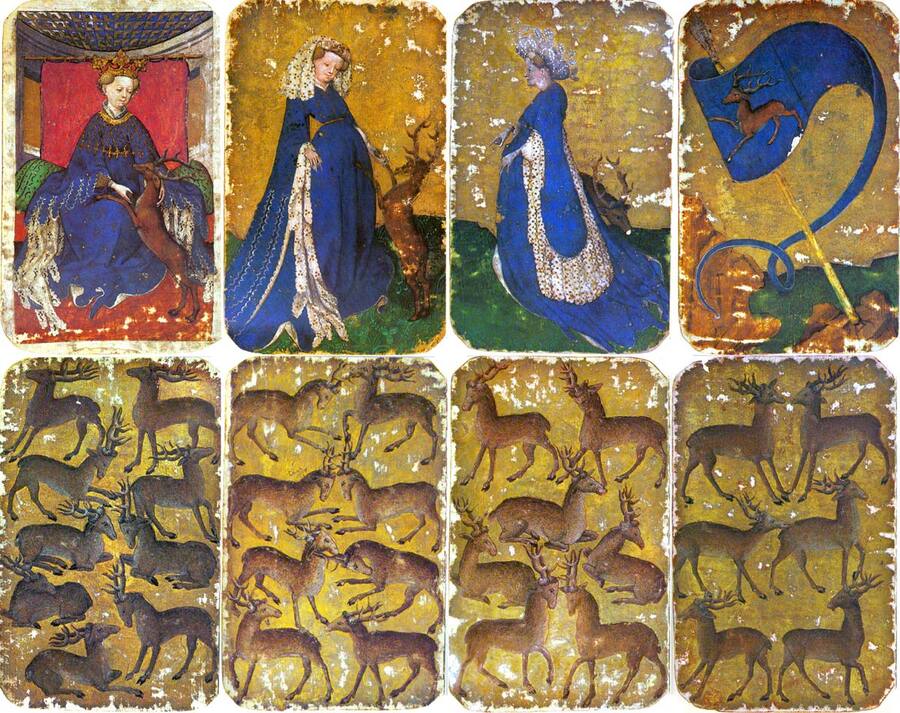
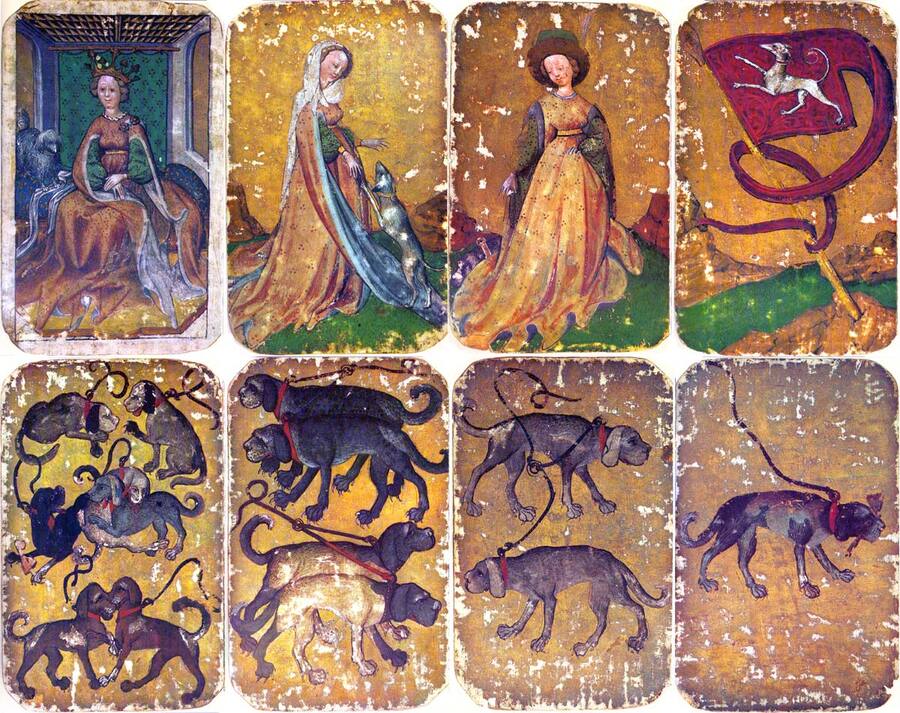
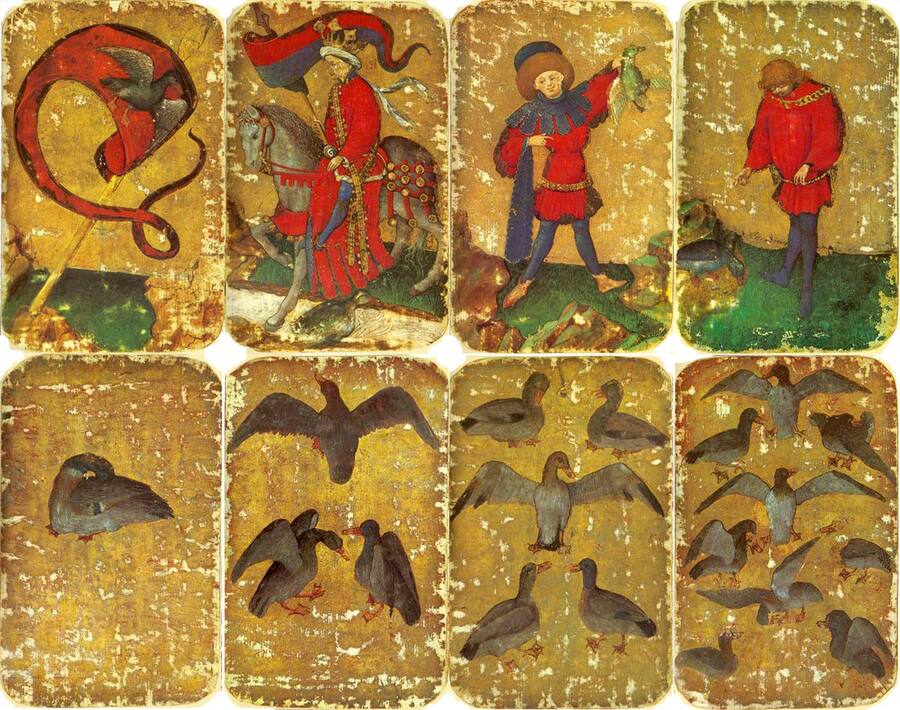
German deck of hand-drawn cards, artist unknown, 1430.
It should also be noted that the size and suit design of the decks were not standardized. Although it is likely that the Mamluk cards entered Europe with distinct suits, in Europe they were reworked into symbols more familiar to the local populations. Frequently, attributes from the fauna of the lands where the maps were drawn were used.
Although it is worth noting that in several regions, the suits retained a design closer to the Mamluk original.
When printing made maps available, they became more rudimentary
The audience shifted from peasants to townspeople, and the church began to protest maps.
For the elite, maps were a metaphor for the order of the world.
For the lower classes, maps were a means of usury.
St. John Capistrano calls upon his followers to burn maps and game boards in Bamberg Cathedral Square. Author unknown, 1470–1474.
Maps begin to depict everyday life, more familiar to the average person, moving away from chivalric ideals.
The Status of Cards in Russia
Card games were unpopular among the nobility. They were common in the lower classes and spread from the people to the elite.
In the 18th century, the elite began to play a role
In Russia, there was no domestic production. The cards were imported.Later, people began to stamp the cards, making foreign decks more expensive. Later, Paul I GIFTED THE MANUFACTURE WITH A CARD PRODUCTION FACILITY.
Shevtsov V. V. Playing Cards in Russian Culture: From Novelty to Everyday Standard / Shevtsov V. V. [Electronic Resource] // Faculty of History, Lomonosov Moscow State University: [website]. — URL: https://www.hist.msu.ru/Science/Conf/lomweb01/shevcov.htm (Accessed: 11/13/2026).
Lipetsky V. Playing Cards in the Foster Home / Lipetsky V. [Electronic Resource] // ANTIQUE LAND: [website]. — URL: https://antiqueland.ru/articles/796/ (Accessed: 11/13/2026).
Sertakova I. N. Daily Life Culture of 18th-Century Russia / Sertakova I. N. [Electronic Resource] // CYBERLENINKA: [website]. — URL: https://cyberleninka.ru/article/n/povsednevnaya-kultura-rossii-xviii-v (Accessed: 11/13/2026).
Yershov B. A., Tonkikh V. A., Kondratenko L. I. THE PEASANT REFORM OF 1861 IN RUSSIA AND MODERNITY / Yershov B. A., Tonkikh V. A., Kondratenko L. I. [Electronic Resource] // CYBERLENINKA: [website]. — URL: https://cyberleninka.ru/article/n/krestyanskaya-reforma-1861-goda-v-rossii-i-sovremennost/viewer (Accessed: 11/13/2026).
Stuttgart pack, c. 1430 / [Electronic Resource] // THE World OF Playing Cards: [website]. — URL: https://www.wopc.co.uk/germany/stuttgart (Accessed: 11/15/2026).
Recreating early-Renaissance playing cards / [Electronic Resource] // V&A: [website]. — URL: https://www.vam.ac.uk/articles/recreating-playing-cards (Accessed: 11/15/2026).
F. Speelberg, M. McDonald, A. Rudnick, L. Zanis Paper Pastimes: Puzzles, Games, and Other Creative Outlets from the Collection of Drawings and Prints / F. Speelberg, M. McDonald, A. Rudnick, L. Zanis [Electronic Resource] // THE MET: [website]. — URL: https://www.metmuseum.org/ru/perspectives/paper-pastimes (Accessed: 11/16/2026).
Husband, T. B. The World in Play: Luxury Cards 1430–1540 / T. B. Husband. — New York: The Metropolitan Museum of Art; New Haven; London: Yale University Press, 2015. — 136 p. — ISBN 978-1-58839-608-2
T. Husband Welcome to The World in Play: Luxury Cards, 1430–1540 / T. Husband [Electronic Resource] // THE MET: [website]. — URL: https://www.metmuseum.org/ru/perspectives/welcome-to-the-world-in-play (Accessed: 11/16/2026).
Voroshilin S. I. Game Addiction: Social, Psychological, and Biological Foundations / Voroshilin S. I. [Electronic Resource] // CYBERLENINKA: [website]. — URL: https://cyberleninka.ru/article/n/igrovaya-zavisimost-sotsialnye-psihologicheskie-i-biologicheskie-osnovy (Accessed: 11/16/2026).
The History of Playing Cards / [Electronic Resource] // THE World OF Playing Cards: [website]. — URL: https://www.wopc.co.uk/the-history-of-playing-cards/#socialContextHeading (Accessed: 11/16/2026).
D. Nosowitz Playing Cards Around the World and Through the Ages / D. Nosowitz [Electronic Resource] // Atlas Obscura: [website]. — URL: https://www.atlasobscura.com/articles/history-of-playing-cards (Accessed: 11/16/2026).
Merinov I. V. Playing Cards: From Origin to Today / Merinov I. V. [Electronic Resource] // Monetnik.ru: [website]. — URL: https://www.monetnik.ru/obuchenie/antikvariat/playing-card/ (Accessed: 11/16/2026).
Girina A. History and Philosophy of Playing Cards / Girina A. [Electronic Resource] // deziiign: [website]. — URL: https://game.deziiign.com/project/b-5e6d785438484e68a3e37b6f0695254f (Accessed: 11/16/2026).
Stuttgart pack, c. 1430 / [Electronic Resource] // THE World OF Playing Cards: [Website]. — URL: https://www.wopc.co.uk/germany/stuttgart (Accessed: 11.15.2026).
Playing cards through time / [Electronic Resource] // THE World OF Playing Cards: [Website]. — URL: https://www.wopc.co.uk/explore/timeline/1400s/ (Accessed: 11.15.2026).
F. Speelberg, M. McDonald, A. Rudnick, L. Zanis Paper Pastimes: Puzzles, Games, and Other Creative Outlets from the Collection of Drawings and Prints / F. Speelberg, M. McDonald, A. Rudnick, L. Zanis [Electronic Resource] // THE MET: [Website]. — URL: https://www.metmuseum.org/ru/perspectives/paper-pastimes (Accessed: 11.16.2026).
T. Husband Welcome to The World in Play: Luxury Cards, 1430–1540 / T. Husband [Electronic Resource] // THE MET: [Website]. — URL: https://www.metmuseum.org/ru/perspectives/welcome-to-the-world-in-play (Accessed: 11.16.2026).
D. Nosowitz Playing Cards Around the World and Through the Ages / D. Nosowitz [Electronic Resource] // Atlas Obscura: [Website]. — URL: https://www.atlasobscura.com/articles/history-of-playing-cards (Accessed: 11.16.2026).
Merinov I.V. Playing Cards from Their Origin to the Present Day / Merinov I.V. [Electronic Resource] // Monetnik.ru: [Website]. — URL: https://www.monetnik.ru/obuchenie/antikvariat/playing-card/ (Accessed: 11.16.2026).