Introduction
The film Whiplash (2014, dir. Damien Chazelle) tells the story of Andrew Neiman—a young drummer who dreams of becoming one of the greatest jazz musicians of his generation. After enrolling at the prestigious Shaffer Conservatory, he joins an orchestra under the direction of Terence Fletcher—a talented yet ruthless instructor who employs humiliation, psychological pressure, and physical exhaustion as teaching tools. Andrew’s drive for perfection gradually transforms into obsession: music ceases to be purely art and becomes a space of constant struggle for recognition, supremacy, and the right to be deemed worthy.
Image
At first glance, «Whiplash» is a story about the cost of talent and the limits of human potential. However, the film’s conflict extends far beyond the traditional confrontation between student and teacher. Fletcher seeks not merely impeccable performance from Andrew, but complete subjugation to his own system of perfection. In turn, Andrew accepts these rules, gradually sacrificing his own health, relationships, and ordinary life. The musical rehearsal transforms into a sort of athletic contest, and the performance becomes an ordeal where a mistake is perceived almost as a defeat. In this context, jazz becomes not only a subject of the narrative but also a metaphor for the struggle for control—over music, one’s own body, and another person.
Image
The film’s visual narrative plays a particularly crucial role in creating this sensation. Shotzel uses cinematic tools not merely to illustrate events, but to convey the characters' psychological states and the nature of their relationships. The enclosed spaces of the music school—doorways and hallways—generate a feeling of isolation; the framing composition emphasizes the hierarchy between Fletcher and his students; and close-ups of hands, faces, and musical instruments transform the performance into an almost physical process. Light and color gradually heighten the atmosphere of tension, while the rapid editing subordinates the viewer’s perception to the rhythm of the music, forcing them to literally feel the pressure of every beat.
Image
The hypothesis of this research is that the visual language of «Whiplash» becomes an extension of the control system Fletcher establishes around Andrew. The camera, editing, composition, and lighting not only accompany the characters' conflict but also reproduce it at a formal level: they restrict space, segment action into individual movements, and direct the viewer’s attention just as Fletcher manages his musicians.
The study systematically examines the film’s main visual techniques and their connection to the development of the relationships between the characters. Initially, the organization of space and frame composition—which establishes hierarchy within the orchestra—is analyzed; subsequently, the portrayal of the human body as a perpetually tested instrument; further on, the editing rhythm, light, and color are examined as means of intensifying tension. Special attention is paid to the final performance, where the familiar power dynamic between teacher and student begins to shift. Comparing the opening and concluding scenes allows us to trace whether Andrew truly gains autonomy or merely achieves perfection within the very system he sought to escape.
Navigator
1. Login2. Control Space3. The Body as Instrument4. Montage as Metronome5. Light and Overheating6. Changing the Conductor7. Conclusion
Log In
At the very beginning of the film, the viewer hears a drumroll before seeing its source. For a few moments, the image remains black, and then a long, empty corridor appears before the audience. In the distance, through a doorway, Andrew is visible, rehearsing at a drum set.The first encounter with the protagonist doesn’t happen through his face, biography, or dialogue, but through sound and space. The music literally precedes the person, and the camera observes him from a distance, as if stumbling upon him accidentally in a closed room.It is here that the question arises—a question that will accompany the entire film: who is in control of what is happening—the musician, his mentor, or the rhythm itself?
«Obsession» can be interpreted as a film where the visual language becomes an extension of the relationship between the teacher and the student.
Fleicher strives to completely control Andrew: his movements, attention, emotional responses, and, ultimately, his musical performance. Notably, the form of the film itself is organized in a similar manner. The composition restricts space, the editing establishes a rigid rhythm, and the light isolates specific parts of the human body, transforming them into objects of scrutiny.
Thus, the camera does not merely record events; it reproduces the system of discipline within which the protagonist exists.
The visual techniques gradually cease to be neutral narrative devices—they become part of the conflict.
The opening of the film presents an unusual sequence of perception: first, the viewer hears the drums, and only then is given the chance to see the musician. Sound here functions not as accompaniment to the image, but as an independent instrument for organizing attention. It compels the viewer to search for the source of the action and literally guides them through the corridor space. This choice creates the feeling that the music already exists independently of the person. Andrew doesn’t so much start playing as he finds himself inside a long-running mechanism.
The long corridor establishes a pronounced sense of perspective. The vertical lines of the walls and doorways direct the viewer’s gaze toward the single point where Andrew is located.
The composition leaves the viewer little room for independent exploration of the frame. The eye almost automatically follows the prescribed direction.
This is an early example of visual control that can be found even before Fletcher. The film’s space is already organized in such a way as to direct attention and limit freedom of movement.
In the first frame, the protagonist, Andrew, does not fill the entire image space. Instead, he is framed within a doorway, surrounded by dark walls.
The door functions as an additional frame within the shot. This technique creates a voyeuristic effect: the viewer is not next to the musician but is observing him through the boundary between two spaces.
Interestingly, this visual motif recurs throughout the film. The characters are often positioned inside doorways, windows, and other architectural frames.
The lighting in the first scene is built on the contrast between the dark corridor and the relatively illuminated space of the rehearsal room. However, the light does not reveal the entire room. It merely allows the viewer to distinguish the figure of the musician and individual elements of the drum kit. This lighting arrangement creates a visual hierarchy: the audience’s attention is focused on the single action, while the surrounding space remains virtually unseen.
Fletcher’s appearance disrupts the initial compositional stability. Previously, the viewer observed a solitary musician fully immersed in his own rehearsal. Now, another person enters the space, gradually capturing the audience’s attention.
Fletcher doesn’t merely appear in the frame; his presence changes the nature of the scene. The music transforms from an individual practice into an action that can be judged, interrupted, or rejected.
Thus, the film’s central conflict arises.
Comparing the opening shots of Andrew and Fletcher reveals a difference in their spatial positioning. Andrew is shown as a person confined within a bounded space. Fletcher, conversely, appears as a figure capable of freely moving between different zones of the setting. This difference does not necessarily imply that the director consciously assigned a specific visual position to each character. However, the repetition of such a spatial arrangement in subsequent scenes allows us to consider it a stable pattern.
Doorways, windows, and room boundaries frequently become additional frames within the composition. They separate the subjects from one another, visually confine their space, and allow the viewer to observe the action as if from the outside. It is especially interesting to trace how often Andrew finds himself within such frames in solo scenes. Even when he is formally free from Fletcher’s presence, the space continues to create a feeling of isolation.
The visual language of «Obsession» establishes a distance between the viewer and the protagonist from the outset.The camera does not immediately seek intimacy with Andrew. Instead, it observes him through architectural frames, isolating his figure with light and guiding the viewer’s gaze along a predetermined perspective.This system does not yet belong to Fletcher, but it already echoes the principles of his teaching: attention must be focused, movement restricted, and error is unacceptable.
Control Space
A significant portion of the film’s action takes place within the Shaffer Conservatory. Its spaces comprise a relatively limited set of areas where the same actions are constantly repeated: rehearsals, performances, private lessons, and encounters between characters. Production Designer Melanie Paysis-Jones worked with real interiors, adapting the spaces for different scenes. This frames the film’s space not as a detailed reconstruction of a musical institution, but as a deliberately organized environment in which each interior assumes a specific dramatic function.
The main rehearsal room resembles an arena. Musicians are positioned before the conductor, and the space between them becomes a site of constant confrontation. Fletcher occupies a position from which he can observe the entire ensemble. The musicians, in turn, are focused on him and are forced to constantly track his gestures. As a result, the space acquires a distinct hierarchical organization. One person directs what is happening, while the others must adhere to established rules.
The musical instruments and music stands play a significant role in the composition. They create additional vertical and horizontal lines that divide the image into distinct sections. Musicians often appear visually separated from one another by their own instruments. Even when in the same room, they are not always perceived as a unified ensemble. This type of composition emphasizes the individual responsibility of each performer—one person’s mistake becomes visible to everyone.
In collective scenes, the composition is often structured around the contrast between Fletcher and the musicians. The conductor occupies a position that allows control over the unfolding action, while the other characters are arrayed before him.
This choice is especially striking in scenes where rehearsals pause. The moment Fletcher interrupts the performance, the collective movement ceases, and the attention of everyone present shifts to one person.
Authority is expressed here not only through dialogue but also through the organization of space.
Fletcher often becomes the visual center of the rehearsal room, even when he doesn’t take up a large part of the frame. His presence is defined primarily by the fact that the other characters orient themselves relative to him. The musicians' gazes are directed toward him, and the start and stop of the performance depend on his gestures. Thus, Fletcher becomes a kind of gravitational center for the image. Even without physical action, he is able to organize the behavior of all the other participants in the scene.
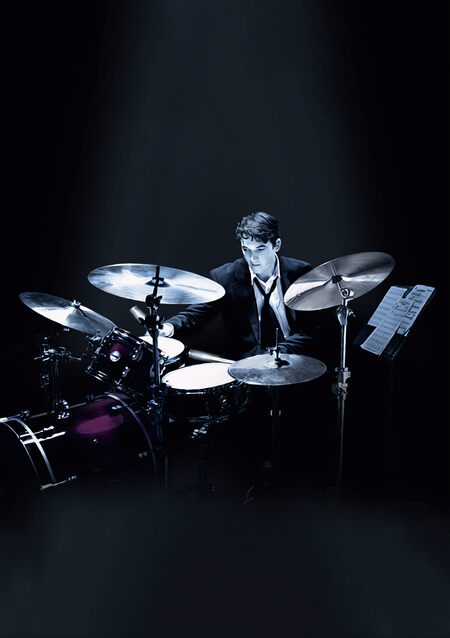
Unlike Fletcher, Andrew is more often directly connected to a specific area of space—his drum kit. The instrument becomes a kind of boundary between the musician and the surrounding world. Behind it, Andrew can focus on the performance, but he is simultaneously constrained by the necessity of remaining in one position constantly. The drum kit both provides the protagonist with an opportunity for self-expression and anchors him within a disciplined space.
Outside of the music school, Andrew finds himself in entirely different spaces. A home, a restaurant, and a movie theater do not possess the same rigorous structure as a rehearsal room.
Yet, even here, the protagonist gradually loses the ability to exist outside of music. His attention constantly returns to the drums, performances, and the need for self-improvement.
The contrast between these spaces demonstrates how deeply the system of musical discipline permeates the protagonist’s daily life.