Navigator:
1. Concept
2. The Doll—as a doppelgänger of a person that simultaneously evokes anxiety and comparison with humanity
3. The doll becomes an image of a person who has lost individuality and personal agency
4. The artificial body dismantles the notion of human anatomy as a cohesive system
5. The doll—on the boundary between life and death
6. Conclusion
1. Concept
The doll holds a special place in modernist culture because it represents a conditional boundary object—one that contains a human form yet lacks consciousness, independent will, and the capacity for life. The phenomenon of the doll’s existence is fundamentally based on a contradiction: it possesses a human physical form but is perceived by everyone as an object. In the art of the first half of the 20th century, this image gained particular expressiveness amidst the crisis of humanistic concepts, the shifting perception of the human body, the rise of mechanization, and the spread of psychoanalytic ideas. The doll becomes a means of investigating human experience, the image of alienation, the unconscious, corporeality, identity, and death. In this study, we will examine the doll image through the work of Giorgio de Chirico and Hans Bellmer, as both approaches can be compared to trace the difference in how the artists engaged with this phenomenon—the doll. The first addresses the doll-mannequin as an image of anonymity, immobility, and metaphysical solitude, while the second explores the doll as an artificial body subject to transformation, isolating fragments and imbuing the object with sensual and sexual characteristics.
Principle of Material Selection for Visual Content
The core visual material comprises works by Giorgio de Chirico alongside photographic, graphic, and sculptural pieces by Hans Bellmer. The selection of works by these artists is based on the presence of the phenomenon described in the piece, and we also consider works featuring motifs such as the artificial human body, the mannequin, doppelgängers, anonymity, and breaches of anatomical integrity. Priority is given to works that allow for the analysis of not only the narrative but also the visual characteristics of the object: form, material, plasticity, composition, spatial positioning, and the nature of the interaction with the viewer.
The Principle of Rubrication (Structuring) of Research
The structuring of research is based on the problematic aspects of a phenomenon within a chosen time frame; that is, various facets of the subject are examined, as well as how it influences human perception and how the phenomenon is perceived by the individual. The research is divided into four parts: the doll as a double of a human; the doll as an image of loss of subjectivity; the artificial body that disrupts the concept of human anatomy; and the doll as a liminal state between life and death. Each thesis is elaborated through theoretical material, which will be described below, and the visual component is presented through the works of two artists—Giorgio de Chirico and Hans Bellmer.
Principle of Selecting and Analyzing Textual Sources
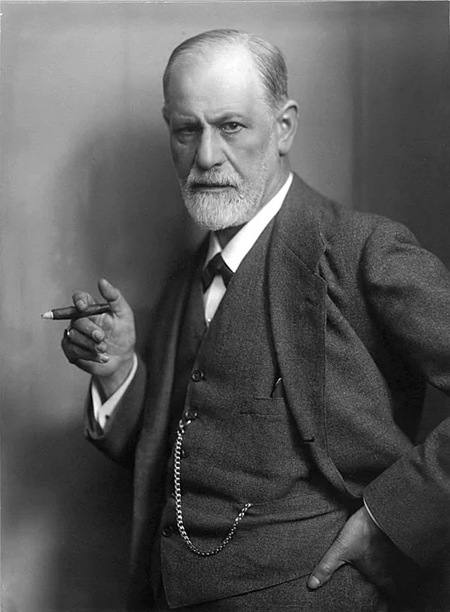
Every thesis in the research is explored through theoretical material. Particular attention is given to the works of Sigmund Freud, who, during the Modernist era, introduced the concept of the «Uncanny» (Das Unheimliche). This concept is related to dolls, although its literal translation means something that is not native, yet is familiar to human perception.
The theoretical foundation consists of works on psychoanalysis, philosophy, and the history of Modernism, particularly the writings of Sigmund Freud, André Breton, and Ernst Junger, alongside contemporary art historical studies. The sources are analyzed to identify concepts such as duality, the uncanny, the artificial body, alienation, and objecthood. The theoretical propositions are correlated with the visual characteristics of the works by the two selected authors.
The Key Research Question and Hypothesis
The central question of this research is how the doll in Modernist art becomes an artistic model of human existence, a space where the boundary between the animate and the inanimate, and between subject and object, dissolves.
Underpinning this hypothesis is the premise that in Modernist art, the doll transcends being a mere depiction or imitation of a human being to become an autonomous metaphor for the crisis of human identity—that is, self-knowledge is achieved through the image of the doll. Giorgio de Chirico uses it to express alienation, anonymity, and stasis, while Hans Bellmer demonstrates bodily instability, its subjugation to external forces, and the potential for infinite transformation and physiological division. Despite differences in artistic methods, both artists explore the artificial body as a space where the contradictions of human nature are revealed.
2. The doll—as a doppelgänger of the human being, which simultaneously evokes anxiety and comparison with a person.
The doll replicates human appearance, yet its resemblance to a person is unaccompanied by consciousness or independent life. This contradiction relates to the concept of the «Uncanny» (das Unheimliche), formulated by Sigmund Freud in his 1919 essay of the same name: anxiety arises when the familiar acquires alien and indeterminate properties. Freud initially describes the phenomenon of the «Uncanny» as something un-native [1, pp. 1–2], because in the German language, this designation has a distinctly oppositional character to the concept of «Native,» or das Heim. Therefore, the doll becomes an intermediate form between a living being and an object, as the viewer simultaneously recognizes the human body in it while also perceiving its artificial nature. In the painting of Giorgio de Chirico and the surrealist photography of Hans Bellmer, this effect becomes a means of exploring the boundaries between the human and the non-human.
Giorgio de Chirico, «Oracle Mystery, ” 1910
The human presence here takes on a mysterious and detached form. The figure, reminiscent of an ancient archetype, does not engage directly with the viewer.
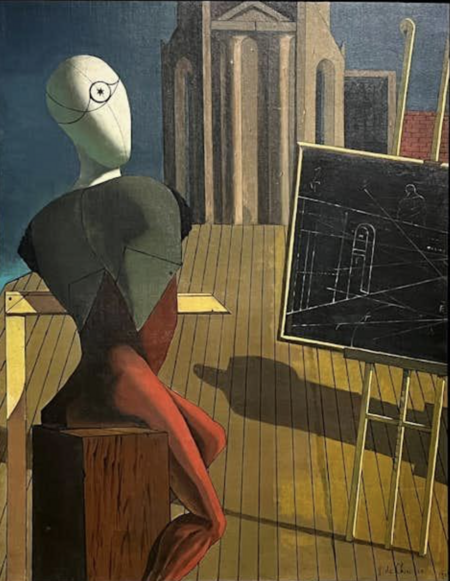
Giorgio de Chirico, The Diviner, 1914–1915.
The artificial figure acquires the qualities of a person imbued with special knowledge, yet it remains a static construct. The contradiction between the title and the character’s visual lifelessness intensifies the sense of the uncanny.
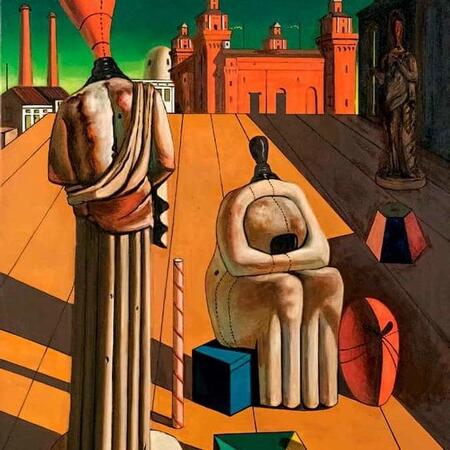
Giorgio de Chirico, «The Haunting Music,» 1918.Mannequins retain human poses and proportions relative to their external environment, yet they lack natural faces, expressions, and organic bodily proportions. Their presence creates a sense of duality: the viewer perceives a semblance of humanity that cannot be recognized as a living being.
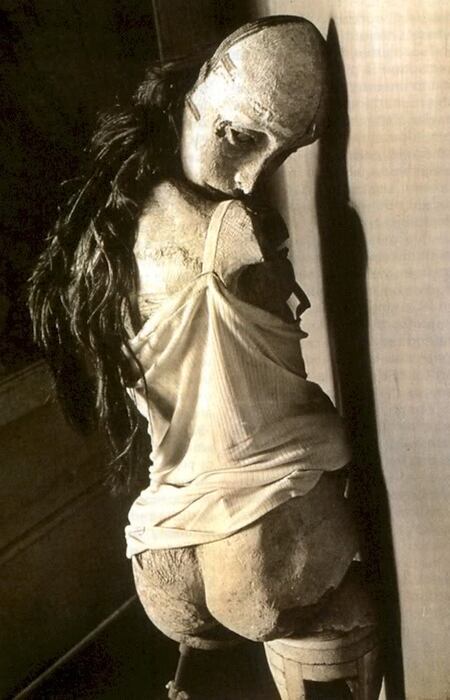
Hans Bellmer’s first doll reproduces the human figure at life size, complete with all its parts, yet the realism of individual body components coexists with the obvious artificiality of the construction, creating ambiguity between the living body and the object.
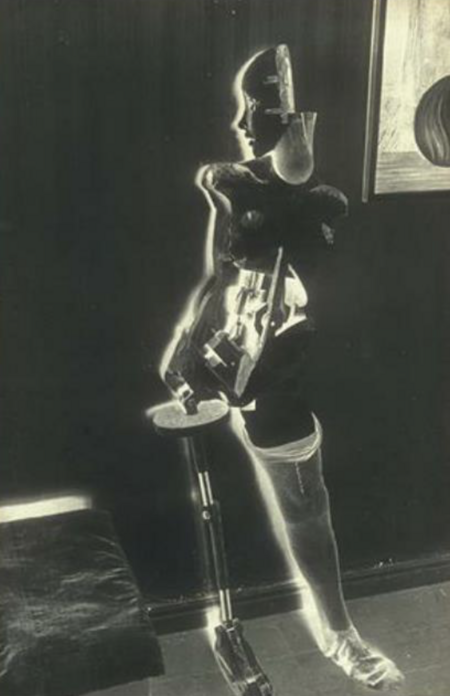
Hans Bellmer, «The Doll, ” photograph of the first doll, 1934
Hans Bellmer, photograph of a jointed doll, 1935
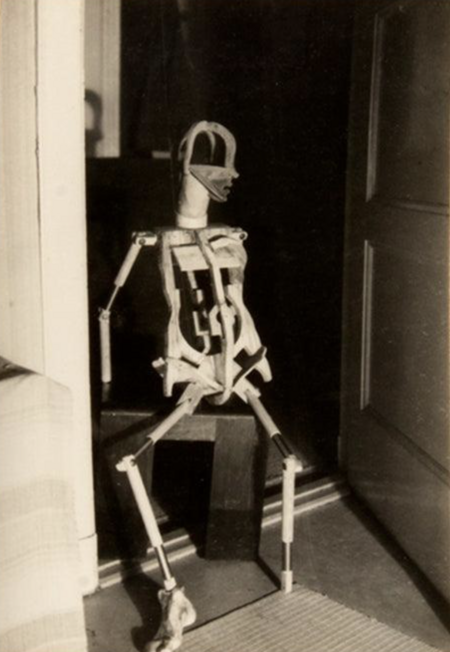
Hans Bellmer, «The Doll,» photograph of a doll in an interior setup, 1936.Placing the artificial body within a domestic space creates a sense of human presence. The familiar home environment contrasts with the stillness and artificial embodiment of the figure.
André Breton, in the first «Manifesto of Surrealism» (1924), stated that in mannequins and similar objects that might initially elicit a smile, «an insatiable human anxiety» emerges [2, p. 26].
The doll becomes a double of the human precisely because of its imperfect correspondence with them. For Giorgio de Chirico, anxiety arises from the stillness and facelessness of the figure, whereas for Hans Bellmer, it stems from the body’s realism within space, connected to its artificial construction.
3. The doll becomes an image of a person who has lost individuality and their own subjectivity.
In Modernism, the artificial human body often functions as a metaphor for the estrangement of the individual from their own existence. Humanity ceases to be perceived as a unique subject and transforms into a faceless figure, subjugated to external forces and circumstances. In this context, De Chirico’s mannequin can be viewed as an image of the dehumanized person, stripped of individual traits and psychological expression. Bellmer develops this problem through an artificial body that possesses no will of its own and exists solely dependent on the actions of its creator.
Giorgio de Chirico, «The Great Metaphysician, ” 1917
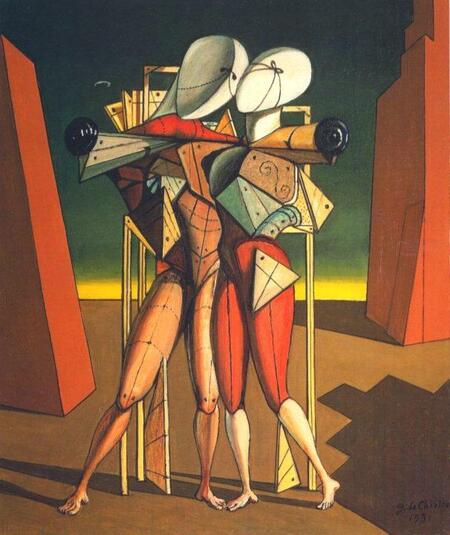
Giorgio de Chirico, «Hector and Andromache, ” 1917.The mythological heroes are presented in the form of mannequins. Consequently, even this emotionally charged narrative of a farewell before war lacks conventional psychological expressiveness: the characters cannot convey feelings through their faces or gestures, and the work loses the familiar individuality that is typically conveyed through facial expressions and other aspects of human nature.
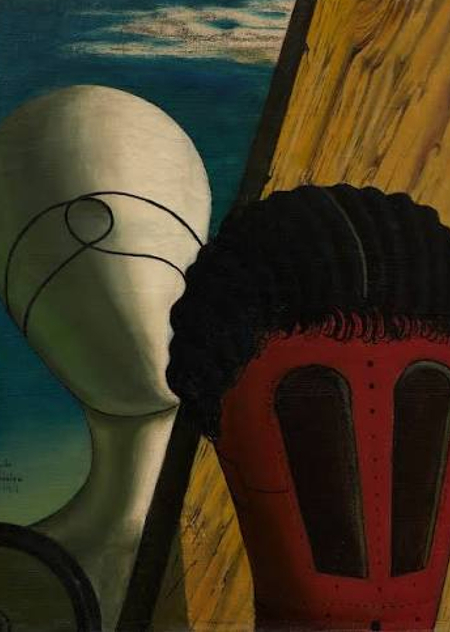
Giorgio de Chirico, «Two Masks, ” 1915
The image of paired figures allows for the exploration of duality and interchangeability. The similarity of the artificial bodies diminishes the sense of individuality and the uniqueness of each character.
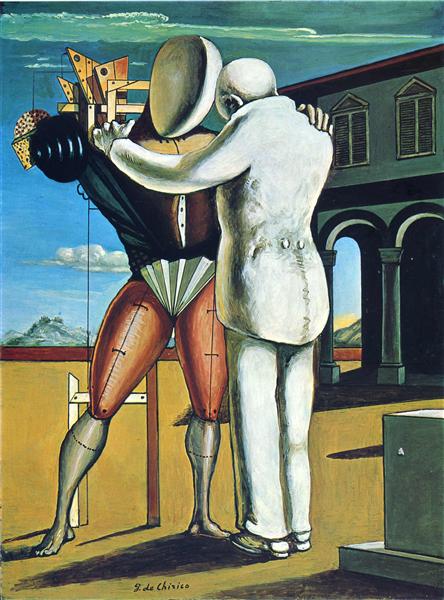
Giorgio de Chirico, «The Return of the Prodigal Son, ” 1922.Human relationships are depicted through stylized figures and geometric compositions that resemble sculptural objects more than living characters.
Hans Bellmer, «The Doll, ” photograph of a doll in the process of assembly, 1934
The doll exists as the result of successive assembly. Its identity is entirely determined by the external intervention of the artist, who selects the form, proportions, and connection of the parts—thus, it loses its original identity.
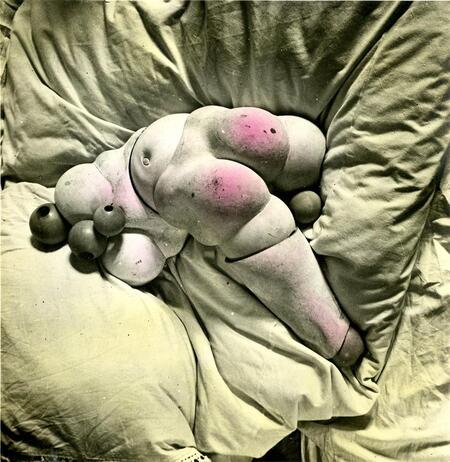
Hans Bellmer, «La Poupée, ” photograph of a doll on a bed, 1935–1936The figure is situated in a space typically associated with human intimacy. However, the lack of any self-directed activity transforms it into an object of observation, conveying a sense of stillness in the image.
Hans Bellmer, photograph of a doll with an altered limb configuration, 1935–1936