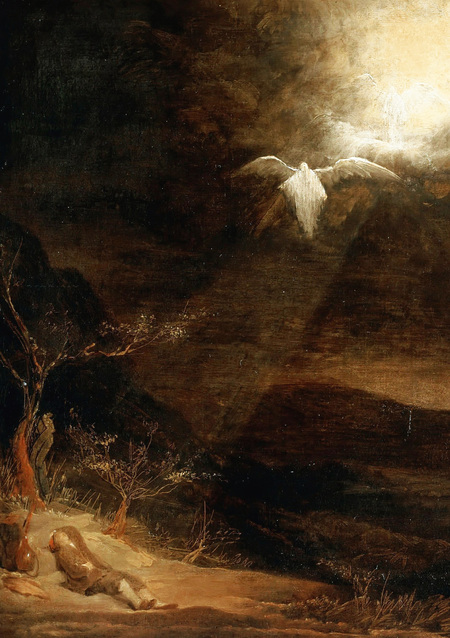
Jacob is a rather contradictory figure in the Old Testament. He is Isaac’s younger twin, who deceitfully receives the blessing intended for his elder brother. Fearing his brother’s vengeance, Jacob flees. During this flight, Jacob falls asleep, resting his head on a stone, and has a vision.
«Behold, the ladder rests on the earth,
and its top touches heaven;
and behold, the angels of God ascend and descend upon it.
And behold, the Lord stands upon it» (Genesis 28:12–13).
From the top of the ladder, God gave Jacob the blessing of the covenant (Genesis 28:13–15). Waking up, Jacob named the place Bethel, meaning «God’s house, ” set a stone as a memorial pillar or altar, and poured oil upon it.
The theme of the «Jacob’s Ladder» frequently appears in art, with nearly every artist interpreting it in their own way. In this study, I will first analyze the roots of the ladder image and then trace how the depiction of the theme has evolved. The goal of this research is to understand what artists emphasized in different eras and how the understanding of the «Jacob’s Ladder» has changed.
Ladder: Roots of the Image
Before delving into the image of the «Jacob’s Ladder» in visual art, I would like to discuss what the image of the ladder that appeared in Jacob’s dream symbolizes and what it draws its inspiration from.
Axis Mundi
Axis Mundi, or the World Axis, is a sacred symbol representing a vertical line that connects three worlds: the celestial, the earthly, and the underworld.
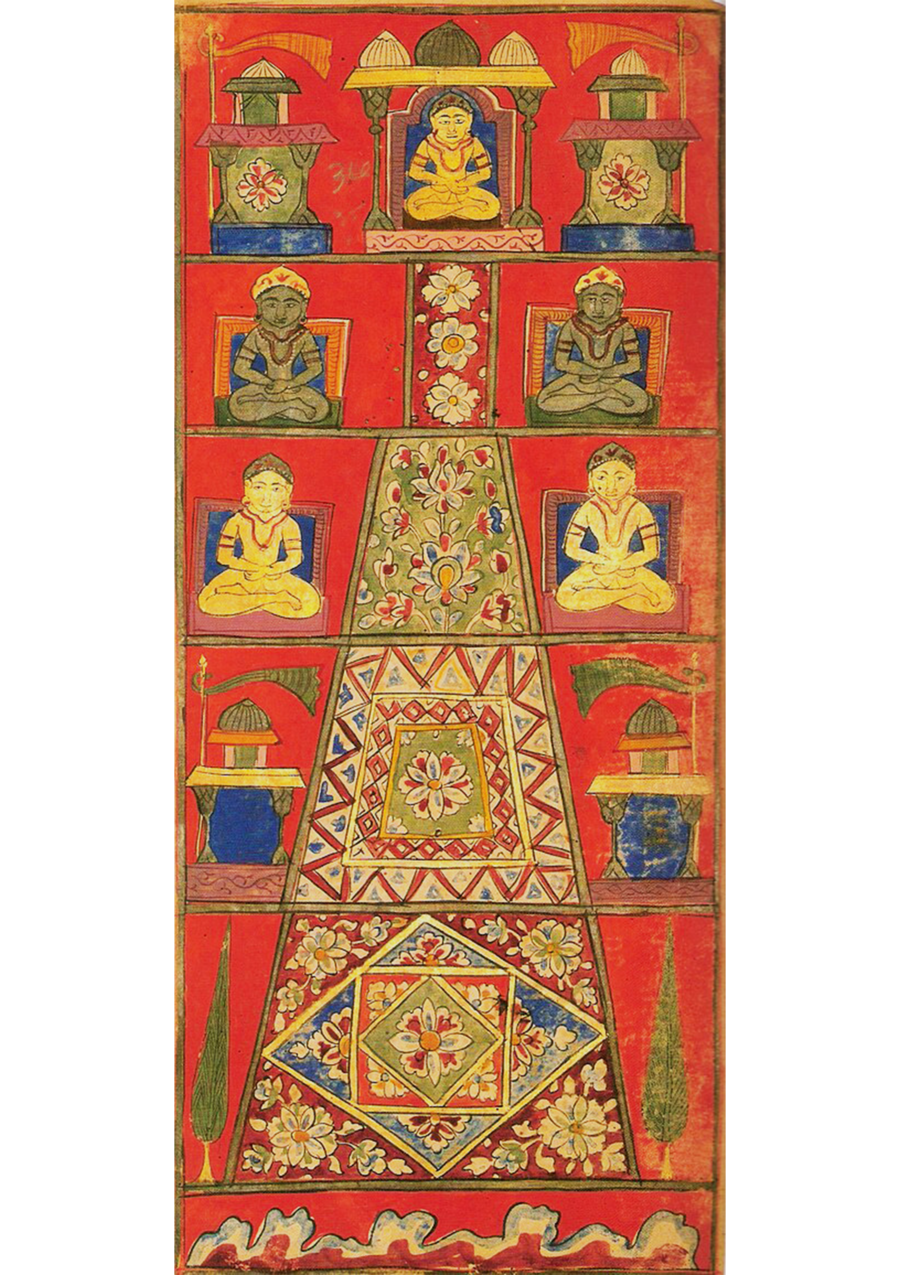
«Meru Mountain» according to Jain cosmology from «Sankhya-Narayana.» 17th century
This vertical axis has been manifested by different people throughout the centuries. In the mythology of various peoples, the image of the World Axis is embodied in the World Tree, such as Yggdrasil among the Norse. In ancient Greece, the World Axis is embodied in Mount Olympus; in the cosmology of Hinduism and Buddhism, it is the sacred Mount Meru. The Sinai Mountain can also be included in this category. There are infinite examples of the manifestation of the World Axis.
These examples show us that throughout the centuries, different cultures have felt a need to connect various levels of existence—the earthly and the celestial. They also demonstrate how important it was for people to embody this idea of an Axis that unites everything into a recognizable, describable form.The Axis Mundi is more of a metaphorical, invisible concept, but people desired for it to become visible and comprehensible. This led to the emergence of the World Tree, Ziggurats (we will discuss these in more detail later), Mount Olympus, and Jacob’s Ladder, which also connects heaven and earth.I won’t claim that Jacob’s Ladder is precisely the same thing as Mount Olympus for the ancient Greeks, but I believe it can be viewed as one manifestation of the Axis Mundi, as it generally fulfills the function of an Axis that connects different planes of existence.
Ziggurats
So, we have already mentioned Ziggurats as the image of the world’s axis. But the Ziggurats have a more direct connection to the image of Jacob’s Ladder than other interpretations of the Axis Mundi.
A little about the linguistic features and Mesopotamia. «Jacob’s Ladder» is a translation. In Hebrew, «Jacob’s Ladder» is pronounced Sulam Yaakov. The word Sulam, which translates to «ladder,» is linguistically quite close to the Akkadian word simmiltu, which translates to «stepped structure» or «ramp.» What significance does this have for us?
As we know, Jacob’s background is somehow connected to Mesopotamia, as he fled to northern Mesopotamia escaping his brother Esau’s wrath.In Mesopotamia, Ziggurats were built—massive stepped pyramids. A Ziggurat served as an earthly dwelling for a god and was also considered a «stairway to heaven,» connecting humans with the divine. The lower tier of the structure symbolized the earth, while the Ziggurat’s summit housed a sanctuary that symbolized the heavens—it was to this sanctuary that the gods seemed to «descend.» A prime example is the Babylonian Ziggurat of Etemenanki, which served as the precursor to the Tower of Babel.
«The Tower of Babel.» Pieter Bruegel the Elder. 1563
It’s interesting to note that Ziggurats can, in a way, be contrasted with Jacob’s Ladder. Ziggurats were built by people themselves to somehow construct a stairway to the gods in heaven, or perhaps to independently connect heaven and earth.However, in Jacob’s dream, the god descends and builds the ladder—that is, he initiates the action for the person, rather than the other way around.
«Jacob’s Ladder»: Iconography
The Cornerstone
Quite expressive, the previous image, «Jacob’s Ladder, ” was a mosaic from the Cathedral in Syracuse, Sicily. Here we see a rather accurate interpretation of the text from the Book of Genesis. Jacob sleeps, resting his head on a stone, and the ladder behind him truly touches the heavens, with the Angels of God ascending and descending upon it, and the Lord standing at the summit of the ladder.
Mosaics of «Jacob’s Ladder.» Montreal Cathedral. 12th Century
Regarding the precision of the narrative interpretation, we can also note that the master employs simultaneity to show us events after Jacob’s awakening. We see him pouring oil onto the stone, which will later become an altar. This is an important moment because in this image, the staircase is not the center of the composition, and the stone also plays a vital role. Unlike other elements, it transforms—it changes from a cushion into an altar. The Mosaicists of Monrealle demonstrate this development quite clearly.
Mosaic «Jacob’s Ladder.» Montreal Cathedral. 12th Century
When discussing composition, it is interesting to note that the stone is positioned where the staircase meets the ground—in essence, the stone acts as a point connecting heaven and earth, the place where two worlds converge. The stone functions as a sacred space that brings the individual closer to the divine; it is truly a holy altar.
Some later artists used this same technique in their works—that is, they placed the start of the staircase exactly where the stone was located.
«Landscape with the Sleep of Jacob: The Ladder of Angels.» Michael Vilmann. 1691
«Jacob’s Dream.» Adam Elsheimer. 1597–1600
«Jacob’s Dream.» Giovanni Battista Tiepolo. 1724–29
The last thing I can say about the stone is that in a way, it serves as a link between the Old and New Testaments. One could argue that the stone symbolizes Christ in some sense, as in the New Testament, it is often called the «cornerstone, ” since Jesus is the foundation upon which humanity’s faith rests. Furthermore, the mosaic in Montreal, through this stone, emphasizes the idea of the steadfastness of faith and continuity.
The staircase as the main focal point