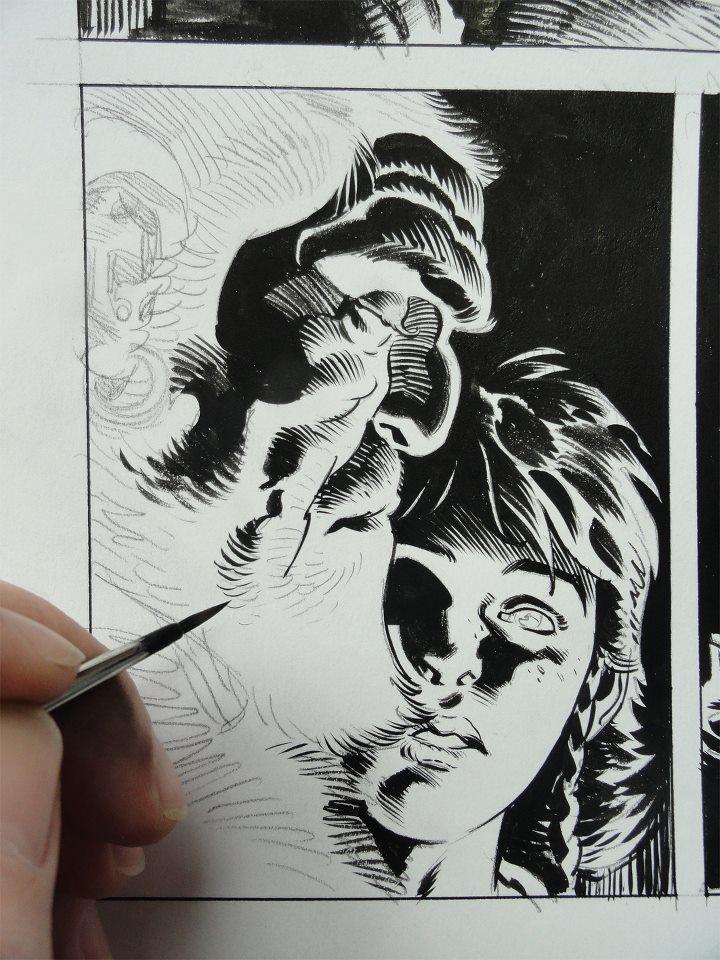
Abstract
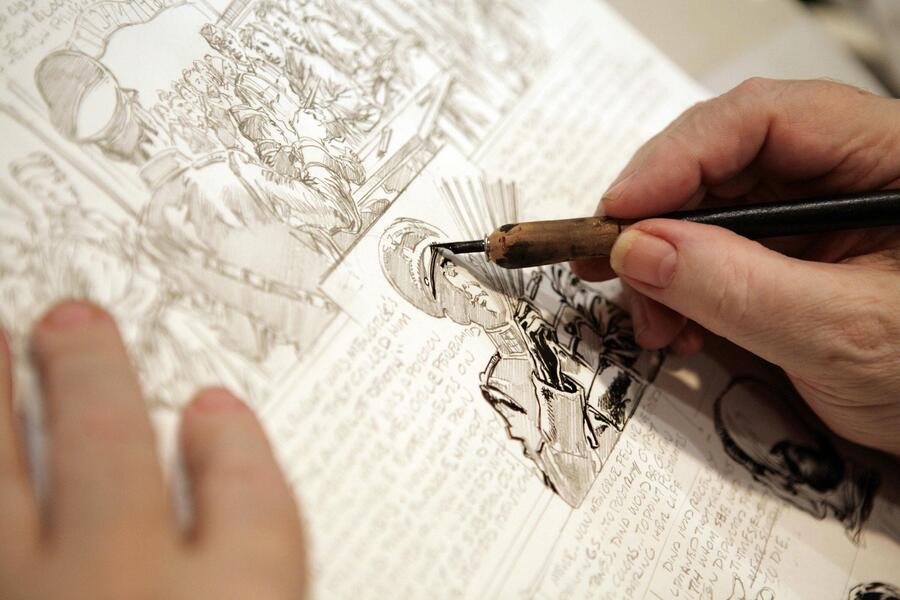
Artist’s Work in Pen
This visual study is dedicated to exploring the line as a fundamental means of artistic expression in the history of comics. The line is examined not only as a tool for creating images and conveying form but also as an independent element of visual language that defines the character, style, and emotional perception of a graphic work.The research traces the evolution of linear graphics in Western comics, spanning from early newspaper strips and classic American comics to contemporary graphic narratives. Special attention is given to various drawing and outlining techniques, line weight and plasticity, degree of detail, the character of the stroke, and the unique nuances of an artist’s signature style.The study aims to identify how technical methods, artistic movements, and the individual approaches of artists influenced the formation and transformation of the comic’s visual language.
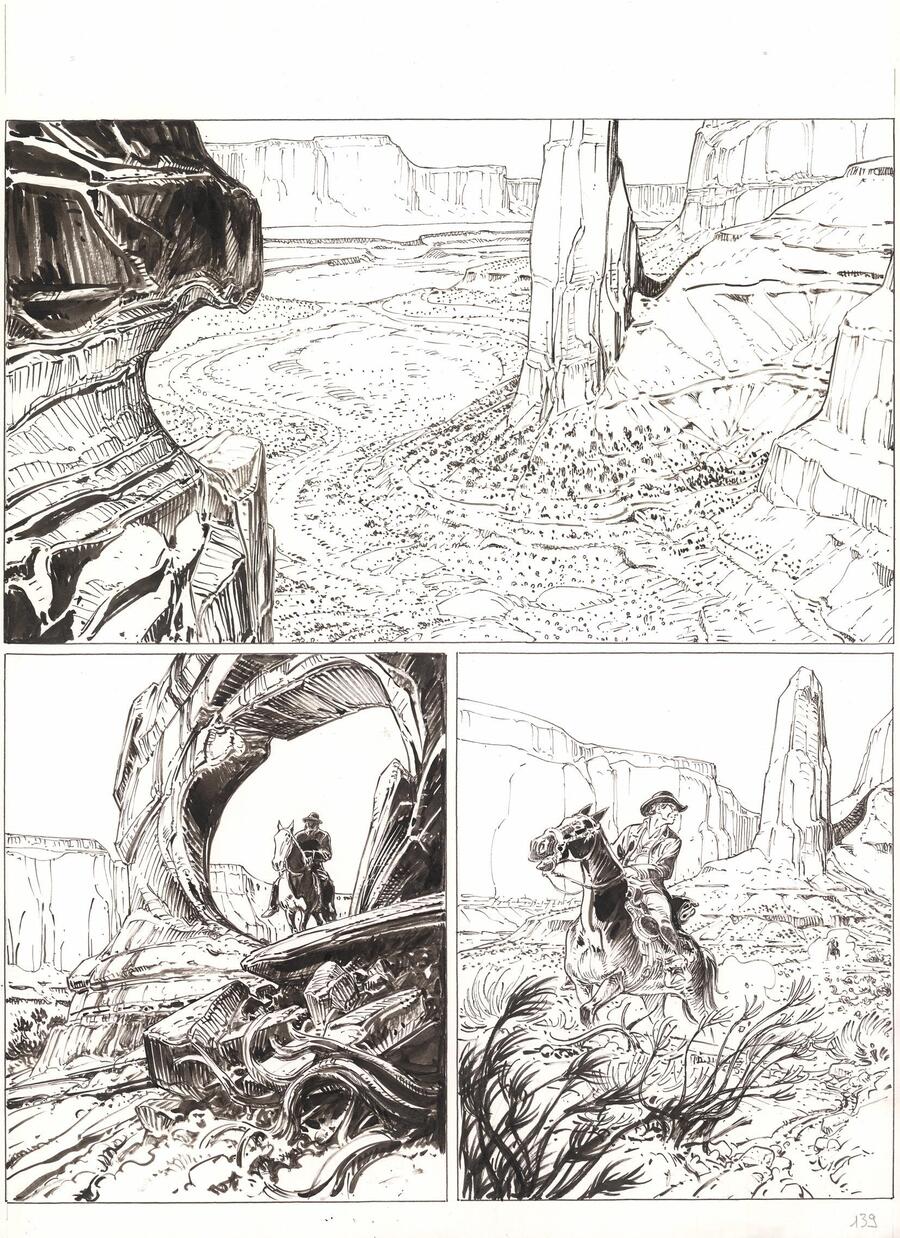
François Boc — original page
Original Comic Pages
Raster Printing
Introduction
Winsor McCay — Little Nemo (1908)
Line is one of the fundamental elements of visual art. It is with line that an artist defines form, creates volume, conveys texture, and shapes the visual structure of an image. In comics, line takes on a special significance, as it becomes the foundation of the graphic language that defines the appearance and artistic expressiveness of the work.
Throughout the history of the comic, the methods of working with line have undergone significant changes. From the concise contour drawings of early newspaper strips to the complex, detailed graphics of contemporary creators—each historical period has shaped its own visual characteristics. The character of the line drawing was influenced not only by the individual styles of the artists but also by available tools, printing technologies, image reproduction methods, and general trends in graphic arts.
In comics, line can be thin and elegant, rough and expressive, geometrically precise, or free and plastic. Differences in the character of the stroke, the thickness of the contour, the density of the image, and the methods of inking shape the unique visual identity of each creator. Therefore, studying line allows us to trace not only the technical evolution of the drawing but also the development of artistic approaches to creating comics.
George Herriman — Krazy Kat
The relevance of this topic lies in the opportunity to examine the history of the comic strip through the lens of its graphic language, paying close attention to the artistic and technical aspects of the imagery rather than its narrative content.The goal of this research is to trace the evolution of the line as a means of visual expression in Western comics and to identify the fundamental changes in its artistic and technical characteristics.
Chapter 1. Forming the Linear Language of Comics
Richard Outcault — The Yellow Kid early newspaper comic
The line occupied a crucial place in shaping the visual language of the comic from the very beginning. Early comics, which were primarily distributed in newspapers and magazines, were created with the constraints of print production in mind. Artists had to work within limited space, small image formats, and the technical capabilities of letterpress printing. This directly influenced the nature of the drawing: it needed to remain sufficiently crisp, simple, and clear even after being reduced and reproduced on newsprint.
One of the primary tools available to artists of that era was the pen and ink. These allowed for the creation of sharp contours, variation in line weight, and the transmission of numerous details. However, working with the pen demanded a certain level of precision, as the line itself became the foundation of the image. Unlike painting, where form could be generated through blocks of color and tonal transitions, in early comics, it was the outline that defined the boundaries of objects and the structure of the drawing.
Winsor McCay — Little Nemo 1905–1906. Complex composition, delicate line work
The line gradually stopped serving solely a technical function. Artists began to experiment with its character, using varying stroke weights, combining thin and bold contours, adding decorative elements, and employing more complex cross-hatching. This contributed to the formation of individual graphic styles.
A particularly interesting example of an early approach to line is the work of Winsor McCay. His pieces display high levels of detail, delicate rendering of elements, and a complex organization of space. For McCay, the line transcends simply denoting form; it becomes a tool for creating a cohesive graphic composition.
Thus, the early period of comic development laid the foundation for the subsequent evolution of linear graphics. Technical limitations of printing gradually transformed into distinctive artistic features, and the line became one of the primary means of a comic’s visual identity.
Winsor McCay — Little Nemo, 1906 Early newspaper illustration, delicate line work, and detail
George Herriman — Krazy Kat 1922. Free drawing, heterogeneous contour
Chapter 2. Artistic Characteristics of Line
Pen and cross-hatching
In a comic, the line performs much more functions than simply outlining objects. It shapes the structure of the image, defines its visual character, and influences the perception of the graphic composition. Even without color, the qualities of the line drawing can create a sense of depth, volume, texture, and movement.
One of the most noticeable characteristics of a line is its thickness. Thin lines allow for the creation of light and detailed images, conveying small elements and complex textures. Conversely, thicker and bolder contours make the image graphically expressive, highlight main forms, and intensify the contrast between elements. Combining lines of varying thickness helps the artist build a visual hierarchy within the image.
Line Weight Variation The Contrast Between Fine and Bold Outlines
The character of the stroke plays an equally important role. A line can be smooth and continuous, sharp and angular, freeform, or geometrically precise. These characteristics define the individual character of a drawing. For instance, a smooth line is often used to create soft, rounded forms, whereas sharp and broken strokes lend the image a harder, more expressive quality.
Layout and Texture
Particular attention should be paid to line work. In some graphic styles, object contours are clearly defined and virtually unbroken, while in others, form can be created using individual hatching, shadows, and large black masses. These differences are particularly noticeable when comparing the European comic school—for instance, the ligne claire style—with more contrasting American graphic traditions.
Hatching is also a crucial tool. By using intersecting, parallel, or chaotically placed lines, the artist can convey volume, shadow, and surface texture. The density of the hatching determines the degree of darkening in the image, and the direction of the lines helps emphasize the form and structure of the objects.
Line and Graphic Mass The relationship between white space and black
Thus, the line functions as an independent artistic instrument, whose capabilities extend far beyond the simple act of creating an outline. It is the combination of its thickness, direction, quality, and density that forges the artist’s unique graphic style.
Chapter 3. The Evolution of the Authorial Hand in Comic History
Jack Kirby — Fantastic Four massive graphics, expressive contours, and cross-hatching
The development of the comic was accompanied by constant shifts in artistic approaches to representation. Despite the existence of general graphic principles, each artist gradually developed their own distinctive way of working with line. This individual style became an important part of the comic’s visual identity, allowing one to distinguish the works of different creators even without knowing their names.In classic American comics, expressive contour line work gained significant importance. This is particularly noticeable in the works of Jack Kirby, whose drawing style is characterized by powerful outlines, active use of hatching, and complex forms. His graphic language is based on combining large, expressive elements with numerous internal lines that help create volume and emphasize the image’s structure.