Why can visually similar film traces belong to incompatible conceptions of what cinema is and how it should be structured?
Film damage is usually considered a result of physical wear and tear. Scratches occur from mechanical contact with equipment, chemical changes disrupt the structure of the light-sensitive layer, and prolonged storage in unfavorable conditions leads to the gradual loss of the photographic record. However, the origin of damage cannot always be determined by visual inspection alone. The difference between defects is found by examining the circumstances of their occurrence and the place they occupy within the film’s structure. In conventional narrative cinema, the film serves as the material support for the photographic record. It holds the frames, perforations, edges, and splices, but the semantic organization of the work is primarily related to what was captured in front of the camera and subsequently assembled in the edit. Experimental cinema has repeatedly challenged this distribution of roles, bringing the strip itself, its signs of processing, and the circumstances of its display back into view. Such interventions sometimes destroyed part of the photographic information, sometimes created a new graphic layer, and sometimes altered the relationship between the captured action and the time of its subsequent existence in the archive. Therefore, the question of the aesthetic function of the defect must be shifted from the individual frame to the film as a whole. A hypothetical vertical line might cut across a face, disrupting the compositional closure of the frame; yet, it can repeat over dozens of minutes with a predetermined periodicity, transforming into a means of organizing screen duration. Similarly, an archival stain, created without directorial involvement, only acquires meaning after it is selected from the collection, placed within a specific editing sequence, and synchronized with sound. Studying these differences requires taking into account the morphology of the mark, the sequence of its changes, the origin of the material, and the artistic program within which it is employed.
For this research, two historically defined avant-garde approaches—letterist and structural film—were selected, and experimental practices of chemical intervention and archival reuse were subsequently examined. The latter cannot be considered independent styles without reservations, which is precisely why they are useful for testing the initial hypothesis: similar material processing can emerge outside the direction in which it was first theoretically substantiated. The focus is on the films of Isidore Izu, Maurice Lemaitre, Owen Land, Paul Sharits, Naomi Uman, Jürgen Reble, Peter Delpöte, and Bill Morrison. Comparing their works does not imply reconstructing authorial styles; individual pieces are examined as different modes of organizing material trace. Theoretical support is drawn from the studies of Kaira Kabanyas on letterism, P. Adams Sitney on structural film, Peter Ghidal’s structural-materialist concept, Kim Knowles' photochemistry practices, and Giovanna Fossati’s exploration of film archives. Nessa Johnston’s work is essential for comparing the sound structure of two archival works. These authors establish varying scales of inquiry—from the history of a specific avant-garde movement to the conditions of cinematic material existence and its re-editing.
01. Letterism. Image after carving
The Lettrist program emerged as an attempt to re-examine the fundamental unit of artistic language. In poetry, Isidore Isou proposed working with sound and letter before the formation of a coherent word; in the context of film, this implied questioning the notion that movement must be built around a finished scene, with sound merely confirming its meaning. His view of art history as a succession of phases of expansion and «carving out» suggested a point when established forms exhaust their possibilities and become subjects of deconstruction. The physical damage to film proved to be a convincing embodiment of this position: the destruction was shifted from a negative judgment of existing cinema to a specific production operation. The Lettrist intervention, however, cannot be reduced to mere extravagant handling of the film. For Isou, it was fundamentally not just that an image could be ruined, but how it ceased to maintain a central position in the film. His theory of «discrepant cinema» allows for the independent organization of sound and visuals. Furthermore, the concept of the «carved-out image» extends destruction to the photographic material itself. To consider these operations in isolation is to miss the overarching logic of the movement: the concordance between the word, the visible action, and the physical medium is no longer taken as an inherent property of cinema.
Isidor Izu. «Tractate on Saliva and Eternity, ” 1951
The film Iz is structured as a collage of disparate fragments: it features street footage, documentary imagery, discussions about the film itself, dialogue that doesn’t always align with what is happening on screen, and sections of film manipulated by hand. This heterogeneity is significant because it systematically denies the image the status of a single central focus for the film. In a conventional scene, synchronized sound, editing sequence, and perspectival space support each other, creating a sense of continuous event. In Iz, these supports progressively diverge, and the mark made on the film presents a particularly clear case of this divergence: the photographic capture and the subsequent graphic action occur at different times but are forced to coexist on the same piece of celluloid.
We should examine the nature of this duality more closely. If the black line appears in the image of the street because an actual wire was captured, it adheres to perspective, can be obscured by moving objects, and belongs to the filmed world. The scratched line does not correspond to either perspective or the movement of figures. It is capable of traversing over faces, buildings, and skies without changing its direction; its boundaries are defined by the instrument’s movement. Because of this, the image ceases to appear as a unified space containing all visible elements. Its integrity becomes conditional. The photographic frame exists simultaneously with the surface available for subsequent processing. Destruction here is better understood as an operation performed on an already existing recording, rather than simply adding abstract texture. In preserved examples, the «carving» of lines may correspond to individual faces, signs, and elements within the documentary frame. Their impact cannot be assessed without answering the question of precisely what they are covering. When, for instance, examining a modified segment of the chronicle, it is necessary to distinguish between the disappearance of information, the shift in emphasis from an individual character to a situation, and the emergence of new graphic connections overlaid on the original photograph. In cases where part of a face is crossed out, the remaining visibility of the person and the inability to read the image entirely form a more complex structure than a completely obliterated frame. Kabanjas views such actions within the context of the letterist rejection of the autonomy of the photographic image.
Frame-by-frame analysis allows us to pinpoint another characteristic. A scratch on the physical strip can change its shape from one frame to the next, becoming a moving graphic event. In this process, the viewer does not see the movement of an object captured by the camera, but rather the shifting of lines whose coordinates are dictated by the film processing procedure. The recorded world remains photographic, yet an independent visual process unfolds atop it, separate from the original capture. The intersection of these two temporalities—the moment of recording and the moment of intervention—makes the material surface the subject of the film, even though the action formally continues to take place within the frame.
Maurice Lemaitre. «Has the film already started?», 1951
Maurice Lemaitre’s film continues the Lettrist program in a direction where modified film stock is no longer the sole boundary of the work. The director utilizes found fragments, accelerated image sequencing, drawing, and traces of physical alteration, but simultaneously incorporates the act of viewing into the concept—the actions occurring in the hall, the reaction of the session organizers, the placement of the screen, and the possibility of interrupting the accustomed viewing experience. Through the concept of syncinéma, he understood the event in which cinematic relationships are reconfigured within the exhibition space itself. Visually, it is crucial not to confuse graphical superimposition with mere decorative framing. Lettrist processing permits the coexistence of photographic fragments, drawings, arbitrary signs, and traces of wear, and these do not necessarily need to form a cohesive composition in the conventional sense. This heterogeneity does not require the image to be completely eradicated; rather, what is more crucial is that none of the layers possess absolute priority. Photography ceases to dictate the meaning of the drawing, and the graphic sign can be read independently of the subject upon which it is imposed.
The distinct quality of «The Film Has Already Begun?» is that the disruption of conventional cinematic order is extended to the relationship between the film and the conditions of its exhibition. In a typical screening, the screen functions as a stable boundary for the work; the actions in the auditorium are not part of its structure. In Synkino, conversely, the screen and the venue are considered elements of a singular event, and the audience’s situation is permitted to enter the artistic construct. It also explains why Lettrist film degradation does not become a separate technique of abstract graphics—it belongs to a broader reevaluation of the film’s conditions of existence. For comparison with Izú, it is particularly significant that Lemaitre changes the scale of intervention. In Izú, the trace is a violent intrusion into the photographic frame and a part of the disjunction between sound and image. Lemaitre extends a similar gesture to the film screening as an institutional and spatial procedure. The focus is on dismantling the conventional connections between the material, the screen, sound, and the venue, rather than on the mandatory physical destruction of every image.
02. Structural Film. Process Over Finished Scene
In 1960s American experimental cinema, the material aspect of the film took a noticeable place within a different intellectual endeavor. The term «structural film, ” proposed by P. Adams Sitney, described works where the form of the whole was more defined than the changing content of individual episodes. This definition is useful if it doesn’t replace the description of each specific work, because the stable characteristics of the movement are revealed differently and do not necessarily imply a direct damage to the celluloid. Engagement with material in structural film is characterized by attention to how the film is produced and how long it lasts. This gives rise to a fundamental difference from the Letterist stance of „carving out“ dominant cinematic language. A structural film can make a peripheral technical element central without the gesture of expressive negation, and a scratch can only acquire meaning after repeated viewing, within a rhythm that builds the structure of the entire piece.
Owen Land. «Film featuring marginalia, perforation holes, dirt particles, etc.», 1965–1966
Owen Land’s film, «Film Containing Border Markings, Perforations, Dirt Particles, etc.» (1965–1966), nearly entirely describes its visual content. The frame presents test strips of film stock: technical notations, color charts, and an image of a woman in a red dress—the so-called China Girl—who was used for laboratory print and color reproduction calibration. This material, which is usually outside of public exhibition, is presented in its own right, without being transformed into a narrative scene. The image remains almost static, yet the woman occasionally blinks, and this brief gesture disrupts the impression of frozen time.
For analysis, the composition’s structure is significant: the female figure is enclosed between technical fields not intended for pictorial narration. Near the face are markings and color sections, the meaning of which is established by the laboratory’s work. She ceases to be a character because the film offers no information about her actions or circumstances; however, the face continues to draw the viewer’s eye, creating a tension between the conventional human focus and the technical framing of the image. This tension is one of the reasons why Land’s work is not merely a demonstration of cinema’s «underbelly,» as it also exposes the very conventionality of isolating an object within the frame. The rare blink acts here more precisely than any editing event. Because the image is virtually static, minimal movement is highlighted as a disruption to the immutable structure, the viewer’s expectation of narrative development is unsupported by any new scene, and duration acquires independent weight. It is important that the graphic markings and the image of the woman reside on the same plane, even though before being transferred to the screen, they held different roles in the technological chain. The projection equalizes the technical notation and the photographic figure, transforming production details into a quality of the image itself. Compared to letterism, this operation appears almost antithetical. Iuze applies a new mark to the recording, altering an already existing photograph, whereas Land organizes the presentation of material that was technically created for other purposes. He is not obligated to scratch the emulsion to question the transparency of the cinema screen; it is sufficient to alter the display frame and the duration of the showing.
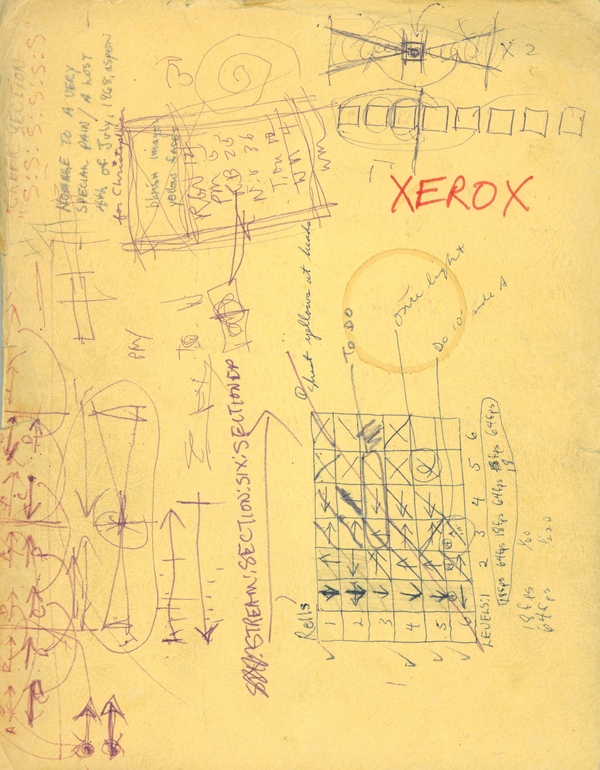
Pol Sharits. «S: TREAM: S:S: ECTION: S:ECTION: S:S: ECTIONED,» 1971
Paul Sharits’ film S: TREAM: S:S: ECTION: S:ECTION: S:S: ECTIONED (1971) allows for an examination of material intervention with a precision that is difficult to achieve when analyzing a single damaged frame. The work is forty-two minutes long and consists of three fourteen-minute segments, built around a repeating structure of water flow imagery. At the beginning of each segment, six recordings of flow, oriented differently, are superimposed; subsequently, the number of layers decreases, and a more distinct photographic depth gradually emerges through their mutual overlay. Simultaneously, vertical scratches appear over the image, the quantity of which increases according to a specific system. It grows in groups of three and reaches twenty-four. Distinct horizontal splicing marks are also visible on the film, and the sound track includes signals and an increasingly complex verbal structure. The crucial point here is that water is chosen as an image of movement that cannot be directly correlated with the projection’s direction. The water flow branches, changes speed, and creates visual intersections, making it visually difficult to determine where the current is moving after merging several layers. The scratches, conversely, anchor stable vertical axes within the frame, tied to the length of the film strip. Two orders of magnitude coexist in the composition: the motion of water recorded by the camera, and the physical direction of the material moving through the projector mechanism.
A particularly expressive moment occurs when, after the gradual fading of the overlaid streams, the photographic space should acquire greater clarity, but simultaneously begins to be obscured by a system of scratches. The deepening and material closure of the image do not happen sequentially. The mechanical line maintains orientation relative to the film even when the direction of the water inside the frame changes. This relationship cannot be called a random conflict of textures because the pattern of introducing scratches organizes the temporal movement of the entire film. Horizontal splices complicate the construction. They interrupt the vertical continuity of the lines, revealing the strip’s connection, and short sound signals tie the visual break to an auditory event. The image, the mechanical seam, and the sonic count are equally valid, though non-coincident, systems of organizing duration; in this respect, Sharitsa’s film is more complex than the familiar formula that structural film «shows film stock.» A separate shot, S: TREAM: S:S: ECTION: S:ECTION: S:S: ECTIONED, reveals little about this logic. Four or five scratches on their own might appear as copy damage. Only when the shots, arranged in their actual sequence from different parts of the film, are observed does the systematic nature become evident. This creates a significant difference from letterism for cross-style comparison. In Izu’s work, the sign intervenes in an already shot photograph as an action directed at its artistic status, whereas in Sharitsa’s, the trace becomes a variable composition without which the form of the work would disappear.
It is necessary to stipulate separately that Peter Adams Sitney’s term «structural film» and the concept proposed by Peter Guidal describe non-identical theoretical positions. Sitney highlighted specific formal characteristics of works where the film’s cohesive structure became more important than individual images. Guidal, conversely, criticized the risk of such a structure turning into a new aesthetic fetish, where the viewer merely recognizes the rule instead of engaging with the production of cinematic meaning. His program text addresses the material relationships of imagery, editing, projection, and the act of filmmaking itself, as well as the counteraction to the illusionistic transparency of the image. This distinction also impacts the interpretation of Sharits. Although his work is historically rooted in American structuralist experimental cinema, his consideration of the material strip, the splices, and the recurring organization of form makes it comparable to the questions raised by Guidal. This comparison does not imply that Sharits belonged to a British structuralist-materialist program or merely illustrated a pre-existing theory. For the purpose of research, it is important to demonstrate the historical connection of these problems without substituting it with a misclassification of the artists. The damage to the film stock, in this context, becomes one of the foundations of a conversation between approaches that do not align in their intellectual history.
03. Modifying a Previously Captured Image
Practices involving the direct manipulation of found material allow us to determine whether the proposed juxtaposition retains meaning beyond the confines of two historical movements. If the physical operation itself were to dictate the style, then any attempt to remove the emulsion or scratch the film should yield a similar result. In reality, the significance of the same action shifts depending on the source material and what the artist chooses to retain or intentionally exclude.
Naomi Uman. «Remote, ” 1999
In the film «Removed» (1999), Naomi Uman utilized found pornographic film stock, protecting the areas she wished to preserve with lacquer while treating the images of the female bodies with bleach. Following the chemical reaction with the emulsion, transparent zones appeared where the figures were; when projected, these zones are read as light, mobile silhouettes, whereas the surrounding space and other figures continue to exist within the frame. The artist herself described this method in an interview with Millennium Film Journal, and it is analyzed in publications concerning the aesthetics of absence. It is necessary to distinguish between two types of loss: the physical loss of the emulsion and the loss of the imaged subject. They do not perfectly coincide. The recording layer is physically removed, but compositionally, the female figure does not disappear; rather, its former placement is underscored by the outlined void, and its movements remain discernible through the changing contour. Consequently, the film produces a unique negative of the human body—an image of its absence. Uman preserves the system of viewing and scene construction but deprives it of its customary visual subject. Furthermore, Uman’s method demands meticulous manual work on every fragment of the film. The boundary of the white spot does not arise from free corrosion; it depends on the carefully selected protected areas and the original configuration of the body. The void may appear uneven, blurred, or almost as a self-sufficient figure, yet its placement cannot be considered a random natural pattern. This is a significant distinction from the signs of archival degradation, which do not account for the contours of the bodies depicted. The more precisely the chemical treatment follows the original figure, the clearer the dependence of the new image on the old becomes.
A simple «before and after» comparison fails to convey the full scope of the operation, as the central effect emerges through movement. The light silhouette changes shape and position in sync with the actress’s original gestures while simultaneously retaining the trace of manual manipulation in every frame. Within a single sequence, the photographic residue, the transparent void, and the sound track continuously refine one another. Uman demonstrates the extent to which an image can maintain a structural dependence on something that can no longer be seen directly within it.
Jürgen Reble. «Zillertal,» 1991
Jürgen Reble approaches a different mode of working with photochemical media. For the film Zillertal (1991), an old trailer was used—a reel that had been exposed to the trees in a garden for a long time and periodically subjected to chemical treatment. The Light Cone catalog directly connects the appearance of new color zones with the decomposition of the originally black-and-white image. While in «Distant, ” the chemical reaction is constrained by a chosen contour, Reble’s boundaries of influence depend on the material’s condition, its interaction with the environment, and the development of processes that do not conform to precise frame-by-frame mapping. The artist controls the experimental conditions and decides how to use the resulting outcome, but does not design the outline of each spot like a graphic sign. The creative action is distributed across material preparation, waiting, re-treatment, and subsequent editing. The word „random“ only describes a limited predictability of the local form, not the absence of intent. Fragments of figural imagery may emerge in the frames of Zillertal: faces, gestures, and familiar genre situations momentarily take shape before dissolving again among the chemical formations. The emerging masses of color do not correspond to the lighting of the original scene and are not obligated to replicate its perspective. Color belongs to the subsequent history of the film; thus, the image becomes both an old black-and-white record and a new chromatic surface. Unlike a drawing added on top of a photograph, the chemical influence affects the very structure of the photographic material, meaning the new layer cannot be entirely separated from the deteriorated original.
04. Found Film and Time of Its Destruction
When working with archival film material damaged prior to the start of a new artistic project, signs of wear, deformation, and decay are not artificially created but are discovered within an existing collection. The artist selects fragments and determines their duration, sequence, framing, and sound environment, but the chemical form of the damage was created by a different history—the conditions of storage, exhibition, and the aging of the medium itself. This establishes a significant boundary between artistic intervention in the film and the artistic decision to preserve what archival practice would typically aim to correct or stabilize, if possible. The material cost of such a decision must also be considered. The degradation of nitrate film stock is not a process that can be romanticized without qualification. It leads to the loss of emulsion, distortion of the recording, and sometimes the complete destruction of the medium. In a conservation context, the goal is to preserve accessible information and ensure safe storage conditions. In experimental archival cinema, these same traces can be incorporated into a new work, but the artistic value of a frame does not negate the loss of the original source.