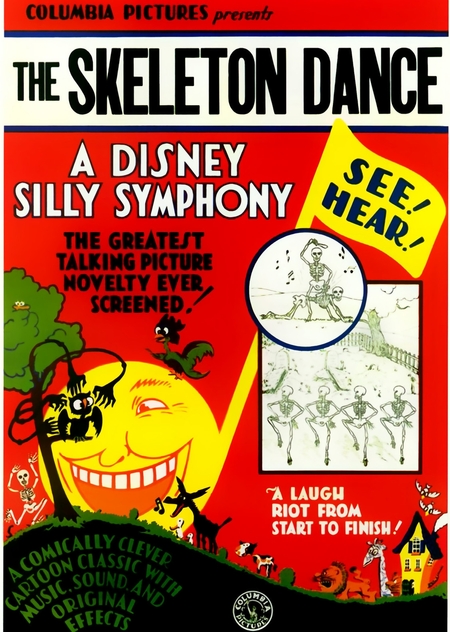
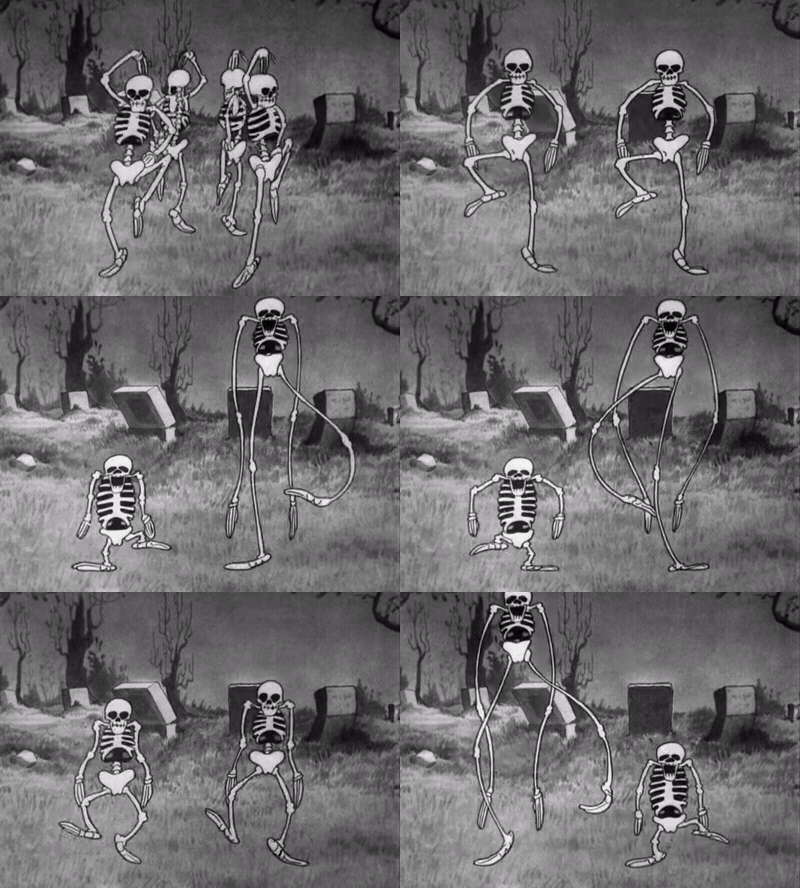
The Skeleton Dance, 1929, USA.
Concept
In early drawn animation, the body easily sheds its conventional properties. It stretches, inflates, transforms into an object, or disintegrates into parts. Even the bones behave as if they were made of rubber. I am interested in the moment when the viewer has noticed the form’s disruption but can still recognize the character. In this brief moment of ambiguity, a comedic effect—and sometimes a sense of unease—arises.
The research is built around eight films. In each one, I examine a specific episode: precisely what changes, how the transformation is prepared, and what remains afterward. This scope allows for a comparison of the drawing, movement, and the character’s action, without reducing the work to a mere retelling of the studios' stories.
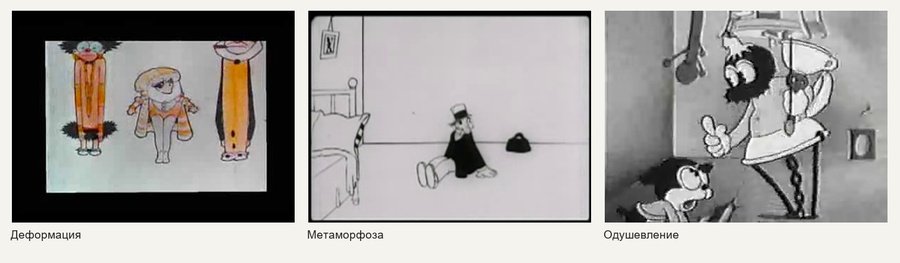
Deformation: elongated characters from Little Nemo. Metamorphosis: Felix in the form of a bag. Animation: a figure composed of objects in Bimbo’s Initiation. Creative compilation; stills belong to the respective films.
Contents
- Emil Kohl: the continuity of line.
- Windsor Mackay: the stretching of the recognizable figure.
- Komar Mackay: growth, mass, and the limit of the body.
- Felix: transformation as problem-solving.
- Disney: the skeleton that plays with itself.
- Flashes: objects and space versus the hero.
- Minnie the Moocher: human plasticity in a spectral body.
- Snow White: movement through changing envelopes.
- Comparisons and conclusions.
Fantasmagorie, 1908, France
At the beginning of the animation sequence, a hand draws a small figure against a dark background. The character has minimal internal detail—it is defined by several contours, a cap, and simple body geometry. Any change in the line work is clearly visible on such a drawing. The appearance of the hand sets the viewing condition: the figure exists because of the artist’s work, and its structure can change right within the frame.
The hand introduces the character into the image. «Fantasmagorie» 1908.
In most episodes, there is open space around the figures. Objects appear as needed, so the viewer does not have to compare the transformation against a fixed interior. The new contour quickly replaces the former one. The absence of a detailed background directs attention to the transition itself—you must learn the image before it changes again.
Image sequence: bottle, flower, elephant. «Fantasmagorie» 1908. The intervals between frames vary.
In the episode featuring the bottle, flower, and elephant, one image picks up the motion of another. The elongated contour of the bottle transitions into an organic form; then, a long, flexible line integrates into the image of the elephant. There is no domestic causal link between the objects. Instead, they share common outlines that guide the eye. The narrative briefly gives way to a chain of recognitions.
Hands assemble the disintegrated figure. «Fantasmagorie» 1908.
As the piece approaches its climax, the figure begins to dissolve, and hands re-enter the frame. They gather the character, and the motion continues. This intervention gives the viewer a direct understanding of reversibility: the artist is capable of correcting the damage. Moreover, the drawn hero and the real hands belong to different layers of the image. Their meeting makes the contingency of what is happening visible.
A chain of transformations in continuous motion. «Fantasmagorie» 1908.
In Kolya, the continuity of transformation remains paramount. A distinct object might disappear, yet the line continues to function in a new form. Recognition becomes a brief event: the viewer notices a bottle, a flower, or an elephant before the shape slips further away. For subsequent associations, this is the initial case where the transformation is governed by the very organization of the drawing and the visible intervention of the artist.
Little Nemo, 1911, USA.
Little Nemo features an extended in-game introduction where McGee draws and displays his work to those around him. The animation segment is perceived as the result of this demonstration. The characters already possess recognizable costumes and silhouettes. When their proportions change, the viewer can compare the new state to the norm just seen. The deformation is grounded in a stable image.
The space between Impy and Flip before the figures are strongly stretched. «Little Nemo» 1911. The depiction of Impy contains the racial caricature of its era.
Flip and Imp extend vertically next to Nemo. The clothing changes along with the body—color sections elongate, details separate, but the costume’s identity remains discernible. Therefore, the figure retains its name and character even with a drastic distortion of proportions. To read these transformations, only a few consistent traits distributed across the altered silhouette are needed.
Sequential states of elongated characters. «Little Nemo» 1911. Intervals between frames are eight seconds.
The sequence of frames reveals that growth is not merely about replacing a small figure with a large one. Elongated states emerge between them, which appear inherently unstable. Nemo takes a central place, helping to gauge the transformation of neighboring characters. The gradual transition allows the viewer to trace the direction of the stretching and to sense its duration. Here, movement itself becomes the subject of display.
Nemo does not draw a Princess. «Little Nemo» 1911.
After demonstrating the deformations, Nemo creates the Princess image himself. Inside the animation, the action that Mackey previously performed in the game introduction is repeated. The character gains the ability to generate a different figure. This transfer changes his role—he becomes a participant in the construction of his own world. The resulting Princess then acts alongside him, giving temporal continuation to the drawn image.
Altering vertical proportions. «Little Nemo» 1911.
In the chosen episode, the change in proportions does not negate the characters' identities. The costume, figure arrangement, and nature of movement connect the extreme states. Unlike Kolya’s sequence, here it is important to observe what happens to a body already familiar to the viewer. The scene tests the limits of its plasticity and shows how far the change can go while the audience continues to recognize the same character.
How a Mosquito Operates, 1912, USA.
A mosquito pursues a human and reaches their bed. The main action centers on the repeated feeding: the insect’s abdomen swells, and its customary movements gradually become hindered. McKay maintains the character’s original design. He retains slender legs, wings, and a long proboscis. The proportions of the parts change, and the size of one begins to dictate the entire body’s behavior.
Slim mosquito legs before significant abdominal swelling. «How a Mosquito Operates» 1912.
In the early frames, the mosquito leans on long, slender legs. Next to the enlarged abdomen, they appear increasingly precarious. The outline communicates the strain even without explanatory text: the large, rounded mass is supported by almost thread-like limbs. The enlargement of the abdomen turns overeating into a structural problem. The character must continue to act with a body whose proportions have already changed.