Introduction
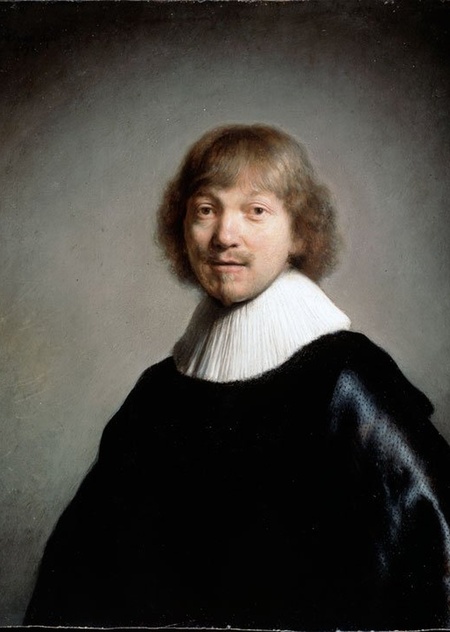
A double portrait, or pendant, consists of two separate portraits intended to hang side-by-side. They were most often used to depict married couples: the husband and wife would be painted on two boards or canvases of the same size, with each painting remaining a complete work on its own. The occasion for commissioning such a piece was usually a wedding, though less frequently, an election to office or friendship. The genre developed in the 15th century in the Netherlands and Italy, and in 17th-century Holland, it became one of the most common commissions for wealthy citizens.The pendant presents the artist with a unique challenge. The two paintings must be self-sufficient while simultaneously being read as a single scene. There is always a gap between them: two frames, a strip of wall, or sometimes the gap of a folding screen. The way the artist bridges this gap is the subject of investigation. Over less than two centuries—from Memling and Piero della Francesca to Hals and Rembrandt—the method for joining the two halves of the pair changed noticeably, and these changes clearly illustrate how the very understanding of the portrait evolved. The cover features one half of such a pair: a portrait of the engraver Jacob de Heyn III by Rembrandt, which is housed in London, and a corresponding double portrait of his friend Maurits Huygens, which is in Hamburg.
Ключевой вопрос
How did artists of the 15th–17th centuries transform two separate portraits into a single image, how did the manner of this connection evolve, and what is lost by the pair when its halves are separated?
The connection between the two halves of the pair gradually shifts from the surrounding environment to the behavior of the depicted subjects. In the 15th to early 16th century, the two panels are united by a shared landscape or common architecture. This is later followed by the mirror symmetry of the poses. In the 17th century, the linking elements become the turn, gesture, and gaze: the portrayed individuals turn towards each other across the frame, and towards the viewer, who becomes a third participant in the scene. The flip side of this transformation is fragility: the more each half depends on the other, the more the pair loses itself when separated by the antiquarian market.
Material Selection Principle
The study includes 12 pairs of easel paintings created between approximately 1470 and 1641. Both halves of each pair were painted by the same artist and were conceived as a pair from the beginning; both are held in open museum collections and have been published on the museums' websites. Pairs where one half is in a private collection were not included in the sample. Within each block, the pairs are arranged in chronological order. Rembrandt’s works hold a notable place in the selection not by chance: his pendants have been studied more thoroughly than others, and—which is important for the fourth block—they are more widely dispersed across museums worldwide.
Navigation
- Introduction — Research Concept — Key Question and Hypothesis — Material Selection Principle
- Main Body — One Space for Two — The Mirror — Gaze and Gesture Through the Frame — Separated Pairs
- Conclusion — Sources
Main Body
One space for two
The first way to connect two portraits is to place both subjects in a single space. A Renaissance portrait is constructed like a window: the figure is in the foreground, with a landscape or architecture behind them. If the background continues from one panel to the next, the two windows merge into one, and the couple appears side-by-side, even if they are not looking at each other. The figures themselves remain motionless; the entire connection is achieved by the setting.
Piero della Francesca. Portraits of Battista Sforza and Federico da Montefeltro. c. 1473–1475
On the left is Battista Sforza, wife of the ruler of Urbino. She died in 1472, and the portrait, according to museum dating, was painted after her death. Piero depicts her in a strict profile, much like on a medal: the figure takes up nearly the entire height of the board, behind which begins a wide landscape of hills and water, viewed from above. The horizon line is low.
On the right is Federico da Montefeltro. He is placed on the right, contrary to custom, where the man occupies the honored left side. Researchers explain this by saying that Federico lost his right eye in a tournament, and he was depicted only from the left. In his left profile, he looks to the left, and in order for the couple to look at each other, his board had to be placed on the right. The same landscape, at the same horizon height, continues behind him. According to the Uffizi’s interpretation, this panorama represents the couple as the owners and rulers of the lands of Urbino.
The two boards were once connected by hinges and folded like a book. It is the landscape that unites them: the profiles stand in the foreground, each by itself, while the same horizon stretches behind both. The principle of shared space unifies the two static profiles into a single depiction of their domains.
So that the couple looks at each other, Pierrot breaks the rule: the husband is on the right.
Raphael. Portraits of Agnolo Doni and Maddalena Strozzi. c. 1504–1507
On the left is Agnolo Doni, a wealthy Florentine textile merchant. He married Maddalena Strozzi on January 31, 1504, and soon after the wedding, he commissioned Raphael to paint two portraits. Doni is shown from the waist up, in three-quarter view, with a light, hilly landscape and vast sky set behind him. Unlike Piero’s profiles, he is turned toward the viewer and looks at them.
On the right is Maddalena Strozzi. Her three-quarter pose with folded arms against the landscape recalls Leonardo’s portrait of Lisa del Giocondo—during these years, Raphael in Florence closely studied Leonardo’s art. The landscape behind her does not literally continue her husband’s landscape, as Piero’s does, but it resonates with it: the same low horizon, the same bright aerial distance, the same figure height within the frame.
The Doni couple stands at a midpoint between two modes of connection: the background is still shared, but no longer unified, and the similarity of their poses begins to function. The couple’s story continues on the reverse side: there the Master of Ceruminide painted scenes from the Flood and the myth of Deucalion and Pyrrha—the couple who repopulated the earth after the flood. Since 2018, the portraits have been displayed in the Uffizi to allow both sides to be seen. The principle of shared space here is softened: the couple is united not by a single landscape, but by a single weather system and a single light.
Hans Holbein the Younger. Portraits of Jacob Meyer zum Hasen and Dorothea Kannengisser. 1516
On the left is Jacob Meyer zum Hasen, a merchant who became the first non-noble mayor of Basel in 1516. His election was likely the reason for the commission. The artist was around eighteen years old and had only lived in Basel since 1515. Meyer is depicted beneath a coffered arch against a blue sky. The arch does not fit entirely on his panel and continues onto the adjacent one.On the right is Dorothea Kannengisser, Meyer’s second wife. On her panel, the same arch continues and rests upon a gilded column. The two paintings combine to form a single loggia: the couple stands beneath the same vault, and the dividing line between the panels passes through the center of the architecture, as if one painting had been cut in half. According to researchers, Basel painting had not employed this technique before Holbein.Holbein takes the idea of a shared background to its extreme. In the landscape, the connection must be imagined, and the eye completes the half-cut arch itself: each panel looks incomplete on its own. The principle of shared space transforms two portraits into two halves of a single building.
While the portrait is constructed like a window, the pair connects what is seen outside the window: a shared horizon or a common arch. The figures are still—the environment creates the connection.
Mirror
The second method of composition does not require a shared background. Two figures can stand against a dark, neutral field if they are constructed as a reflection of each other: identical format, identical scale, a unified floor line, and postures oriented toward the center. Such a pair is read as a whole because the viewer perceives symmetry. This technique proved to be the most enduring—it appears in both the 15th and 17th centuries.
Hans Memling. Portraits of Tommaso Portinari and Maria Portinari. c. 1470
On the left is Tommaso Portinari, a Florentine who headed the Medici bank branch in Bruges from 1465 to 1478. The portraits were likely commissioned for his wedding in 1470. Memling depicts him half-length, three-quarters view, against a dark background, with hands clasped in prayer; the museum specifically notes the accuracy with which the stubble and scar on his chin are rendered. Tommaso is turned to the right, toward his wife.On the right is Maria Baroncelli, who was fourteen years old at the time of their marriage. Her figure mirrors her husband’s: the same dark background, the same scale, the same clasped hands, but turned to the left. Neither looks at the other nor at the viewer, but into the space between them.That space was once occupied by a third panel. The portraits were the hinged wings of a small triptych, in the center of which, according to researchers' reconstructions, was an image of the Madonna and Child. The central section is lost, and the mirrored poses now face emptiness. The principle of reflection holds the couple together even without a center—symmetry itself indicates where the main element should be.
The Portinari couple prays for the one who is no longer there in the painting.
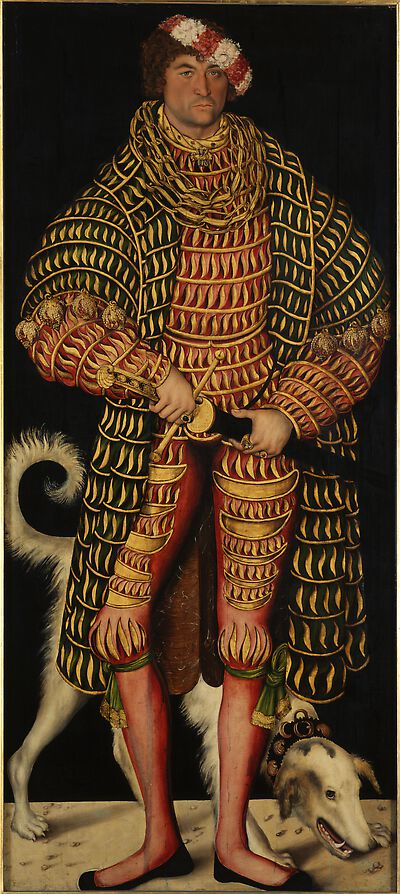
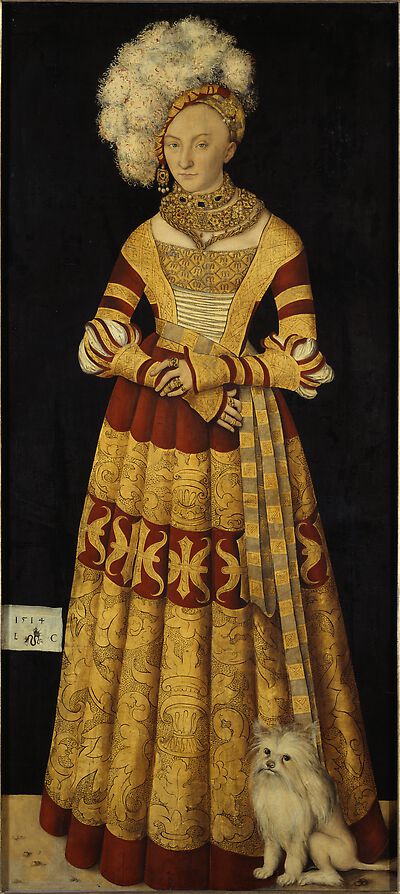
Lucas Cranach the Elder. Portraits of Duke Henry the Pious and Duchess Catherine of Mecklenburg. 1514
To the left is Heinrich the Pious, Duke of Saxony. Cranach portrays him in full length and life size: the Dresden Museum calls this pair the first full-length secular portrait in European painting. The figure fills a tall, narrow format entirely, without landscape or architecture. The Duke is shown with a hunting dog, at the moment he draws his sword.To the right is Catherine of Mecklenburg. Her portrait mirrors her husband’s in its construction: the same format, the same figure height, the same floor line. On her panel, Cranach placed a cartouche with her initials, the date, and a winged serpent—the mark of his workshop. Because there is no surrounding environment whatsoever, the silhouettes create the entire sense of connection. Two elongated silhouettes in elegant attire read as the panels of a single heraldic emblem.Cranach’s use of the mirror operates in its purest form, without the support of landscape or an arch. Combined with the life-size depiction, this creates a new sensation: the couple is not visible in a window, but rather standing on the wall next to the viewer. The principle of the mirror unites the spouses through symmetry alone—and that proves sufficient.
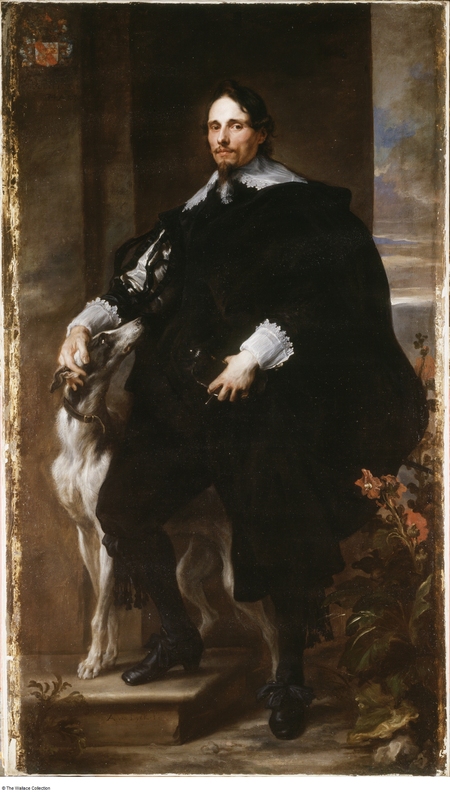
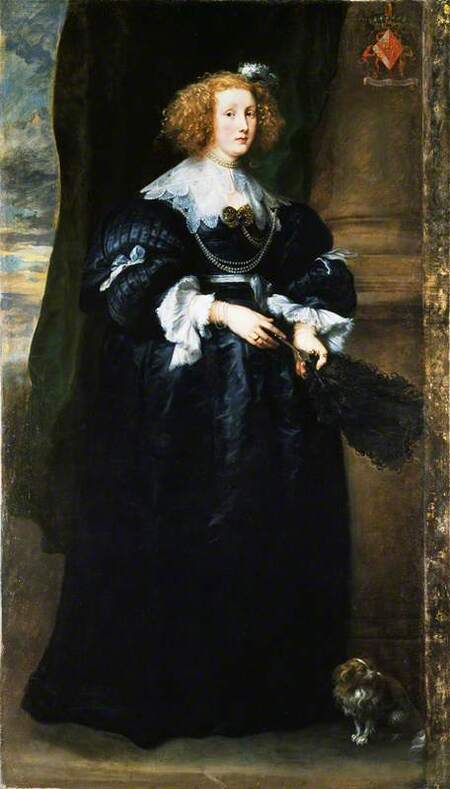
Anthony van Dyck. Portraits of Philippe Le Roux and Marie de Rat. 1630–1631
On the left is Philippe Le Roux, grandson of an Antwerp gunpowder manufacturer who built a career through shrewd business sense. The portrait was painted in 1630, likely for an engagement. A full-length portrait was an expensive affair, associated with aristocracy, and the Wallace Collection directly links the choice of format to the patron’s ambition. Le Roux is depicted with a dog, posed in a free and confident courtly manner. This is one of the few paintings on which Van Dyck signed his work.On the right is Marie de Rat. In 1631, when she was sixteen, she married Le Roux, and Van Dyck painted her portrait a year after painting her husband’s. Despite the one-year gap, the paintings match in size within a centimeter, the figures are rendered in the same scale, and each spouse is accompanied by a dog. This indicates that the second half of the couple was constructed as a reflection of the first.Van Dyck’s mirror is softer than Cranach’s: the poses are freer, the figures inhabit a space rather than a flat background. But the principle remains the same: the couple is bound by an identical form, not by an event between them. The mirror principle allows one to depict a couple separated by time—yet still unify them as a whole.
The mirror links the pair through form: one format, one scale, poses oriented toward the center. But the figures are not yet acting—they reflect each other, but they do not communicate.
A View and Gesture Through the Frame