Navigation and Authorial Concept
Navigator
Who watches whom? The zoo, the cage, and the gaze as a device of distance. On the animal level. Perspective, scale, humor, and the rejection of stable visual hierarchy. When the animal becomes one of us. Home, physical closeness, and photography as a relationship. Repetition as a form of attachment. The series, rhythm, and time of shared life. Another’s archive, a personal history. The found photograph and editorial authorship. From photograph to photobook. How the sequence, spread, and materiality of the book change the ethics of looking.
Original Concept
This research originated from the observation that the animal in photographic history is rarely merely the «subject.» Instead, it functions as a test case for the structure of the photographic gaze itself. The way a photographer approaches an animal—how they situate it relative to the human, whether they include or exclude it from the social space—defines not only the formal composition but also the model of relationship. An animal can be observed from a safe spectator’s distance, through a screen; the camera can be lowered to the ground, foregoing the human height standard; the daily documentation of a pet can be transformed into a long, autobiographical project; finally, the photographer might not be the creator of the original images at all, but rather discover the relationship between humans and animals years later by curating someone else’s family archive into a new book.
The selection of five photobooks—Harry Winogrand’s The Animals (1969), Masahisa Fukase’s Sasuke!! My Dear Cat (1978), Elliott Erwitt’s DogDogs (1998), Erik Kessel’s and Marion Blomeyer’s In Almost Every Picture № 5 (2006), and Erik Kessel’s In Almost Every Picture № 9 (2010)—is not based on the desire to construct a linear «evolution of humanity» from distance to affection. Such a schema would be too convenient and factually incorrect.
Chronology is important here, but even more so are four distinct modes of image production and organization: the institutional public space of the zoo; private, almost corporeal observation of a domestic animal; street photography compiled into a retrospective typological corpus; and finally, a found amateur archive transformed into an authorial statement through editorial montage. The last mode is examined using two books by Kessel, which allow for a comparison of different ways of representing the animal in family photography: the repetition of its presence in daily life versus the repetition of attempts to render the animal photographically recognizable.
It is precisely the comparison of these modes that allows us to test whether the photobook does more than simply unite images of one theme—whether it produces independent meaning through sequence, repetition, pauses, and spreads.
The research method, therefore, is built not around the «character of the animals, ” but around the camera’s position and the reader’s position. The first selection criterion for illustrations is spatial relationship: who is in front of the obstruction, who is looking, and where the photographer is located. The second is scale: the entire body, a fragment, a snout, an eye, a silhouette, a person next to the animal. The third is sequence: does the meaning of the photograph change when juxtaposed with another photograph? The fourth is the book’s materiality: format, gutter, fold, the alternation of full-page and small images, or the presence of blank pages or text. The fifth is the image’s origin: professional shoot, personal diary entry, street observation, or an anonymous family photograph.
The study’s main hypothesis is formulated as follows: the representation of an animal in an author’s photo book arises not so much within an individual image as in the spaces between images. The sequence forces one photograph to comment on another; a spread creates a temporal or metaphorical proximity; repetition generates a sense of duration; the image’s scale defines the reader’s distance; the book’s gutter can literally cleave a human or animal body. Therefore, the same motif—for example, an animal’s gaze directed at the lens—is capable of signifying entirely different relationships: confinement in Vinogrand’s work, an encounter in Fukase’s, a comedic subversion in Erwitt’s, or familial recognition in Kessel’s and Blomeyer’s.
At the same time, this hypothesis is critically examined. A close camera shot does not guarantee ethical intimacy, nor does distance necessarily imply coldness. In Fukase’s work, an extreme close-up can be an expression of love or a form of appropriation. In „The Animals, ” the gaze through the bars simultaneously exposes human observation while capitalizing on its potential. Erwitt’s humor has the capacity to dismantle anthropocentric hierarchies, but sometimes this is achieved at the expense of anthropomorphization. The family shots of the Dalmatian in „In Almost Every Picture #5“ are emotionally immediate, yet the artistic significance we read into them today is largely constructed by editors.
The structure, therefore, moves not from author to author, but from one approach to form to another. It begins by examining the gaze as power and spectacle; next, the perspective capable of destabilizing that power; subsequently, private space and repetition as a mechanism of intimacy; after that, the issue of memory and the other’s archive; finally, the four books are juxtaposed once again as distinct book machines. This principle aligns with the course requirement to view the photobook not as a container for individual works, but as an independent medium where photography, design, and editing form an inseparable structure.
Who is looking at whom? The zoo as a machine of gaze
The American photographic line of inquiry begins not with an animal, but with an institution. «The Animals» appears two years after the MoMA exhibition «New Documents» in 1967, where John Sharkovsky presented Winogrand alongside Diane Arbus and Lee Friedlander as a new generation of documentary photography. Sharkovsky’s formula was fundamental: these photographers used documentary technique not to reform society, but for a personal exploration of the world. This shift moves documentarity from a mode of «proof» to a mode of subjective observation.
Winogrand photographed in New York zoos and the Coney Island aquarium between 1962 and 1969. MoMA later articulated the series' key effect: the boundary between viewer and subject blurs, and human and animal behavior form strange parallels. However, this characteristic requires clarification: the boundary does not vanish. It is extremely material—the frames almost insistently feature grids, bars, glass, stone walls, and fences. What changes is that photography prevents one from taking for granted which side of that boundary the subject occupies.
Harry Winogrand. «New York, ” from the series and photo book „The Animals, ” 1962.
Three visitors stand before the elephants; one person is hidden behind a cardboard box. The most absurd human body ends up being the most conspicuous: in a world where the exotic animal is meant to be observed, it is the visitor who transforms into the spectacle. The central pair, wearing identical plaid shirts, further emphasizes the theme of «exhibition»: the people’s clothing becomes a visual marker comparable to species characteristics. The zoo attraction subtly turns against the spectator.
Harry Winogrand. «New York, ” c. 1962.
The man and woman by the wolf’s enclosure almost deliberately ignore the animal. Their posture resembles a portrait of a couple, relegating the wolf to a secondary element in the composition. However, the cage dominates much of the frame, transforming the space into a visual score of verticals. We begin to see not so much the animal as the infrastructure of its presentation.
Harry Winogrand. «Bronx Zoo, New York City, ” 1963.
The meeting of the man and the rhinoceros is constructed almost mirror-like: two profiles face each other across a parapet. The man holds a cigarette; the animal extends its head. It is this compositional equivalence that generates the ambiguity. The rhinoceros is not depicted as «nature, ” and the man is not depicted as a neutral observer; both become participants in the same spatial scene.
Harry Winogrand. «New York City,» 1964.
An adult’s hand reaches toward a small monkey through the glass; children stand nearby. The gesture both directs attention and teaches observation: the adult is not just pointing out an animal, but transmitting the very model of visual consumption of the zoo to the next generation. Thus, «The Animals» becomes a book not only about animals but also about the cultural education of the gaze.
Harry Winogrand. Cover of the first edition of «The Animals, ” MoMA, 1969.
On the cover, an elephant’s trunk touches a human hand. This gesture, lifted out of the context of the zoo, becomes almost an icon of interspecies contact. However, once you open the book, this promised connection is constantly complicated by cages, crowds, photographers, and posing. The cover thus functions as a visual lure: it promises touch, while the book explores the institutional conditions under which that touch became possible.
Harry Winogrand. Frontispiece of the first edition of «The Animals,» 1969.
A photograph of an orangutan on the left sits beside a large, empty field on the right of the title page. The animal is not yet immersed in the dense sequence and is perceived as an entry figure. Unlike a magazine spread, the book grants it a pause—a space before the narrative begins.
Harry Winograd. «The Animals» spread, MoMA reissue, 2004: visitor at the mesh cell.
This spread particularly illustrates the distinction between photography as an object and photography as a page. The large white margin returns the photograph from the world into the confines of the book; the visitor reading or making notes next to the grid becomes the figure of the reader—a person who has temporarily diverted their gaze from the displayed animal.
Harry Vinogrand. Plate from «The Animals, ” MoMA Reprint, 2004: llamas behind bars.
On the page, the vertical grid bars almost transform into a graphic pattern. In the book, the grid ceases to be merely a zoo exhibit element and evolves into a structural motif for the entire series. Repeating, it forms a visual «mesh» for the whole project.
The first edition of «The Animals» was published by MoMA in 1969: 48 pages, 46 illustrations, and an afterword by John Sharkovsky. Distribution in the United States and Canada was handled by the New York Graphic Society. The book was associated with the MoMA exhibition of the same name, which ran from October 24, 1969, to January 18, 1970. Here, it is useful to reference an earlier American touchstone—Walker Evans’ «American Photographs, ” 1938. MoMA emphasizes that Evans’ precise sequencing and montage helped establish the photobook as an „indivisible unit of artistic expression.“ „The Animals“ operates on a related logic: an individual frame captures an episode, but the recurrence of fences, hands, tilted bodies, and reciprocal gazes transforms the book from a zoo catalog into an investigation of the act of observation itself. This is not proof of direct influence from Evans on Vinogrand; rather, it is a historical comparison of two methods of employing sequence within the American photobook tradition.
At the animal level: perspective, scale, and comic parity
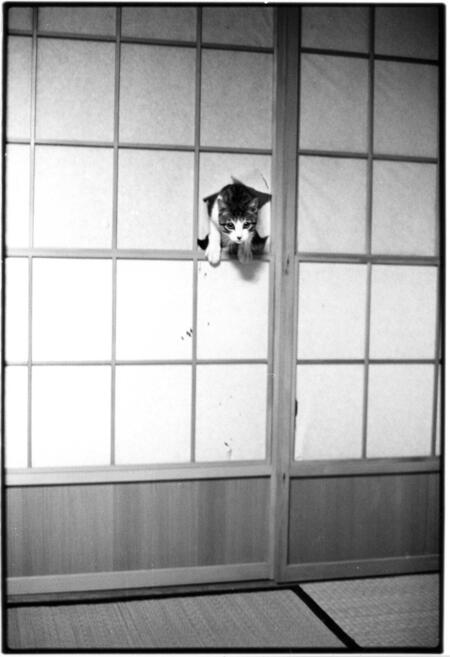
In 1977, Fukase decided to photograph his cat, Sasuke, for an entire year, literally lying on the floor to be at eye level with him. This biographical detail is documented in the Masahisa Fukase Archives. It is significant because the «animal’s level» here is not a metaphor or a later interpretation, but a deliberate photographic strategy.However, a lowered shooting point is not exclusive to Fukase. For Erwitt, it becomes a primary source of humor. He often photographs dogs so that the human body is cropped at the knees, ankles, or the edge of the frame. The hierarchy of vision shifts: the familiar human scale ceases to be the norm, and the dog receives a full portrait where the human is reduced to a fragment.
Masahisa Fukase. «Sasuke!! My Dear Cat, ” 1978: a cat among crumpled paper.
A near-theatrical conflict of textures arises on the tatami: soft wool, fragile paper, and the rigid geometry of the straw mats. The cat is not integrated into the interior as a decorative element; rather, its body disrupts the spatial order. Fukase is not photographing a «beautiful cat, ” but the activity of a being that changes the surrounding matter.