Concept
In the latter half of the 19th century, amid the societal advancement of science and technology, there remained a persistent interest in mysticism, spiritualism, and the possibility of communicating with the deceased. One unusual manifestation of this interest was spiritual photography—a practice involving the creation of images wherein spectral figures and depictions of the dead would appear alongside living people.
The theme is interesting in the context of the marginal and liminal within art and cultural history, as spiritual photography exists at the intersection of the real and the supernatural, the visible and the invisible, science and mysticism, and art and mythmaking.
The research will trace how the belief in the afterlife found visual expression and why photography began to be perceived as potential proof of the supernatural.
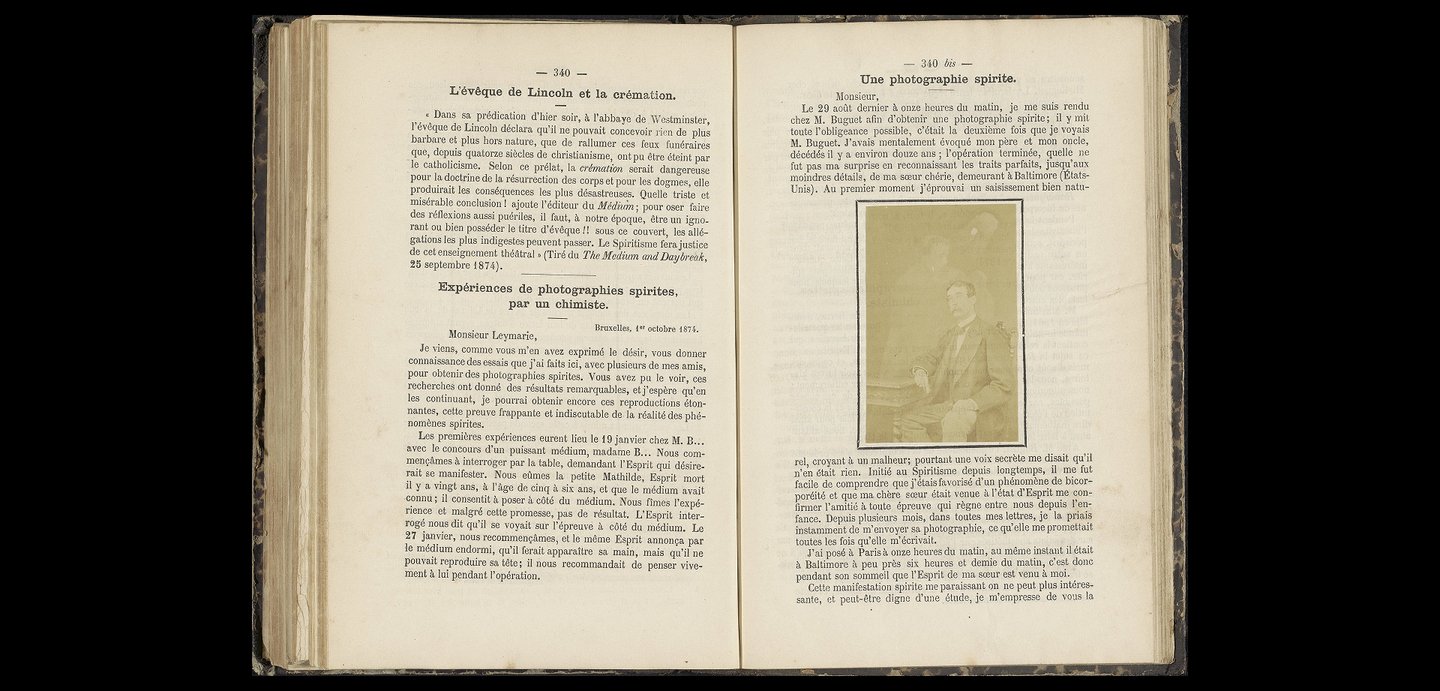
Page from the magazine «Revue spirite» featuring a pasted spiritual photograph by Edouard Bouygues, «Auguste Boyard and the spirit of his sister, ” (1874).
The primary materials will consist of spiritual photographs from the latter half of the 19th century, focusing mainly on American works, as well as British and French pieces. These will include works by medium photographers William Mumler, Frederick Hudson, and Edouard Bouguet, archival images from museum collections (The Getty Museum, The Metropolitan Museum of Art, Rijksmuseum), publications from spiritualist journals, and contemporary exposé materials. The selection process will consider the historical provenance of the photographs, their visual characteristics, and their cultural context.
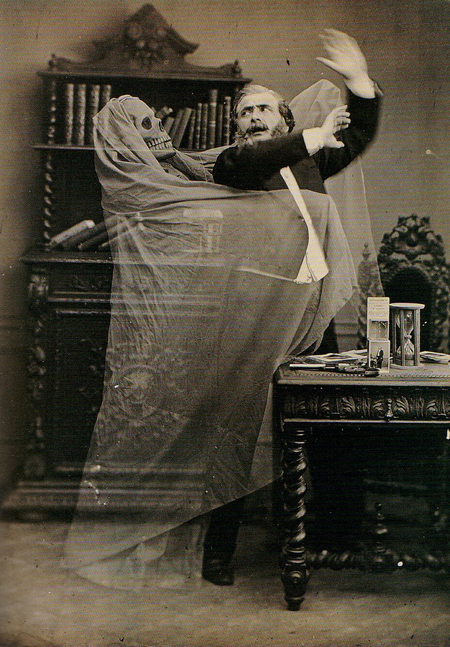
Spiritual photography was published in specialized magazines as evidence—for instance, the Parisian publication «Revue spirite» featured photographs by Édouard Bougé. Professional photographers made these images for both famous figures and private clients. Among the most well-known images was William Mamler’s portrait of the widow of U.S. President Mary Todd Lincoln, accompanied by pages from Frederick Hudson’s London album and an anonymous family portrait featuring the spirit of a deceased loved one. This same technique was openly used for entertainment: the illusionist Henri Robert commissioned promotional photographs with a «ghost.» The boundary between belief and hoax was not in the image itself, but in how the viewer perceived it.
Left: William Mumler, «Mary Todd Lincoln with the Spirit of Abraham Lincoln» (1872); Center: a page from Frederick Hudson’s album of spiritual photographs (1872); Right: a portrait with a «spirit, ” unknown artist (1873).
The research is structured thematically. It moves from the cultural underpinnings of spiritualism to an examination of photography as a liminal phenomenon. Next, the development of spiritual photography is analyzed using the example of William Mumler, followed by an exploration of the visual language of these images and the typology of otherworldly figures. Special attention is dedicated to the techniques used to create spectral figures and to exposing photographic mystifications. The concluding section focuses on the shifting status of spiritual photography and its reinterpretation within museum and contemporary cultural spaces.
Eugène Tibault, advertising photography, «Henri Robert and the Ghost,» (1863)
The research draws upon both Russian-language and international scholarly literature—including monographs, academic articles, 19th-century publications, judicial case materials, and museum exhibition catalogs. Texts from the era (photographers' memoirs, spiritualist press, critics' essays) are analyzed as evidence of belief and doubt. Contemporary photographic studies and theory aid in interpreting the images and their liminal status.
The central research question is how spiritual photography visualized belief in the afterlife and why it became a liminal phenomenon at the intersection of science, mysticism, and art.
The research hypothesis posits that spiritual photography emerged as a liminal phenomenon within 19th-century visual culture, melding the technical veracity of photographic imagery with mystical conceptions of the afterlife. Through this medium, the invisible acquired a visual form, perceived by parts of society as evidence of the supernatural.
Culture on the Threshold: Precursors to the Spiritist Movement
The nineteenth century marked a period of profound change in humanity’s perception of the world, life, and death. Advancements in natural sciences, medicine, and technology were reshaping the conventional worldview, yet the fascination with mysticism and the possibility of life after death persisted. This contradiction became particularly evident in the latter half of the century, which can be clearly observed when comparing images from the mid-1850s. Public lectures by the physicist Michael Faraday drew the fashionable crowd to the Royal Institution, while Parisian salons were gripped by the craze for «hypnotic chairs» during the same years. It is telling that in 1853, Faraday experimentally explained the movement of these chairs as the result of the participants' unconscious efforts, yet the popularity of séances did not diminish because of this explanation.
On the left: Alexander Blakeley, «Faraday Lecturing at the Royal Institute» (1856); on the right: «Rotating Tables, ” engraving from L’Illustration (1853).
Interest in the supernatural originated long before the advent of organized spiritualist movements. As early as the late 18th and early 19th centuries, phantasmagoria—spectacular performances that used magic lanterns, projections, smoke, and special optical devices to create illusions of ghosts and skeletons—became popular in Europe. Media art researcher Oliver Grau emphasizes the unique nature of this spectacle: «Unlike the panorama and other illusionistic machines, phantasmagoria implies the possibility of establishing contact with souls, with the dead, or with artificial life forms» [1, p. 101].
Robertson’s Phantasmagoria, engraving, (1831)
A significant event in the formation of the modern spiritual movement occurred in 1848 at the American settlement of Hyde Park, New York. Sisters Kate and Margaret Fox claimed they heard mysterious knocks in the walls and furniture of their home, which they attributed to the spirit of a deceased person attempting to communicate with the living. The sisters devised a system of coded knocks to which the spirit would respond to the questions of those present. The story quickly spread beyond the settlement, and the sisters began to appear before the public. As early as 1852, portraits of them, along with older sister Leah, were sold as lithographs, and the home in Hyde Park later became a site of remembrance for spiritualists. This incident is widely considered the starting point of the modern spiritual movement.
On the left: «Mrs. Fish and Miss Fox, ” lithograph (1852); on the right: The Fox family home in Hydeville, commemorative poster (date unknown).
Spiritism later gained traction in the United States and Europe. One of its most prominent theorists was the French educator Allan Kardec. In 1857, he published The Spirits' Book, in which he systematized concepts surrounding the existence of spirits, the immortality of the soul, and the possibility of communication between the living and the deceased. His ideas spread widely, particularly in France and other European nations. The era’s literature speaks to the scope of this fascination: «Spiritualism was so popular that writers, regardless of their stance on the phenomenon, participated in séances» [2, p. 312].
On the left: a portrait of Allan Kardec (19th century); on the right: the title page of «The Spirits' Book» (1860).
Women mediums played a vital role in the spread of spiritualism. In the 19th century, women’s opportunities for public participation in scientific and social life were restricted; however, spiritualistic practices offered them an unusual form of self-expression. During séances, women acted as intermediaries between the living and the deceased, conveying messages from spirits, demonstrating automatic writing, and entering states of trance.
Left: Portrait of Kate Fox, Garney Atelier, (19th century); right: «Miss Emma Harding, ” lithograph, (mid-19th century).
Thanks to this, some mediums gained public recognition. Kate Fox, starting with home sessions, eventually performed for audiences in the United States and the United Kingdom. The Englishwoman Emma Harding-Brittain, before becoming a medium and one of the most famous spiritualist orators, was an actress and dancer. Her journey illustrates how the stage and the spiritual séance were closely related forms of female public presence.
Mourning brooches with the hair of the deceased (19th century)
The spread of spiritualism was also linked to changing attitudes toward death. In the 19th century, high mortality rates, epidemics, and illness made the loss of loved ones a part of daily life, and the culture of mourning required preserving material memories of the deceased—hair strands were placed in mourning brooches, gravestones and weeping willows were depicted on enamel. By the middle of the century, a unique cultural environment had formed, where interest in the supernatural combined with belief in the possibilities of new technological discoveries. Fantasmagorias accustomed audiences to visual illusions of the beyond, while spiritualism offered practices for communicating with the deceased, and mediums became intermediaries between two worlds. All of this laid the groundwork for the emergence of a new way to visualize the invisible—spiritual photography.
Photography as a Borderline Invention: Between Art and Science
The advent of photography in the 19th century transformed the public’s perception of how reality could be captured and preserved. It seemed that the camera did not merely record what the human eye saw, but that it fixed reality itself—precisely and impartially. This understanding became ingrained in theory; as E. V. Petrovskaya notes, in the most influential concepts, «photography is viewed as an imprint (a trace) that tells us about the past» [5, p. 168]. However, even the earliest photographs demonstrated that photography perceived the world differently than humans do. In Louis Daguerre’s daguerreotype, «Temple Boulevard» (1838), a bustling Parisian street appears empty: because of the long exposure time, moving carriages and passersby did not register. Only the person standing still while having their shoes shined remained.
Louis Daguerre, «Temple Boulevard, ” daguerreotype, (1838)