Project Description
More and more «neural artists» are emerging who use neural networks to create content or to generate ideas. If the neural network is able to capture an author’s style, coming up with an interesting reference or concept becomes even more compelling.I was curious to see how the neural network would reproduce my drawing style and whether it could maintain that style across different compositions.
Image Library
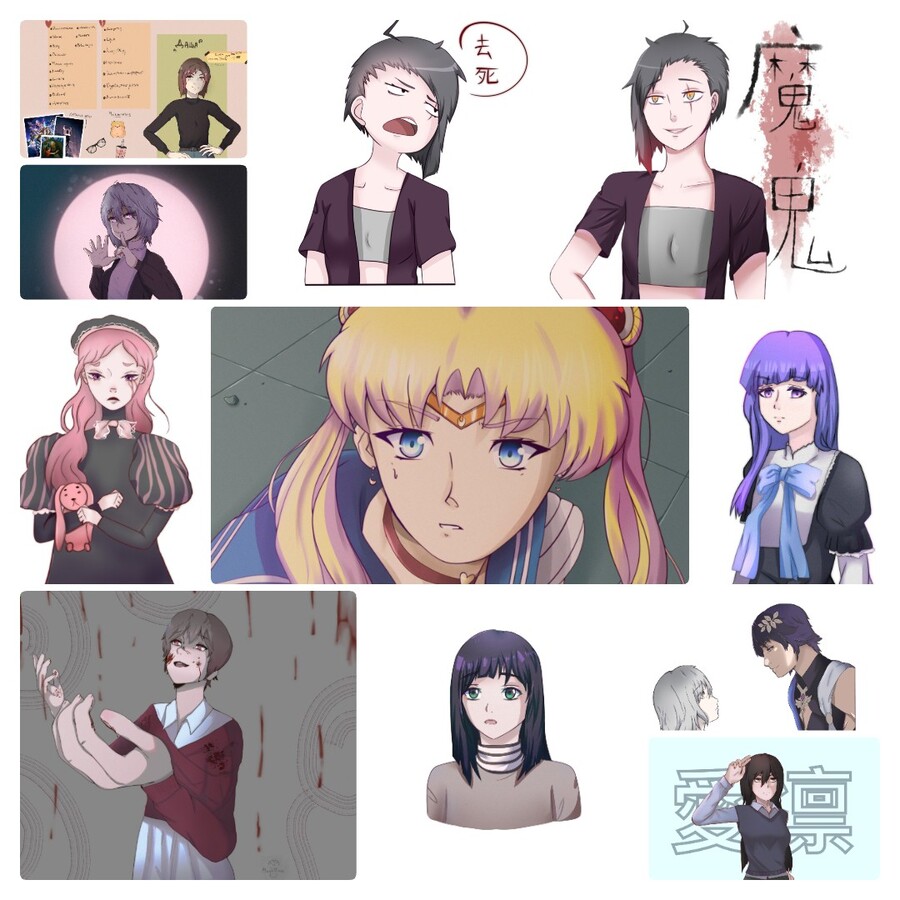
Image Source: Author’s personal work. All works are original and belong to the project author.
For this training set, I selected 11 personal illustrations, each with a different composition and set of characters. The key criteria for selection were the color palette, stylistic consistency, and the specific brushes and effects I employed.This database is sufficient for creating a LoRA, allowing it to learn and roughly replicate my illustrations.
The Learning Process
Method: I fine-tuned Stable Diffusion XL 1.0 using the DreamBooth + LoRA method. The base model remains unchanged; only small, low-rank additional matrices are trained, which are integrated into the U-Net attention layers. The output is a small file containing the «style weights» (LoRA), which is overlaid onto SDXL during generation. This allows me to teach the large model my style using a small dataset and on a free graphics card. Dataset: I compiled 11 of my own works in a consistent style (hyper-realistic anime, soft shading, clean lines). To increase the volume and show the model different scales, I cropped each piece into three 1:1 squares: a wide shot, a portrait, and a close-up of the torso. This resulted in 33 images, each sized at 1024×1024. I removed signatures and watermarks through cropping. Captions: For each image, I wrote a short description in English (who is depicted, clothing, background) and added a general style «tag» to the beginning: drawing in dashastyle style, … The model learns to associate this phrase with my style, while the content of the image is described separately in words. This means I can later control the plot using a prompt while «activating» the style with the tag.How the training proceeds: The images are encoded into a compressed «latent» representation using a VAE. Random noise of varying intensity is added to the latents, and the U-Net learns to predict this noise based on the caption. The error between the true and predicted noise (MSE) constitutes the loss function: the lower it is, the better the model «understands» what my style looks like. Only the LoRA matrices are updated; the text encoders and the core of the U-Net remain frozen.
Parameters:Model: stabilityai/stable-diffusion-xl-base-1.0, VAE: madebyollin/sdxl-vae-fp16-fix. Training Resolution: 512×512 (images are automatically downscaled). Batch Size 2 with Gradient Accumulation 3, resulting in an effective batch size of 6. Learning Rate 1e-4, fixed; LoRA Rank 32. Optimizer: 8-bit Adam, mixed precision fp16. snr_gamma=5.0: noise level loss weighting, which stabilizes training. 500 steps (approximately 90 passes over the dataset), checkpoint every 250 steps, seed 0.
How to run SDXL on a free graphics card: SDXL is a heavy model, so I utilized gradient checkpointing (part of the computations is recalculated to save memory), an 8-bit optimizer, fp16, and a corrected VAE fp16-fix, which eliminates artifacts and «corrupted» pixels. During generation, I enabled CPU offload and VAE tiling (processing the image in chunks), which allowed me to generate 1024×1024 images.Generation: Images are created «from scratch» in text-to-image mode: the model starts with random noise and transforms it into an illustration based on the prompt over 25–30 steps. The original images are not involved in the generation. The strength of the style can be adjusted using the scale parameter (0 is pure SDXL, 1.0 is the full LoRA effect). For comparison, I used the same prompts and seed for both the base model and the LoRA-enabled model.
Resulting Image Series
To track whether anything needs to be changed and where there are gaps, I created the first image in my style.
drawing in dashastyle style, girl with short red hair and a green scarf, looking at the viewer, white background
Overall, I liked the first image; the texture and line work resembled the original images, so I continued working on it.
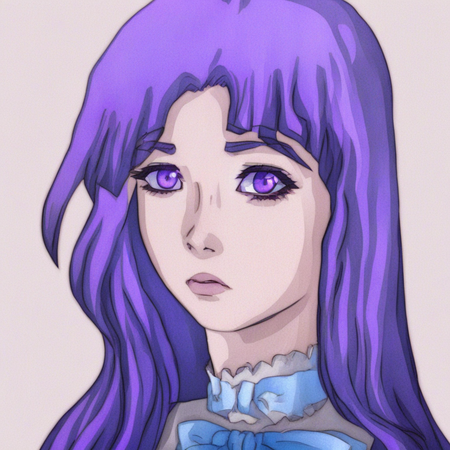
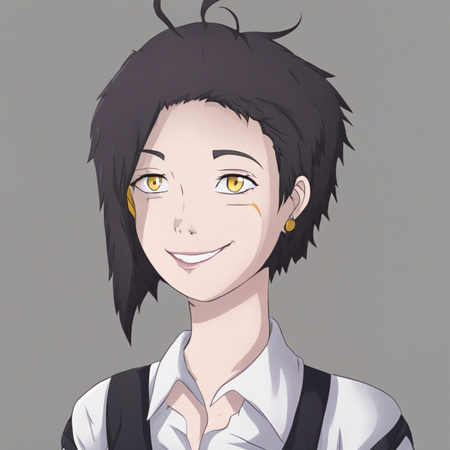
1. 'drawing in dashastyle style, close-up portrait of a girl with long purple hair and violet eyes, white background', 2. 'drawing in dashastyle style, person with short dark hair and yellow eyes, smirking, hand on hip, white background'
Here, the first image has slightly lost its style, however, the second image is even more consistent with the style than the very first one.
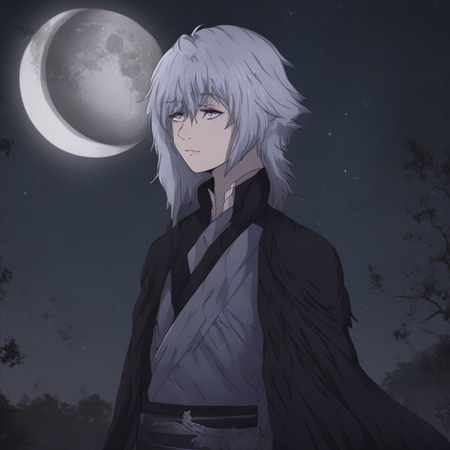
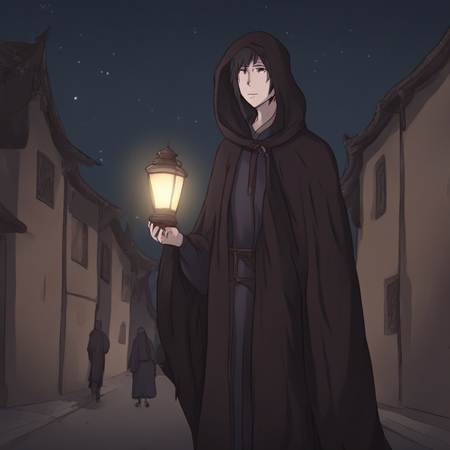
1. 'drawing in dashastyle style, boy with silver hair, black coat, large pale moon behind him, dark night', 2. 'drawing in dashastyle style, tall person in a long cloak holding a lantern, night street'
Next, I tried working with complex backgrounds, which are usually absent from my pieces, and while the styling is a bit rough, it turned out quite similar.
'drawing in dashastyle style, bust portrait of a girl with black hair and green eyes, turtleneck, white background'
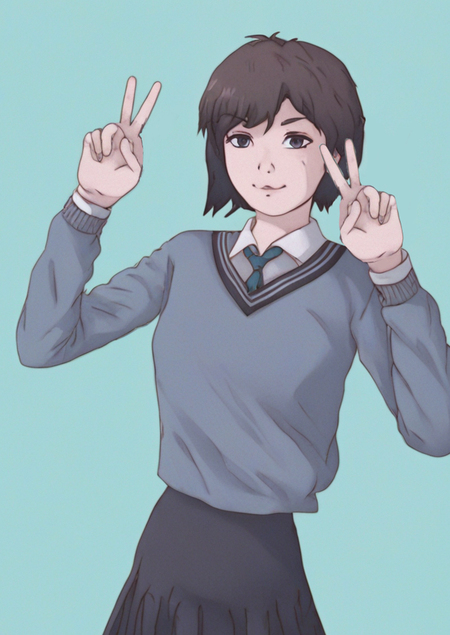
'drawing in dashastyle style, girl in a school uniform making a peace sign, pale cyan background'
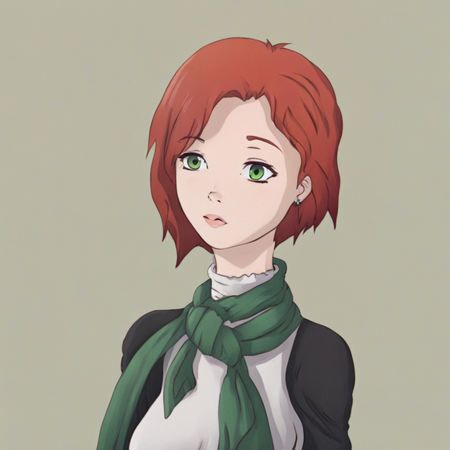
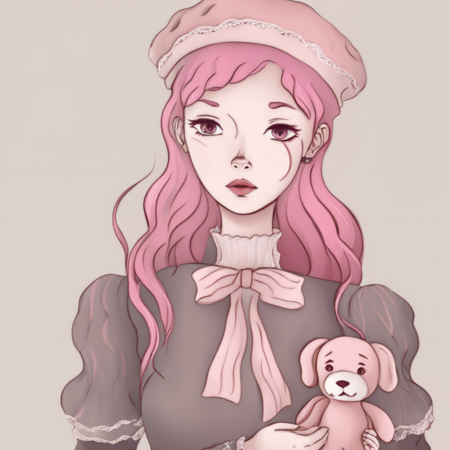
1. 'drawing in dashastyle style, girl with short red hair and a green scarf, white background', 2. 'drawing in dashastyle style, girl with wavy pink hair and a beret, holding a plush toy, white background',
All images next to each other
LoRA Power Example
Conclusion
What was successfully conveyed:
- Face type: Large eyes with a pronounced lash line, a small nose and lips, and pale skin with soft rosy shadows. This is close to my semi-realistic anime portraits.
- Soft shading and contour: The color fills are smooth, the shadows are rendered in broad patches rather than harsh hatching, and the line work is thin and dark.
- Muted palette: Dusty pink, gray-beige, and turquoise backgrounds, with cool bluish tones in the clothing instead of rich ones.
- Clothing and accessory details from the dataset: ruffles, bows, voluminous sleeves, turtlenecks, and chokers.
- The monochromatic backgrounds in the portraits and the turquoise background in Image 7 repeat a choice from my drawings.
What turned out worse:
- The white background was not maintained: I requested a white background in the prompts, but it came out tinted (beige, gray-pink) almost everywhere. The overall «color» of my work had a stronger influence than the words in the prompt.
- Leaching of details from the training data. Image 3 featured a blue bow and a lace collar, even though they were not in the prompt: the model took them from my drawing of a violet-haired character. This indicates that part of the dataset was retained over 500 steps (about 90 passes of 33 frames).
- Complex scenes resemble my style less. Night scenes 2 and 8, with the moonlit landscape and street, look like more «standard» anime art: a realistic background and dense rendering were added. My drawings rarely feature detailed backgrounds, so the model completed them in its own way. In Image 2, a thin crescent moon appeared instead of the «large pale moon,» meaning the prompt was not fully followed.
- Anatomy. In Image 7, the «pose» was not perfect: the fingers on the left hand look superfluous—this is a typical weakness of diffusion models.