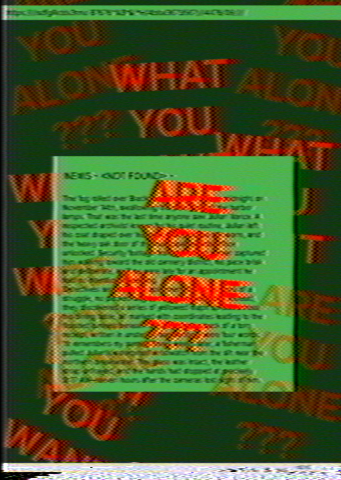
Concept: How a plain white webpage became the internet’s greatest fear
The internet today—it is a vibrant part of everyone’s life. Social media, email, dating profiles, blogs, and channels. Every day, people participate in all of this. They leave comments, share reactions, visit websites, and watch funny cat videos.
And of course, what people love most is experiencing emotions. And the most interesting thing for people is fear. Currently, there is a surge in audiobooks about true crime.
True crime is a documentary genre in literature, cinema, podcasting, and other media, where the creator explores a real crime, detailing the actions of offenders and their victims.
People are interested in this genre because it evokes emotions in them. Network horror shares a similar appeal, having deep roots in internet history. Most often, this takes the form of personal profiles, posts on websites, links to official materials, and strange comments composed of symbols and broken links.
Relevance of the Topic
The research topic centers on how digital elements are typically used on websites as simple tools we interact with daily. However, in the horror genre, these elements function as the primary drivers of the narrative. Whereas in cinema, the viewer is an observer, here the user is a participant—a detective exploring a space. The user is solely responsible for solving puzzles, deciphering codes, and even reading the page’s code to progress.
Interest in this phenomenon is evident within academic circles. In 2021, researcher Cecilia Sayad published the book The Ghost in the Image: Technology and Reality in the Horror Genre, which examines the interplay between technology, imagery, and concepts of reality in horror. The forms she explores include creepypasta, documentary practices, video games, and other methods of engaging the audience in supernatural narratives.
In 2025, the journal Contemporary Legend released a special issue dedicated to creepypasta, digital horror, and the formation of internet legends within interactive media. This demonstrates that digital horror stories are viewed not just as entertainment content online, but as an independent subject of study within folklore and media studies.
Network Horror
Networked horror is a subgenre of horror where the internet, digital technologies, and human interaction with them become the foundation of a frightening narrative. Events unfold around enigmatic websites, forbidden links, anonymous messages, encrypted files, and other network elements that conceal inexplicable dread. The internet here is not merely a medium for communication or a place to publish a scary story; it is a space where the individual confronts a threat and involuntarily becomes a participant in it.
The defining characteristic of this type of horror is the transformation of routine actions into a source of danger. Clicking a link, watching a video, downloading a file, or attempting to decipher a code becomes a point of no return—a moment after which the protagonist can no longer simply close the page and forget what they saw. Curiosity compels them to continue searching, and every new discovery does not so much explain what is happening as it amplifies the feeling that they have uncovered something not meant for them.
Fear is built upon uncertainty, anonymity, and the loss of control: it remains unclear who created the site, how the sender knows personal details, or why digital events begin to impact real life. Gradually, the boundary between the screen and the surrounding world blurs—what initially seemed like fiction, a prank, or a technical glitch within the story acquires the quality of a personal threat.
Is a white website that awful?
This research proposes to examine network horror not merely as a psychological fear, but also as an object of visual communication. Attention will be paid to how page design, color, and form create specific conditions for the user on the website.We will study key elements of these sites—what actually frightens people and how the screen becomes a stage for interaction. We will analyze the most popular and historically frightening websites. Furthermore, we will explore why people still enjoy this format, and why they are willing to spend months deciphering codes and code just to find answers. We will also examine how the overall design of websites has evolved from the 2000s to 2026—what influenced this progress, or what events led to the change or enhancement of website horror. Finally, we will consider how this format affects people, their creative endeavors, and what projects have emerged from this stylistic fear.We will also examine the constituent materials of these sites: archives, navigation, buttons, advertising, secret codes, compromised accounts, and so on.
Part One: Genesis
From a board game to an internet nightmare
Storytelling Plot Examples
Interactive Reading
Interactive storytelling did not emerge with the internet. Long before the advent of web pages, there were literary books where the reader could autonomously influence the narrative’s development. A prime example of this approach is the choose-your-own-adventure book.
The choose-your-own-adventure book is a form of interactive literature where the story’s conclusion is divided into distinct segments. At specific points, the reader is prompted to make a choice that dictates the future progression of the events. Instead of reading linearly from the first page to the last, the user navigates independently between section pages, forging their own path.
One of the most renowned series in this field is Choose Your Own Adventure, which began publication at Bantam Books in 1979. Its foundation was built on Edward Packard’s idea—that the reader should not merely observe the protagonist but actively make decisions and select the ensuing course of action. An earlier iteration of this concept was published in the book The Adventures of You on Sugarcane Island in 1976.
The main distinction of a book-game from traditional literature is the power to alter the reader’s decisions. The reader is no longer limited to a standard plot or pre-established events by the author; instead, they gain the ability to take action within the story. However, this freedom of choice remains constrained by the author. The reader can only select from predetermined options, and all possible consequences are built into the work beforehand. Thus, interactivity arises not from complete user freedom, but from the ability to independently choose one of the provided paths.
Early Internet Culture: Personal Pages, Blogs, and Web Archives
Cat Page 1998–1999
The visual language of the early internet differed noticeably from modern concepts of web design. Many user pages featured: — basic background images and textures — bright color combinations — decorative fonts and large headings — small GIF animations — a simple structure of text blocks and links — guest books, visitor counters, and thematic menus

It is important to note that these are not universal characteristics of all websites of that era. Early internet featured a wide variety of page types—ranging from simple personal diaries to more informational resources. However, user sites on GeoCities and Angelfire became a noticeable part of the visual culture of the early web.The low standardization and accessibility of publishing tools facilitated the appearance of a large number of individual pages. Each user could independently select the background, text color, images, and element placement. As a result, a web page often reflected not only its content but also the personality of its creator. Navigation held special significance. Links could lead to other pages on the same site, personal resources of friends, thematic communities, or third-party projects. The user gradually formed their own route through the internet, moving from one resource to another.Thus, the early web represented not just a collection of individual documents, but a space of interconnected user pages.
This shows that users of that time were often seeking out the information they needed themselves. Since it was difficult to verify or simply obtain the information, they were, in a sense, early internet researchers.
First text, first fear, first link
The proliferation of user-generated webpages created the conditions for the emergence of new forms of horror stories. Unlike traditional literature, these could spread through personal pages, forums, email, and blogs, gradually acquiring the characteristics of collectively created digital folklore.
One of the most prominent phenomena in this area is creepypasta—horror stories circulated online that users can copy, retell, modify, and augment. In this process, the origin of individual stories sometimes becomes less significant than the process of their dissemination and overall reinterpretation.
Digital folklore is not simply the transplantation of myths and legends onto the internet. New technologies are altering the ways such stories are created, transmitted, and perceived. Users can not only read the material but also publish their own versions of events, create imagery, discuss details, and weave disparate ideas into a cohesive whole.
Creepypasta refers to scary stories that spread across the internet. The word is a portmanteau of the English words «creepy» and «copypasta.» The main characteristics of creepypasta include: short text (usually no more than a page), first-person narration, elements of mysticism or horror, and an ending that often leaves the reader uneasy.
Ted the Caver Homepage
Ted the Caver, published in 2001, is considered one of the early examples of net horror. It is presented as a personal webpage hosting the diary of a person named Ted, documenting his exploration of a mysterious cave.The narrative is constructed around a series of dated diary entries. The reader receives information incrementally, following the page’s author and his description of the unfolding events. The photographs, drawings, and links are crucial in establishing the sensation of documentary evidence.The ELMCIP digital archive classifies Ted the Caver among early examples of net horror, describing the work as a gothic hypertext story formatted as a diary. Furthermore, the current version of the site is explicitly noted as an archival reconstruction of the original page hosted on Angelfire.
The next example is The Dionaea House by Erik Haisserer, published in 2004. Unlike Ted the Caver, where the narrative develops primarily through sequential diary entries, the story here is distributed across multiple digital platforms.
The central part of the work is presented as correspondence between characters. Later, this is supplemented with updates, links to other blogs, and additional materials that reveal new circumstances unfolding in the story. The email, comments, and external pages become not merely a means of conveying information, but integral components of the artwork itself.
These principles later developed in collaborative online projects. For example, the SCP Foundation began forming in 2007 after the publication of the first story about SCP-173. The first version of the wiki platform appeared in 2008, and the project subsequently evolved into a collective repository of fictional documents. The site describes itself as a collaborative project of authors dedicated to an organization that is tasked with discovering, containing, and protecting humanity from anomalous objects.
Realism or fiction—where is the line drawn?
Tools of Internet Horror
One of the key tools in internet horror is the creation of a sense of verisimilitude. Unlike traditional horror stories, which usually present themselves as fiction from the outset, internet horror can utilize visual forms that mimic real digital documents.This effect is achieved not through a single element, but through a combination of several techniques: — a first-person narrative — dated entries and update logs — photographs and images — the use of familiar webpage structures — imitation of email correspondence and messages — links to other resources and materials — the retention of minor errors, inconsistencies, and incomplete information.Visual simplicity plays a crucial role. If a page is designed like a personal diary, an archive, or a standard user website, the user might perceive it as someone else’s ordinary site. It doesn’t necessarily have to look like a deliberately designed horror piece—in fact, its aesthetic can resemble a typical online resource.
In this context, photographs take on particular significance. Visual imagery is often perceived as a trace of an event or evidence of a person’s presence in a specific location. However, in an artistic work, a photograph can serve a different function—creating the impression that the depicted events truly occurred.
Cecilia Sayad, in her book The Ghost in the Image, examines the relationship between imaging technologies and perceptions of reality. The researcher notes that photographs and videos can be used not only as tools for documentation but also as instruments for constructing or staging credibility. This approach is especially important when analyzing internet horror, where images frequently function as part of fictional testimony.
However, credibility does not necessarily mean that the user truly believes the events described. It is more accurate to speak of creating a sense of credibility—an artistic condition in which a fictional narrative utilizes recognizable forms of real communication, prompting the user to evaluate the presented information independently. A prime example is The Dionaea House. The work’s external structure is built around correspondence, private messages, and sequential website updates. The reader is not simply asked to consume a finished text, but to trace the course of an investigation, reconstruct the connection between individual messages, and determine which sources are trustworthy.
This implies that the data’s credibility lies in its totality. To amplify the effect of tension and fear, sources of different formats are distributed across various websites. However, the user is ultimately the one who decides whether they are accurate or not, since a poor-quality photograph is not an answer or a genuine photograph taken by a person. Now, the user is faced with a question: is this document truly the next step in finding a diary, or is it merely a site description, immediately creating tension? The person cannot determine where the accuracy lies or where the next link will lead.