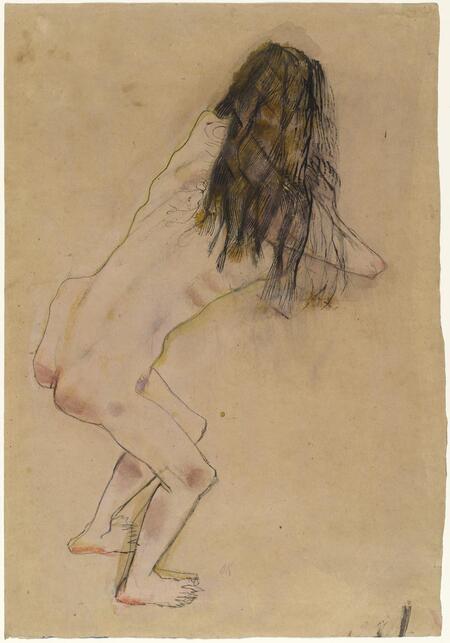
How did German Expressionist artists transform the depiction of the nude human body, shifting it from an object of aesthetic contemplation to an image of psychological vulnerability, anxiety, and inner crisis?
The human body is one of the few forms through which a person’s physical presence and inner state manifest simultaneously. It can be an object of admiration, desire, and aesthetic contemplation, but it also becomes a testament to weakness, fear, pain, and vulnerability. In the history of European art, the nude figure has long been associated with notions of beauty, harmony, and perfection. However, at the beginning of the twentieth century, the conventional image of the ideal body begins to disintegrate. This process is especially clear in German Expressionism, where the human figure loses anatomical correctness and becomes a reflection of emotional instability.
Expressionists approach the body not as a perfect form to be reproduced, but as a space of human experience. Distorted proportions, angular silhouettes, tense poses, and unnatural skin tones disrupt the conventional perception of the nude. The body no longer demonstrates physical perfection—it seems to lose its ability to maintain its own integrity. Its deformation becomes a means of speaking to the condition of a person facing anxiety, loneliness, alienation, and internal conflict.
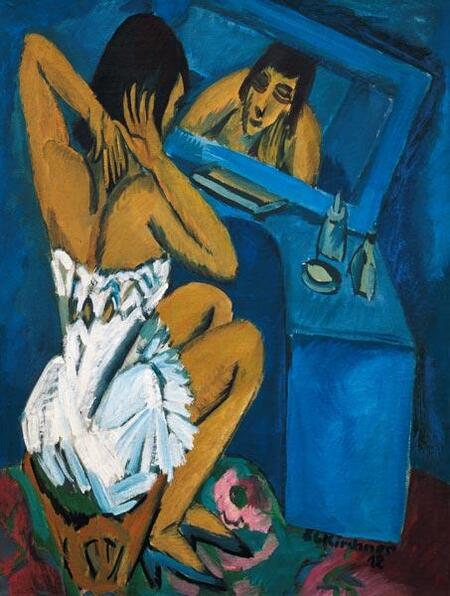
Ernst Ludwig Kirchner — «Toilet. Woman Before a Mirror, ” 1913 (revised in 1920)
The significant contradiction lies in the very nature of nudity. On one hand, the lack of clothing renders the body exposed to view, stripping it of external protective layers and conventional social signifiers. On the other hand, this very exposure can be perceived as vulnerability. The human figure is presented without familiar means to conceal its own fragility. In this context, the nude figure becomes not merely a depiction of a physical body, but an archetype of human existence, where frailty and defenselessness are inseparable from the very nature of being human.
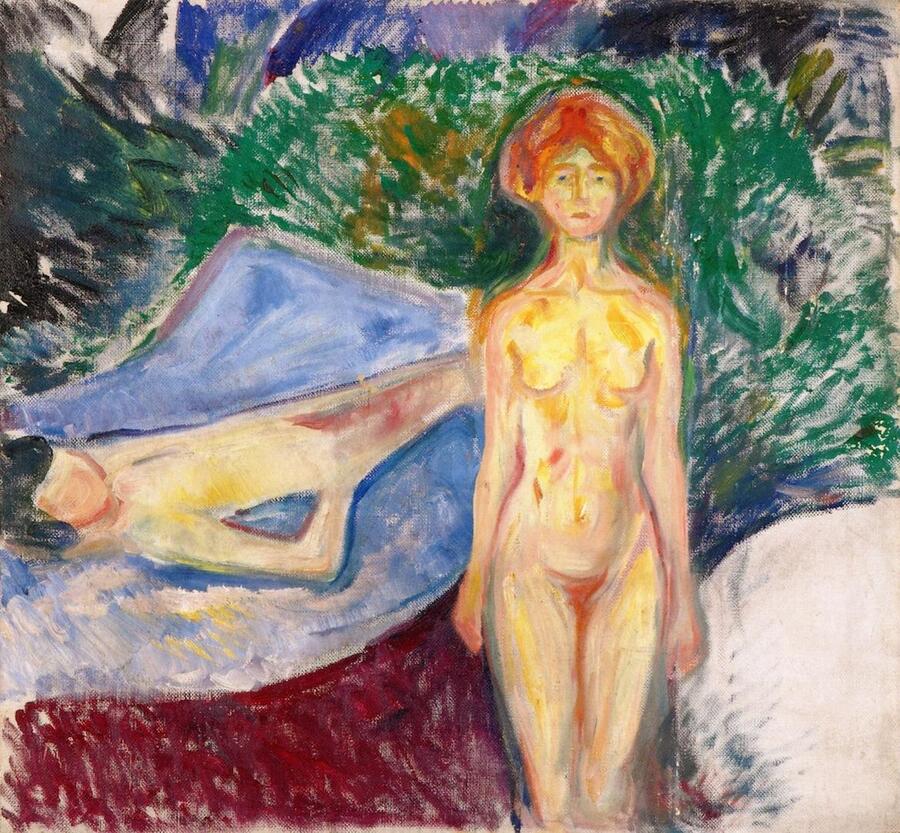
Edvard Munch — «Nude Models: Standing and Reclining, ” 1917
The gap between outer form and inner state takes on special significance. Artists employ distortion, gesture, color, and composition to convey what cannot always be expressed through facial expression or narrative. A curved back, tense limbs, an averted face, or an unstable posture can create a sense of oppression and isolation. The space surrounding the figure also ceases to be neutral—it can amplify the individual’s isolation, disrupt the sense of balance, and emphasize their alienation from the surrounding world.
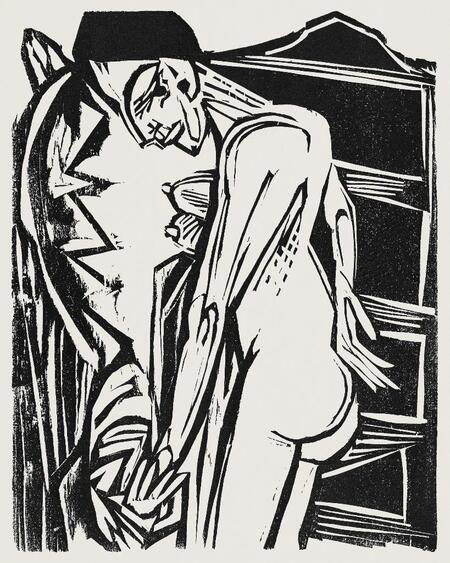
Through the works of Ernst Ludwig Kirchner, Erich Heckel, Karl Schmidt-Rottluff, and other representatives of German Expressionism, a shift is revealed—from the body as the embodiment of an ideal to the body as a testimony to human vulnerability. Their artistic language allows us to view imperfection not as the opposite of beauty, but as an independent form of expression.Thus, the central idea of this research is that the deformation of the nude body becomes a means of visualizing unseen internal experience. Through the disruption of bodily harmony, Expressionists depict the human being not as a complete and perfect figure, but as a fragile, feeling, and unprotected creature. The body transforms into the boundary where the human inner world meets the pressure of external reality.(Erich Heckel — «Crouching Woman, ” 1913)
The object of study is the nude human body in European art, with a primary focus on German Expressionism of the early twentieth century (1905–1925). The hypothesis is that the deformation of the body, the disruption of proportions, and the rejection of idealization become artistic means of conveying human vulnerability, anxiety, fear, and internal tension.
1. The Body Before Expressionism
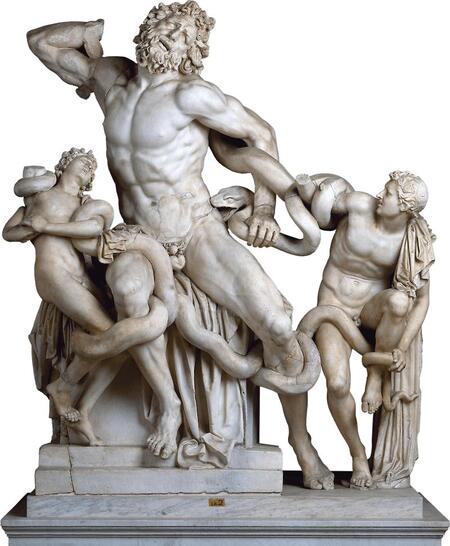
In ancient art, the human body became one of the foremost embodiments of beauty and physical perfection. Ancient Greek sculptors strove to convey the harmony of the human form through precise proportions, symmetry, and balance. To achieve this, they employed mathematical ratios of body parts, meticulous anatomical rendering, and a natural distribution of the figure’s weight. One characteristic technique is contrapposto—a posture where weight is shifted onto one leg, creating a natural curve in the torso and a sense of motion. Even in dynamic poses, the overall harmony of the form was maintained: the tension of the muscles and the placement of the limbs adhered to the ideal concept of the human body.
(«Laocoön and His Sons,» circa 1st century BCE)
Sandro Botticelli — «The Birth of Venus» 1482–1486
In the Renaissance, the renewed interest in classical heritage brought the nude figure back to the center of artistic attention. The study of anatomy and proportion allowed artists to create more realistic, yet idealized, portrayals of the human form.
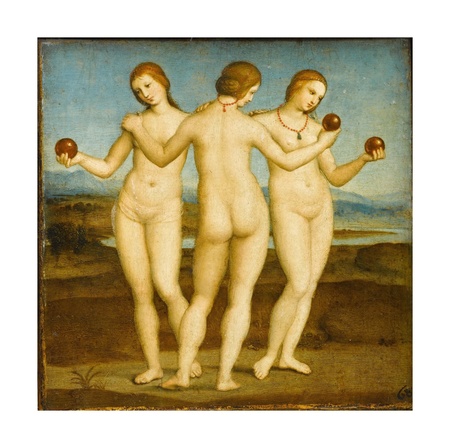
In painting, linear perspective, chiaroscuro modeling, and smooth contours are used, giving the body volume and naturalism. Artists meticulously render musculature, limb positioning, and body movement, striving to unite anatomical accuracy with aesthetic harmony. In doing so, the human figure becomes not only a symbol of physical beauty but also an expression of intellectual and spiritual perfection. (Raphael — «The Three Graces, ” c. 1504–1505)
In the nineteenth century, the concept of the human body gradually grew more complex. Romanticism focused on intense emotions, internal conflicts, and dramatic human states. To convey emotional tension, artists utilized dynamic poses, sharp movements, expressive gestures, and contrasts of light and shadow.
Eugène Delacroix — «Death of Sardanapalus» 1827
The body becomes part of the dramatic action and begins to reflect the experiences of the depicted person. Realism, in turn, rejects mandatory idealization and turns toward depicting reality. Artists display natural proportions, individual features of the figure, skin characteristics, and physique. A freer composition and the abandonment of academic ideals allow the human body to be presented as it exists in daily life, with all its imperfections. Thus, the focus gradually shifts from the depiction of perfect form to the individual and the physical reality of the person.
At the turn of the nineteenth and twentieth centuries, traditional conceptions of the human figure began to be actively re-evaluated. Artists moved away from academic conventions, experimenting with form, color, and composition in an effort to transcend the precise reproduction of reality.
Henri Matisse — «Blue Nude» 1907
Post-Impressionists moved away from accurately reproducing reality, simplifying the contours of objects, generalizing silhouettes, and using color to convey their own perception of the world. In Fauvism, color completely loses the need to correspond to natural tones and becomes an independent expressive means. The approach to the human figure also changes: artists increasingly turn to simplifying anatomy, distorting proportions, and creating abstract space. The correctness of the image gradually ceases to be the main objective, giving way to the search for expressive form. The human body no longer needs to conform to realistic proportions to remain recognizable and expressive.
2. Epoch and Cultural Context
German Expressionists worked during a period of profound social and cultural upheaval sweeping across Germany at the turn of the twentieth century. Industrialization, rapid urbanization, technological advancements, and the shifting patterns of life were accompanied by a sense of instability and alienation. Old notions of humanity and the surrounding world gradually lost their solidity. The First World War and its repercussions added further tension, intensifying artists' focus on themes of suffering, fear, and human loneliness. Against this backdrop, art moved away from realistic depiction of reality and increasingly turned toward subjective perception, internal conflicts, and emotional experience.
Nineteenth Century: the body as a harmonious or anatomically accurate figure. Twentieth Century: the body as a reflection of inner conflict and emotional state.
Young artists increasingly moved away from academic rules of representation, striving to convey their own perception of reality rather than merely reproduce its external appearance. One of the first groups to unify these searches was the German art collective Die Brücke («The Bridge»), founded in Dresden in 1905. The emergence of this group marks one of the most critical stages in the development of German Expressionism.
Die Brücke artists were influenced by Post-Impressionism, Symbolism, and Fauvism. Specifically, they addressed simplified forms, expressive color, and free composition. Art from the peoples of Africa and Oceania was also an important source of inspiration—art that European artists of that time studied in museums and collections. Today, this interest must be viewed within the colonial context of the era.
The association was founded by four architecture students: Ernst Ludwig Kirchner, Erich Heckel, Karl Schmidt-Rottluff, and Max Pechstein. Max Pechstein later joined the group.
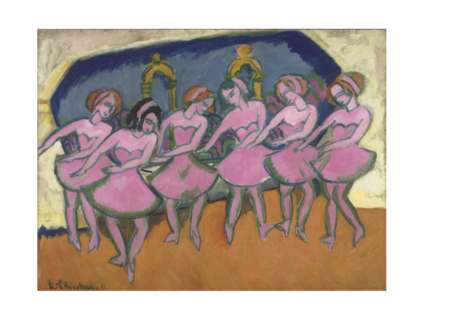
Die Brücke lacked a single, rigid manifesto with a detailed program. However, the participants shared several key tenets: Rejection of academicism. The artists did not aim for an exact reproduction of nature and considered it permissible to intentionally alter proportions and anatomy. Emotional expressiveness. Color, line, and form were used to convey subjective experience, rather than just external resemblance. Simplification of form. Figures and objects were often depicted in a generalized manner, with sharp contours and angular silhouettes. Freedom of composition. The artists experimented with perspective, space, and the arrangement of figures. Interest in the nude and nature. They painted nude models, people bathing, and scenes in nature, contrasting the immediacy of these subjects with the conventions of bourgeois city life. Development of graphics. Woodcut printmaking—printing from a wooden block—became especially important. The rough contour, contrast of black and white, and simplification of the image aligned well with their artistic language.
(Ernst Ludwig Kirchner—"Six Dancers,» 1911)
Ernst Ludwig Kirchner — «Conversation of Naked Girls, ” 1909
«Conversation of Nude Girls”—this is how Kirchner captioned the painting on the back. It is presumed that the work depicts the first meeting between Marcelle and Senta at the Die Brücke association studio. Both girls subsequently became frequent models for the group’s artists.
The painting reflects the core principles of Die Brücke: immediacy of the image, spontaneity, and an interest in the nude form. The work’s artistic language is built upon simplified forms, broad areas of pure, saturated color, and expressive black outlines. Primitive sculpture, German woodcut engraving, and Fauvism influenced the artist’s style.
Erich Heckel — «The Lying Francis» 1910
The painting depicts a nude woman named Francie—one of the models for the Die Brücke artists. Heckel rejects the academic rendering of the human body: the figure takes on angular contours, proportions are simplified, and the pose appears relaxed yet slightly awkward. The contrast between dark and light areas intensifies the expressiveness of the silhouette. Rather than conveying anatomical accuracy, the artist communicates the immediacy of movement and the naturalness of the body’s posture.
3. The Body as a Subject of Study