Navigation Menu
1 City Scale: Human Amidst Skyscrapers
2 City Speed: Transportation as Visual Rhythm
3 City Surface: Advertising, Signage, Crowds
4 City Space: Architecture and Composition
5 City Motion: Montage, Repetition, Rhythm
Concept
The topic, «The Image of the Big City in Early Animation, ” was chosen because the metropolis is one of the key visual representations of the first half of the 20th century. During this period, the urban environment was rapidly transforming: skyscrapers were rising, transportation was evolving, streets were filled with cars, advertising, shop windows, and streams of pedestrians. The city became not merely a setting but an independent symbol of modernity—a space characterized by speed, scale, noise, motion, and human anonymity. Early animation is particularly interesting for studying this image. Unlike live-action cinema, it does not capture a real city; rather, it recreates it—simplifying architecture, heightening contrasts, making motion more expressive, and lending greater impact to the scale of buildings and transportation. Therefore, the animated city allows us to see which features of the megacity seemed most significant to the filmmakers: the verticality of skyscrapers, the density of the crowd, the mechanical rhythm of traffic, the abundance of signs, or the sense of individual loneliness amidst massive structures.
Topic selection is also related to the possibility of visual comparison. Cityscapes in early animation can be analyzed not only through narrative but also through frame composition, perspective, character scale, recurring forms, direction of movement, and methods of conveying speed. This makes the research concrete—every thesis can be supported by specific frames, diagrams, and juxtapositions.
The subject material for this study will consist of animated films from the first half of the 20th century where the big city is a prominent part of the visual world. The main period is the 1920s–1940s—a time of active development in commercial animation, the emergence of recognizable studio styles, and the formation of enduring urban imagery.
Fragments from the works of various studios and creators will be selected for analysis to compare different approaches to depicting the city. The corpus will include city sequences from series featuring Felix the Cat, short films by Fleischer Studios with Betty Boop and Popeye the Sailor, as well as early Disney films, including Steamboat Willie (1928), Traffic Troubles (1931), and Building a Building (1933). This selection will allow for a comparison between the stylized, grotesque city of early comedic animation and the denser, «New York-esque» city of Fleischer, alongside the more organized, theatrical city of Disney.
A key selection criterion will be the presence of one or more central motifs in the frame: skyscrapers, transportation, crowds, signage, advertising, street activity, bridges, rooftops, subways, or other elements of the big city. Fragments where the city appears only as brief, visually insignificant background will not be included. To provide contextual comparison, individual shots from urban films of the 1920s may be used, notably Manhatta (1921), Berlin: Symphony of a Great City (1927), and Man with a Movie Camera (1929). These works are significant as a visual backdrop to the era, presenting the city through the geometry of architecture, the flow of people and traffic, unusual angles, and the rhythm of editing.
The primary sources will be the animated films themselves: specific frames, snippets, and sequences. The analysis will focus on a visual deconstruction of the imagery, rather than summarizing the plot. For each chosen frame, the following will be documented: camera angle, composition, the scale of the character relative to the architecture, crowd density, type of transportation, the number and nature of signage, direction of movement, color palette, and the method used to convey speed.
Textual sources will serve a supplementary function. They will help contextualize the visual observations—explaining why the skyscraper, the flow of traffic, advertising, and the crowd became enduring symbols of urban modernity. Specifically, research into early animation shows that in the 1930s, Fleischer and Disney were already presenting contrasting approaches: Fleischer leaned toward a more urban, gritty, and expressive city, while Disney favored a brighter, more orderly, and staged environment. These observations will not be used as definitive conclusions but as a foundation for the students' independent analysis of the animation frames.
Sources will be selected based on relevance: preference will be given to scholarly articles, museum and archival materials, as well as publications on the history of animation, urban cinema, and visual culture. Quotations will be used sparingly and only when they serve to clarify a term, date, the historical context, or confirm a significant pattern.
Key research question: how was the image of the big city visually constructed in early animation of the first half of the 20th century, and how did different animators approach this challenge?
Hypothesis: In early animation, the big city is portrayed not as a neutral setting, but as an active visual environment built on the contrast between architectural scale and the small character, between the ordered movement of traffic and street chaos, and between the city’s commercial brightness and the potential solitude of the individual within it.
It is suggested that the image of the big city in early animation is formed through several persistent techniques: vertical composition, exaggerated building scale, repeating silhouettes of pedestrians, dynamic transportation, an abundance of signs, and a fast rhythm of movement. Moreover, different studios create different versions of the city: for Felix, the city is often stylized, grotesque, and playful; for Fleischer, it is dense, commercial, noisy, and mechanical; and for Disney, it is more ordered, theatrical, and conventional.
The outcome of this research should be a visual portrait of the big city in early animation—not a list of films, but a system of recurring techniques that animators used to transform the metropolis into a vibrant, noisy, vertical, and constantly moving space.
City Scale: A Person Amidst Skyscrapers
The main goal of the chapter is to demonstrate how different animators resolve the conflict between a small character and a huge city.
In early animation, the skyscraper becomes a way to depict the relationship between humans and the big city. Tall buildings, vertical perspectives, and dense construction allow animators to convey a sense of modernity: the city can appear majestic, overwhelming, comedic, or orderly. The scale of the building here functions not just as an artistic device, but also as a means of establishing the character’s position within the urban environment.This chapter examines how various animators resolve the conflict between a small character and enormous architecture. We compare the stylized and grotesque city from early Felix the Cat series, the dense and vertical city of Fleischer Studios, and the more ordered, theatrical city of Disney, as presented in the short film Building a Building (1933), where Mickey works on the skyscraper construction site.
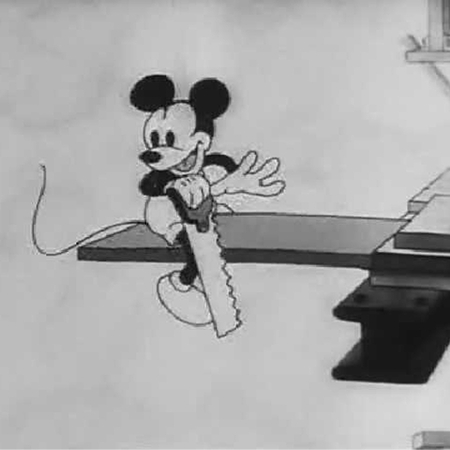
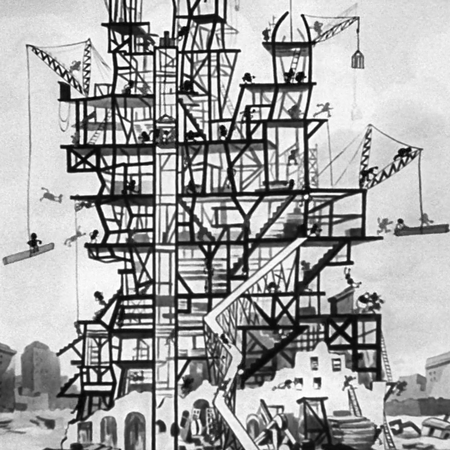
David Hand, Walt Disney Productions, «Building a Building, ” 1933.
In David Hand’s «Building a Building» (1933), the skyscraper’s scale is conveyed through the active interplay between the character and the architecture. Mickey is working on a construction site where steel frames, cranes, and unfinished floors create the sensation of a growing city. The verticality here is not merely a backdrop but an integral part of the action: the character navigates the structures, balances on beams, and finds himself inside the future skyscraper. The building’s scale simultaneously underscores the city’s technical power and humanity’s vulnerability within a massive environment. Disney presents the skyscraper as an ordered, theatrical space where the individual still maintains an active role.
In David Hand’s «Building a Building,» the skyscraper is portrayed not as a finished set piece, but as a space that a person creates and inhabits. The building’s scale emphasizes the city’s grandeur without overwhelming the character; Mickey remains an active participant in the urban environment. Thus, Disney presents verticality as ordered and theatrical, rather than oppressive or chaotic.
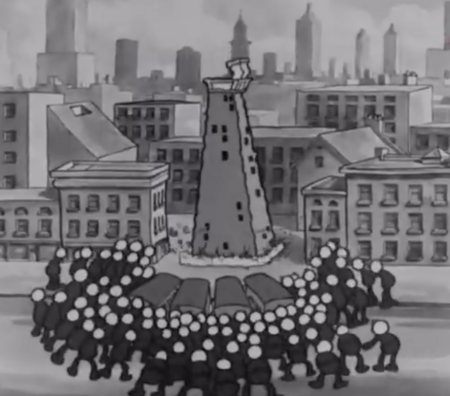
In «Betty Boop’s Big Boss» (1933), Dave Fleischer depicts the scale of the city through a crowded and deformable building. In one scene, skyscrapers are filled with crowds, and the architectural volume visually «deforms» under their pressure: the building ceases to be a stable vertical structure and becomes a cramped, overpopulated space. In another segment, police officers take active action while the city and buildings remain static; this creates a contrast between human movement and the stationary urban environment. The scale of the buildings here emphasizes not grandeur, but rather the overcrowding and vulnerability of the metropolis. Fleischer presents the city as a dense, mechanical, and oppressive organism, where architecture is capable of «swallowing» the individual.
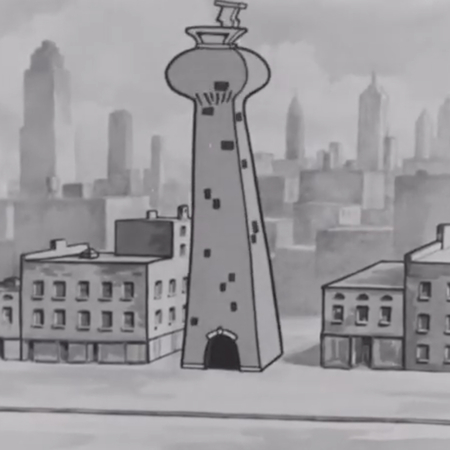
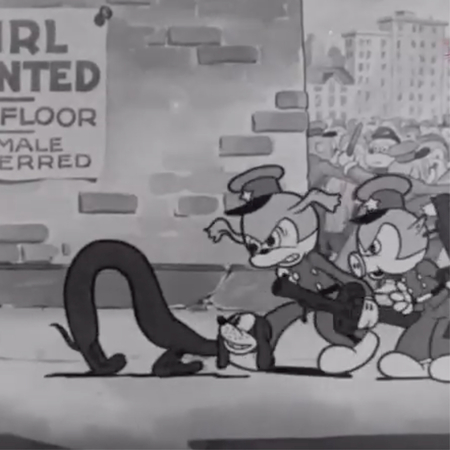
Dave Fleischer, Fleischer Studios, «Betty Boop’s Big Boss,» 1933
A comparison between David Hand’s «Building a Building» and Dave Fleischer’s «Betty Boop’s Big Boss» reveals how a skyscraper can evoke different sensations of a city. In the Disney depiction, the building appears ordered and integral to the scene, whereas Fleischer’s rendering is crowded and almost «alive» because it distorts under the weight of the crowd. In the former, the scale emphasizes the power and order of the city; in the latter, it highlights the density and the way an individual dissolves into the urban mass.
add video
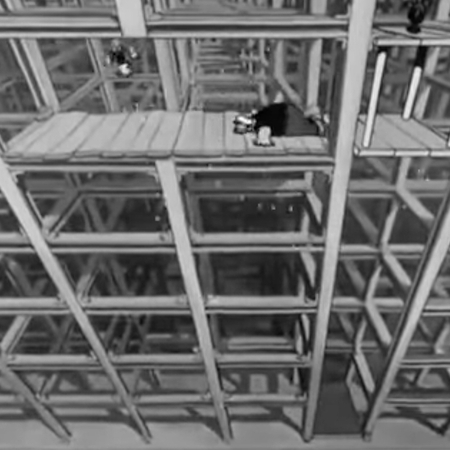
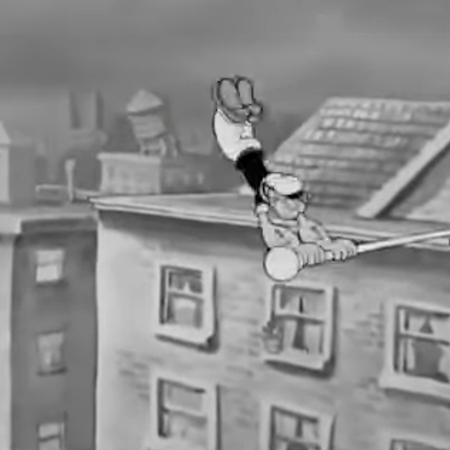
Dave Fleischer, Fleischer Studios, «A Dream Walking,» 1934
In the first segment, the small character figures atop the construction site emphasize the height of the structure. The second segment shifts the action to the rooftops of neighboring buildings. The buildings in the background are depicted from various angles—slanted facades and diverging rooflines render the urban space unstable. Coupled with the movement of the characters above the street, this intensifies the sense of height and risk.
Just like in the scenes with Mickey, the unfinished skyscraper becomes a playground for stunts and movement. Therefore, it is important to note the similarity: in both animations, the city’s scale is revealed through action—the viewer senses the height by watching the characters traverse beams and rooftops.
In the selected excerpts, the scale of the city becomes apparent through the interaction of characters with the buildings. On construction sites, the characters traverse beams and find themselves high above the rooftops—allowing the viewer to perceive the skyscraper’s immense height. In the scene with Betty, this relationship shifts: the building no longer dictates the movement of the people; instead, the crowd changes its form. Here, architecture is not merely a backdrop—it actively participates in the action and helps convey the city’s scale.
2 City Tempo: Transport as Visual Rhythm
How Transportation Movement Conveys the Pace of a Metropolis
Transportation allows us to depict not only the structure of a large city but also its rhythm. Cars, trams, and trains dictate the motion within the frame: they can flow smoothly, collide, or impede pedestrians. In this chapter, we compare how different animators portray urban transit and its interaction with characters. The main objective is to understand what generates the sense of speed and what the city appears like—organized or chaotic, accessible to humans or difficult to navigate.
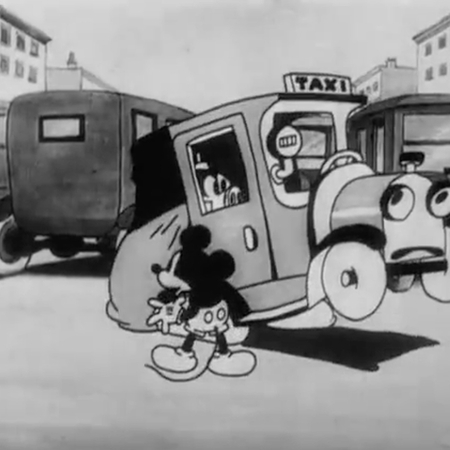
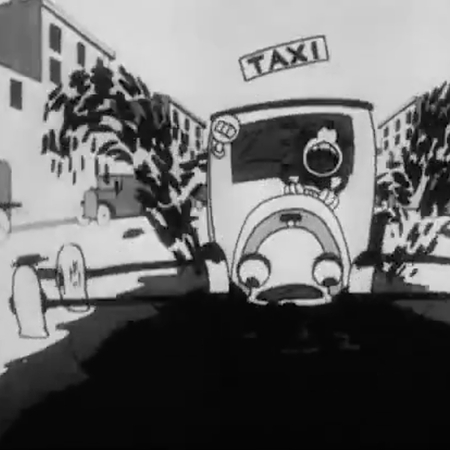
Bert Gillette, Walt Disney Productions, «Traffic Troubles, ” 1931
Flow of Traffic. This shot establishes the city as an environment of constant motion. Cars move in a dense stream, and Mickey’s taxi must find its place within it. Speed here arises not only from rapid driving but also from the proximity of other vehicles—the movement appears continuous, yet dangerous and cramped.
The Heavy Passenger Deforms the Car. The passenger’s weight stretches the cabin, and the car leans backward as its front wheels lift off the ground. This is no longer just a traffic obstacle: the vehicle itself becomes a flexible, living object that reacts to the human.
Wheels Spread to Avoid a Pothole. The car adapts to the uneven road: the axles and wheels stretch to navigate around the obstacle. Here, the deformation is related not to a person, but to the condition of the urban infrastructure—potholes, bumps, and irregularities disrupt smooth movement.
At the beginning of the film, Mickey works as a taxi driver and tries to navigate a crowded city street. The first shot shows a heavy flow of traffic: the taxi moves among other vehicles, which have to maneuver in dense congestion. The sense of speed here arises not only from fast driving but also from the narrowness of the street.In the second segment, a large passenger deforms the car: the cabin stretches, the body leans, and the front wheels lift off the ground. In the third, the wheels spread out to avoid a pothole. Transportation becomes a flexible object that adapts to the passenger and the uneven road. Like the tower in Betty Boop’s Big Boss, it changes shape under the pressure of the urban environment, but here the deformation is related not to a crowd, but to the difficulties of movement. The city appears as a space of fast, yet continuously disrupted, motion.