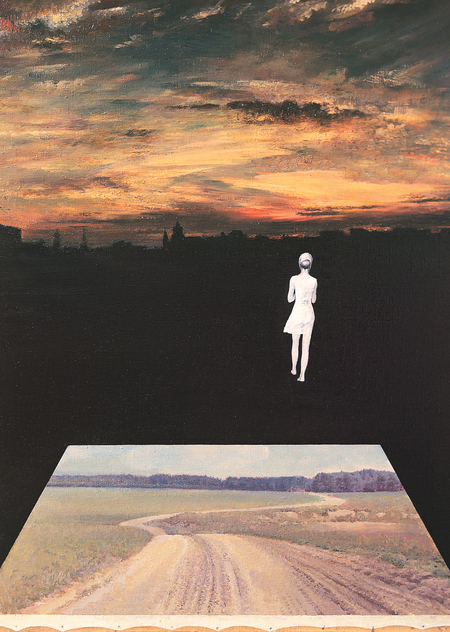
The road is one of the most familiar elements of the landscape. It divides space, defines perspective, connects the foreground to the horizon, and directs the viewer’s gaze. However, in the paintings of Oleg Vasilyev (1931–2013), this motif takes on a special significance: the road becomes a way to represent time that cannot be seen directly.
Navigator [1] Concept [2] Journey Space [3] The Vanishing Traveler [4] Light at the Edge of Vision [5] Traces of Time [6] Returning to the Source [7] Conclusion
Image Sources
[1] Concept
The artist developed within the milieu of Soviet unofficial art, but unlike many representatives of this movement, his artistic method is not limited to a direct commentary on social or political reality. His focus is on individual perception of the world, personal experience, and the capacity of memory to transform surrounding space. Turning to individual experience was significant within the context of Soviet culture, where the public depiction of people and history was largely dictated by ideological doctrines.The main research question is: how does Vasilyev use compositional and painterly means to transform the image of a road—from a mere element of a landscape—into a metaphor for time and memory? The research hypothesis is that the road becomes an image of memory not only through associations with the life journey but also through the structure of the painting itself. Perspective creates a sense of temporal distance; light defines the limits of visibility; the repetition of motifs demonstrates the variability of memory; and the presence or absence of a human figure alters the viewer’s position relative to the depicted space.The core of the study consists of paintings from 1965–2010 that feature roads, paths, human movement, the motif of return, or a visually expressed transition from one space to another. Additionally, individual works without a literal depiction of a road are examined if they reveal the artist’s spatial principles or allow for a comparison between early and late iterations of a single motif. Special attention is given to the Soviet period: works from the 1960s–1980s, when Vasilyev’s artistic method took shape. Works created after the artist moved to the U.S. in 1990 are viewed as a continuation and development of this method, rather than as a separate survey of post-Soviet art. This comparison allows for a distinction between the consistent characteristics of his artistic language and the shifts related to the distance between the artist and the depicted past.
The material is divided into five conceptual chapters. The first chapter explores the spatial structure of the road and its relationship to the artist’s formal experiments. The second chapter examines the human figure as a mediator between the viewer and the landscape. The third chapter is dedicated to light, darkness, and the varying degrees of accessibility within the depicted space. The fourth chapter analyzes changes in the natural environment and the marks of time on the road’s surface. The fifth chapter brings together works related to returning to a familiar place, the motif of home, and the re-engagement with an already created image. The organization is structured not solely chronologically, but by visual characteristics: the same motif across different years can serve varied functions.
In this study, the road is not viewed as a universal symbol that can be read uniformly across all paintings, but rather as a shifting visual structure. The aim is to discover how a familiar route ceases to be merely a depiction of a locale and transforms into a model of the relationship between the present and the past. In this instance, physical movement and the movement of memory operate differently: a person continues to live within time, yet their consciousness constantly returns to what has already been traversed.
[2] The Journey Space
To understand the trajectory of Vasiliev’s painting, it is important to examine the period during which his artistic method was forming. In the 1960s, the artist strived to merge the tradition of Russian realistic landscape painting with explorations into the spatial organization of the canvas. Encounters with Vladimir Favorsky played a significant role in these investigations; his approach to composition included the dimension of time—an image could unite different moments of perception within a single space.
Oleg Vasiliev. House on Anzer Island. 1965.
The work is placed at the beginning as the starting point of the artistic method. Here, the motif of the road itself is not as important as the artist’s relationship to a specific place. The house becomes a symbol of stillness, while the road in subsequent works will express movement toward or away from this center. Returning to the same image decades later will complete the investigation.
Oleg Vasilyev. In the Field (Abramtsevo). 1972.
The title ties an image to a specific location; however, the expansive nature of the field allows the pathway to be considered primarily as a human relationship with the surrounding world. Unlike an image of an architectural monument or historical event, ordinary landscape does not possess a ready-made narrative—its form is shaped by the viewer’s gaze.
Oleg Vasiliev. Road. 1982.
Oleg Vasiliev. Landscape with Space. 1988.
The title separates two concepts usually perceived as a single entity: landscape and space. This work serves as a formal context for analyzing the road. In Vasiliev’s work, nature can be perceived simultaneously as a depicted place and as a specially organized field within the painting.
The road becomes a way for Vasiliev to construct a picture and organize the viewer’s experience. It doesn’t require a specific event: the image itself suggests movement because the viewer sequentially perceives near and distant sections. Thus, the space acquires a temporal dimension. The next question is—who makes this movement within the painting?
[3] The Traveler’s Disappearance
In landscape painting, the human figure often serves as a measure of scale, allowing the depicted space to relate to the human body. In Vasiliev’s work, it performs an additional function: it connects a specific person with the time they experienced. If a person is turned with their back to the viewer, their face ceases to define the narrative. The figure’s relationship to the space becomes significant, offering the viewer the opportunity to mentally inhabit that space.
This principle is especially clear in the triptych «Walk» from 1975. The Zimmerli Museum presents it as an example of the progressive shift in the relationship between the human figure and the forest landscape. The series allows one to observe not three independent landscapes, but a gradual transformation in the visibility of the human presence.
Oleg Vasiliev. Walk. 1966.
The word «walk» itself denotes an action unfolding over time, rather than a specific point on a route. Depicting such an action differs from a neutral view of nature: space is perceived as a location for human presence. This work serves as a starting point for comparison with the triptych of the following decade.
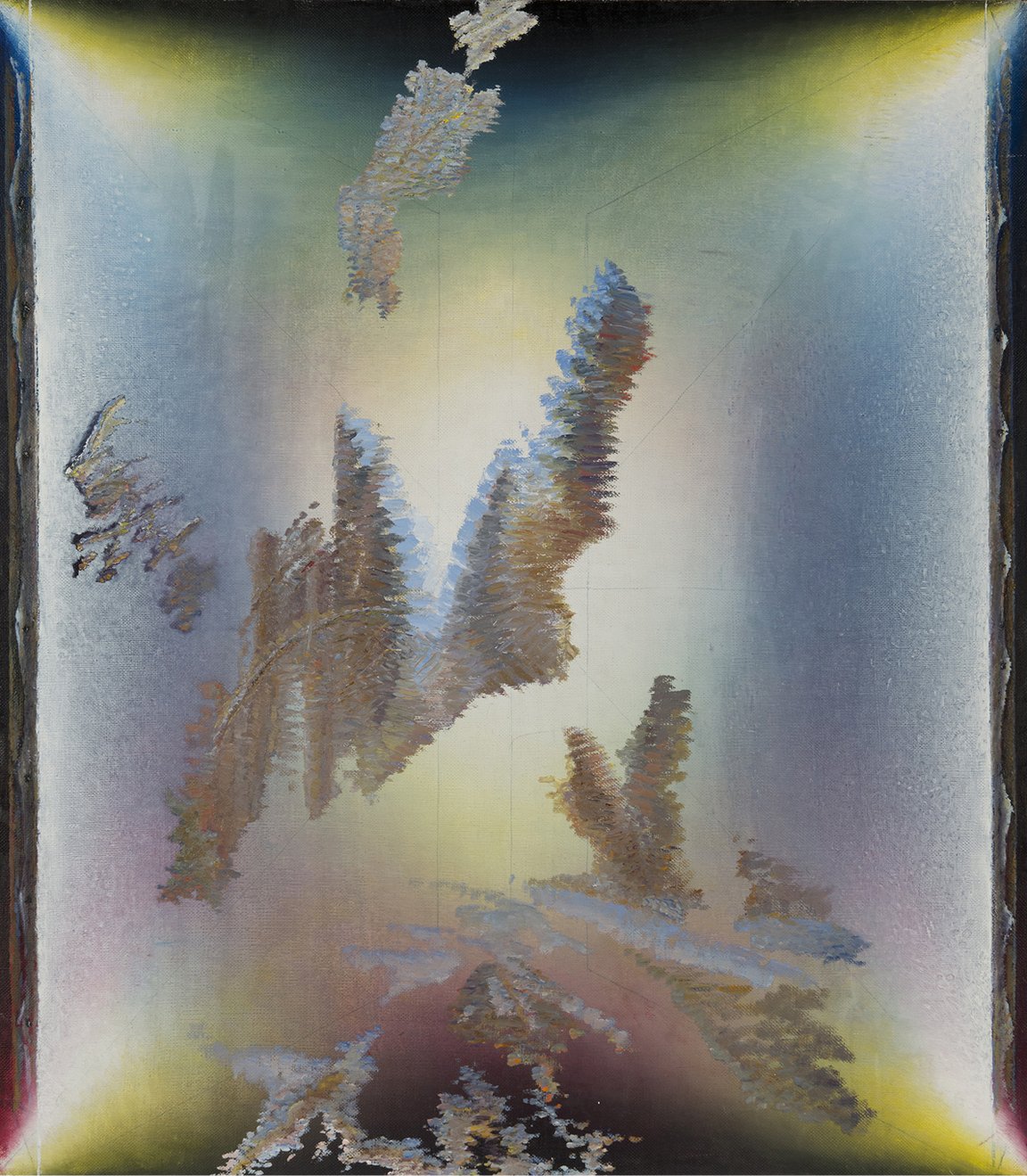
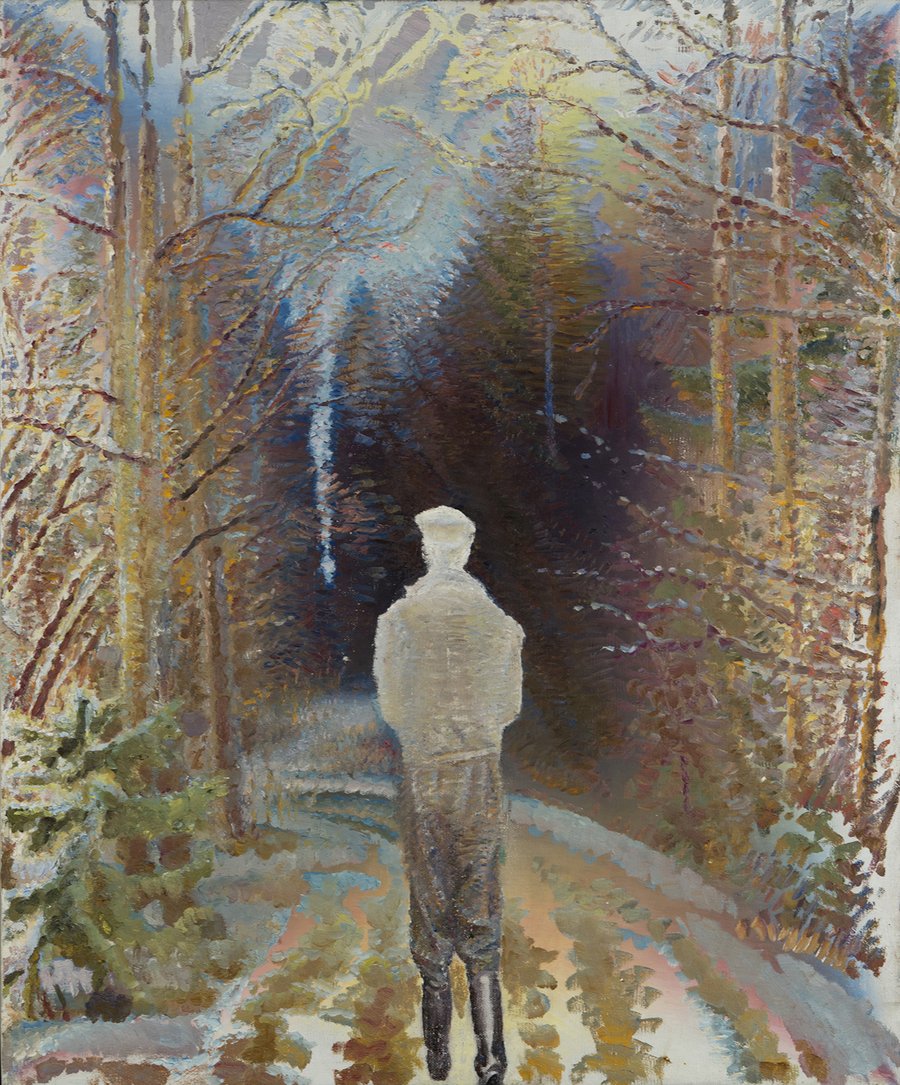
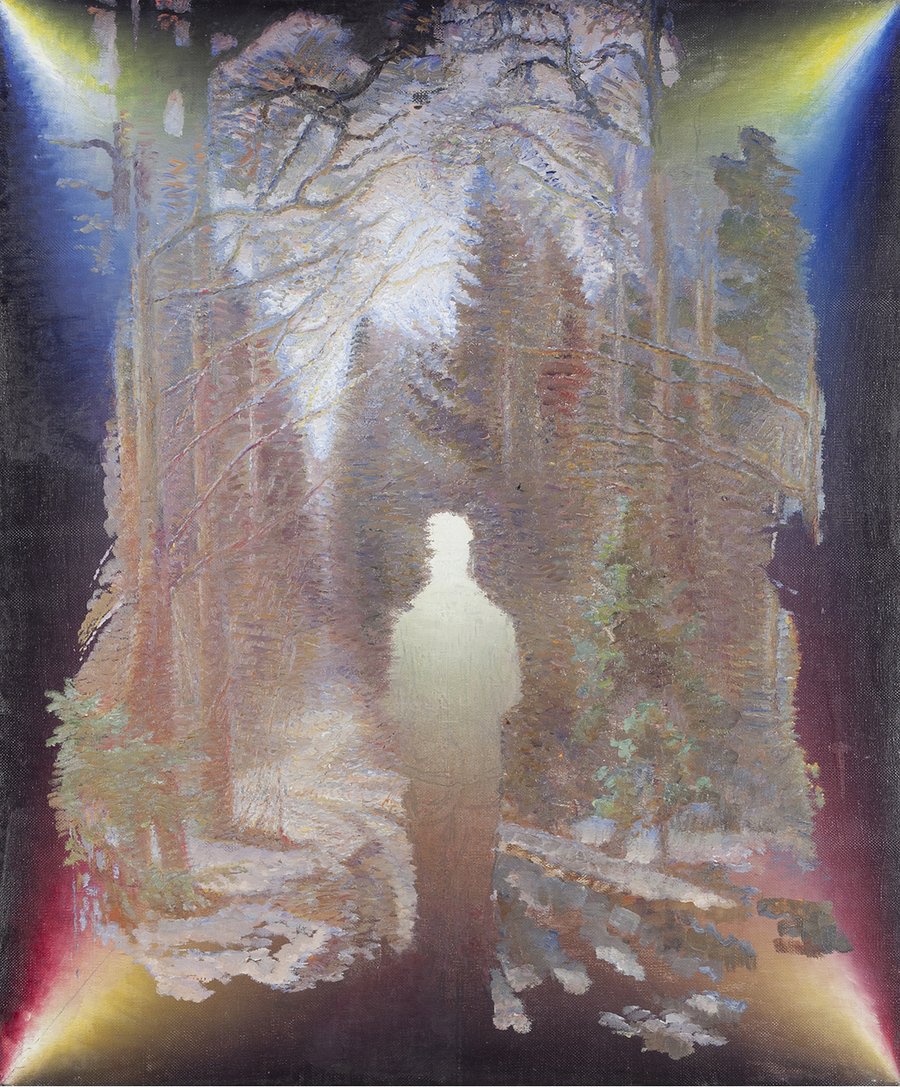
Oleg Vasiliev. Walk I, II, and III (from a triptych). 1975.
Vasiliev O. V. House on Anzer Island, 1965 [Electronic resource] // Oleg Vasiliev: Official Website. — URL: https://ru.olegvassiliev.com/paintings/1-house-on-the-island-anzer (accessed: 11/18/2026).
Vasiliev O. V. Integrated Space (from the series «Spaces»), 1968 [Electronic resource] // Oleg Vasiliev: Official Website. — URL: https://ru.olegvassiliev.com/paintings/integrated-space-from-the-series-spaces-2 (accessed: 11/18/2026).
Vasiliev O. V. In the Field (Abramtsevo), 1972 [Electronic resource] // Oleg Vasiliev: Official Website. — URL: https://ru.olegvassiliev.com/paintings/in-the-field-abramtsevo (accessed: 11/18/2026).
Vasiliev O. V. Road, 1982 [Electronic resource] // Oleg Vasiliev: Official Website. — URL: https://ru.olegvassiliev.com/paintings/road (accessed: 11/18/2026).
Vasiliev O. V. Unpaved Road, 1987 [Electronic resource] // Oleg Vasiliev: Official Website. — URL: https://ru.olegvassiliev.com/paintings/unpaved-road (accessed: 11/18/2026).
Vasiliev O. V. Landscape with Space, 1988 [Electronic resource] // Oleg Vasiliev: Official Website. — URL: https://ru.olegvassiliev.com/paintings/landscape-with-space (accessed: 11/18/2026).
Vasiliev O. V. Untitled (Road), 1989 [Electronic resource] // Oleg Vasiliev: Official Website. — URL: https://ru.olegvassiliev.com/paintings/untitled-a-road (accessed: 11/18/2026).
Vasiliev O. V. Stroll, 1966 [Electronic resource] // Oleg Vasiliev: Official Website. — URL: https://ru.olegvassiliev.com/paintings/stroll (accessed: 11/18/2026).
Vasiliev O. V. Stroll I (from a triptych), 1975 [Electronic resource] // Oleg Vasiliev: Official Website. — URL: https://ru.olegvassiliev.com/paintings/stroll-i-aka-walk-i-from-triptych (accessed: 11/18/2026).
Vasiliev O. V. Stroll II (from a triptych), 1975 [Electronic resource] // Oleg Vasiliev: Official Website. — URL: https://ru.olegvassiliev.com/paintings/stroll-ii-aka-walk-ii-from-triptych (accessed: 11/18/2026).
Vasiliev O. V. Stroll III (from a triptych), 1975 [Electronic resource] // Oleg Vasiliev: Official Website. — URL: https://ru.olegvassiliev.com/paintings/stroll-iii-aka-walk-iii-from-triptych (accessed: 11/18/2026).
Vasiliev O. V. Walking, 1978 [Electronic resource] // Oleg Vasiliev: Official Website. — URL: https://ru.olegvassiliev.com/paintings/walking (accessed: 11/18/2026).
Vasiliev O. V. Figure in the Forest, 1983–1985 [Electronic resource] // Oleg Vasiliev: Official Website. — URL: https://ru.olegvassiliev.com/paintings/the-figure-in-the-woods (accessed: 11/18/2026).
Vasiliev O. V. Outside of Moscow (Two Figures Walking on an Abandoned Road), 1995 [Electronic resource] // Oleg Vasiliev: Official Website. — URL: https://ru.olegvassiliev.com/paintings/outside-of-moscow-aka-unknown-two-figures-walking-on-abandoned-road (accessed: 11/18/2026).
Vasiliev O. V. Walk in the Rain, 1990 [Electronic resource] // Oleg Vasiliev: Official Website. — URL: https://ru.olegvassiliev.com/paintings/walk-in-the-rain (accessed: 11/18/2026).
Vasiliev O. V. The Forest Outside (aka Forest All Around), 1993 [Electronic resource] // Oleg Vasiliev: Official Website. — URL: https://ru.olegvassiliev.com/paintings/the-forest-outside-aka-forest-all-around (accessed: 11/18/2026).
Vasiliev O. V. The Night Road, 1999 [Electronic resource] // Oleg Vasiliev: Official Website. — URL: https://ru.olegvassiliev.com/paintings/the-night-road (accessed: 11/18/2026).
Vasiliev O. V. The Night Road, 2001 [Electronic resource] // Oleg Vasiliev: Official Website. — URL: https://ru.olegvassiliev.com/paintings/night-road-aka-neglected-road (accessed: 11/18/2026).
Vasiliev O. V. The Abandoned Road, 2001 [Electronic resource] // Oleg Vasiliev: Official Website. — URL: https://ru.olegvassiliev.com/paintings/the-abandoned-road (accessed: 11/18/2026).
Vasiliev O. V. Light in the Space of Memory, 2010 [Electronic resource] // Oleg Vasiliev: Official Website. — URL: https://ru.olegvassiliev.com/paintings/light-in-the-space-of-memory (accessed: 11/18/2026).
Vasiliev O. V. First Walk in Spring, 1989 [Electronic resource] // Oleg Vasiliev: Official Website. — URL: https://ru.olegvassiliev.com/paintings/first-walk-in-spring (accessed: 11/18/2026).
Vasiliev O. V. The Last Autumn Leaves / A Country Road in Early Spring / From the Past (after Vasily Polenov’s «Grandmother’s Garden»): Triptych, 1992 [Electronic resource] // Oleg Vasiliev: Official Website. — URL: https://ru.olegvassiliev.com/paintings/the-last-autumn-leaves-a-country-road-in-early-spring-from-the-past-after-vasily-polenovs-grandmothers-garden-triptych (accessed: 11/18/2026).
Vasiliev O. V. Home I: Thaw on an Open Road, 1993 [Electronic resource] // Oleg Vasiliev: Official Website. — URL: https://ru.olegvassiliev.com/paintings/home-i-open-road-thaw (accessed: 11/18/2026).
Vasiliev O. V. The Lost Road (Early Spring), 2003–2004 [Electronic resource] // Oleg Vasiliev: Official Website. — URL: https://ru.olegvassiliev.com/paintings/the-lost-road-early-spring (accessed: 11/18/2026).
Vasiliev O. V. The Lost Road, 2004 [Electronic resource] // Oleg Vasiliev: Official Website. — URL: https://ru.olegvassiliev.com/paintings/the-lost-road (accessed: 11/18/2026).
Vasiliev O. V. Furrows of a Spring Road, 2009 [Electronic resource] // Oleg Vasiliev: Official Website. — URL: https://ru.olegvassiliev.com/paintings/spring-road-furrow (accessed: 11/18/2026).
Vasiliev O. V. Kira on the Path to the Country House, 1991 [Electronic resource] // Oleg Vasiliev: Official Website. — URL: https://ru.olegvassiliev.com/paintings/kira-on-the-path-to-the-country-house (accessed: 11/18/2026).
Vasiliev O. V. 55th Kilometer from Moscow, 1992 [Electronic resource] // Oleg Vasiliev: Official Website. — URL: https://ru.olegvassiliev.com/paintings/the-55th-km-from-moscow (accessed: 11/18/2026).
Vasiliev O. V. Remembrance of Summer (A Little Bridge), 1995 [Electronic resource] // Oleg Vasiliev: Official Website. — URL: https://ru.olegvassiliev.com/paintings/remembrance-of-summer-aka-a-little-bridge (accessed: 11/18/2026).
Vasiliev O. V. Pass to the Lake, 1992 [Electronic resource] // Oleg Vasiliev: Official Website. — URL: https://ru.olegvassiliev.com/paintings/pass-to-the-lake (accessed: 11/18/2026).
Vasiliev O. V. Path to the Lake, 2001 [Electronic resource] // Oleg Vasiliev: Official Website. — URL: https://ru.olegvassiliev.com/paintings/the-path-to-the-lake (accessed: 11/18/2026).
Vasiliev O. V. Path to the Lake, 2003 [Electronic resource] // Oleg Vasiliev: Official Website. — URL: https://ru.olegvassiliev.com/paintings/path-to-the-lake (accessed: 11/18/2026).
Vasiliev O. V. Path to the Lake, 2004 [Electronic resource] // Oleg Vasiliev: Official Website. — URL: https://ru.olegvassiliev.com/paintings/path-to-the-lake-2 (accessed: 11/18/2026).
Vasiliev O. V. Return Home, 2002 [Electronic resource] // Oleg Vasiliev: Official Website. — URL: https://ru.olegvassiliev.com/paintings/return-home (accessed: 11/18/2026).
Vasiliev O. V. Home on Anzer, 2001 [Electronic resource] // Oleg Vasiliev: Official Website. — URL: https://ru.olegvassiliev.com/paintings/the-home-on-the-anzer (accessed: 11/18/2026).