Research Objective
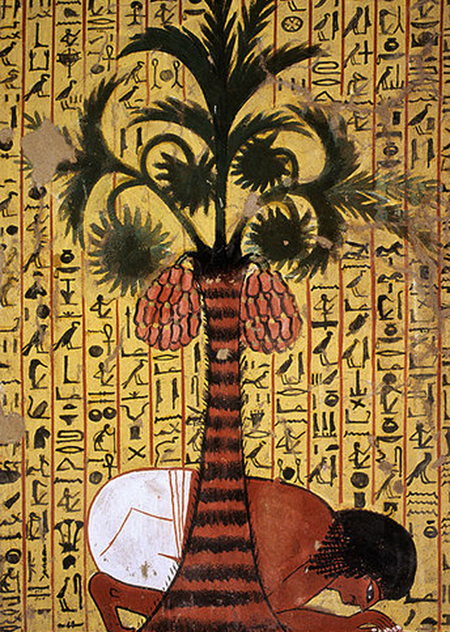
The objective of this study is to examine the portrayal of trees in the art of Ancient Egypt—their artistic embodiment and symbolic significance within the ancient Egyptian civilization’s culture. By analyzing wall paintings, temple reliefs, papyri, funerary art, and other artistic monuments, this research aims to investigate how trees were depicted, what images and associations were linked to them, and what role they occupied in the visual culture of Ancient Egypt.
Particular attention is paid to the symbolism of the tree in religious beliefs and mythology—its connection to concepts of life, death, rebirth, and the afterlife. Studying this image allows for a deeper understanding of how the ancient Egyptians perceived nature, divine powers, and the structure of the cosmos, and how these concepts were reflected in their art.
Research Question
Why did the image of the tree occupy such a significant place in Ancient Egyptian art, and how did its depiction convey the ancient Egyptians' understanding of life, death, rebirth, and the connection between the human and divine worlds? How did a natural object acquire such profound religious and mythological significance? Why was it portrayed in scenes of the afterlife, alongside gods and the deceased, and what symbolic meanings were hidden within its various artistic representations?
Hypothesis
It is presumed that in the art of Ancient Egypt, the tree was one of the significant symbolic images that extended far beyond a simple depiction of nature. Its meaning was rooted in concepts of life cycles, fertility, renewal, and immortality. The tree was perceived as an image of continuous existence and an intermediary between different planes of existence—the earthly, the divine, and the afterlife.
It can be presumed that the special place of the tree in ancient Egyptian art is fundamentally linked to its ability to unite opposing concepts: life and death, decay and rebirth, the material world and eternity. Because of this, the tree became not only an independent religious symbol but also an important artistic medium for conveying complex mythological ideas. Its depictions reflected the ancient Egyptians' aspiration to preserve the idea of life even beyond the limits of human physical existence.
When does the tree appear in Ancient Egyptian art?
The earliest botanical motifs date back to the pre-dynastic period—around the 5th–4th millennia BCE. They appeared on pottery, ritual objects, and decorative items. Some researchers interpret certain ornaments as stylized palm tree images, but their precise meaning is still debated.
Negada II · circa 3650–3300 BCE · ceramics, painted ware · The Metropolitan Museum of Art, New York.
The vessels from the Negada II period (c. 3650–3300 BCE), decorated with stylized depictions of plants and trees, are particularly fascinating. Their ornaments reveal that natural forms were already becoming autonomous elements of an artistic language at that time. However, it is not always possible to identify the specific type of plant or determine the precise symbolic meaning of each image.
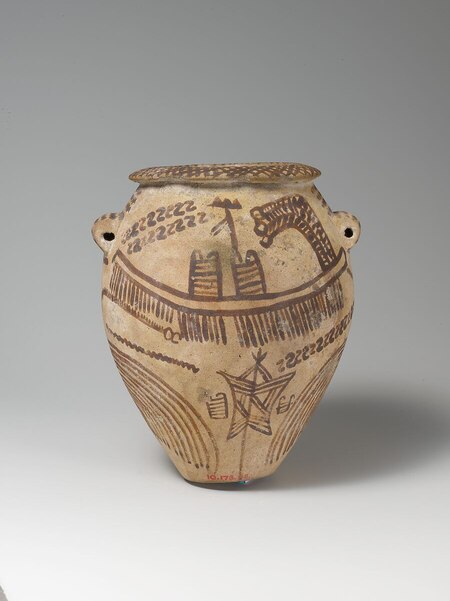
Another interesting early artifact: a vessel with depictions of boats and trees from the Metropolitan Museum of Art collection (c. 3650–3500 BCE).
The Sacred Tree: Source of Life and Rebirth
Thutmose III, nourished by the sacred tree. Tomb of Thutmose III, Thebes, 15th century BCE. Wall painting.
In the fresco, Pharaoh Thutmose III is depicted beside a sacred sycomore, which takes the form of the goddess Isis. The goddess’s bosom emerges from the trunk of the tree, which she uses to nurse the pharaoh. Thus, the tree is presented not merely as a plant, but as a living embodiment of divine power. The act of nursing symbolizes the transmission of vital energy, protection, and renewal.
Just as a mother nourishes a child, the sacred tree grants the Pharaoh the strength to continue existing. In the context of funerary art, this image is also associated with the rebirth of the deceased and their preparation for eternal life. The convergence of the tree and the mother goddess imagery is particularly significant: natural power becomes a source of divine sustenance, and the tree itself transforms into a symbol of birth, renewal, and immortality.
The Sacred Tree: The Gift of Life in the Afterlife
Sennedjem and his wife before the goddess of the sacred sycamore. Tomb of Sennedjem (TT1), Deir el-Medina, 19th Dynasty, circa 1295–1186 BCE.
The image depicts a deceased Senndjem and his wife approaching the sacred sycamore, in whose canopy a tree goddess appears. She offers them water and food—gifts essential for sustaining life. In ancient Egyptian beliefs, the sycamore was associated with maternal care, protection, and rebirth. Its dense canopy provided shade, its fruit served as sustenance, and the water symbolized vital energy. Consequently, the tree became an archetype of a divine source capable of sustaining human existence even after death.
It is particularly significant that the goddess is not merely near the tree—she appears to merge with it. This imbues the natural image with a divine essence: the tree itself becomes an embodiment of care and patronage. The scene symbolizes the hope for eternal life, where the deceased continues to receive nourishment, protection, and support from the gods.
Central Idea: The tree was perceived as a source of life that continues to nourish and protect humanity even after death.
The Tree as a Symbol of Royal Power and Eternity
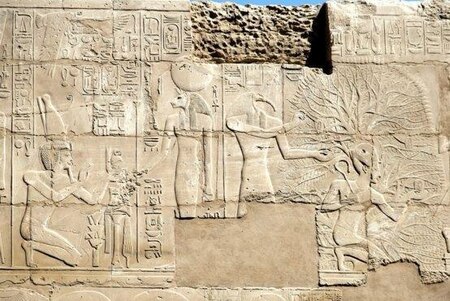
The gods Thoth and Seshat record the pharaoh’s reign years on the leaves of the sacred tree Iset. Similar scenes can be found in temple reliefs, particularly at Karnak.
In ancient Egyptian mythology, the Isid tree was considered a sacred tree of life. According to Egyptian beliefs, the gods inscribed the names of pharaohs and the years of their reigns on its leaves. This image linked the tree to the divine order, historical memory, and eternity.
The inscription of the king’s name held profound significance: the name was considered the most crucial element of a person’s identity, and its preservation ensured continuity. Therefore, the image of the tree became a symbol not only of the pharaoh’s power but also of its eternal recognition by the gods. Thus, the tree functioned as a kind of guardian of time and memory, linking earthly rule to the divine order.
The Tree as an Image of the Eternal Garden
Nebamun’s Tomb. Fragment of the painting from Nebamun’s mortuary chapel at Thebes, circa 1350 BCE, 18th Dynasty. Fresco on stucco.
The painting depicts a beautiful garden with a pond, surrounded by sycamores, date palms, and dum palms. Among the trees are birds, fish, and lotus flowers. This is not merely an image of a rich garden, but a representation of a prosperous and eternal life after death.
The trees here symbolize fertility, abundance, and the continuous renewal of nature. Their fruit represents sustenance and prosperity, while the shade and greenery convey protection and comfort. The body of water intensifies the image of a living space where nature is in constant motion and development.