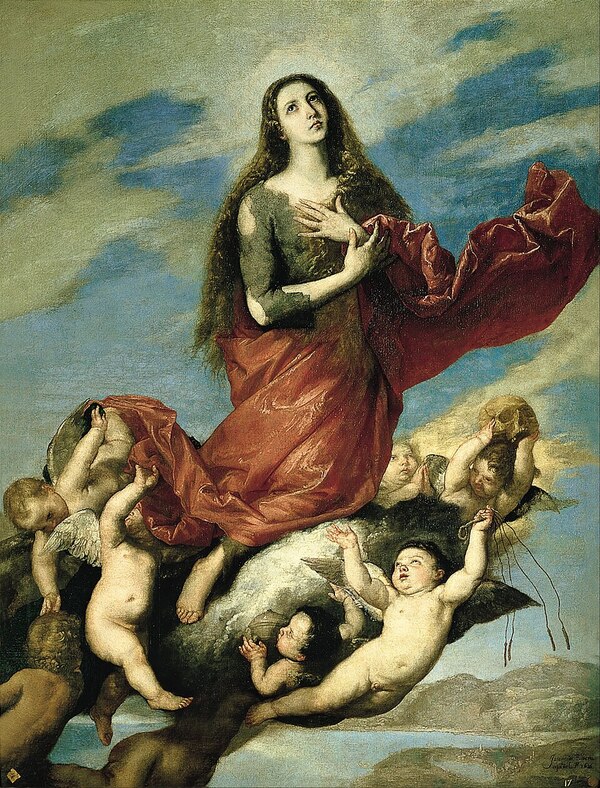
CONCEPT
This research examines the figure of Mary Magdalene in 16th–17th century European painting, revealing her as an artistic embodiment of the human spiritual journey—from repentance and inner transformation to faith, sanctity, and eternal life with God.
The theological ambiguity that developed within the Western Christian tradition holds particular significance for understanding this image. Mary Magdalene is often conflated with several Gospel female figures, notably the unnamed sinner who washed Christ’s feet with her tears and anointed them with perfumes, as well as Mary of Bethany. Consequently, the image of Magdalene absorbed motifs of a sinful past, repentance, and devotion to the Savior. This is clearly reflected in the paintings: vessels of unguents, unbound hair, gestures of remorse, and scenes of foot washing became established elements in her depiction.
The composition of this study is structured not geographically or chronologically by the works, but along the spiritual path of Mary Magdalene herself: from repentance and renunciation of her former life—through love and devotion to Christ—to contemplative prayer, holiness, and eternal life with God. Comparing the works of different masters allows us to see not only the evolution of Magdalene’s artistic representation but also the diversity of ways to depict spiritual experience.
The study is divided into thematic sections.The first part of the study— «Metanoia”—focuses on the theme of repentance as the initial stage of Mary Magdalene’s spiritual journey. It examines the formation of the penitent woman’s image in European painting, as well as the primary artistic techniques artists use to convey her inner state. Special attention is given to the motifs of remorse, tears, prayer, and rejection of worldly values. Characteristic gestures and poses of the heroine, facial expressions, direction of gaze, costume features, and surrounding space are analyzed. By comparing different artistic interpretations, it is traced how Magdalene’s image transitions from an external expression of repentance to a deeper depiction of an internal spiritual turning point.The second part— „Witness to Christ”—unfolds the connection between Mary Magdalene and the Savior through Gospel events: Christ washing the feet, remaining near Him, mourning, and meeting the resurrected Christ. The encounter between Magdalene and the risen Christ becomes a crucial scene, where she acts as a witness to the Resurrection. Scenes of the meal at Simon the Pharisee’s house are also analyzed, where themes of love, forgiveness, and devotion are revealed through gestures, composition, and character interaction. The focus is not only on Magdalene’s repentance but also on her unique spiritual relationship with Christ.The third part— „Spiritual Transformation”—is devoted to the conclusion of Magdalene’s journey; now she dwells in prayerful contemplation and intimate closeness to God. Unlike the scenes of repentance, here the heroine is often depicted in a state of inner peace, prayer, or ecstasy.
The research objective is to trace how different artists engage with a shared artistic tradition by utilizing recurring symbols while offering their own unique artistic solutions. The comparison focuses on composition, gestures, gazes, color and light contrasts, the rendering of space, and the traditional attributes of Mary Magdalene. Particular attention is paid to the vessel of incense, the skull, the open book, the crucifixion, the mirror, and the sources of light. The study examines how the meaning of these elements shifts depending on the subject matter and the author’s interpretation: the skull can allude both to death and to the Resurrection, the book to Truth and spiritual knowledge, and light to the constant Divine presence.
METANOIA
Metanoia (Greek: μετάνοια) — repentance, internal spiritual transformation, and a change in consciousness.
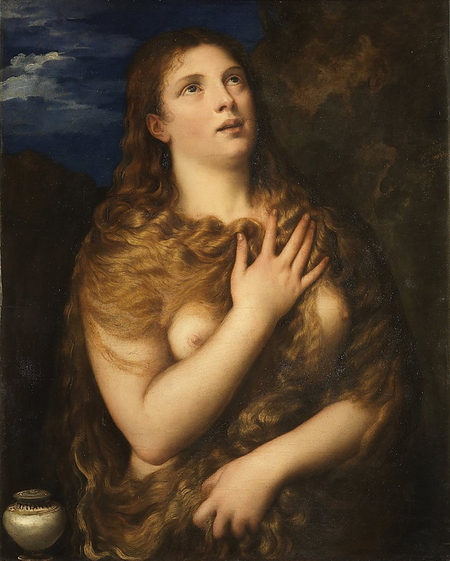
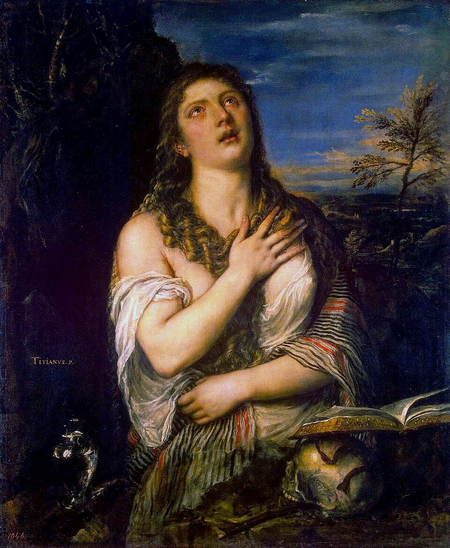
1. Magdalen Penitence / Titian (c. 1531) 2. Magdalen Penitence / Titian (c. 1565)
There are several original variations and copies of Titian’s painting, «Penitent Magdalene.» In this case, two works by the same artist, created nearly thirty years apart, are presented.In the version from the 1530s, Titian depicts Mary Magdalene as sensually alluring: her long hair flows freely, winding around her body and exposing it. Her right hand is pressed against her chest—a gesture that conveys repentance and internal turmoil—while her left hand holds her hair near her hips. In the lower left corner is a vessel of incense (one of the traditional attributes of Mary Magdalene in Western European painting).
The 1960s version appears more restrained in its depiction of the nude body, yet it possesses a greater emotional intensity. Mary Magdalene’s hair is shorter and less voluminous, and her body is draped in carelessly falling garments. Her left hand retains the gesture of repentance, while her right clutches the fabric as if in a moment of agitation. Her eyes are reddened with traces of tears; her facial features are swollen and anxious. Unlike the gentle, almost serene face of the early versionIn the lower left corner, the vase of incense remains, and on the right, an open book and a skull upon which it rests appear. The book can be interpreted as a symbol of the Holy Scripture—the source of spiritual knowledge and revelation about God. The skull is a frequently recurring attribute in depictions of Mary Magdalene (we will return to its symbolism later).
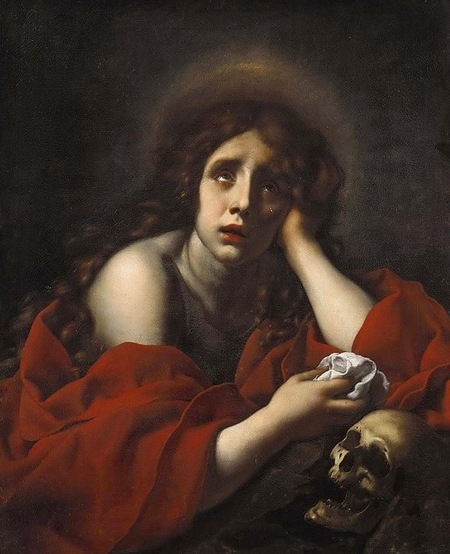
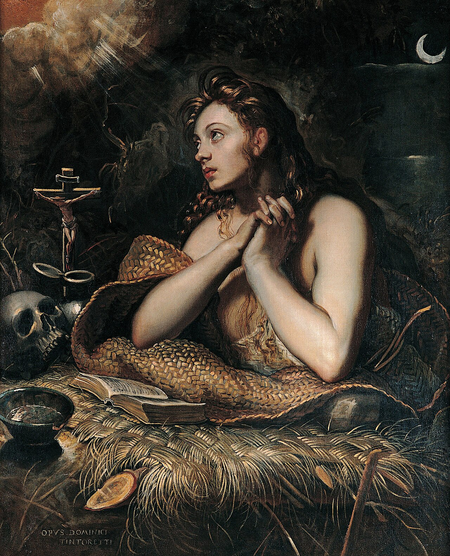
3. Magdalen in Penitence / Carlo Dolci (1616–1686) 4. Magdalen in Penitence / Domenico Tintoretto (1598–1602)
Carlo Dolci Magdalene leans thoughtfully on her left hand. Her eyes are once again filled with tears, and her right hand clutches a white kerchief, likely intended to wipe them away. Behind the saint’s head, a blurred oval halo suggests her sanctity.In Domenico Tintoretto’s work, Mary does not look straight up; instead, she gazes toward the heavens in the upper right corner of the painting. This makes her gaze appear calmer and more natural. Furthermore, the artist incorporates elements of the celestial world into the composition—light breaking through the clouds and the moon—as if uniting the earthly space where Magdalene resides with the heavenly one. Thus, Mary appears not only in a state of repentance but also in direct communion with the divine world. In other words, Magdalene’s appeal to the heavens is met: the celestial light is a response to her prayer; on the heroine’s face, there is already a tranquility of prayerful concentration, unlike the anxieties seen in other paintings.
5. Penitent Mary Magdalene / Mateo Crespo Jr. (1661)
Similar motifs appear in Matteo Sereso’s painting, yet here the figure of Mary Magdalene takes on a more corporeal and sensual character.
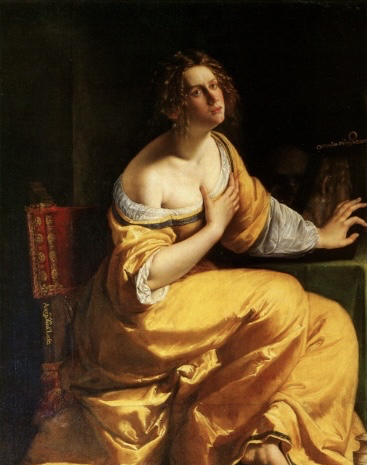
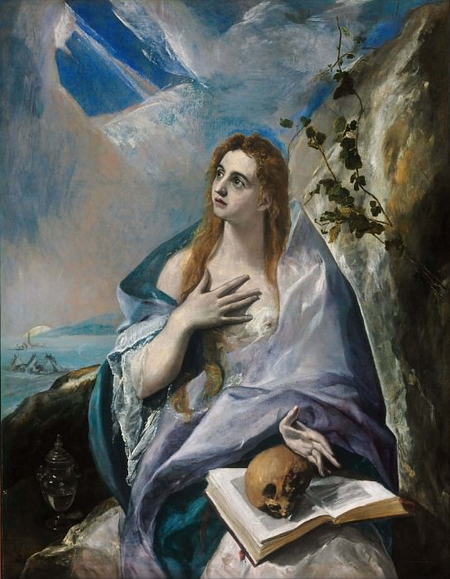
6. Magdalen in Repentance / Artemisia Gentileschi (c. 1615–1620) 7. Magdalen in Repentance / El Greco (1576–1577)
In Artemisia Gentileschi’s work, the typical iconography of Mary Magdalene almost vanishes, leaving only a gesture of repentance. A particular focus is drawn to Magdalene’s attire: she wears a luxurious golden-yellow dress with off-the-shoulder sleeves adorned with white fabric. The richness and sheen of the fabric maintain a connection between the heroine and worldly beauty and affluence. However, this garment is now perceived differently—it conflicts with Magdalene’s gesture and gaze, symbolizing a transition from outward beauty and worldly values toward a spiritual path.
As in previous works, the skull reappears here as a symbol of death. However, in the Christian understanding, death is not the ultimate limit—it is conquered through the sacrificial cross of Christ and His Resurrection. Domenico Tintoretto and Matteo Serese emphasize this idea by placing the Crucifixion above the skull.
A representation of Mary Magdalene similar to the previous examples can also be seen in El Greco’s work. The familiar symbolism—the vessel of unguents, the gesture of penitence, and the calm gaze directed toward the heavens—is retained. However, unlike the works previously discussed, the landscape here is not somber, but filled with daylight, early morning light. The skull and the open book reappear, but this time the skull is placed directly upon the open Bible, seemingly emphasizing the necessity of remembering death («Memento mori”—“Remember death»).
8. Magdalen Repentant / Michelangelo Merisi da Caravaggio (1594–1595)
In Caravaggio’s painting, the figure assumes a reserved character (a tilted head, cast-down gaze), unlike in his other works. This lowered gaze can be interpreted as a prayerful «shame» before God—an acceptance of humility and one’s own sinfulness.We again see the vase of incense, clear like the transparency before God Himself.
CRIST’S WITNESS
«For there is no other name under heaven given among men by which we must be saved» (Acts 4:12)
Mary Magdalene—she is not an isolated biblical figure; she is an immediate participant in the Gospel events, a witness to the life, death, and Resurrection of Christ.
9. Noli me tangere / Andrea del Sarto (1510)
Maria Magdalene greets the resurrected Christ in Andrea del Sarto’s painting, «Do Not Touch Me.» The artist references a biblical episode where Magdalene, having recognized the Savior at the tomb, attempts to draw near to Him, but Christ stops her with a gesture.
10. The Apparition of Christ to Mary Magdalene (Noli me tangere) / Rembrandt van Rijn
Rubens uses a dramatic contrast of light and shadow (chiaroscuro), which causes the figures of Christ and Magdalen to stand out against the darkened space—this lighting choice intensifies the emotional expressiveness of the scene.
11. Feast at the House of Simon the Pharisee / Unknown Master (1510–1520)
Historical-theological nuance: In Western European painting, the woman washing the feet of Christ was often depicted as Mary Magdalene. However, her identity remains ambiguous in the Gospel texts. The Gospel of Luke (7:36–50) recounts an unnamed woman who washes Jesus’ feet with tears, dries them with her hair, and anoints them with perfume. The Gospel of John (12:1–8) features a similar act by Mary of Bethany, the sister of Martha and Lazarus. Over time, these female figures in Western Christian tradition were merged with the image of Mary Magdalene.
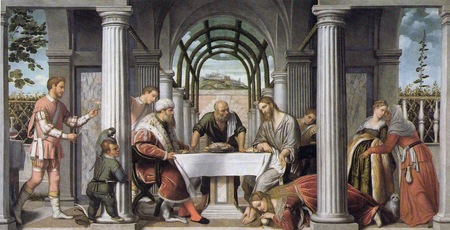
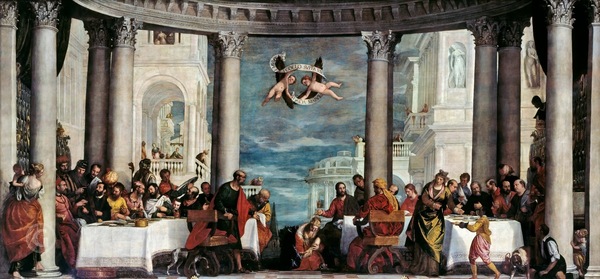
12. Dinner at the House of Simon the Pharisee / Moretto da Brescia (1544) 13. Banquet at the House of Simon the Pharisee / Paolo Veronese (1570)
In Moretto da Brescia’s painting, the scene unfolds within an architectural interior, and the figures of the diners form a kind of frame around the central event. Magdalene is depicted at the feet of Christ, while the surrounding characters are engaged in observing the action and conversing with one another.