Образ смерти в искусстве средневековой Европы IX–XIV веков
Navigation
- Concept
- Hypothesis
- Christian Themes
- Three Dead and Three Living
- Triumph of Death
- Conclusion
Concept
Death has always held a unique place in the human experience. From ancient times, it has influenced the formation of cultures and found reflection in art—from burial traditions to contemporary works. As humanity evolved, so too did our understanding of this phenomenon.
This study focuses on how medieval art constructed the collective perception of death through visual means and how that perception evolved.
Hypothesis
My hypothesis is that the image of death in medieval art represents a highly functional cultural construct, carrying multiple objectives—to instruct, to caution, to comfort, and to critique.
Christian themes
In the Early Middle Ages, the theme of death was explored through Christian narratives, yet it did not hold a central place or possess personification; instead, it was expressed symbolically.
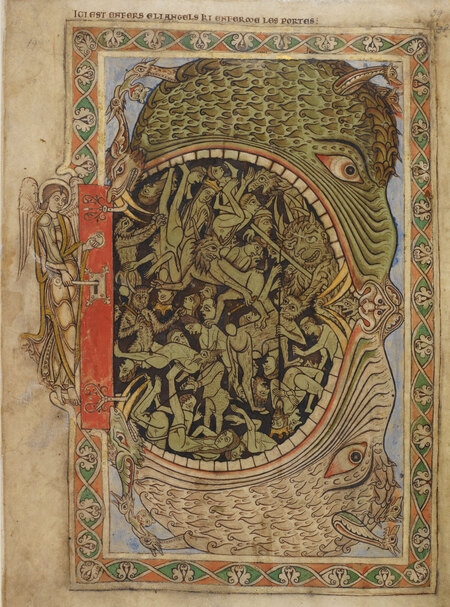
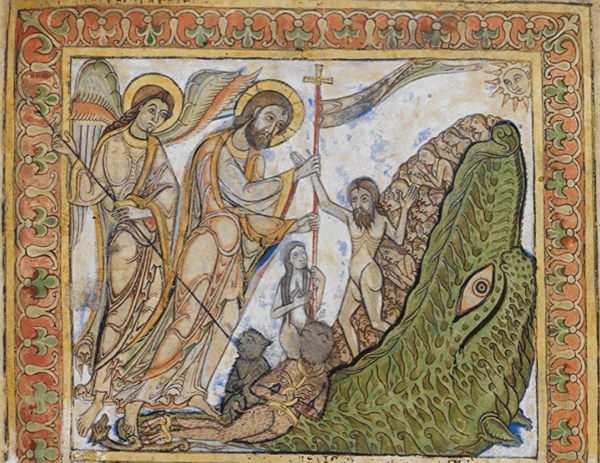
«Angel Shutting the Gates of Hell, ” 12th century // „Descent into Hell, ” 12th century
The first miniature depicts hell as a colossal, monstrous maw, chaotically filled with sinners and demons.
The second miniature shows Jesus Christ descending into hell with the aim of conquering death and freeing the souls of the righteous.
«The Last Judgment, ” Giotto di Bondone, 1303–1306
At the center, surrounded by angels, Christ floats in an almond-shaped radiance. His figure is the thematic axis of the entire fresco. His right hand is open and turned toward the chosen, while his left is closed and points toward the damned. Christ’s gaze is also directed toward the saved, and the wound in his side and the traces of his suffering emphasize the cost of redemption. Arranged in a semicircle around him are the twelve apostles, and above them are symmetrical ranks of celestial choirs.
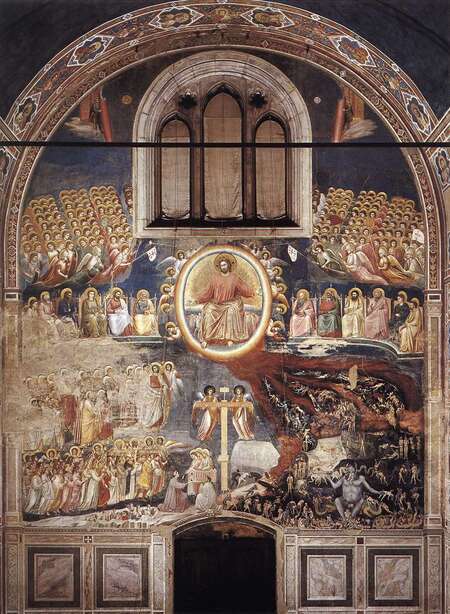
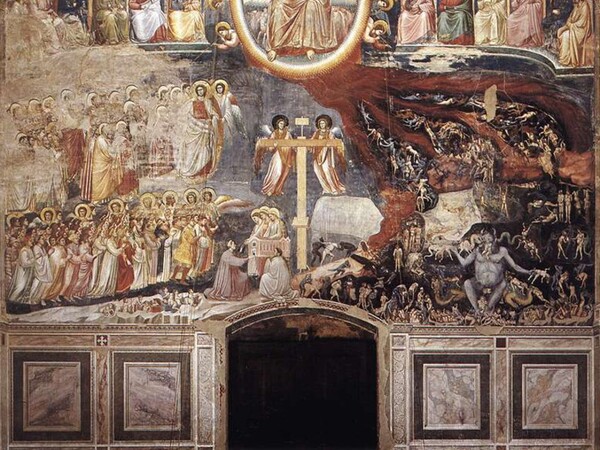
Unlike the serene rows of the blessed, the sinners are depicted with realistic physicality: their bodies are distorted, exposed, and subject to physical suffering. Death ceases to be an abstract transition and becomes a palpable terror.
Three dead and three alive
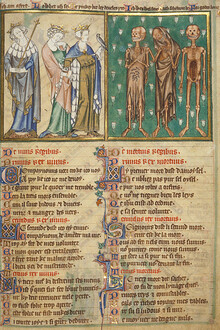
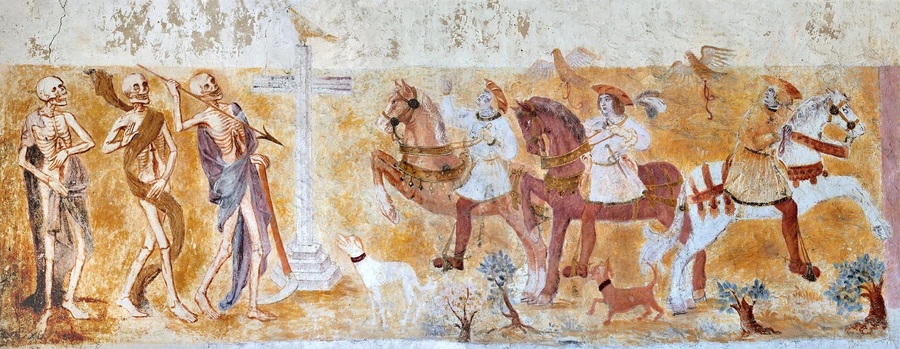
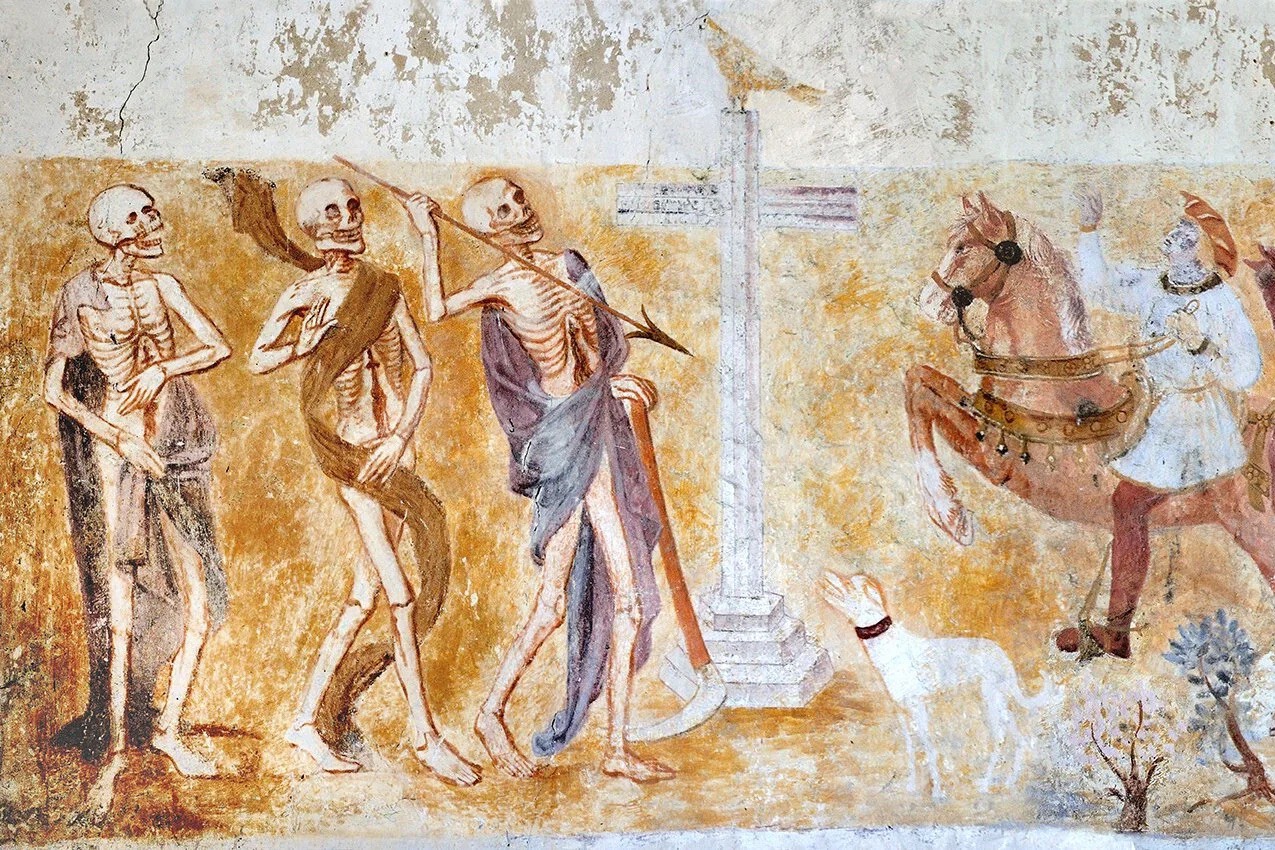
«Three Living and Three Dead, ” Psalm by Robert de Lilli // „The Tale of Three Living and Three Dead, ” fresco in Saint-Germain Church, La Ferté-Loupier
The story of «The Meeting of Three Living and Three Dead» (Les Trois Morts et les Trois Vifs) is an independent and very common legend in the Middle Ages, existing in both literary and visual traditions.
The story tells of three young aristocrats (often kings or noble knights) who, during a hunt or outing, suddenly encounter three corpses in various stages of decomposition. The dead address the living with the words: «What you are now, we were; what we are now, you will become» (French: «Nous fûmes ce que vous êtes, vous serez ce que nous sommes»). This warning is intended to urge the living to renounce worldly pleasures and contemplate the salvation of their souls.
In this fresco, the figures of the dead express various emotions. The first on the left is static, holding its arms close to its body, as if aware of its grotesque condition. The central figure moves toward the living, with a raised arm—either in a gesture of greeting or an attempt to soothe the aristocrats. The last dead figure walks ahead, holding a spear in its right hand—already raised and aimed at the living with malevolent intent. With its left hand, it leans on a scythe, one of the most recognizable symbols of death.
It is difficult to gauge the emotions of the young people in this encounter from their faces. The young man on the left seems scarcely to have noticed the dead—he is too absorbed in the bird that has flown away. The person in the center displays either distrust or skepticism, or perhaps has not yet grasped what is happening. The third aristocrat has already turned his horse and is striving to leave the situation, but it is unclear whether his success awaits him—it is more likely that the dead man in the blue fabric intends to throw a spear at him, symbolizing that one cannot escape death.
It is interesting that the animals depicted in the fresco are related to the three dead men with obvious aggression.
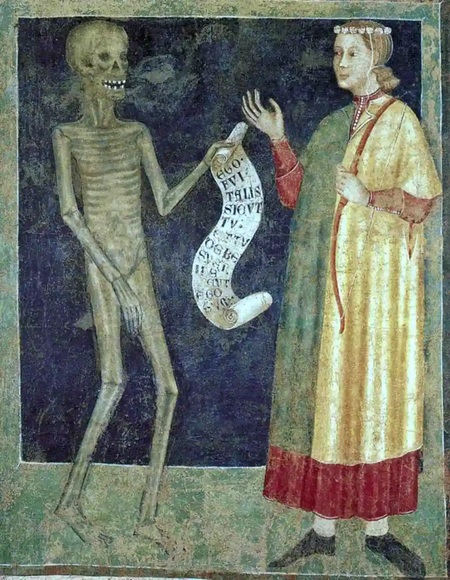
«The Cavalier and Death,» 1320sDeath holds a scroll with the inscription: «I was like you; you will be like me.»The young man appears completely unfazed by such a warning.An example of the depiction of Death as a skeletal figure.
The narrative «Three Living and Three Dead» established the figure of Death-the-undead as a speaking, corporeal, leveling, and reflective entity. It transformed death from an abstract theological concept into a concrete interlocutor with whom the viewer confronts face-to-face. It was this very narrative that laid the visual and rhetorical groundwork for subsequent forms—the «Danse Macabre» and the «Triumph of Death”—where death ultimately acquires its own subjectivity and mass scale.
Triumph of Death
«Triumph of Death, ” Buonamicco Buffalmacco, 1330s
In the left portion of the composition, we see noble ladies and gentlemen, dogs, and falcons, who are riding out hunting. However, their path intersects with three open coffins containing bodies in various stages of decomposition—from a relatively «fresh» corpse to a naked skeleton intertwined with snakes—clearly depicting the theme of «The Three Living and the Three Dead.» One of the riders holds his nose against the stench.
In the right section of the fresco, a scene unfolds depicting the struggle between angels and demons for the souls of the deceased. The souls are represented as small nude figures emerging from the mouths of the departed. The angels strive to ascend them to heaven, while the demons attempt to drag them into hell. This scene emphasizes the eschatological meaning of death as the moment of a final choice between salvation and damnation.