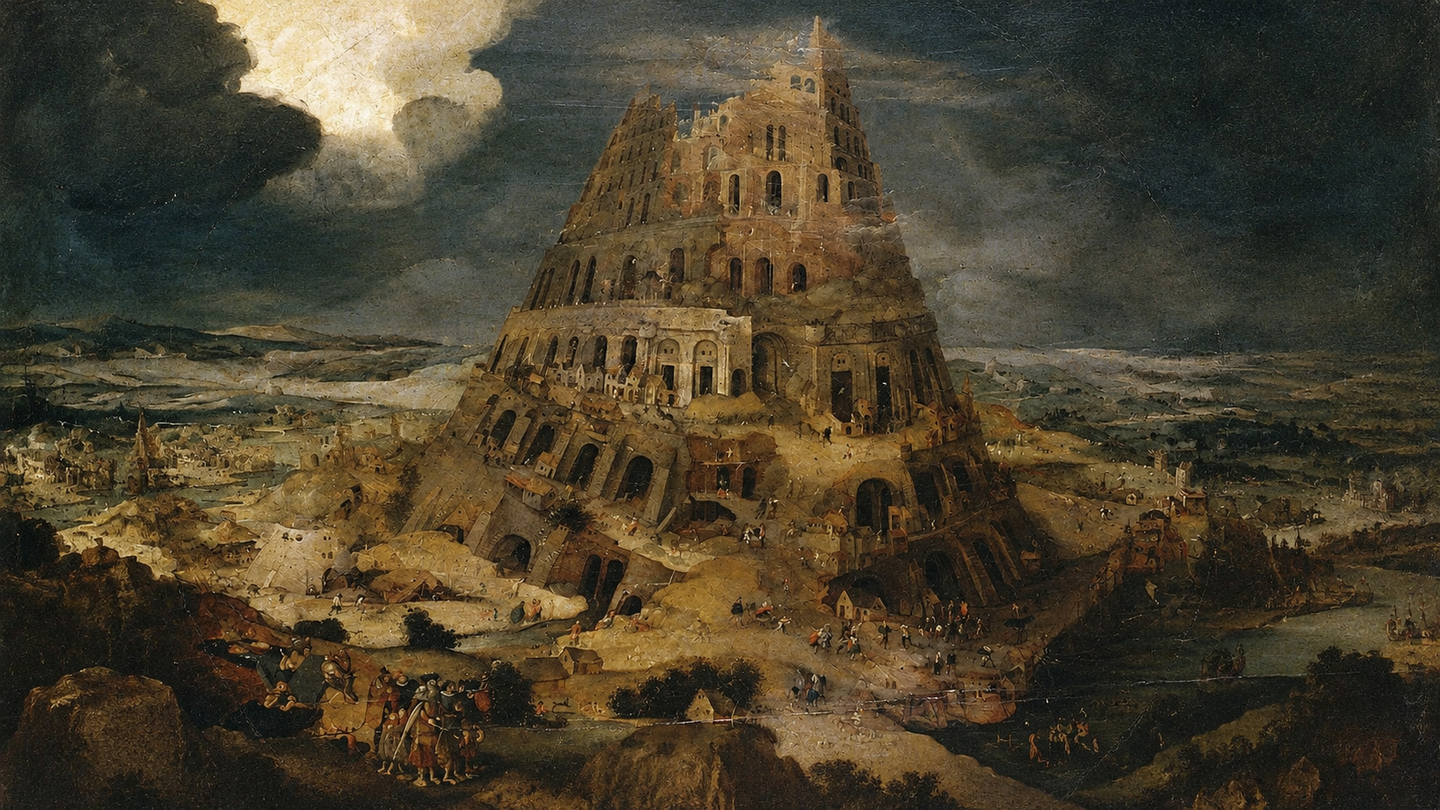
Образ Вавилонской башни в средневековом искусстве XI–XV веков: архитектурные прототипы и художественные интерпретации
Трансформация архитектурного образа Вавилонской башни в средневековом искусстве XI–XV веков
Concept
The Tower of Babel is one of the most recognizable architectural motifs in art history. Its depiction has changed countless times throughout the centuries, mirroring artists' evolving understandings of architecture, construction, and space.
Why the image of the Tower of Babel during the 11th–15th centuries?
Research Topic — The image of the Tower of Babel in medieval art from the 11th to the 15th centuries. This subject was chosen due to an interest in how architecture becomes a part of artistic narrative and transforms into a symbol that transcends its original function. The Tower of Babel is particularly interesting because it is simultaneously a biblical narrative, an architectural motif, and a symbol of humanity’s striving for greatness. Furthermore, it is compelling to trace how artists from different centuries depicted this structure—without a precise historical model—and which architectural characteristics of their era they projected onto its representation.
Principles for Material Selection in Research
When selecting materials for the visual investigation, I adhered to the following principles: the presence of a distinct architectural image of the Tower of Babel, which allowed for tracking the trends in its depiction in medieval art, as well as the examination of architectural forms and the degree of detail. The historical context of the creation period of the works was also taken into account, as was the possibility of comparing the presented image with real architectural structures of the Medieval era.
Principle of Material Chunking
In my visual research, the categorization of the study is built on a combination of chronological and thematic principles. The main sequence of sections is determined by the historical periods of the 11th–15th centuries, which allows tracking the evolution of the Tower of Babel’s depiction and identifying the unique aspects of its artistic interpretation across different centuries. Within each period, the material is grouped by the character of the architectural image, compositional solutions, and visual techniques employed.
The research begins by examining the biblical narrative and the formation of the Tower of Babel’s image in medieval culture. This section explores the tower’s significance as a symbol of human pride, the aspiration for unity, and the attempt to reach the heavens. This allows us to establish the semantic foundation upon which subsequent artistic interpretations were built.
The next section is dedicated to the depictions from the 11th–12th centuries. It examines early medieval concepts of the tower, the specifics of its conventional depiction, and the characteristic architectural elements of the Romanesque period. Special attention is paid to the geometry of the structure, the massiveness of the forms, the tiered design, and the methods used to convey volume.
Subsequently, the works from the 13th–14th centuries are investigated, in which the tower’s image becomes more detailed and compositionally complex. Changes in proportions, the appearance of additional architectural elements, the complication of the silhouette, and the use of forms characteristic of Gothic architecture are examined. At this stage, it is important to trace how contemporary architectural structures may have influenced the depiction of the biblical edifice by artists.
A separate section is devoted to 15th-century art. In it, more detailed and realistic architectural interpretations of the Tower of Babel are analyzed, focusing on the portrayal of the construction process, spatial organization, and the surrounding urban environment. Particular attention is paid to how artists depicted the act of building the tower and the interaction of people with the architectural space.
The concluding part of the research is dedicated to a comparative analysis of the works examined.
The Principle of Selecting and Analyzing Textual Sources
The core principles guiding the selection and analysis of textual sources for this research were their credibility, relevance, academic grounding, informational value, and alignment with the chosen topic. Material selection also considered the potential for its application in visual research, analysis, and the confirmation of the study’s hypothesis. The chosen materials were analyzed within the context of the historical and cultural prerequisites for the formation of the image of the Tower of Babylon during the Middle Ages. Subsequently, the architectural features of depictions of the Tower of Babylon from the 11th–15th centuries were studied, focusing on characteristic constructive and compositional solutions.
Key Research Question and Hypothesis
How did the architectural depiction of the Tower of Babel change in the art of the 11th–15th centuries, and to what extent did its images reflect actual medieval architectural structures? Medieval artists represented the Tower of Babel through architectural forms characteristic of their era. For this reason, its depictions became a unique reflection of the architectural concepts and artistic thought of different periods of the Middle Ages.
The Origin of the Architectural Image of the Tower of Babel
«The Construction of the Tower of Babel» late 12th century
According to the Book of Genesis, humans decided to build a city and a tower whose top reached the sky. In response to humanity’s desire for unity and transcendence, God confused the builders' languages, causing the construction to cease.
This narrative has formed the basis for numerous artistic interpretations.
In the Christian tradition, the Tower of Babel was primarily perceived as a symbol of human arrogance, overconfidence, and the drive to achieve the unattainable. At the same time, the plot reflected themes of human unity, the division of peoples, and the emergence of different languages. This is why the image of the tower could serve not only a narrative but also a didactic function.
Etemenanki as a potential architectural prototype
Etemenanki was the principal ziggurat of Babylon, dedicated to the god Marduk. Its name is usually translated as «The House of the Foundation of Heaven and Earth.» The structure was repeatedly rebuilt and restored. The most well-known phase of reconstruction is associated with the reign of Nebuchadnezzar II in the 6th century BCE. Etemenanki is often regarded in studies as one of the historical architectural sites connected to the formation of the concept of the Tower of Babylon.
Stele of Nebuchadnezzar II (604–562 BCE)
Yona Lendering. «Reconstruction of the Ziggurat of Etemennanki.» 2007 (image publication). Based on research by Hansjörg Schmidt, 1995.
As we can see, the ziggurat was a multi-tiered structure with a square base and progressively smaller upper levels. Its composition was formed by massive platforms stacked one upon the other. According to reconstructions based on cuneiform sources, the structure included seven levels, the uppermost of which was occupied by a temple. The stepped structure ensured a gradual transition from the wide base to the smaller upper section, creating the impression of a monumental vertical composition.
Despite historical evidence concerning Etemenanki, medieval artists lacked reliable data regarding the structure’s appearance that would allow for an accurate reproduction of its original architecture. Consequently, the Tower of Babel gradually evolved into an autonomous artistic motif. The tower’s exterior was shaped not only by the biblical narrative but also by the architectural forms familiar to the artists of the time. Therefore, the historical ziggurat and medieval depictions of the tower should be viewed as related, yet distinct, phenomena.
Forming the Medieval Image of the Tower of Babel in the 11th–12th Centuries
The 11th and 12th centuries became a crucial period in the development of medieval European art. During this era, religious themes remained highly significant, and biblical narratives were widely employed in illuminated manuscripts, wall paintings, and mosaics.
Medieval Mosaic «Construction of the City of Babylon» Late 12th Century
Features of Romanesque Architecture
The Romanesque architectural style is distinguished by its characteristic monumentality and simplicity of form. Buildings from this era predominantly featured massive walls, narrow window openings, towers, and arched structures with semicircular terminations. Such architectural solutions defined the appearance of medieval structures and influenced the artistic perception of architecture, including the formation of the image of the Tower of Babel in works of art.
«The Construction of the Tower of Babel» (c. 1100) — part of the famous cycle of Romanesque frescoes at the Abbey of Saint-Savin-sur-Gartempe.
«The Construction of the Tower of Babel, ” early 12th century
One of the earliest examples of depicting this narrative is a miniature from the Anglo-Saxon «Hexateuch» of Elfric in the 11th century. It shows that the story of the tower’s construction was already becoming part of illustrated biblical narratives. By the 12th century, the story is also found in Byzantine manuscript tradition, particularly in illustrated lists of the «Octateuch.» These works allow us to examine early methods of visually representing the biblical narrative.